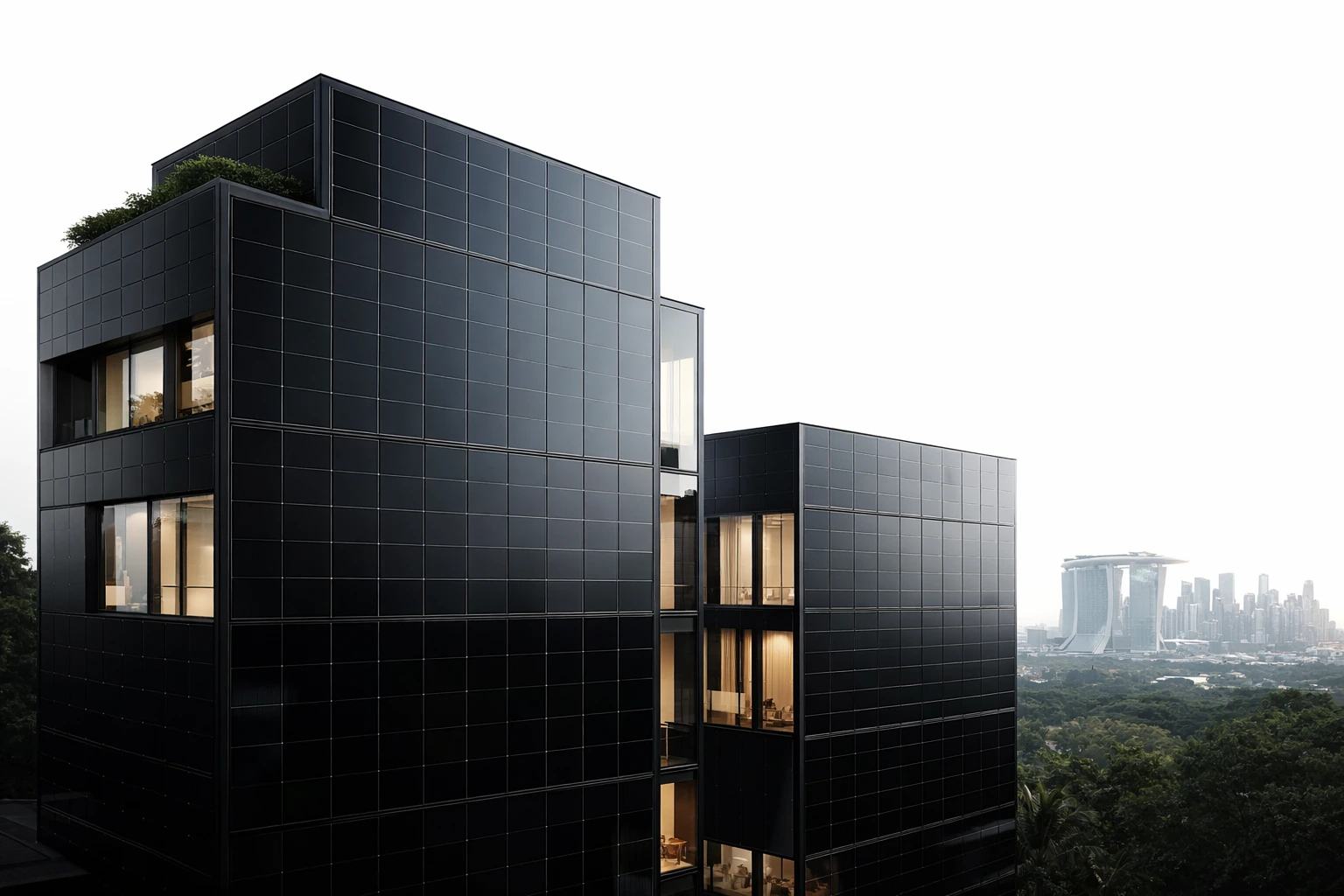
The bottom line: A typical Singapore terrace house fits 16–28 solar panels (5–8 kWp) generating 6,000–10,000 kWh per year — enough to cut electricity bills by 70–85%. Installation costs S$8,000–S$16,800, or S$0 upfront from S$99/month with Sunollo. Payback is 3–5 years, followed by 20+ years of nearly-free electricity.
Solar Panels for Terrace Houses Singapore 2026: Maximising Returns from Limited Roof Space
If you own a terrace house in Singapore, you already know the economics of landed living: the space is tighter than a semi-detached or bungalow, yet the electricity bills are just as punishing. Most terrace homeowners we speak to are paying between S$200 and S$450 per month — running one or two aircon units, a family of three or four, and the usual appliances that keep a Singaporean household comfortable.
Here is the good news: terrace houses are among the most cost-effective properties for solar in Singapore, precisely because the constrained roof forces a right-sized system that delivers outstanding returns per dollar invested. The key is precision — choosing the right panels, the right inverter setup, and the right energy plan so that every kilowatt-hour your roof generates translates into real savings on your bill.
This guide covers everything a terrace homeowner needs to know: system sizing, realistic savings, equipment choices, electricity plan strategy, battery considerations, installation logistics, and the subscription alternative. We will use real numbers, not vague promises.
Why Terrace Houses Need Precision Solar Design
A terrace house is not a blank canvas. Unlike a detached bungalow with 200–400 sqm of unobstructed rooftop, a typical terrace roof offers 80 to 150 sqm of total area, with usable panel space often closer to 40–80 sqm once you account for ridgelines, setbacks, vents, water tanks, and the narrow geometry of the roof itself.
Several characteristics make terrace roofs unique:
- Shared party walls: Your roof butts up against your neighbours on one or both sides. This means shading from adjacent structures — particularly if your neighbour has a higher roofline, an extended upper storey, or a large tree overhanging the boundary.
- Narrow roof sections: Terrace roofs are typically long but narrow, sometimes only 5–7 metres wide. Panel layout has to work within these constraints, often requiring portrait orientation or single-row configurations on certain faces.
- Multiple roof angles: Many terrace houses have front and rear roof faces at different pitches, or a combination of flat and pitched sections. A front-facing roof may catch morning sun while the rear catches afternoon sun — or vice versa, depending on your orientation.
- Obstructions: Satellite dishes, water heaters, skylights, roof access hatches, and ventilation pipes all eat into available space. On a large bungalow roof, losing 4 sqm to a water heater is negligible. On a terrace roof, it could mean two fewer panels.
The upshot: every panel placement decision on a terrace roof matters. You cannot afford to use low-efficiency panels that waste precious square metres, and you cannot afford an inverter topology that lets one shaded panel drag down an entire string. This is why we specify AIKO ABC panels and SunMax optimisers for virtually every terrace installation — but more on that below.
For a broader view of how solar works on landed properties in Singapore, see our Complete Solar Guide Singapore 2026.
System Sizing for Terrace Houses: 8–18 Panels, 4–9 kWp
Based on hundreds of site assessments across Singapore's terrace housing stock — from Joo Chiat to Serangoon Gardens to Kovan — the typical terrace installation falls in the 4 to 9 kWp range, using 8 to 18 AIKO ABC panels.
Here is how the sizing breaks down:
Small Terrace System (8–10 panels, ~4–5 kWp)
- Roof type: Single usable face, narrow frontage (typically intermediate terrace with constraints)
- Monthly generation: ~450–600 kWh
- Best for: Households with S$200–S$280/month electricity bills
- Typical cost: S$8,000–S$12,000 (purchased outright)
Medium Terrace System (11–14 panels, ~5.5–7 kWp)
- Roof type: Two usable roof faces or a single generous face (common on corner terrace units)
- Monthly generation: ~600–850 kWh
- Best for: Households with S$280–S$380/month electricity bills
- Typical cost: S$12,000–S$16,000 (purchased outright)
Large Terrace System (15–18 panels, ~7.5–9 kWp)
- Roof type: Corner terrace or end-terrace with multiple roof faces, generous footprint
- Monthly generation: ~850–1,100 kWh
- Best for: Households with S$350–S$450/month electricity bills, or those planning EV charging
- Typical cost: S$16,000–S$20,000 (purchased outright)
These costs include panels, inverter, optimisers (where needed), mounting hardware, wiring, EMA application, SP metering, and full installation. They do not include an optional battery, which adds S$5,500–S$8,000 depending on the unit selected.
For a detailed comparison of panel technologies and why AIKO ABC leads the field, read our Best Solar Panels Singapore 2026 guide.
Real Savings Calculations: What a S$300/Month Household Can Expect
Let us work through a concrete example. Take a typical intermediate terrace household paying S$300 per month in electricity — roughly 900–1,000 kWh of monthly consumption at current SP tariff rates (approximately S$0.31–S$0.33/kWh in Q1 2026).
Scenario A: Solar Only (No Battery)
A 12-panel AIKO ABC system (~6 kWp) on this terrace house would generate approximately 700–750 kWh per month. However, not all of that generation aligns with your consumption. During the day, when panels are producing, many households consume only 30–50% of their generation directly (self-consumption ratio). The remainder is exported to the grid.
Under net metering, exported units offset imported units at the prevailing tariff rate — but only within the same billing period. With a well-matched system:
- Direct self-consumption: ~250–350 kWh/month (valued at S$0.31–S$0.33/kWh = ~S$80–S$115 saved)
- Exported and offset via net metering: ~350–450 kWh/month (valued at S$0.31–S$0.33/kWh = ~S$110–S$150 saved, up to the cap of your net import)
- Total monthly saving: approximately S$150–S$200
- Annual saving: approximately S$1,800–S$2,400
- Payback period: approximately 5–7 years on a S$13,000–S$14,000 system
After payback, you enjoy 18+ years of near-free daytime electricity. With panel warranties of 25–30 years, the total lifetime saving on a terrace system can reach S$40,000–S$55,000.
Scenario B: Solar + 5 kWh Battery
Adding a 5 kWh battery changes the equation meaningfully. Instead of exporting surplus daytime generation to the grid, the battery stores it for use during the evening peak hours (typically 6 PM–11 PM) when aircon runs, dinner is cooked, and the family is home.
With the battery absorbing 4–5 kWh of surplus solar daily:
- Self-consumption ratio increases from ~40% to ~65–75%
- Direct + battery-assisted consumption: ~450–550 kWh/month
- Remaining export offset: ~150–200 kWh/month
- Total monthly saving: approximately S$200–S$280
- Annual saving: approximately S$2,400–S$3,360
- System + battery cost: ~S$19,000–S$22,000
- Payback period: approximately 6–8 years
The battery's value is most pronounced when paired with an OEM electricity plan — specifically the PacificLight 9 To 9 plan, which we analyse below. For a deeper dive on battery strategy, see our Solar Battery Storage Singapore 2026 Guide.
Why Every Panel Counts: AIKO ABC at 24.2% Efficiency
On a bungalow with room for 30+ panels, the difference between a 21% efficient panel and a 24% efficient panel might mean two or three extra panels' worth of output — nice but not transformative. On a terrace roof with space for only 10–14 panels, that same efficiency gap is the difference between offsetting 60% of your bill and offsetting 85%.
The AIKO ABC panel delivers 24.2% module efficiency — the highest commercially available residential panel in Singapore as of 2026. Each panel produces approximately 490–510 watts in its standard residential format. Here is what that means in practice:
- Per-panel annual output in Singapore: ~580–620 kWh (accounting for Singapore's ~4.2 peak sun hours/day and typical system losses)
- Per-sqm output: ~270–290 kWh/year — roughly 15–18% more than conventional PERC panels
- Temperature coefficient: –0.29%/°C, meaning the panel holds its efficiency better in Singapore's 30–35°C roof surface temperatures
For a terrace owner, this translates directly: fewer panels needed for the same output, or more output from the same roof space. When your roof can only physically fit 12 panels, getting 510W instead of 420W from each one adds up to an extra 1,080W of system capacity — roughly S$25–S$35 more in monthly savings.
We compare AIKO ABC against other leading panels in our Best Solar Panels Singapore 2026 review.
Why SunMax Optimisers Are Critical for Terrace Houses
If there is one component that separates a well-designed terrace system from a mediocre one, it is panel-level power optimisation. Here is why this matters more on a terrace than on almost any other property type.
The Shading Problem on Terrace Roofs
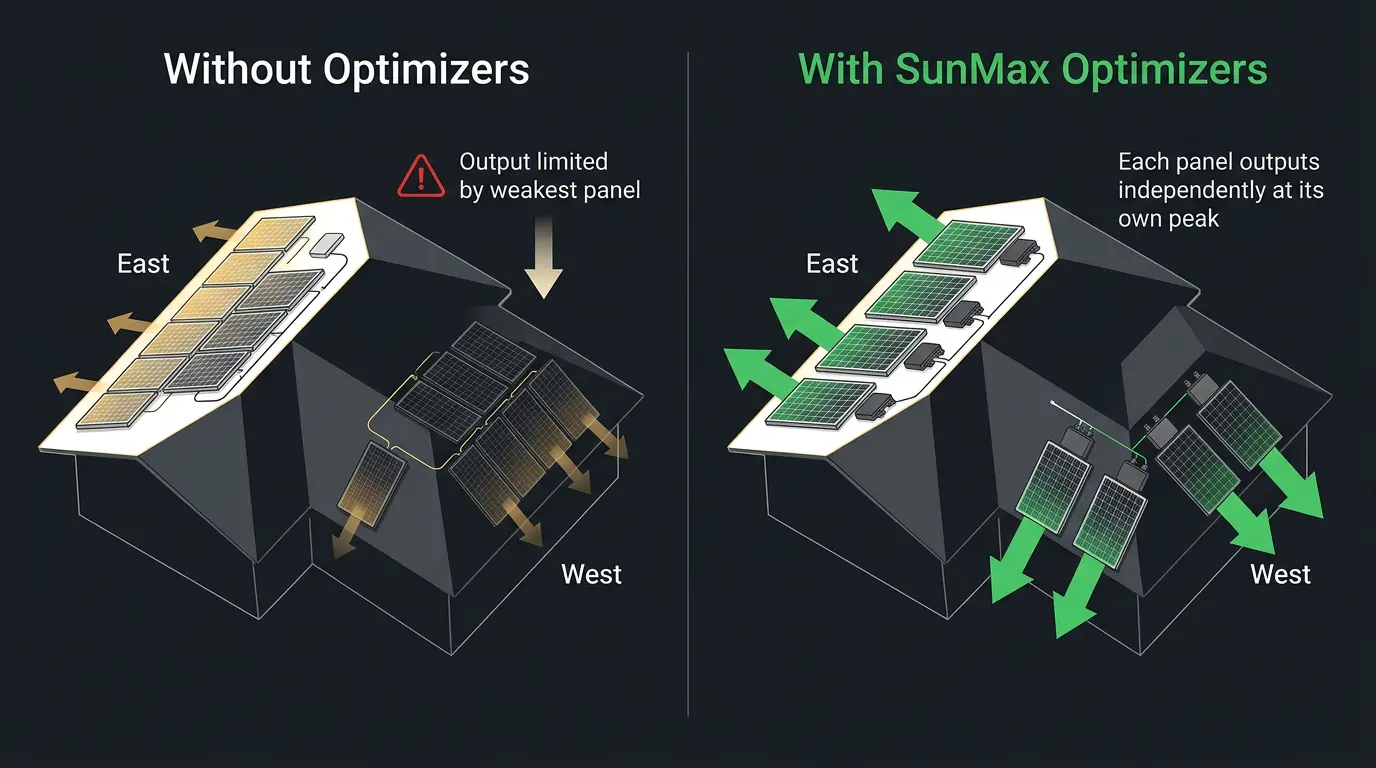
Terrace houses sit in rows. Your neighbour's roof ridge, chimney, water tank, or even a tall tree in their garden can cast shadows across your panels — especially in the early morning and late afternoon when the sun is low. In a conventional string inverter system, one shaded panel drags down the entire string. If you have 12 panels in a single string and one is 40% shaded, you do not lose 8% of output — you can lose 25–40% due to the electrical mismatch.
The Multi-Angle Problem
Many terrace roofs have panels on two or more faces — a front-facing section and a rear-facing section, or a main roof and a dormer. These faces receive sunlight at different intensities and different times of day. Without optimisers, the lower-performing face constrains the higher-performing face when they share an inverter string.
How SunMax Optimisers Solve This
Sunollo's SunMax optimisers attach to each individual panel and perform Maximum Power Point Tracking (MPPT) at the panel level. Each panel operates independently at its own optimal voltage and current, regardless of what is happening on adjacent panels. The benefits:
- Shading tolerance: A shaded panel only loses its own output — it does not drag down neighbours. On a terrace system, this can recover 10–20% of annual yield that would otherwise be lost.
- Multi-angle support: Panels on different roof faces operate independently. A north-facing panel producing 80% of its rating does not constrain an east-facing panel producing 100%.
- Panel-level monitoring: You can see exactly how each panel is performing in the Sunollo app, making it easy to spot issues like bird droppings, leaf accumulation, or equipment faults.
- Safety: SunMax optimisers provide rapid shutdown capability, reducing DC voltage to safe levels within seconds if the system is switched off — a critical safety feature for terrace houses where the roof is close to living spaces.
For terrace houses with any partial shading or multi-angle roof configurations, we consider SunMax optimisers non-negotiable. The cost premium (typically S$800–S$1,500 for a terrace system) is recovered within 1–2 years through the additional energy harvest. Read the full technical breakdown in our SunMax Optimisers for Multi-Angle Roofs article.
PacificLight 9 To 9 Plan: When It Makes Sense and When It Does Not
The PacificLight 9 To 9 plan is one of Singapore's most talked-about OEM electricity plans for solar homeowners. It offers free electricity from 9 AM to 9 PM — the exact hours when solar panels are generating. In exchange, you pay a fixed daily charge of S$1.01/day (approximately S$30.30/month) plus standard tariff rates for any electricity consumed outside the 9 AM–9 PM window.
For terrace homeowners, the analysis is nuanced:
When PacificLight 9 To 9 Works Well (12+ Panels)
If your system has 12 or more panels (~6+ kWp), you are likely generating significant surplus during the 9 AM–9 PM window. Under this plan:
- All daytime consumption is free (covered by the plan), so your solar generation is entirely surplus
- That surplus can be exported and offset against your nighttime consumption via net metering
- The S$30/month fixed charge is easily justified because your daytime consumption alone (typically S$80–S$150/month worth) is fully covered
- Net result: Monthly bill drops to roughly S$30 (fixed charge) + S$20–S$60 (nighttime consumption after export offset) = S$50–S$90/month versus S$300 without solar
When PacificLight 9 To 9 Is Less Attractive (Below 10 Panels)
If your system has fewer than 10 panels (~5 kWp or less), the calculus shifts:
- Your daytime generation may only partially cover your daytime consumption, meaning the "free 9-to-9 electricity" benefit is partially redundant with your solar generation
- The S$30/month fixed charge becomes a larger proportion of your total savings
- You may achieve similar or better results on a standard SP tariff with net metering, without the fixed charge overhead
- Break-even point: Generally, the 9 To 9 plan breaks even versus standard tariff at around 10–12 panels. Below that, standard net metering is often more economical.
We recommend running the numbers both ways for any system in the 8–12 panel range. For systems of 13+ panels, PacificLight 9 To 9 almost always wins. For detailed analysis of OEM plans and how they interact with solar and battery systems, see our Singapore OEM Electricity Plan Solar Battery Guide.
The Case for a 5 kWh Battery on a Terrace House
Battery storage is not a one-size-fits-all decision, and terrace homeowners should be especially deliberate about sizing. A common mistake is over-sizing the battery relative to the system and consumption profile. Here is why 5 kWh is the sweet spot for most terrace installations.
Understanding the Evening Gap
A terrace household's consumption typically follows this daily pattern:
- 6 AM–9 AM: Moderate consumption (breakfast, getting ready — 1.0–1.5 kWh)
- 9 AM–5 PM: Low to moderate consumption (panels generating, most family members out — 2.0–4.0 kWh consumed, 4.0–7.0 kWh generated)
- 5 PM–11 PM: Peak consumption (aircon, cooking, entertainment, showers — 4.0–7.0 kWh)
- 11 PM–6 AM: Low consumption (aircon in bedrooms, standby loads — 2.0–3.5 kWh)
The evening gap — the 5 PM to 11 PM window when panels have stopped generating but consumption peaks — is where a battery delivers its value. A 5 kWh battery can cover 3–4 hours of evening consumption, bridging the gap between solar generation ending and the household winding down for the night.
Why Not 10 kWh?
A larger battery stores more energy, but on a terrace system generating 5–7 kWp, the daily surplus available for battery charging is typically only 4–8 kWh. A 10 kWh battery on a 6 kWp terrace system would frequently be only half-charged, meaning you are paying for capacity you cannot use. The economics work much better with a right-sized 5 kWh unit that fills fully most days and discharges fully most evenings.
The Sunollo Abundance Pro system pairs a 5 kWh battery with intelligent energy management that prioritises self-consumption, charges during peak solar hours, and discharges during peak consumption hours — all automatically.

Learn more about how the Abundance Pro integrates with your solar system in our Singapore Home Battery Guide: Abundance Pro.
Single-Phase vs Three-Phase: A Critical Consideration for Terrace Houses
Most terrace houses in Singapore are wired for single-phase electricity supply. This has a direct impact on solar system design:
- Single-phase systems are limited to a maximum solar inverter output of approximately 5 kW AC before the system may cause voltage rise issues and nuisance tripping at the main breaker.
- If you want a system larger than 5 kWp (roughly 10+ panels), you may need to either upgrade to three-phase supply or work within single-phase constraints using careful inverter sizing.
What Happens If You Oversize on Single Phase?
When a single-phase solar system generates more power than the house consumes and the grid can absorb at the local transformer, the voltage at your supply point rises. If it exceeds the threshold (typically 253V), your inverter will reduce output or shut down entirely, and your main circuit breaker may trip. This is not a theoretical risk — it happens regularly on sunny afternoons when generation peaks and household consumption is low.
We have written a dedicated article on this issue: Why Solar Systems in Single-Phase Homes Trip Frequently. If your terrace house is currently single-phase and you want a system above 5 kWp, there are two paths:
- Upgrade to three-phase: This involves an application to SP Group, rewiring your distribution board, and typically costs S$2,000–S$5,000 depending on the complexity. The process takes 4–8 weeks. Once done, you can comfortably run systems up to 10+ kWp without voltage issues.
- Stay single-phase with export limiting: Some inverters can be configured to limit export power, reducing the risk of voltage rise. However, this means you may not fully utilise your system's generation capacity during peak sun hours.
For most terrace homeowners planning a system of 10+ panels, we recommend the three-phase upgrade. It future-proofs your home for solar expansion, EV charging, and other high-power loads. For more on EV readiness, see our Solar EV Charging Singapore 2026 Guide.
Neighbour Considerations and Party Wall Awareness
One of the most common questions we hear from terrace homeowners is: "Can I install solar if my neighbour hasn't?" The answer is a clear yes — your solar installation is entirely on your own roof and requires no consent from your neighbours. However, there are practical considerations worth noting:
- Party wall boundaries: Solar mounting systems must not extend beyond your property's roof boundary. Our installers use precise measurements and maintain a minimum 100mm setback from the party wall line to ensure compliance and avoid disputes.
- Drainage: Panel arrays can redirect rainwater flow. On terrace roofs where drainage runs along shared gutters, we ensure that panel placement does not concentrate water flow onto a neighbour's section of the roof.
- Aesthetics: While you are not legally required to match your neighbour's roofline, we design installations to look clean and orderly. Panels are aligned in neat rows and the wiring is concealed, so the installation enhances rather than detracts from the terrace row's appearance.
- Shading from neighbours: If your neighbour's property shades part of your roof (a taller extension, a large tree), this is where SunMax optimisers become essential. They ensure that the shaded panels do not degrade the performance of the rest of your array.
- Communication: While not required, we recommend informing your immediate neighbours before installation day. The work involves brief periods of noise from drilling (for mounting brackets) and there will be a work team on your roof for 1–2 days. A quick heads-up goes a long way in maintaining good relations.
Roof Types: Concrete Tile and Mounting Approach
The vast majority of Singapore terrace houses feature concrete tile roofing — the standard clay or cement tiles laid on timber battens over a waterproof membrane. This is actually one of the most straightforward roof types for solar mounting.
How Panels Are Mounted on Concrete Tile Roofs
- Tile hooks: Specialised stainless steel hooks slide under the concrete tiles and anchor to the timber rafters beneath. No tiles need to be permanently removed or damaged.
- Aluminium rails: Lightweight aluminium mounting rails attach to the tile hooks, creating a framework that sits approximately 100–150mm above the tile surface. This gap allows airflow beneath the panels, which actually helps keep them cooler and improves efficiency.
- Panel mounting: AIKO ABC panels are secured to the rails using stainless steel clamps. The entire assembly is engineered to withstand wind speeds well above anything Singapore typically experiences.
- Waterproofing: Each tile hook penetration point is sealed with EPDM rubber gaskets and silicone sealant. The tiles are repositioned around the hooks so that the roof's rain-shedding profile is maintained. We have never had a leak on a properly installed tile roof system.
Some terrace houses have metal roofing (standing seam or corrugated), which uses a different mounting approach — standing seam clamps that grip the roof's raised seams without any penetrations at all. If your terrace has a flat concrete roof section (common on rear extensions), we use ballasted or mechanically anchored flat-roof mounting systems with appropriate tilt angles.
For a complete walkthrough of the installation process, read our Solar Panel Installation Singapore 2026 Guide.
Installation Process: What to Expect
Terrace house installations are among the fastest residential solar projects. Here is the typical timeline:
Pre-Installation (2–4 Weeks)
- Site assessment: Our engineer visits your home, measures the roof, assesses structural integrity, checks electrical supply (single vs three-phase), identifies shading sources, and photographs all relevant features. This takes approximately 60–90 minutes.
- System design: We produce a detailed design with panel layout, wiring diagram, expected generation profile, and savings estimate. You review and approve.
- Permits and approvals: We handle the EMA (Energy Market Authority) application, BCA notification, and SP Group metering application. For terrace houses, URA approval is generally not required as solar panels are considered permissible installations on landed residential roofs.
Installation Day (1–2 Days)
- Day 1: Mounting hardware installation. The team installs tile hooks, mounting rails, and runs DC cabling from the roof to the inverter location (typically the ground floor utility area, car porch, or an external wall). Duration: 4–6 hours.
- Day 1–2: Panel installation and electrical connection. Panels are lifted onto the rails and secured. The inverter is mounted and connected. DC and AC wiring is completed and tested. Duration: 3–5 hours.
- Commissioning: The system is powered on and tested. We verify generation, check all connections, configure the monitoring app, and walk you through the system. Duration: 1–2 hours.
Post-Installation (2–6 Weeks)
- SP meter upgrade: SP Group schedules the installation of a bidirectional meter (to measure both import and export). This typically takes 2–4 weeks after our application.
- System goes live for export: Once the bidirectional meter is in place, your system can export surplus to the grid and receive net metering credits. During the waiting period, your system still operates and reduces your direct consumption — you just cannot export yet.
For a full picture of what your system includes and how it works, see Your Sunollo Solar System Explained.

Sunollo Care Package: 10 Years of Coverage
A solar system is a long-term investment, and terrace homeowners rightly want assurance that their system will be maintained and supported over its lifetime. The Sunollo Care Package provides 10 years of comprehensive coverage:

- System monitoring: Sunollo's operations team monitors your system's performance remotely, 24/7. If generation drops below expected levels, we investigate proactively — often before you even notice.
- Maintenance visits: Scheduled inspections and cleaning to ensure panels, wiring, and mounting hardware remain in optimal condition. Singapore's tropical environment means panels can accumulate dust, bird droppings, and organic debris that reduce output by 3–8% if left unchecked.
- Component warranty coverage: If any component (panel, inverter, optimiser, battery) fails within the warranty period, Sunollo handles the replacement — including labour and logistics. You do not need to chase manufacturers or arrange your own repairs.
- Performance assurance: If your system consistently underperforms relative to its design specifications (adjusted for weather), we investigate and rectify the issue at no additional cost.
- Software updates: Inverter and battery firmware updates are applied remotely or during maintenance visits to ensure your system benefits from the latest efficiency improvements and features.
The Care Package is included with all Sunollo purchased systems. For subscription customers, ongoing maintenance is part of the subscription agreement. Learn more about our savings commitment in the Sunollo Savings Guarantee article.
Subscription vs Purchase: The Terrace Homeowner's Decision
Not every terrace homeowner wants to invest S$12,000–S$20,000 upfront, even with strong payback prospects. Sunollo offers a subscription model as an alternative:
How the Subscription Works
- Zero upfront cost: Sunollo installs, owns, and maintains the solar system on your roof.
- Fixed monthly fee: You pay a predictable monthly subscription that is lower than your current electricity bill savings, guaranteeing you are cash-positive from day one.
- No maintenance worries: All maintenance, repairs, and component replacements are Sunollo's responsibility for the duration of the subscription.
- Contract flexibility: Typical subscription terms are 10–15 years, with options to purchase the system at fair market value during or at the end of the term.
When Subscription Makes More Sense for Terrace Owners
- Budget-conscious households: If you would rather deploy your capital elsewhere (renovations, investments, children's education) while still saving on electricity, subscription makes sense.
- Uncertain tenure: If you might sell your terrace house within 5–7 years, a subscription avoids the risk of not reaching payback on a purchased system. Subscriptions can often be transferred to the new owner.
- Risk aversion: The subscription shifts all technology and maintenance risk to Sunollo. If an inverter fails in year 6, it is our problem, not yours.
For a side-by-side comparison of subscription versus purchase economics, read our Subscribe or Buy with Sunollo analysis.
Budget 2026: What Terrace Homeowners Should Know
The Singapore Budget 2026 introduced several measures relevant to landed homeowners considering solar. While the specifics are covered in detail in our Budget 2026 Solar Singapore Guide for Landed Homeowners, the key points for terrace homeowners are:
- Enhanced Green Building incentives continue to support residential solar adoption, with streamlined approval processes for landed properties.
- Electricity tariff trajectory: The government's long-term energy strategy suggests continued tariff pressure as Singapore transitions away from natural gas. This strengthens the economic case for solar, as your locked-in generation cost (effectively S$0/kWh after payback) becomes increasingly valuable against rising grid tariffs.
- EV charging readiness: New provisions encourage landed homeowners to prepare for EV charging. A solar system sized with slight headroom can power a home EV charger, turning your terrace house into a self-sufficient energy hub.
Terrace vs Semi-Detached: How the Value Proposition Differs
If you are comparing the solar economics of your terrace house against a friend's semi-detached, here is how they stack up:
- Roof space: Semi-detached homes typically have 120–250 sqm of roof area versus 80–150 sqm for terrace. The terrace has less room but also proportionally lower electricity consumption.
- Cost per kWp: Terrace systems often have a slightly higher cost per kWp because the fixed costs (scaffolding, permits, inverter, commissioning) are spread across fewer panels. However, the total outlay is lower.
- Savings as percentage of bill: A well-designed terrace system can offset 50–80% of the electricity bill — comparable to semi-detached installations in percentage terms.
- Payback period: Similar — typically 5–8 years for both property types when sized correctly.
For homeowners with semi-detached properties, we have a dedicated guide: Solar Panels for Semi-Detached Homes Singapore 2026.
Frequently Asked Questions
Can I install solar panels if my neighbour hasn't?
Yes, absolutely. Your solar installation is entirely on your own property's roof. No consent from neighbours is required. Our mounting systems maintain a proper setback from the party wall boundary, and the installation does not affect your neighbour's roof structure in any way. Many terrace rows in Singapore have one or two homes with solar while the rest do not — this is completely normal and creates no issues.
Will panels fit on my narrow terrace roof?
In almost all cases, yes. Even the narrowest terrace roofs (5–6 metres wide) can accommodate panels in portrait orientation. A single row of AIKO ABC panels in portrait is approximately 1.1 metres wide, meaning you can fit 4–5 panels across even a 6-metre wide roof face. If the roof is exceptionally narrow or has significant obstructions, we assess this during the site visit and design around the constraints. We have successfully installed systems on terrace roofs as narrow as 4.5 metres.
How much roof space do I actually need?
Each AIKO ABC panel requires approximately 1.9 sqm of roof area (including mounting clearances). For a minimum viable system of 8 panels, you need roughly 15–16 sqm of unobstructed, south- or east/west-facing roof area. Most terrace houses have at least this much usable space.
What if my roof faces north?
In Singapore (1.3°N latitude), roof orientation matters less than in higher-latitude countries. A north-facing roof in Singapore still receives 85–90% of the irradiance compared to a south-facing roof. East and west faces receive approximately 90–95%. The main losses come from shading, not orientation. SunMax optimisers are especially valuable here, as they allow panels on different orientations to operate independently.
Do I need to upgrade my electrical supply?
If your terrace house currently has single-phase supply and you want a system larger than approximately 5 kWp (10+ panels), we recommend upgrading to three-phase. This costs S$2,000–S$5,000 and takes 4–8 weeks. For systems of 8–10 panels on single-phase, no upgrade is typically needed. We assess this during the site survey and include it in our proposal if necessary.
How long do the panels last?
AIKO ABC panels carry a 25-year product warranty and a 30-year performance warranty guaranteeing at least 88.9% of rated output at year 30. In practice, well-maintained panels in Singapore continue producing efficiently for 30–35 years. The inverter typically has a 10–15 year warranty and may need replacement once during the panel lifetime.
What happens during a power outage?
A standard grid-tied solar system (without battery) will shut down during a grid outage for safety reasons — this is called anti-islanding protection and is required by regulation. If you have a battery system with backup capability, designated circuits in your home can continue to operate during an outage, powered by the battery and/or panels. Power outages in Singapore are extremely rare (among the lowest in the world), so this is typically not a primary decision driver.
Will solar increase my property value?
While there is limited Singapore-specific data on the property value premium from solar, international studies consistently show a 3–5% increase in property value for homes with owned (not leased) solar systems. For a S$3–4 million terrace house, that translates to a potential S$90,000–S$200,000 premium — far exceeding the system cost. More importantly, an increasing number of property buyers in Singapore are specifically looking for homes with existing solar installations.
Can I add more panels later?
Yes. If your roof has unused space, you can expand the system later. The inverter may need to be upgraded or a second inverter added, depending on the original sizing. We design systems with future expandability in mind — for example, specifying an inverter with slightly more capacity than the initial panel array requires, so additional panels can be added without replacing the inverter.
What maintenance is required?
Solar panels require minimal maintenance. In Singapore's climate, we recommend:
- Annual inspection: Checking all electrical connections, mounting hardware, and panel surfaces. Included in the Sunollo Care Package.
- Panel cleaning: Every 6–12 months, depending on your environment. Properties near trees or in dusty areas may need more frequent cleaning. Rain handles most dirt, but bird droppings and tree sap require manual cleaning.
- Monitoring: Check your Sunollo app periodically. Any sudden drop in generation usually indicates a panel-level issue (dirt, shade, or equipment fault) that should be addressed.
Making the Decision: Is Solar Right for Your Terrace House?
Let us summarise the decision framework. Solar is an excellent investment for your terrace house if:
- Your electricity bill is S$200/month or more — the savings justify the system cost with payback typically under 7 years
- Your roof has at least 15 sqm of usable space — enough for a minimum 8-panel system
- You plan to stay in your home for 5+ years — long enough to reach payback (or use the subscription model if your tenure is uncertain)
- You want to hedge against rising electricity tariffs — your generation cost is locked at S$0/kWh after payback
- You value energy independence — producing your own clean energy and reducing reliance on the grid
For a terrace house paying S$300/month in electricity, a well-designed 12-panel system with SunMax optimisers delivers S$1,800–S$2,400 in annual savings, pays for itself in 5–7 years, and generates S$40,000–S$55,000 in lifetime savings over its 25+ year lifespan.
Add a 5 kWh battery and pair it with the PacificLight 9 To 9 plan, and your monthly bill could drop from S$300 to under S$70 — a reduction of over 75%.
That is a compelling return from a narrow roof.
Ready to find out exactly how much your terrace roof can save you? Get a free Sunollo assessment — we will survey your roof, design your system, and show you the numbers before you commit to anything.
Further reading:
- Complete Solar Guide Singapore 2026
- Best Solar Panels Singapore 2026
- Solar Battery Storage Singapore 2026 Guide
- Singapore OEM Electricity Plan Solar Battery Guide
- Solar Panel Installation Singapore 2026 Guide
- Sunollo Savings Guarantee
- Solar Panels for Semi-Detached Homes Singapore 2026
- SunMax Optimisers for Multi-Angle Roofs