The bottom line: Charging an electric vehicle with rooftop solar in Singapore costs effectively zero versus S$0.32/kWh from the grid — saving S$800–S$1,300 per year for typical EV usage (15,000 km annually). With a 10 kWp solar system, a battery for evening charging, and a Level 2 EV charger, your home becomes a self-contained energy ecosystem. Sunollo Abundance Pro integrates all three with EnergyHub control.
Singapore is at the forefront of a dual revolution. The city-state's electric vehicle (EV) adoption is accelerating at a pace few predicted, while rooftop solar installations continue to climb year after year. In 2025 alone, EV registrations surged past 12,000 new units — a record fuelled by favourable Certificate of Entitlement (COE) rebates for cleaner vehicles, expanded charging infrastructure, and a growing awareness that petrol and diesel cars are on their way out. The government's ambitious Singapore Green Plan 2030 targets 60,000 charging points island-wide by 2030, up from roughly 6,000 today, signalling that electric mobility is no longer a niche but a national priority.
At the same time, landed homeowners across Bukit Timah, Serangoon Gardens, Sembawang, and the East Coast are discovering that pairing rooftop solar panels with a home EV charger is one of the smartest energy investments available in 2026. Instead of paying SP Group's retail electricity tariff every time you plug in your car, you can charge your EV with free, clean energy generated right on your roof.
Meanwhile, Singapore's carbon tax — which rose to S$25 per tonne in 2024 and is slated to reach S$50–80 by 2030 — is making fossil-fuel-derived electricity progressively more expensive. For EV owners, this means that grid-charged driving costs will only climb higher over time. The solution? Generate your own clean electricity on your rooftop and funnel it straight into your car.
This guide is the most comprehensive resource on solar EV charging in Singapore — covering system design, costs, ROI, regulations, battery storage integration, and how Sunollo delivers turnkey solar + EV solutions for Singaporean homeowners. Whether you drive a Tesla Model 3, BYD Atto 3, Hyundai Ioniq 5, or Mercedes EQS, the principles — and the savings — are the same.
Considering solar for your own home?
Sunollo installs and operates residential solar across Singapore — buy outright or from $0 upfront ($99/month), with the same battery-ready hardware on both paths; SunolloCare is bundled on $0-upfront and elective on outright. Get a free savings estimate →
Why Pair Solar Panels with EV Charging in Singapore?
Owning an EV without solar is like buying an energy-efficient home but leaving all the lights on. You reduce tailpipe emissions, yes — but you are still drawing electricity from a national grid that relies heavily on imported natural gas. Pairing your EV with rooftop solar solves three problems simultaneously.
1. Dramatic Cost Savings
Singapore's residential electricity tariff hovers around S$0.32–0.35 per kWh in 2026 (inclusive of GST). A typical EV consumes approximately 15–18 kWh per 100 km. If you drive 15,000 km per year — roughly the national average — you will consume around 2,400 kWh annually just for charging.
At grid rates, that is S$770–840 per year in electricity costs. With solar, that same energy is generated on your rooftop at an effective cost of S$0.04–0.06 per kWh over the system's 25-year lifespan. Your annual EV charging cost drops to approximately S$100–145 — a saving of over S$650 per year on EV charging alone, before counting the savings on your household electricity bill.
2. Carbon Footprint Reduction
Singapore's grid emission factor is approximately 0.408 kg CO₂ per kWh. Charging your EV from the grid still produces roughly 980 kg of CO₂ per year for an average driver. Solar-powered EV charging reduces this to near-zero operational emissions. Over a 10-year vehicle ownership period, that is nearly 10 tonnes of CO₂ avoided — equivalent to planting over 450 trees.
3. Energy Independence and Price Protection
Electricity tariffs in Singapore are reviewed quarterly and are linked to global natural gas prices, which can be volatile. Between 2021 and 2023, Singapore saw tariff spikes of over 40% in a single quarter. Solar locks in your energy cost for 25+ years, shielding you from future price shocks. When you combine that with EV charging — which replaces petrol costs entirely — you are insulating your household from two volatile energy markets at once.
4. Total Cost of Ownership: Solar EV vs Petrol Car
Consider the full picture. A petrol car consuming 10 litres per 100 km at S$2.80 per litre costs roughly S$4,200 per year in fuel for 15,000 km of driving. An EV charged from the grid costs approximately S$770–840 per year. An EV charged from solar costs just S$100–145 per year. Over a 10-year COE cycle, the cumulative fuel and energy savings of a solar-charged EV versus a petrol car exceed S$40,000 — enough to cover the cost of the solar system, the EV charger, and a significant portion of the car itself.
Types of EV Chargers for Singapore Homes
Before designing a solar EV charging system, it is important to understand the types of chargers available and which ones make sense for residential use in Singapore.
Level 1 Chargers (Portable / Socket Chargers)
Level 1 chargers plug into a standard 13A socket and deliver approximately 2.4 kW. They add roughly 10–12 km of range per hour of charging. While they require no special installation, they are painfully slow — taking 20–30 hours to fully charge a typical EV battery. Level 1 chargers are best suited as emergency backup options, not primary home chargers.
Level 2 AC Chargers (Recommended for Homes)
Level 2 chargers operate on a dedicated circuit (typically 32A single-phase or three-phase) and deliver 7.4 kW to 22 kW. At 7.4 kW, you can add approximately 40 km of range per hour — meaning an overnight charge of 8 hours adds over 300 km. This is the sweet spot for Singapore homes, where most EVs are parked overnight.
Popular Level 2 charger brands in Singapore include:
- ABB Terra AC — 7.4 kW to 22 kW, OCPP-compliant, compact design
- Wallbox Pulsar Plus — 7.4 kW, smart scheduling, app-controlled, solar integration capability
- Schneider Electric EVlink — 7.4 kW to 22 kW, robust build quality, widely available in Singapore
- Delta AC Mini Plus — 7.4 kW, compact form factor, RFID authentication
DC Fast Chargers
DC fast chargers (25 kW to 350 kW) are designed for commercial and public charging stations. They are rarely installed in homes due to their high cost (S$30,000+), large physical footprint, and significant electrical infrastructure requirements. For home solar EV charging, Level 2 AC chargers are the practical and cost-effective choice.
AC vs DC Charging: Which Is Better for Home Solar?
All home solar systems produce AC electricity after inverter conversion. AC EV chargers accept this AC power directly, making them the natural partner for residential solar. DC fast chargers, by contrast, convert AC to DC internally before feeding the car's battery — an additional conversion step that is unnecessary and expensive at the home scale. For solar EV charging, AC Level 2 chargers are the clear winner: they are affordable, efficient, quiet, and perfectly matched to the power output of a residential solar system.
Smart Chargers and Solar Integration
Smart EV chargers can communicate with your solar inverter to optimise charging schedules. Features to look for include:
- Excess solar charging mode — the charger only draws power when your solar panels are producing more than your household needs
- Scheduled charging — set charging windows to align with peak solar generation hours (typically 10 AM – 3 PM)
- Load balancing — prevents your home's electrical system from being overloaded when multiple appliances are running
- App monitoring — track charging sessions, energy consumed, and cost savings in real time
- OCPP compatibility — Open Charge Point Protocol ensures your charger works with third-party energy management platforms and future smart grid programmes
When selecting a smart charger, ensure it supports dynamic power adjustment. Some entry-level chargers only offer on/off control, whereas premium models can modulate their charging rate continuously from 1.4 kW up to 7.4 kW (or 22 kW on three-phase) based on real-time solar availability. This granular control maximises your solar self-consumption — the percentage of solar energy used on-site rather than exported to the grid.
How Solar-Powered EV Charging Works
A solar EV charging system in Singapore typically consists of four components working together: rooftop solar panels, a solar inverter, an EV charger, and (optionally) a home battery. Learn more about integrating EV charging stations with home solar panel systems.
System Architecture
During daylight hours, your solar panels generate DC electricity, which is converted to AC by the inverter. This AC power flows to your home's distribution board, where it is used to power household loads — air conditioning, lighting, appliances — and, crucially, your EV charger.
The energy flow priority typically works as follows:
- Household loads first — solar energy powers your immediate consumption
- EV charging second — excess solar energy beyond household needs flows to your EV charger
- Battery storage third — if a home battery is installed, remaining excess charges the battery for evening use
- Grid export last — any surplus is exported to the SP Group grid, earning you credits under the Simplified Credit Treatment (SCT) scheme
Excess Solar → EV Charging
A well-designed system with a smart EV charger can automatically detect when excess solar power is available and begin charging your vehicle. For example, if your 10 kWp solar system is producing 7 kW and your household is consuming 2 kW, the remaining 5 kW can be directed to your EV charger. Over a 5-hour window, that is 25 kWh — enough to add approximately 140–160 km of range, well above the average daily commute in Singapore.
Grid Fallback
On cloudy days or when you need to charge at night, the system seamlessly draws from the grid. There is no disruption and no manual switching required. The grid acts as your infinite backup, ensuring your EV is always ready when you need it.
Optimising Your Charging Schedule
In Singapore, peak solar generation occurs between 10 AM and 3 PM. If your EV is parked at home during these hours — common for retirees, work-from-home professionals, and families with a second vehicle — you can maximise direct solar charging. For commuters whose cars are away during the day, two strategies work well:
- Battery buffer strategy: Excess daytime solar charges a home battery, which then charges the EV in the evening. This is the most cost-effective approach for overnight charging.
- Weekend top-up strategy: Use weekends and work-from-home days to do the bulk of your EV charging directly from solar. A full-day solar charge session on Saturday or Sunday can add 200–300 km of range — more than enough for an entire work week of commuting.
Sizing Your Solar + EV System
Getting the system size right is critical. Too small, and you will still rely heavily on grid electricity. Too large, and you are over-investing in capacity you do not need. Here is how to size your solar system based on your driving habits.
Key Assumptions
- Average EV efficiency: 16 kWh per 100 km
- Singapore average peak sun hours: 3.5–4.0 hours per day
- System performance ratio: 80% (accounting for heat, inverter losses, shading)
- 1 kWp of solar panels generates approximately 1,100–1,300 kWh per year in Singapore
Worked Examples
| Daily Driving Distance | Annual Distance | Annual EV Energy Need | Solar kWp Needed (EV Only) | Total kWp (EV + Home) | Approx. Roof Area |
|---|---|---|---|---|---|
| 30 km/day | 10,950 km | 1,752 kWh | 1.5 kWp | 8–10 kWp | 45–60 m² |
| 50 km/day | 18,250 km | 2,920 kWh | 2.5 kWp | 10–12 kWp | 60–72 m² |
| 80 km/day | 29,200 km | 4,672 kWh | 4.0 kWp | 12–15 kWp | 72–90 m² |
Example: A homeowner in Serangoon Gardens drives 50 km daily (typical for school runs, errands, and occasional trips to the CBD). Their annual EV charging need is approximately 2,920 kWh. At Singapore's average solar yield of 1,200 kWh per kWp per year, they need roughly 2.5 kWp dedicated to EV charging. If their household consumption is 7,200 kWh per year (S$200/month bill), the total system size would be approximately 10.5 kWp — a very common installation for semi-detached homes.
For a detailed guide on system sizing and solar panel specifications, see our complete solar panel installation guide for Singapore.
Costs and ROI of Solar EV Charging in Singapore
Understanding the full cost picture — and the remarkable returns — is essential for any homeowner considering solar EV charging.
EV Charger Installation Costs
| Component | Cost Range (S$) | Notes |
|---|---|---|
| Level 2 EV charger (7.4 kW) | S$800–1,800 | Hardware cost varies by brand and features |
| Installation and wiring | S$500–1,200 | Depends on distance from DB to carpark |
| EMA-compliant metering | S$200–500 | Required for grid-connected systems |
| Total EV charger cost | S$1,500–3,500 | Fully installed and commissioned |
Solar System Costs
At Sunollo's pricing of S$1,000–1,200 per kWp fully installed (including optimisers as standard), a typical combined solar + EV system costs:
| System Size | Solar Cost (S$) | EV Charger Cost (S$) | Total Investment (S$) |
|---|---|---|---|
| 8 kWp | S$8,000–9,600 | S$1,500–3,500 | S$9,500–13,100 |
| 10 kWp | S$10,000–12,000 | S$1,500–3,500 | S$11,500–15,500 |
| 12 kWp | S$12,000–14,400 | S$1,500–3,500 | S$13,500–17,900 |
| 15 kWp | S$15,000–18,000 | S$1,500–3,500 | S$16,500–21,500 |
Annual Savings Breakdown
For a 10 kWp system powering both the home and EV:
- Household electricity savings: ~S$2,800–3,400 per year (offsetting 8,000–10,000 kWh at grid rates)
- EV charging savings: ~S$650–800 per year (offsetting 2,000–2,500 kWh versus grid charging)
- Grid export credits (SCT): ~S$100–200 per year
- Total annual savings: approximately S$3,550–4,400 per year
Payback Period and Long-Term ROI
With total savings of S$3,550–4,400 per year and a combined system investment of S$11,500–15,500, the payback period is 3–4 years. Over the 25-year lifespan of the solar system, your total savings amount to S$88,750–110,000 — representing a 25-year ROI of 580–660%.
For a deeper analysis of solar system costs and financing options, read our complete solar panel pricing guide for 2026.
Battery Storage Integration: Charging Your EV at Night with Daytime Solar
One of the most common questions from Singapore homeowners is: "Can I charge my EV at night using solar energy collected during the day?" The answer is yes — with a home battery storage system. For the complete picture, see our solar battery and EV charging guide.
How Battery-Buffered EV Charging Works
During the day, your solar panels generate more electricity than your household consumes. Without a battery, this excess is exported to the grid at a modest credit rate. With a battery, the excess is stored locally. When you return home in the evening and plug in your EV, the battery discharges its stored solar energy into the charger — effectively giving you free, solar-powered EV charging after dark.
Battery Sizing for EV Charging
A typical overnight EV charge for a 50 km daily commute requires approximately 8–10 kWh. Most residential batteries in Singapore range from 5 kWh to 15 kWh. A 10 kWh battery can comfortably cover both your evening household consumption and a typical overnight EV top-up charge.
Sunollo Abundance Pro: Solar + Battery + EV Integration
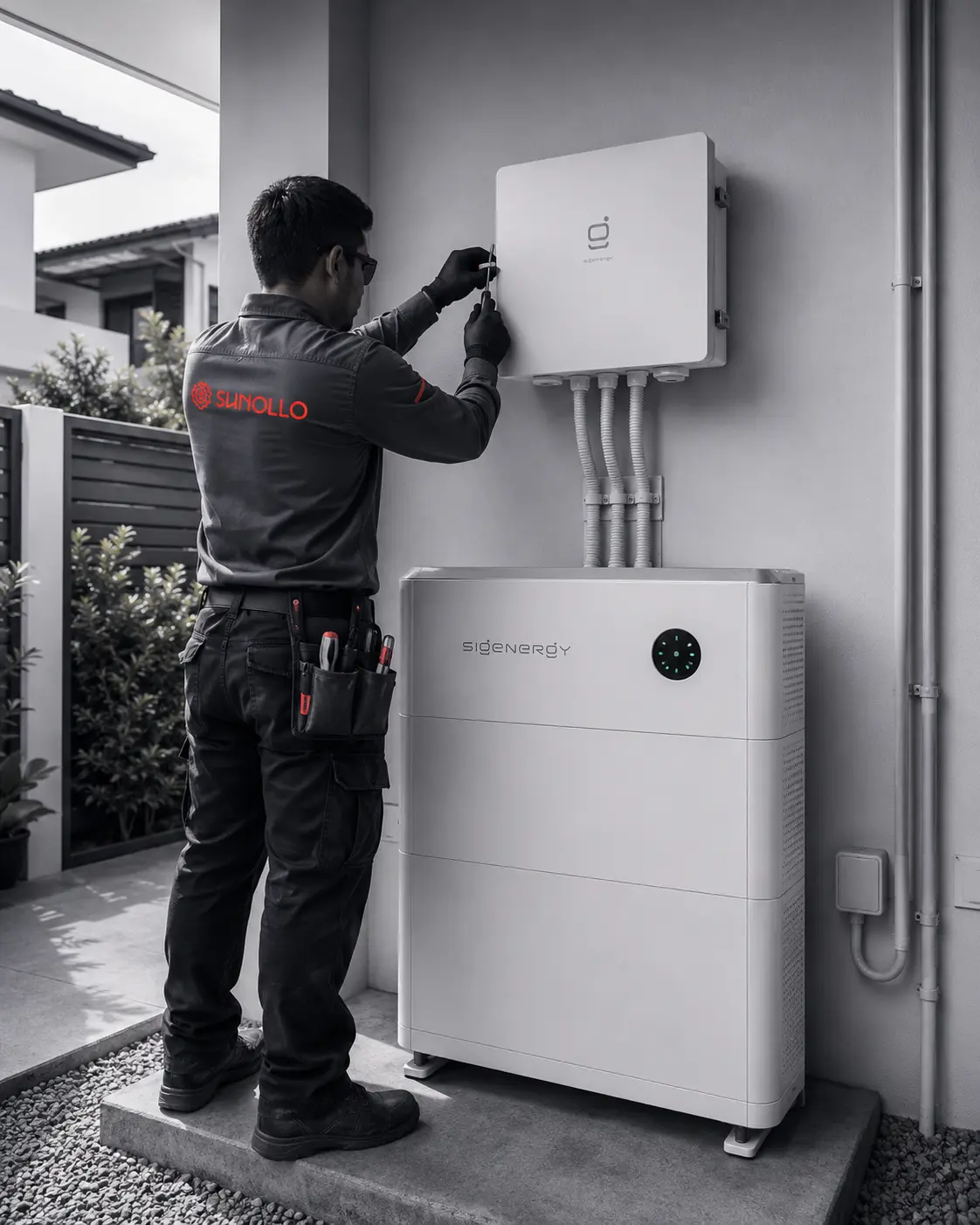
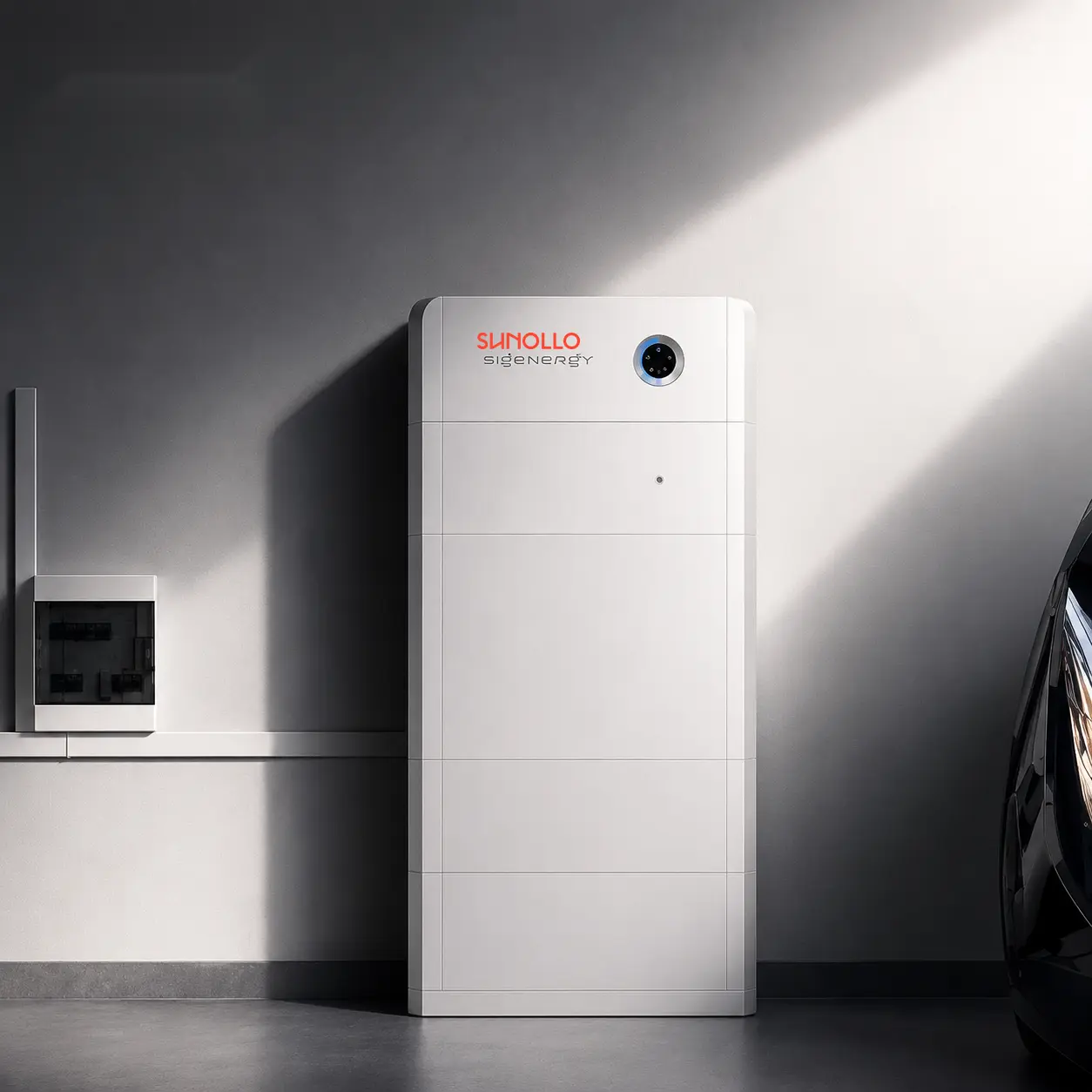
The Sunollo Abundance Pro package is specifically designed for homeowners who want complete energy independence. It combines high-efficiency solar panels, power optimisers, and integrated battery storage in a single, professionally installed system. With the Abundance Pro, your solar energy works for you around the clock — powering your home during the day, charging your EV in the evening, and providing backup power during grid outages.
Choosing the Right Battery Capacity
| Battery Capacity | Best For | Typical Cost (S$) | Overnight EV Range Added |
|---|---|---|---|
| 5 kWh | Light commuters (20–30 km/day) | S$5,000–7,000 | 25–30 km |
| 10 kWh | Average commuters (40–60 km/day) | S$8,000–10,000 | 55–65 km |
| 15 kWh | Heavy drivers + whole-home backup | S$10,000–12,000 | 80–95 km |
Battery storage for standard Singapore homes typically costs S$5,000–12,000, depending on capacity and brand. Combined with a Sunollo solar system, the total payback period remains attractive at 4–5 years, while providing the added benefit of energy resilience and near-total grid independence. For most homeowners, a 10 kWh battery represents the optimal balance between cost, EV charging coverage, and whole-home evening energy needs.
For a comprehensive guide to battery options, see our solar battery storage guide for Singapore 2026.
Singapore Regulations for Solar EV Charging
Installing a solar EV charging system in Singapore involves navigating several regulatory requirements. Here is what you need to know. For a step-by-step walkthrough, see our EV charging installation guide for Singapore homes.
Landed Properties
For landed homes (bungalows, semi-detached, terrace houses), the process is relatively straightforward:
- BCA Approval: Solar panel installations on landed properties require approval from the Building and Construction Authority (BCA). The application typically covers structural loading, fire safety setbacks, and aesthetic guidelines. Sunollo handles the full BCA submission process on your behalf.
- SP Group Metering: To export excess solar energy and receive credits under the Simplified Credit Treatment (SCT), you need a bi-directional meter installed by SP Group. The turnaround time is typically 4–6 weeks from application.
- EMA Registration: Systems above 1 MWac must register with the Energy Market Authority (EMA) as a Market Participant. Residential systems are well below this threshold and are automatically registered through SP Group.
- EV Charger Installation: A licensed electrician must install the EV charger and ensure compliance with SS 638 (Code of Practice for Electrical Installations). A dedicated circuit breaker and appropriate cable sizing are mandatory.
Condominiums and Strata-Title Properties
For condo owners wishing to install an EV charger (solar is typically managed at the MCST level for common rooftop areas):
- MCST Approval: You must obtain approval from the Management Corporation Strata Title (MCST) for any modifications to common property, including running cables from the distribution board to your parking lot.
- Load Assessment: The MCST may require a professional load assessment to ensure the building's electrical infrastructure can handle additional EV charging loads without tripping circuit breakers or overloading transformers.
- Sub-Metering: Individual sub-meters may be required to accurately bill each unit for EV charging electricity consumed.
Fire Safety Considerations
The Singapore Civil Defence Force (SCDF) has issued guidelines for battery storage installations in residential properties. Key requirements include adequate ventilation, fire-rated enclosures for certain battery chemistries, and minimum setback distances from habitable spaces. Sunollo ensures all battery installations comply with SCDF guidelines.
Net Energy Metering and Export Credits
Under SP Group's Simplified Credit Treatment (SCT) scheme, excess solar energy exported to the grid is credited against your electricity bill at the prevailing low-tension electricity tariff minus applicable charges. While the credit rate is lower than the retail tariff, it still provides meaningful value — particularly during midday hours when solar generation peaks and household consumption is low. The SCT scheme is automatic for residential solar systems below 1 MWac and requires no additional licensing.
Future Regulatory Developments
The Energy Market Authority (EMA) is actively evaluating vehicle-to-grid (V2G) technology, which would allow EVs to discharge stored energy back into the home or grid during peak demand periods. Singapore has launched pilot programmes to test V2G in residential settings. When V2G becomes commercially available, homes with solar panels, battery storage, and bidirectional EV chargers will be positioned to earn additional revenue by selling stored energy during evening peak hours — further improving the ROI of integrated solar EV systems.
Solar EV Charging vs Public Charging vs Home Grid Charging
How does solar EV charging at home compare to the alternatives? The table below provides a clear comparison.
| Factor | Home Solar EV Charging | Home Grid Charging | Public Charging (DC Fast) |
|---|---|---|---|
| Cost per km | S$0.007–0.010 | S$0.048–0.063 | S$0.08–0.15 |
| Monthly cost (1,250 km) | S$9–13 | S$60–79 | S$100–188 |
| Annual cost (15,000 km) | S$105–150 | S$720–945 | S$1,200–2,250 |
| Convenience | Plug in at home, charge overnight | Plug in at home, charge overnight | Drive to station, wait 30–60 min |
| Carbon footprint | Near-zero (renewable solar) | ~980 kg CO₂/year | ~980 kg CO₂/year (grid-powered) |
| Price volatility | Fixed for 25 years | Subject to quarterly tariff changes | Operator sets prices, can increase |
| Queue / availability | Always available | Always available | Peak-hour queues common |
| Upfront cost | S$11,500–15,500 (solar + charger) | S$1,500–3,500 (charger only) | None (pay per use) |
The data is clear: while public charging has zero upfront cost, the per-kilometre running cost is 8–15 times higher than solar EV charging at home. Over a 10-year vehicle ownership period, a solar EV charging setup saves between S$10,000 and S$21,000 compared to relying solely on public fast chargers.
For a balanced analysis, read about the advantages and disadvantages of solar EV charging in Singapore.
There are additional qualitative advantages that the numbers do not capture. Home solar charging means never queuing at a public station, never dealing with occupied or malfunctioning chargers, and never making a special trip to charge. You simply plug in when you arrive home. The convenience factor alone makes home solar EV charging the preferred option for the vast majority of landed homeowners in Singapore.
How Sunollo Delivers Complete Solar + EV Solutions
Sunollo is Singapore's trusted provider of integrated solar energy systems for landed homes. Here is what sets Sunollo apart for solar EV charging installations.
Competitive, Transparent Pricing
Sunollo solar systems are priced at S$1,000–1,200 per kWp, fully installed. This includes premium-grade panels, power optimisers as standard (not an optional add-on), inverter, all mounting hardware, cabling, BCA submission, SP Group metering application, and commissioning. There are no hidden costs.
Power Optimisers as Standard
Unlike many competitors who use basic string inverters, Sunollo includes module-level power optimisers with every installation. Optimisers ensure each panel operates at its maximum power point independently, mitigating the impact of partial shading from trees, neighbouring buildings, or satellite dishes. This typically yields 5–25% more energy compared to string-inverter-only systems — energy that can go directly into charging your EV.
SunolloCare: Comprehensive Warranty and Maintenance
Every Sunollo installation comes with SunolloCare, our comprehensive care programme that includes:
- 25-year panel performance warranty
- 12-year inverter warranty (extendable to 25 years)
- Annual system health checks and panel cleaning
- Real-time monitoring with proactive alerts
- Priority service response for any issues
Insurance Coverage
Sunollo provides solar panel insurance coverage as part of the installation package, protecting your investment against damage from storms, falling objects, and other unforeseen events. This is a benefit few solar installers in Singapore offer as standard.
Battery Storage Options
For homeowners who want to charge their EV at night with solar energy, Sunollo offers battery storage solutions ranging from S$5,000 to S$12,000 for standard landed homes. Our team will assess your energy consumption patterns and recommend the optimal battery capacity to maximise your self-consumption ratio. The Abundance Pro package bundles solar, battery, and smart energy management into a single solution.
End-to-End Project Management
From the initial site survey to BCA approval, SP Group metering, installation, and commissioning, Sunollo manages every step. Our average project timeline from contract signing to system switch-on is 6–8 weeks for landed homes. We coordinate with your EV charger installer to ensure seamless integration between the solar system and charging infrastructure.
EV Charger Coordination
Sunollo works with leading EV charger brands and certified electricians to ensure your charging infrastructure is seamlessly integrated with your solar system. Whether you have an existing charger or need a new installation, our engineering team designs the electrical layout to optimise energy flow between your solar panels, battery (if applicable), and EV charger. We ensure proper circuit sizing, cable routing, and smart charger configuration so that your solar energy reaches your car with maximum efficiency.
Explore all of Sunollo's residential solar solutions on our Solar for Homes page.
Frequently Asked Questions
Can I charge my EV directly from solar panels?
Not directly — solar panels produce DC electricity that must first be converted to AC by an inverter. The AC power then flows through your home's electrical system to the EV charger. The process is automatic and seamless; you simply plug in your EV as you normally would, and the system prioritises solar energy when available.
How many solar panels do I need to charge my EV?
For a typical Singapore commute of 40–50 km per day, you need approximately 2–3 kWp of additional solar capacity dedicated to EV charging, which translates to 4–6 panels (assuming 500W panels). However, most homeowners install a larger system (8–15 kWp) that covers both household consumption and EV charging for maximum savings.
Can I charge my EV at night with solar energy?
Yes, but you need a home battery storage system. During the day, excess solar energy charges the battery. In the evening, the battery discharges to power your EV charger. A 10 kWh battery is sufficient for a typical overnight top-up charge for most daily commutes.
What happens on cloudy days or during heavy rain?
Your system automatically draws from the grid when solar generation is insufficient. There is no manual switching required. On cloudy days, your panels still generate 20–40% of their rated capacity, so some solar contribution continues even in overcast conditions.
Do I need a separate electrical circuit for my EV charger?
Yes. Singapore's electrical code (SS 638) requires EV chargers to be installed on a dedicated circuit with an appropriately rated circuit breaker. A licensed electrician must perform the installation and provide a Certificate of Compliance.
Is it worth installing solar just for EV charging?
While solar for EV charging alone offers good savings, the economics improve dramatically when you size the system to offset your entire household electricity bill as well. The marginal cost of adding 2–3 kWp for EV charging to an existing home solar system is relatively small, but the additional savings are significant.
Can I install solar panels and an EV charger in my condo?
EV charger installation in condos is possible with MCST approval, though solar panels on condo rooftops are typically a building-wide decision managed by the MCST. For landed property owners, the entire process is straightforward and Sunollo handles all approvals.
How long does installation take?
A complete solar + EV charger installation typically takes 1–2 days for the physical installation work. However, the end-to-end process — including site survey, design, BCA approval, and SP Group metering — spans 6–8 weeks. The EV charger can often be installed in parallel with the solar system to save time.
Will solar EV charging increase my property value?
Yes. Properties with solar installations and EV charging infrastructure are increasingly attractive to buyers in Singapore, particularly as EV adoption grows. Studies in comparable markets show a 3–5% property value premium for homes with solar installations. With the impending phase-out of internal combustion engine (ICE) vehicles, EV-ready homes are expected to command even higher premiums in the coming years.
What is the total cost to get started with solar EV charging?
A complete solar + EV charging system from Sunollo starts from approximately S$11,500 for an 8 kWp system with a Level 2 charger. For a 10 kWp system with battery storage for overnight EV charging, expect to invest S$16,500–27,500. With a payback period of 3–4 years and 25-year savings exceeding S$85,000, it is one of the highest-returning home improvements available in Singapore.
Conclusion: The Future of Driving in Singapore Is Solar-Powered
The convergence of rooftop solar and electric vehicles represents a generational shift in how Singaporean homeowners power their lives. With the government targeting 60,000 charging points by 2030 and COE policies increasingly favouring electric vehicles, the question is no longer whether to go electric — it is whether you will charge smartly or continue paying a premium for grid electricity and public chargers. Discover why you should consider solar panels for your EV charging.
Solar EV charging at home delivers the lowest cost per kilometre of any charging method, eliminates your carbon footprint, protects you from energy price volatility, and adds value to your property. With payback periods of just 3–4 years and 25-year returns exceeding 580%, the financial case is as compelling as the environmental one.
Singapore's Green Plan 2030 is not just an aspiration — it is a roadmap backed by policy, infrastructure spending, and regulatory reform. COE rebates for EVs, the nationwide rollout of charging points, and rising carbon taxes on fossil fuels are all creating a powerful tailwind for EV adoption. Homeowners who install solar now are not only saving money today; they are future-proofing their homes for a transport landscape that will look fundamentally different within five years.
Sunollo makes the transition seamless. From system design and BCA approval to installation, metering, and ongoing maintenance through SunolloCare, we handle everything — so you can simply plug in, drive clean, and save.
For a curated collection of guides on solar EV charging, see the EV charging resources hub.
Ready to power your EV with sunshine? Get a free solar + EV assessment from Sunollo today and discover how much you can save.
Related Articles: Solar Panel Cost Singapore 2026 Guide | Solar Battery Storage Singapore 2026 Guide | Solar Panel Installation Singapore 2026 Guide