Battery storage has moved from niche technology to mainstream upgrade in Singapore. Prices have dropped 40% since 2022. And for homeowners with solar — or about to get it — adding a battery is the single most impactful decision you can make to control your electricity costs.
This is Sunollo's complete guide. We cover the science, economics, brands, installation, after-sales reality, and every question we've been asked across thousands of customer conversations. Whether you're an existing subscriber, a new customer, or someone exploring options — this article is for you. Bookmark it.
Part 1: How Home Battery Storage Works
A home battery sits between your solar panels and your electrical panel. Its job: store electricity when you have more than you need, release it when you need more than you're producing.
The Daily Cycle in Singapore
- 6–8 AM: Panels start generating. Home is waking up. Most solar self-consumed directly. Battery begins slow charge.
- 9 AM–3 PM: Peak solar. A 10 kWp system generates 5–8 kW. If your household consumes only 1–2 kW (typical when family is at work/school), a massive surplus builds. Without a battery, this goes to the grid as export. With a battery, it fills the battery first.
- 3–6 PM: Solar tapers. Battery is full. Household afternoon routines begin. Solar still covers most load.
- 6–11 PM: Solar drops to zero. Without a battery, you switch entirely to grid power. With a battery, stored energy kicks in. A 10 kWh battery powers a Singapore household's evening needs for 3–5 hours. You may not touch the grid until 9 or 10 PM.
- 11 PM–6 AM: Battery depleted. Home draws from grid overnight — the lowest-value electricity anyway.
Net effect: you shift 30–60% of evening grid consumption to stored solar, dramatically reducing your SP bill.
Grid-Tied Hybrid — The Right Architecture for Singapore
Virtually all Singapore home battery systems are grid-tied hybrid: your home stays connected to the national grid, and the battery adds a layer of self-sufficiency without replacing the grid. This is correct for Singapore because: (1) Singapore's grid reliability is 99.99%+, (2) the NER scheme means exported solar still earns money so you want grid access, and (3) hybrid systems cost 20–30% less than full off-grid setups.
See our hybrid solar inverter guide and our off-grid feasibility analysis.
Part 2: Why Lithium Iron Phosphate (LFP) — The Chemistry That Changed Everything
Not all lithium batteries are the same. Understanding chemistry is the most important technical decision in home storage — and one most guides skip entirely.
LFP vs NMC vs LCO at a Glance
| Chemistry | Cycle Life | Thermal Safety | Cost 2026 | Best Use |
|---|---|---|---|---|
| LFP (Lithium Iron Phosphate) | 6,000–10,000+ | Excellent — 270°C onset | Lowest | Home storage |
| NMC (Nickel Manganese Cobalt) | 3,000–5,000 | Moderate — 150°C onset | Higher | EVs, early home batteries |
| LCO (Lithium Cobalt Oxide) | 500–1,000 | Poor | Highest per kWh | Phones, laptops |
Five Reasons Sunollo Specifies LFP for Every Home
1. Safety. LFP's thermal runaway onset is above 270°C vs approximately 150°C for NMC. In Singapore's tropical climate — where attic and garage spaces reach 45°C+ — this margin is not academic. LFP's olivine crystal structure does not release oxygen during decomposition. NMC can, making thermal runaway potentially self-sustaining. For hardware installed metres from where your family sleeps, this difference matters profoundly.
2. Cycle life. A home battery completing 365 cycles per year over a 10-year warranty = 3,650 cycles. LFP rated at 6,000+ cycles handles this comfortably with significant headroom remaining. NMC at 3,000–4,000 cycles is working much harder to reach the same milestone.
3. Heat tolerance. Singapore's consistently warm climate accelerates calendar ageing — the degradation that occurs just from heat exposure regardless of cycling. LFP is substantially more tolerant of sustained heat than NMC: the better long-term bet for any equatorial installation.
4. Cost. LFP contains no cobalt or nickel — the most expensive and ethically complex battery materials. LFP prices have dropped faster than NMC and continue to diverge. In 2026, LFP costs 25–35% less per usable kWh than comparable NMC systems.
5. Depth of discharge. LFP can be routinely cycled to 90–100% depth of discharge (DoD) without penalty. NMC needs limiting to 80–90% DoD to preserve cycle life. A 10 kWh LFP battery delivers 9–10 kWh usable; the same NMC battery effectively delivers 8–9 kWh. More usable capacity per dollar with LFP.
NMC's one advantage — gravimetric energy density — is irrelevant for homes. Weight matters in a car. In a home, a battery sits on a wall or floor. Whether it weighs 90 kg or 120 kg is irrelevant. LFP wins on every metric that matters for residential storage.
For full price comparisons including brand-specific LFP models, see our battery storage cost guide.
Part 3: Battery Brands Available in Singapore — The 2026 Landscape
Singapore has access to all major global battery brands. Here is an honest assessment based on our installation and maintenance experience across hundreds of systems.
Sunollo Essential (9 kWh) & Sunollo Abundance (18 kWh)
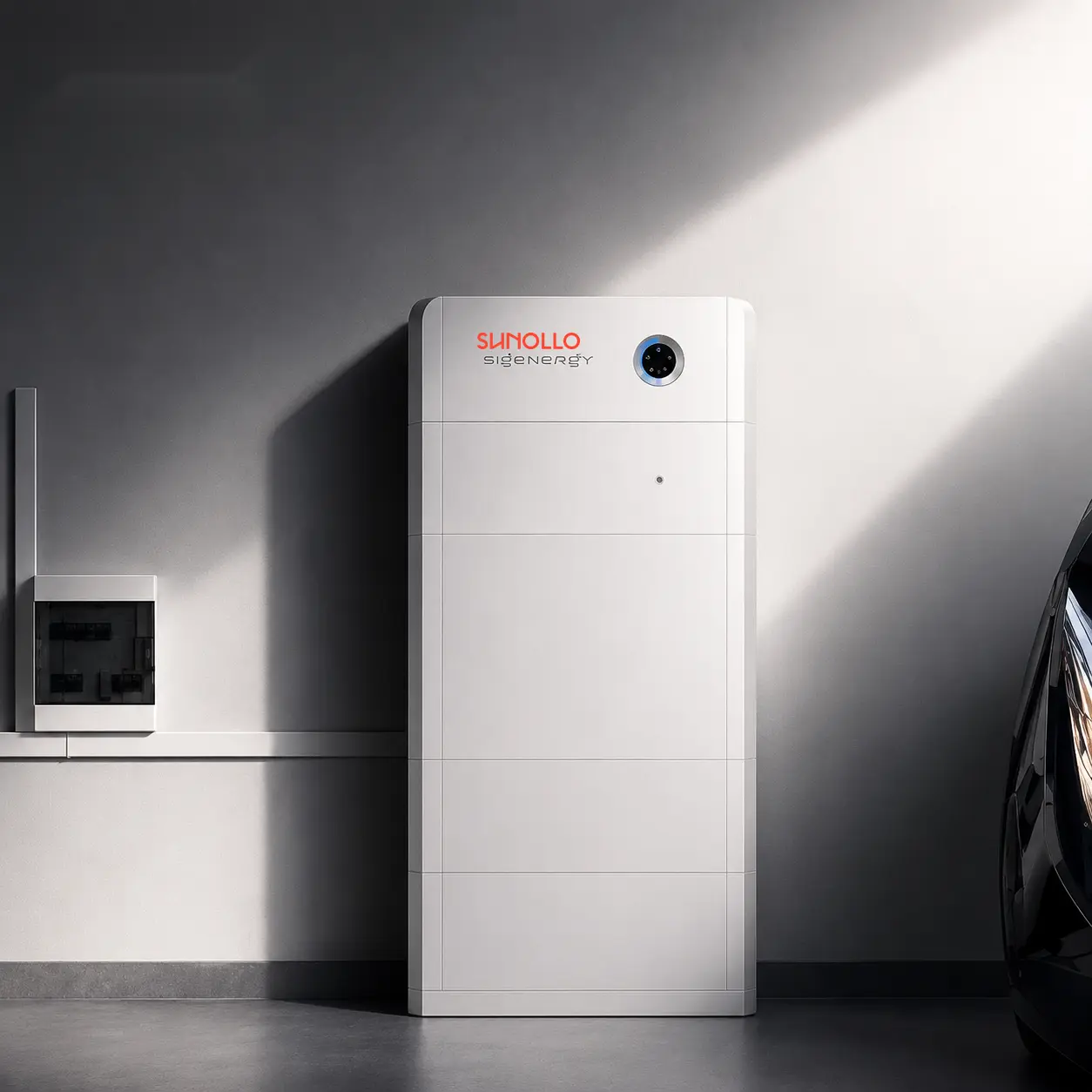
Sunollo Essential: 9 kWh LFP. Installed SGD 6,000. Sunollo Abundance: 18 kWh LFP. Installed SGD 12,000. Both integrate with the Sunollo EnergyHub inverter and LiveTrack app. 10-year warranty.
Sunollo's own batteries are purpose-built for Singapore's tropical climate and electricity market. The Essential covers terrace houses and moderate users (payback ~8 years). The Abundance covers semi-D homes, bungalows, and EV households (payback ~8 years without EV, ~6 years with EV). Unlike third-party batteries requiring separate inverter matching, Sunollo batteries are sold as a fully integrated system — one supplier, one warranty, one app. Available as part of the Abundance Pro subscription at SGD 0 upfront.
Tesla Powerwall 3
13.5 kWh usable LFP. Built-in hybrid inverter. Automatic backup via Gateway 2. Tesla app — the best monitoring UI in the industry. 10-year unlimited-cycle warranty. Installed cost SGD 13,000–18,000.
Best suited for customers who value the ecosystem and brand, and do not mind paying a 15–25% premium over alternatives. The integrated inverter simplifies installation significantly — fewer components, simpler commissioning, single point of contact for support. Tesla's Storm Watch feature also pre-charges the battery before extreme weather events.
For a head-to-head comparison, see Tesla Powerwall vs alternatives in Singapore.
BYD Battery-Box Premium HVS/HVM
5.1–25.6 kWh modular stackable LFP. Blade Battery technology (cell-to-pack — one of the safest architectures in production). Pairs with Fronius, SMA, or GoodWe hybrid inverters. 10-year warranty. Installed cost SGD 5,000–11,000.
Excellent value per kWh. The modular design means you start with what you need today and expand later. BYD's Blade Battery is specifically engineered to prevent internal short circuits — the safest LFP cell architecture currently available.
Huawei LUNA2000
5–30 kWh modular (5 kWh per module). LFP. Designed to pair with Huawei SUN2000 hybrid inverters. FusionSolar app. 10-year warranty. Installed cost SGD 4,500–9,000.
The strongest value when pairing with Huawei inverters. LUNA2000 and SUN2000 are a matched system: single app, single cloud platform, unified energy management. The 5 kWh granularity enables precise sizing. Best choice for existing and new Huawei solar customers.
Enphase IQ Battery 10T
10.08 kWh LFP. AC-coupled microinverter architecture. IQ System Controller for backup. Enphase Enlighten app. 15-year warranty. Installed cost SGD 6,500–9,000 per unit.
The AC-coupled architecture is Enphase's key advantage: it can be added alongside any existing solar inverter without modifying the existing system. Ideal retrofit solution for customers with standard string inverters from any brand.
GoodWe Lynx Home U
6.6–19.8 kWh modular LFP. Pairs with GoodWe ET hybrid inverters. SEMS Portal monitoring. 10-year warranty. Installed cost SGD 5,000–10,000.
Best price-to-performance ratio in the market for most households. GoodWe has a strong Singapore service network. The Lynx Home U's competitive pricing makes it the pragmatic choice when maximising savings per dollar is the priority.
For a full spec comparison see our complete 2026 battery storage guide.
Part 4: Battery Sizing — How Much Do You Actually Need?
Oversizing wastes money. Undersizing leaves savings on the table. Here is how to size correctly.
The Core Formula
Size your battery to cover your evening consumption — the hours between solar ending (~6 PM) and bedtime (~11 PM), typically 5–7 hours:
Battery needed = Evening load (kW) x Hours covered = 1.5–2.5 kW x 5 hours = 7.5–12.5 kWh usable
| Household Type | Evening Load | Recommended Battery | Self-Consumption Increase |
|---|---|---|---|
| 2-person, modest usage | 1.0–1.5 kW | 5–7 kWh | +20–30% |
| 4-person family, average | 1.5–2.5 kW | 9–13 kWh | +25–40% |
| Large family, high usage | 3.0–5.0 kW | 15–20 kWh | +20–35% |
| Home with EV | 1.5–2.5 kW (home only) | 10–15 kWh | +30–50% |
For Singapore's most common home types: the Sunollo Essential (9 kWh) is ideal for terrace houses and 4-person families. The Sunollo Abundance (18 kWh) is designed for semi-D homes, bungalows, and any household with an EV. See our battery planning guide for a detailed step-by-step sizing methodology.
The 80/20 Rule of Battery Sizing
A 10 kWh battery covers approximately 80% of what a 15 kWh battery delivers in savings, at roughly 65% of the cost. Unless you have an EV or unusually high evening consumption, right-sizing around 9–10 kWh is usually the most financially efficient choice for Singapore landed homes.
When to Go Larger
Upsize to 18+ kWh (Sunollo Abundance or equivalent) when you have an EV that charges overnight, your household evening electricity bill exceeds SGD 150/month, or you are targeting near-complete energy independence. Oversizing beyond 18 kWh delivers diminishing returns unless your solar system is 15 kWp or larger.
Part 5: The Full Economics — What You Actually Save
The economics of battery storage in Singapore are driven by one fundamental: the spread between what you receive for exported solar (low NER rate) and what you pay for grid electricity (retail tariff). In 2026, this spread is approximately SGD 0.22/kWh — and it widens every time Singapore's electricity tariff increases.
The Spread Explained
When your solar panels produce more than your home uses, the surplus is exported to the grid via the NER scheme. SP Group pays you approximately SGD 0.10/kWh for this export (the wholesale rate minus administrative charges). If instead you store that surplus in a battery and consume it in the evening, you avoid paying the retail tariff of approximately SGD 0.32/kWh. The difference — SGD 0.22/kWh — is the fundamental value of every kWh your battery stores.
Annual Savings by Battery Size
| System | Capacity | Installed (SGD) | Per Usable kWh |
|---|---|---|---|
| Sunollo Essential | 9 kWh | $6,000 | $667 |
| Sunollo Abundance | 18 kWh | $12,000 | $667 |
| GoodWe Lynx Home U | 6.6 kWh | $5,000–7,000 | $758–1,060 |
| Huawei LUNA2000 (2 modules) | 10 kWh | $6,000–9,000 | $600–900 |
| BYD Battery-Box Premium | 10.2 kWh | $7,000–10,000 | $686–980 |
| Tesla Powerwall 3 | 13.5 kWh | $13,000–18,000 | $963–1,333 |
| Enphase IQ Battery 10T | 10.08 kWh | $7,000–11,000 | $694–1,091 |
The Annual Savings Calculation
- kWh stored and self-consumed: ~3,285 kWh/year (9 kWh/day × 365) via Sunollo Essential
- Spread value captured: ~$0.22/kWh (retail $0.32 minus NER export $0.10)
- Annual savings from Sunollo Essential (9 kWh): 9 kWh × $0.22 × 365 = $723/year
- Total annual savings: SGD 723/year (Sunollo Essential 9 kWh) | SGD 1,445/year (Sunollo Abundance 18 kWh)
These are conservative baseline estimates. EV owners charging from stored solar instead of public chargers (SGD 0.40–0.65/kWh) add SGD 400–600/year in additional savings. Households on time-of-use plans add another 20–30% on top.
Payback Period
At SGD 723/year savings and SGD 6,000 upfront (Sunollo Essential), simple payback is ~8 years. For the Sunollo Abundance (18 kWh, SGD 12,000), payback is also ~8 years without an EV — and ~6 years with EV charging savings.
After payback, every kWh stored is pure savings — at tariff rates that will only be higher than today. An LFP battery rated for 6,000 cycles delivers 16+ years of useful life. A battery that pays back in Year 8 then earns 8+ more years of pure profit. See our detailed battery payback period analysis for full year-by-year calculations.
The Subscription Alternative: Zero Capital Required
Sunollo's Abundance Pro subscription includes battery storage — sized to your home's needs (Essential or Abundance) — for SGD 0 upfront and from SGD 129/month. This makes the payback period irrelevant: instead of putting SGD 6,000–12,000 of capital stays free for other priorities at risk, you pay a monthly amount that is typically less than your current electricity bill and is net positive from month one. Sunollo carries all technology, performance, and replacement risk.
Part 6: Installation — What Actually Happens
Understanding the installation process removes uncertainty and helps you evaluate installer quality. Here is a realistic walkthrough based on hundreds of Sunollo installations.
Site Assessment
Before any installation, Sunollo's engineers evaluate your electrical switchboard capacity, available wall or floor space for the battery (typically 0.5–1.0 m²), cable routing from solar inverter to battery location, and any additional load requirements (EV charger, backup circuits). This assessment takes 60–90 minutes and is conducted during the pre-installation survey.
Installation Day
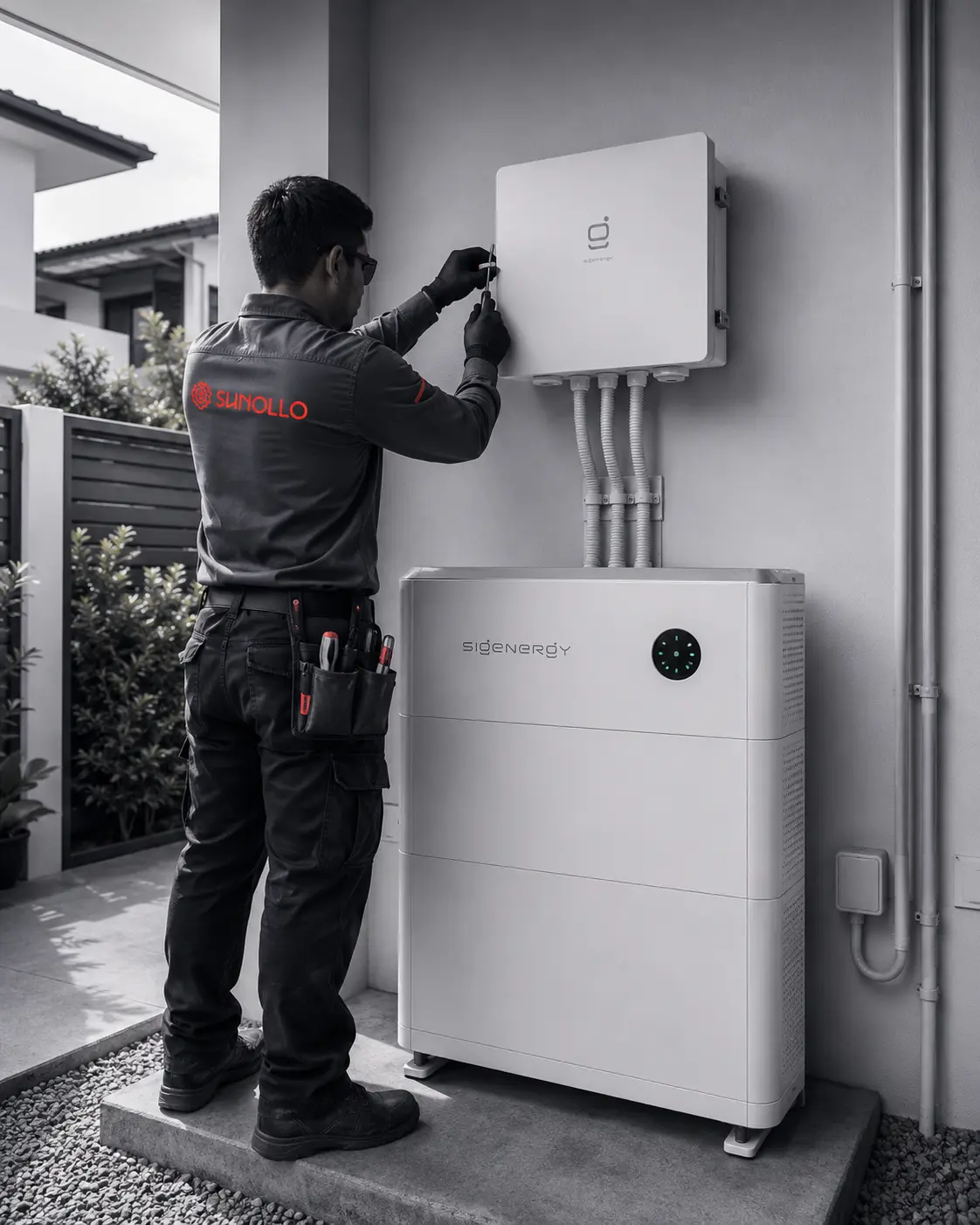
A standard solar-plus-battery installation takes one to two days with a Sunollo crew of three to four. The battery is mounted (wall or floor-standing depending on model), connected to the hybrid inverter, wired to the home electrical panel, and commissioned via the EnergyHub app. You receive a walkthrough of the LiveTrack monitoring interface before the crew leaves.
Post-Installation: What to Expect
In the first few days, you will see the battery charging during peak solar hours and discharging in the evening — exactly as designed. Your SP bill typically drops by 30–60% after the first full billing cycle. The LiveTrack app shows real-time battery state, daily charge/discharge history, and cumulative savings from battery storage specifically.
Retrofitting a Battery to Existing Solar
If you have an existing solar system with a standard string inverter, adding a battery requires either replacing the inverter with a hybrid model or adding an AC-coupled battery (like Enphase or certain BYD configurations). Sunollo assesses retrofit feasibility during the site survey. Most existing Huawei or GoodWe inverter systems can be upgraded to hybrid mode at relatively low additional cost.
Part 7: After-Sales Reality — What No One Tells You
Most battery guides end at installation. Sunollo's experience across hundreds of systems reveals what happens over the following years — and why after-sales support matters as much as the hardware.
Year 1: The Optimisation Phase
Battery performance improves as the system learns your household's consumption patterns. LiveTrack's AI optimisation adjusts charge/discharge timing based on historical usage, improving effective utilisation by 5–15% in the first six months. Most customers see their self-consumption ratio increase from month two onwards as the system adapts.
Years 2–5: Stable Performance
LFP batteries in Singapore's climate show minimal degradation during this period. Sunollo's remote monitoring proactively flags any performance deviations — a battery showing 8% lower output than expected triggers an automatic service check without you needing to notice or report it. This is why the SunolloCare programme exists: battery health is actively managed, not just warranted.
Years 6–10: Approaching Warranty Milestone
By Year 10, a quality LFP battery retains 80–85% of original capacity. For a 9 kWh Sunollo Essential, that means 7.2–7.6 kWh effective capacity — still sufficient for most evening loads. Annual savings decline slightly as capacity degrades, but the battery continues to generate positive returns. If capacity drops below warranty thresholds, SunolloCare triggers a prorated replacement under the 10-year warranty.
Years 11–16+: Post-Warranty Operation
LFP batteries routinely operate beyond warranty at meaningful capacity. A battery at 70–75% of original capacity is still delivering SGD 500–600/year in savings — entirely profit, as the capital cost was recovered years earlier. Sunollo offers extended monitoring and maintenance packages for post-warranty battery operation.
Part 8: Common Questions We Hear Every Day
Can I add a battery to my existing solar system?
Yes, in most cases. Retrofit feasibility depends on your current inverter. Huawei, GoodWe, SolarEdge, and Fronius inverters are typically retrofittable to hybrid mode. Standard string inverters from other brands may require replacement. AC-coupled batteries (Enphase) work with virtually any existing system. Sunollo assesses this during the free site survey.
What happens during a power outage?
Standard grid-tied hybrid systems do not provide backup during grid outages — this is a regulatory safety requirement (to prevent back-feeding into lines that maintenance crews assume are dead). Backup functionality requires specific hardware configuration (Tesla Powerwall with Gateway, or certain Sigenergy systems with dedicated backup circuits). Discuss backup requirements with Sunollo during the design phase if this is a priority.
How do I know if my battery is performing correctly?
The LiveTrack app shows daily charge/discharge cycles, state of charge at any moment, and cumulative kWh statistics. A normally performing 9 kWh battery should show 8–9 kWh charged by early afternoon and 0–2 kWh remaining by 10–11 PM. Sunollo's backend monitoring runs the same checks continuously and alerts our technical team if patterns deviate.
Should I get the Sunollo Essential or Abundance?
For most terrace houses (3–4 bedrooms, daily consumption 15–22 kWh, no EV): Sunollo Essential (9 kWh). For semi-D or bungalow homes, households with higher consumption, or any home with an EV: Sunollo Abundance (18 kWh). Both deliver approximately 8 years payback without EV; the Abundance pays back in ~6 years for EV households. Sunollo will confirm the right choice during your free consumption analysis.
Is there a subsidy or grant for home batteries in Singapore?
As of 2026, there is no direct government grant for residential battery storage in Singapore. However, batteries installed as part of a new solar system may be included within the broader EMA solar generation licence and SP Group NER registration, which carries no additional cost. Sunollo handles all regulatory paperwork as part of the installation.
What is the difference between the Abundance and Abundance Pro?
The Abundance Pro is Sunollo's complete system package — it includes solar panels with optimisers, the Sunollo Abundance battery (or Essential depending on your home profile), EV charging capability, the LiveTrack monitoring system, and SunolloCare insurance coverage, all in one integrated subscription from SGD 129/month with SGD 0 upfront. The Abundance battery is also available as a standalone purchase (SGD 12,000 installed) without the subscription model.
Getting Started
The battery market is moving fast. Prices will continue to fall — but every month without a battery is a month of solar energy exported at SGD 0.10/kWh that could be worth SGD 0.32/kWh to you. The economics of waiting are weaker than they appear.
Book a free consultation with Sunollo. We will analyse your actual SP bill, size the right battery (Essential or Abundance) for your home, and show you the exact payback timeline before you commit to anything. No pressure, no obligation — just clear numbers.
Or if you want to explore the subscription option first: view the Abundance Pro package and calculate what your monthly savings look like versus your current electricity bill. You can also explore Sunollo's home battery storage.
Continue reading: Battery Cost Guide 2026 | Payback Period Analysis | Solar Battery 2026 Guide | Battery & EV Complete Guide | Battery Planning Guide