Can you completely disconnect from the grid and run your Singapore home entirely on solar power? The short answer is: technically possible, practically unnecessary, and financially suboptimal. Here is why — and what you should do instead.
What Off-Grid Actually Means
A true off-grid system has zero connection to the national electricity grid. Your home generates all its own power from solar panels and stores surplus in batteries for nighttime and cloudy periods. If your battery runs empty and the sun is not shining, you have no power.
This is fundamentally different from a grid-connected system with battery storage, where the grid serves as your unlimited backup. Most “energy independent” homes in Singapore are grid-connected with high self-consumption ratios (80–95%) rather than truly off-grid.
The Off-Grid Challenge in Singapore
Cloud Cover Variability
Singapore’s equatorial location delivers strong average solar irradiance, but individual days vary dramatically. A sunny day may generate 4–5 peak sun hours; a heavily overcast monsoon day might deliver only 1–2 hours. An off-grid system must be sized for the worst case, not the average — meaning massive oversizing.
Battery Requirements
To survive 2–3 consecutive overcast days (common during monsoon season), a typical 30 kWh/day household would need 60–90 kWh of battery storage. At current prices, that is SGD 50,000–90,000 in batteries alone — before considering the oversized solar array needed to charge them.
Regulatory Framework
Singapore’s building codes and EMA regulations require grid connection for residential properties in most zones. Fully disconnecting from the grid may require special approvals and could affect property valuations and insurance.
The Better Path: Near-Zero Grid Dependence
Rather than pursuing expensive and risky off-grid status, the optimal strategy for Singapore homeowners is near-zero grid dependence:
- Solar panels: Sized to cover 100–120% of daytime consumption
- Battery storage: 10–15 kWh to cover evening and overnight needs
- Grid connection: Maintained as backup for extended overcast periods and net metering export credits
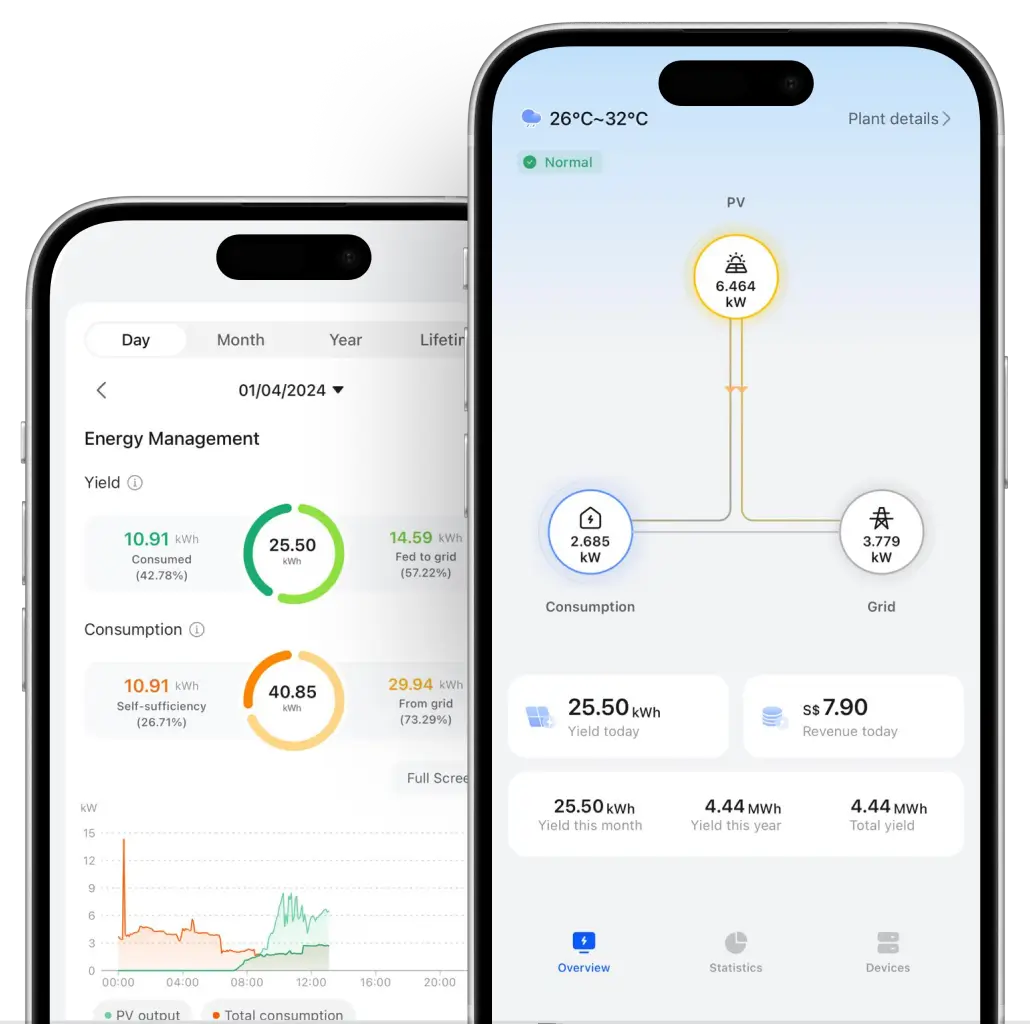
This configuration typically achieves 80–95% energy self-sufficiency at a fraction of the cost of a true off-grid system. The grid serves as your insurance policy — available when needed, rarely used.
Cost Comparison
- True off-grid (for 30 kWh/day home): SGD 100,000–150,000+ (oversized panels + massive battery bank + backup generator)
- Near-zero grid (same home): SGD 25,000–40,000 (right-sized panels + 15 kWh battery) or $0 upfront via Sunollo subscription
The near-zero grid approach costs 70–80% less while achieving 85–95% of the independence. The remaining 5–15% grid dependence costs virtually nothing — your monthly grid bill drops to SGD 20–60.
When Off-Grid Makes Sense
Off-grid solar is viable in specific scenarios:
- Remote installations: Structures without existing grid connection where running new power lines would cost more than a standalone solar system
- Backup/resilience: Critical systems (medical equipment, security, communications) that need guaranteed power independent of grid stability
- Temporary structures: Construction sites, events, or temporary facilities
For permanent Singapore residences, grid-connected solar with battery storage provides superior economics, reliability, and convenience.
The Energy Independence Spectrum
Think of energy independence as a spectrum, not a binary:
- Level 1 — Solar only: 30–50% independence (daytime offset)
- Level 2 — Solar + Battery: 70–90% independence (day and night offset)
- Level 3 — Solar + Battery + EV charging: 80–95% total energy independence (home + transport)
- Level 4 — Full off-grid: 100% independence (extreme cost, limited practicality)
Sunollo’s systems are designed to reach Level 3 — the point of maximum practical independence at optimal cost. Your home generates its own electricity, stores it for nighttime, and powers your car. The grid provides a thin safety net for the few days per year when prolonged cloud cover exceeds your storage capacity. For full details on storage options, see our complete guide to solar battery storage in Singapore.
This is what energy independence looks like for a nation of 6 million people on a 733 km² island: not isolation from the grid, but collective resilience through distributed generation and storage. Every home that reaches Level 3 makes Singapore stronger.
Explore your path to energy independence with Sunollo. We will design a system that maximises your self-sufficiency within a sensible budget.
Continue reading: Complete Battery & EV Guide | Bundle Savings | Compare Packages