


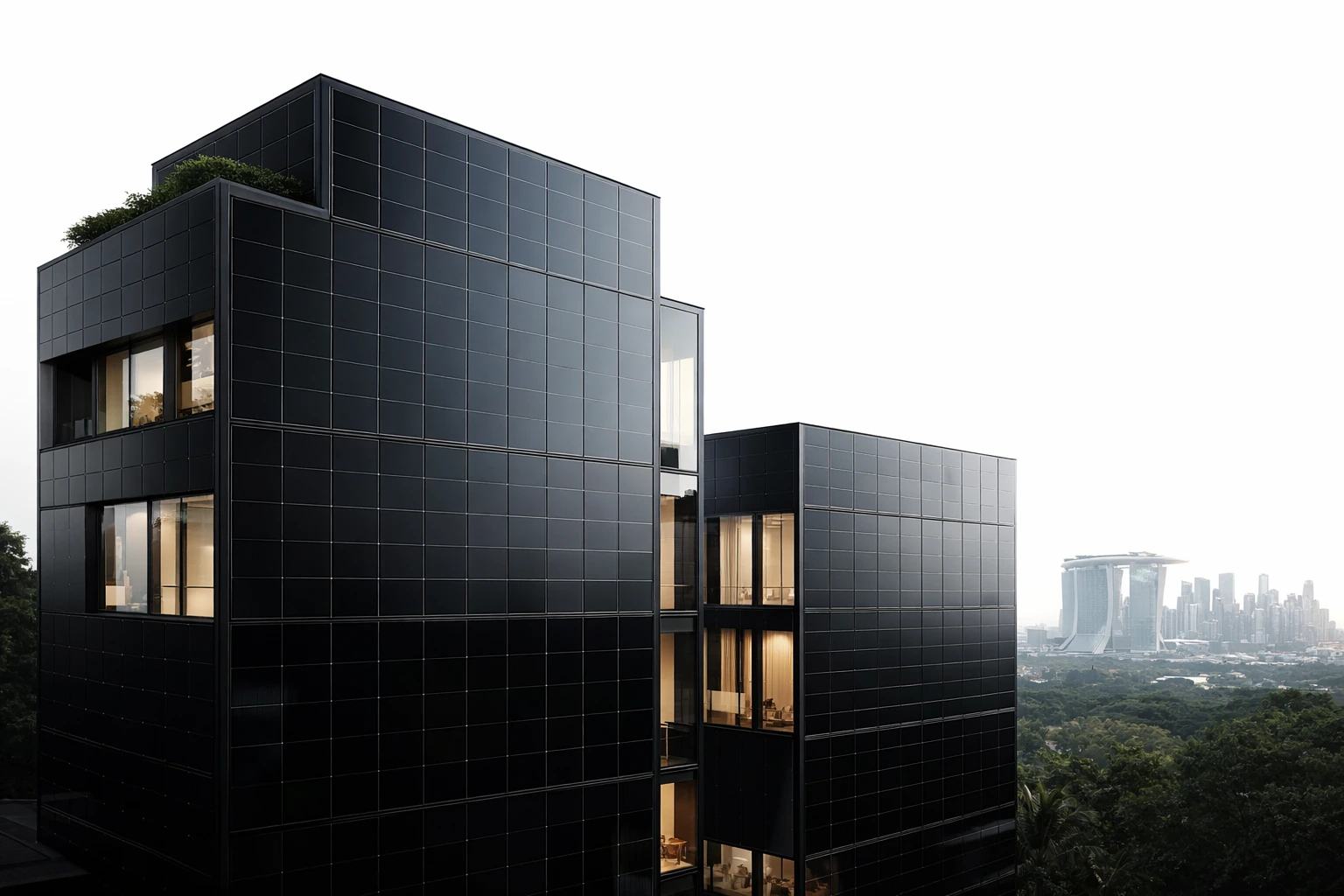
The bottom line: HDB rooftop solar is centrally managed by HDB's SolarNova programme — individual flat owners cannot install panels on HDB roofs, but they benefit indirectly through cheaper common-area electricity (passed on as lower service & conservancy charges). Singapore has 540 MWp installed across HDB blocks with ongoing expansion. For private landed and condo residents, Sunollo offers direct solar installation.
Get a quote for your home
See what solar costs — and saves — on your roof
Book a free, no-obligation site assessment. Sunollo installs and operates residential solar across Singapore — buy outright or from $0 upfront ($99/month), with the same battery-ready hardware on both paths; SunolloCare is bundled on $0-upfront and elective on outright.
HDB Solar Panels in Singapore 2026: Can 80% of Singaporeans Benefit from Solar Energy?
Here is a fact that surprises many Singaporeans: roughly 80% of the population lives in HDB flats. That is over 1 million households — and most assume solar energy simply is not for them.
They are wrong. While you cannot bolt a full rooftop system onto your HDB balcony, the solar revolution has arrived at every HDB block across the island — and it is saving residents money right now. Through the SolarNova programme, community solar models, and a rapidly evolving policy landscape, HDB residents are already benefiting from solar panels on HDB rooftops whether they realise it or not.
This guide covers everything HDB residents need to know about solar in 2026 — from government programmes and community solar credits, to practical alternatives like portable panels and balcony micro-systems. We also explore how HDB residents can help family and friends in landed properties save dramatically with solar, earning referral rewards in the process.
The SolarNova Programme: Singapore's Largest Solar Deployment on HDB Rooftops
What Is the SolarNova Programme?
The SolarNova programme is a landmark government initiative jointly led by the Housing and Development Board (HDB) and the Economic Development Board (EDB). Launched in 2014, SolarNova accelerates the deployment of solar photovoltaic (PV) systems across HDB rooftops, government buildings, and public infrastructure.
The programme aggregates demand from government agencies into large-scale tenders, making solar deployment cost-effective and efficient. Rather than individual blocks applying for solar, the government bundles thousands of HDB blocks into massive procurement rounds.
SolarNova Capacity and Timeline
As of 2026, the SolarNova programme has deployed or committed solar panels across thousands of HDB blocks island-wide. Here is how the programme has scaled:
| SolarNova Phase | Year Awarded | Capacity (MWp) | HDB Blocks Covered |
|---|---|---|---|
| Phase 1 | 2015 | 25 | ~800 |
| Phase 2 | 2016 | 50 | ~1,200 |
| Phase 3 | 2017 | 80 | ~1,600 |
| Phase 4 | 2018 | 60 | ~1,100 |
| Phase 5 | 2020 | 100 | ~2,400 |
| Phase 6 | 2022 | 100 | ~2,200 |
| Phase 7 | 2024 | 125 | ~2,800 |
| Total Target | By 2030 | ~540 MWp | Majority of HDB blocks |
The government's target is to achieve approximately 540 MWp of solar capacity on HDB rooftops — enough to power roughly 135,000 four-room HDB flats annually. This makes the SolarNova programme one of the largest public housing solar initiatives in the world.
How the SolarNova Programme Works
Understanding the mechanics helps HDB residents appreciate the value they receive:
How HDB Residents Benefit from Solar Energy
If you live in an HDB flat, solar is already working for you — even if you have never touched a solar panel. Here is how:
1. Lower Common Area Electricity Charges
The most direct benefit is reduced electricity costs for your block's common areas. Solar panels on your HDB rooftop generate free electricity that powers lifts, corridor and staircase lighting, water pumps, and car park lights. This reduces the electricity portion of your monthly S&CC, saving every household in the block money each month.
2. Sustainability Credits and Carbon Reduction
Every HDB block with solar panels contributes to Singapore's carbon reduction targets. As a resident, you are part of a collective effort that avoids thousands of tonnes of CO₂ emissions annually. Some Town Councils have also begun sharing sustainability dividends with residents — watch this space as programmes mature.
3. Potential for Community Solar Credits
An emerging model gaining traction in Singapore is community solar credits, where the financial benefits of rooftop solar are distributed to individual households within the block. While still in pilot stages, this model could allow HDB residents to see direct credits on their personal electricity bills — a game-changer for apartment dwellers.
4. Increased Property Value
HDB blocks equipped with solar panels and green features are increasingly attractive to buyers. Green Towns programmes, eco-precinct upgrades, and visible solar installations signal a modern, sustainable estate — boosting desirability and potentially resale value.
Community Solar Models: The Future for HDB Residents
For the 80% of Singaporeans who live in apartments, community solar represents the most promising path to personal solar savings. Here is what is emerging:
Virtual Net Metering (VNM)
Virtual net metering allows the solar energy generated on a shared rooftop (such as an HDB block) to be virtually distributed among multiple households. Each participating resident receives a credit on their electricity bill proportional to their share of the solar output.
How it works: Solar panels on your HDB block generate electricity → the energy is exported to the grid → participating residents receive a billing credit based on their allocated share → your monthly electricity bill is reduced.
While Singapore has not yet fully implemented VNM for residential HDB flats at scale, the Energy Market Authority (EMA) has been piloting frameworks, and industry experts expect broader rollout by 2027–2028.
Solar Subscription Programmes
Several energy retailers in Singapore now offer solar subscription plans that allow any household — including HDB residents — to purchase solar energy without owning panels. You subscribe to a portion of a solar farm's output and receive credits or discounted electricity rates.
These programmes typically offer:
Peer-to-Peer (P2P) Solar Energy Trading
Singapore's Smart Grid initiative is paving the way for peer-to-peer energy trading, where households with solar (typically landed properties) can sell excess energy directly to nearby consumers. While still emerging, this model could eventually allow HDB residents to purchase discounted solar energy from neighbours with rooftop systems.
Can You Install Solar Panels on Your HDB Flat?
This is one of the most common questions from HDB residents. The short answer: not a full rooftop system, but limited options exist.
HDB Rules and BCA Guidelines
HDB flats are leasehold public housing, and the rooftops are common property managed by Town Councils. Individual residents cannot install solar panels on the block's rooftop — this is handled exclusively through the SolarNova programme.
For your own unit, the following guidelines apply:
What About Balcony Solar Panels?
Some countries (notably Germany) have embraced "balcony solar" — small plug-in solar panels that residents mount on balcony railings to feed energy directly into their flat. In Singapore, this concept faces several hurdles:
Bottom line: While balcony solar may eventually arrive in Singapore, it is not a practical or approved option for most HDB residents in 2026. Focus instead on the alternatives below.
Alternative Ways HDB Residents Can Go Solar
Just because you cannot install a full rooftop system does not mean you cannot harness solar energy. Here are practical options available right now:
1. Portable Solar Chargers and Power Stations
Portable solar panels paired with power stations are increasingly popular among HDB residents. Place a foldable 100–200W solar panel on your balcony during peak sun hours and charge a portable power station that can run small appliances, charge devices, or provide emergency backup power.
Typical setup:
2. Solar-Powered Gadgets and Appliances
Small solar-powered devices are an easy entry point:
3. Community Solar Subscriptions
As discussed above, subscribing to a community solar programme allows you to benefit from solar energy without any physical installation. Several energy providers offer plans specifically designed for apartment dwellers.
4. Investing in Solar Farms
Some platforms allow individuals to invest in commercial or utility-scale solar farms and receive returns based on the energy generated. This is an indirect way for HDB residents to "go solar" financially while supporting Singapore's clean energy targets.
5. Green Electricity Tariffs
Multiple electricity retailers in Singapore offer green tariffs where 100% of your electricity is matched with Renewable Energy Certificates (RECs) from solar sources. While this does not reduce your bill significantly, it ensures your consumption is carbon-neutral.
For HDB Residents with Family or Friends in Landed Properties
Here is where it gets exciting for HDB residents who want to make a real impact — and earn money doing it.
While HDB flats have limited solar options, landed properties (terrace houses, semi-detached homes, bungalows, and good class bungalows) are ideal for solar panel installations. For a step-by-step walkthrough, see our solar panel installation guide. If you have family members, relatives, or friends who own a landed property, you can help them save thousands of dollars annually — and earn a reward for yourself.
The Sunollo Referral Programme: Earn S$500 Per Referral
Sunollo's referral programme rewards you with S$500 for every successful referral that leads to a solar installation. Here is how it works:
Join the Sunollo Referral Programme →
Think about it: you might not be able to install solar on your HDB flat, but you likely know someone who can. Parents, siblings, in-laws, colleagues, or friends who own a terrace or semi-D could save S$200–600+ per month on electricity — and you get rewarded for making the introduction.
The Economics of Solar: HDB vs Landed Properties
To understand why solar is such a compelling proposition for landed homes, let us compare the typical energy economics:
| Factor | HDB Flat (4-Room) | Landed Terrace | Semi-Detached | Bungalow |
|---|---|---|---|---|
| Average Monthly Electricity Bill | S$80–150 | S$250–500 | S$400–800 | S$600–1,500 |
| Annual Electricity Spend | S$960–1,800 | S$3,000–6,000 | S$4,800–9,600 | S$7,200–18,000 |
| Solar System Feasible? | No (individual) | Yes | Yes | Yes |
| Typical System Size | N/A | 8–12 kWp | 12–20 kWp | 20–40 kWp |
| Monthly Savings with Solar | N/A | S$200–450 | S$350–700 | S$500–1,200 |
| Annual Savings | N/A | S$2,400–5,400 | S$4,200–8,400 | S$6,000–14,400 |
The contrast is stark. A landed property owner paying S$500/month for electricity can slash that bill by 70–90% with a solar system. Over 25 years, the savings are enormous — and with Sunollo's pricing, the payback period is just 3–4 years.
If you are an HDB resident paying S$120/month, solar savings at the individual level are limited. But by referring a landed property owner, you help them unlock S$3,000–14,000+ in annual savings while earning S$500 for yourself.
Solar Panel Cost for Landed Properties in Singapore (2026)
One of the biggest barriers to solar adoption has historically been cost. In 2026, that barrier has largely disappeared — especially with Sunollo's industry-leading pricing.
Sunollo's Pricing: S$1,000–1,200 per kWp
Sunollo offers fully installed solar panel systems at S$1,000–1,200 per kWp — among the most competitive rates in Singapore. This is an all-inclusive price covering:
System Sizes and Total Costs
| Property Type | Recommended System Size | Total System Cost (Sunollo) | Annual Savings | Payback Period | 25-Year ROI |
|---|---|---|---|---|---|
| Terrace House | 8–12 kWp | S$8,000–14,400 | S$2,400–5,400 | 3–4 years | 580–660% |
| Semi-Detached | 12–20 kWp | S$12,000–24,000 | S$4,200–8,400 | 3–4 years | 580–660% |
| Bungalow | 20–40 kWp | S$20,000–48,000 | S$6,000–14,400 | 3–4 years | 580–660% |
With a 25-year ROI of 580–660%, solar panels are not just an environmental choice — they are one of the best financial investments a homeowner can make. For a detailed breakdown by property type, see our complete solar panel cost guide for 2026.
Adding Battery Storage
Battery storage allows landed homeowners to store excess solar energy for use at night or during outages. Sunollo offers battery solutions ranging from S$5,000 to S$12,000 for standard residential homes, depending on capacity and brand.
Batteries are particularly valuable for:
Learn more in our comprehensive solar battery storage guide.
How Sunollo Makes Solar Accessible for Every Singaporean
Sunollo is not just another solar company. We have built our entire approach around making solar simple, affordable, and worry-free for Singapore homeowners.
What Sets Sunollo Apart
SunolloCare: 25 Years of Complete Peace of Mind
SunolloCare is Sunollo's industry-leading service package that covers your solar system for its entire productive life:
This is not a "set and forget" installation. SunolloCare ensures your solar system delivers maximum returns for the full 25-year lifespan — something few competitors can match. Learn more about choosing the right solar company in our guide to the best solar companies in Singapore.
Explore Sunollo's Solar Solutions
Whether you are a landed property owner ready to go solar, or an HDB resident looking to refer someone, Sunollo has options for you:
Singapore's Green Plan 2030 and Solar Energy
Singapore's Green Plan 2030 sets ambitious targets for sustainability across every sector. Solar energy plays a central role in these plans, and every Singaporean — including HDB residents — is part of the story.
Key Solar Targets Under the Green Plan
How HDB Solar Fits Into the National Strategy
The SolarNova programme is a cornerstone of Singapore's solar strategy. By deploying solar across the vast majority of HDB rooftops, the government achieves several goals simultaneously:
For a deeper dive into Singapore's sustainability roadmap, read our comprehensive guide to the Green Plan 2030.
Frequently Asked Questions: HDB Solar Singapore
1. Do HDB flats have solar panels?
Yes. Under the SolarNova programme, thousands of HDB blocks across Singapore already have solar panels installed on their rooftops. These panels power common areas like lifts, corridors, and water pumps, reducing the electricity costs shared by all residents in the block.
2. Can I install solar panels on my HDB flat?
Individual residents cannot install permanent solar panels on HDB balconies or facades due to building regulations and safety concerns. However, you can use portable solar chargers and foldable panels that do not require permanent installation. The rooftop solar is managed centrally through the SolarNova programme.
3. How much do HDB residents save from solar panels?
Savings vary by block and Town Council. The solar energy generated reduces common area electricity costs, which translates into lower Service & Conservancy Charges (S&CC). While the per-household saving is modest (typically S$2–10/month), it adds up across thousands of households and over decades of operation.
4. What is the SolarNova programme?
SolarNova is a government programme that deploys solar panels on HDB rooftops and government buildings. Led by HDB and EDB, it aggregates demand into large tenders to achieve cost efficiency. The target is approximately 540 MWp of solar capacity on HDB rooftops, with the majority of blocks covered by 2030.
5. Can HDB residents subscribe to community solar?
Yes. Several energy retailers offer green electricity plans and solar subscription programmes that any household — including HDB residents — can join. These plans provide solar energy credits or discounted rates without requiring any physical installation.
6. Is solar worth it for landed properties in Singapore?
Absolutely. Landed properties (terrace, semi-D, bungalow) can install full rooftop solar systems and achieve payback in just 3–4 years, with a 25-year ROI of 580–660%. With Sunollo's pricing of S$1,000–1,200/kWp, it is one of the best investments a homeowner can make.
7. How much do solar panels cost in Singapore in 2026?
With Sunollo, fully installed solar systems cost S$1,000–1,200 per kWp. A typical terrace house system (8–12 kWp) costs S$8,000–14,400, while a bungalow system (20–40 kWp) ranges from S$20,000–48,000. See our 2026 pricing guide for full details.
8. What is the Sunollo referral programme?
Sunollo's referral programme pays you S$500 for every successful referral that leads to a solar installation. If you know anyone with a landed property — family, friends, colleagues — you can refer them to Sunollo and earn a cash reward. There is no limit on the number of referrals. Sign up here.
9. Do solar panels work in Singapore's tropical climate?
Yes — Singapore's equatorial location provides consistent, high solar irradiance year-round. While cloud cover and tropical rain reduce output on certain days, the annual solar resource is strong and predictable. Modern panels perform well in high temperatures, and Sunollo's SolarEdge optimisers ensure maximum energy harvest even in partial shade.
10. What happens to excess solar energy in Singapore?
For landed properties with solar panels, excess energy is exported to the national grid under SP Group's Simplified Credit Treatment (SCT) scheme. You receive credits on your electricity bill for every kWh exported, effectively spinning your meter backwards. For HDB blocks, the SolarNova programme manages excess generation centrally.
Conclusion: Every Singaporean Has a Role in the Solar Revolution
Whether you live in a Toa Payoh HDB flat or a Bukit Timah bungalow, solar energy is already changing how Singapore generates and consumes electricity. The SolarNova programme is transforming HDB rooftops into clean energy assets, community solar models are emerging to give apartment dwellers direct financial benefits, and landed homeowners are saving thousands annually with rooftop solar systems.
As an HDB resident, here are your action items:
For landed property owners, the opportunity is even more compelling. With Sunollo's pricing at S$1,000–1,200/kWp, SunolloCare's 25-year protection, and a payback period of just 3–4 years, there has never been a better time to go solar.
Get a free solar assessment from Sunollo →


