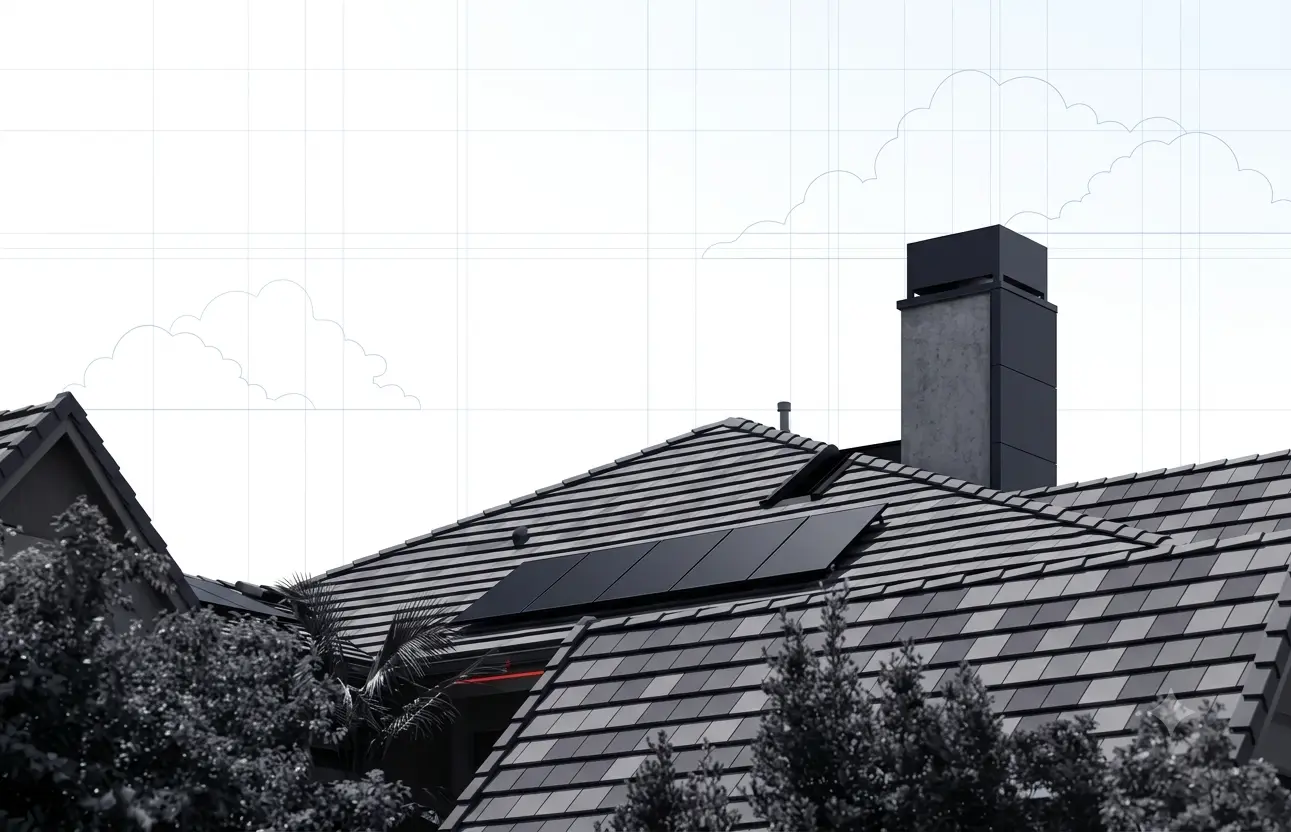
It’s a familiar story for many homeowners with solar panels: a sudden downpour rolls in, and moments later, the solar system trips. The inverter shuts off, the RCCB (Residual Current Circuit Breaker) flips, and power generation stops.
The good news? In most cases, nothing is actually “wrong” with your system. This rainy-day tripping is a known behaviour, especially in single-phase PV setups commonly used in residential homes across Singapore. To understand why it happens, we need to look at how leakage current and humidity interact inside your system.
1. The Role of Leakage Currents
Every solar inverter naturally produces a small leakage current, a tiny flow of electricity that returns to earth through protective grounding. This happens because inverters contain internal filters that reduce electromagnetic noise and stabilize operation.
In a single-phase system, all current flows through just one live conductor and one neutral. The RCCB constantly monitors this balance. When even a small mismatch appears, say, a few milliamps flowing elsewhere, it instantly disconnects power to prevent possible electric shock.
Here’s the catch: in a three-phase system, those small imbalances across different phases often cancel each other out. But in a single-phase home, there’s no balancing effect, so the RCCB “feels” the full leakage current from the inverter and trips more easily, even under normal conditions.
2. Rain and Humidity: The Invisible Triggers
During rain or high humidity, the insulation resistance of your solar system drops temporarily. Moisture can sneak into MC4 connectors, DC isolators, junction boxes, or even the PV module frames.
When that happens, a faint leakage path forms between the electrical conductors and earth, essentially allowing small currents to “leak” out. On their own, these currents are minuscule. But when combined with the inverter’s built-in leakage current, they can push the total above the RCCB’s 30 mA safety threshold.
The result? A protective trip.
And that’s exactly what’s supposed to happen, the RCCB is doing its job to keep you safe, even though the root cause is just temporary moisture rather than an actual electrical fault.
3. Why Single-Phase Houses Feel It More
Here’s where the single-phase difference becomes clear:
- In single-phase systems, the leakage current has only one monitored path, so every minor variation shows up directly on the RCCB.
- In three-phase systems, some leakage cancels between phases, so the total residual current stays lower.
That means a single-phase solar system will reach the 30 mA trip limit much sooner during rain or high humidity, even when everything is working as designed.
4. Other Hidden Contributors
Moisture and insulation aren’t the only culprits. A few design and environmental factors can make rainy-day tripping more likely:
- Water ingress in rooftop isolators or loose cable glands
- Long DC cable runs, which increase total capacitance to earth
- Metal mounting frames that collect surface water and enhance leakage
- Condensation inside conduits or inverter terminals after a heavy downpour
Each of these can slightly raise the system’s residual current. And when added together, they can nudge the RCCB over its sensitive 30 mA threshold.
5. What It Really Means, And What You Can Do About It
If your solar system trips only during wet or humid weather but works fine once dry, it’s likely not a major fault. Instead, it reflects the natural sensitivity of single-phase systems and the protective function of your RCCB.
Here are a few steps that help reduce nuisance tripping:
- Consider reviewing the RCCB rating with a licensed electrician. Sometimes, using a less-sensitive unit (e.g., 100 mA instead of 30 mA) on the PV circuit is permissible and effective, as long as overall system safety remains intact.
- Ask your installer to inspect and reseal connectors, isolators, and junction boxes.
- Keep cable routes elevated and away from areas where water can pool.
These checks can significantly reduce unwanted tripping while keeping your system compliant and safe.
Final Thoughts - It’s Protection, Not a Problem
When your solar system trips during rain, it’s easy to assume something’s broken. But in most single-phase homes, it’s simply the safety system doing its job, reacting to a combination of moisture, insulation changes, and normal inverter behavior.
Understanding this helps shift perspective: the tripping isn’t a flaw, but a feature, proof that your solar installation is actively protecting you and your home.
With proper installation, regular maintenance, and a few simple design adjustments, your solar system will keep performing reliably through every monsoon. After all, true solar resilience isn’t about avoiding the rain, it’s about shining safely through it.
Related Articles: Solar System Maintenance | Solar Installation Step-by-Step | How To Clean Solar Panels In Singapore | Troubleshooting Common Solar Panel Issues