The bottom line: SolarEdge SunMax optimisers (standard on Sunollo Abundance) are essential for Singapore's tightly-packed landed homes — they recover 8–25% of energy lost to shading, AC units, and multi-angle roofs. Without optimisers, one shaded panel can drop string output by 30–50%. SunMax limits losses to only the affected panel, preserving 80–90% system output even with localised shading.
Most solar guides are written for the ideal scenario: a perfectly south-facing, unobstructed roof. But if you own a Singapore landed home — a terrace house, semi-detached, bungalow, or Good Class Bungalow — your roof almost certainly does not fit that description. Hip roofs, pyramid roofs, L-shaped floor plans, corner properties, mature trees, and neighbouring structures all create the kind of complex solar environment where a standard string inverter system quietly underperforms from day one.
The Sunollo Abundance system with SunMax power optimizers was engineered specifically for this reality. If you have signed up for it, your system will outperform a standard solar installation on the same roof — and by a meaningful margin. Here is exactly why, and what your SunMax optimizers do for you every single day.

The Sunollo Abundance system: AIKO solar panels, one SunMax optimizer per panel, and a Sungrow Radiance inverter — engineered for complex, multi-angle Singapore roofs.
Singapore Roofs Are Not Simple
Walk through any Singapore residential estate — Bukit Timah, Serangoon Gardens, Siglap, Sembawang, Jalan Kayu — and count the homes with a single, flat, south-facing roof plane. You will count very few. The vast majority of Singapore landed homes have:
- Hip roofs: Four sloping faces pointing north, south, east, and west simultaneously
- Pyramid roofs: Four equal triangular faces meeting at a central peak, common on bungalows and detached houses
- L-shaped and T-shaped layouts: Terrace houses extended backwards or upwards, creating multiple roof planes at different heights and orientations
- Partial shading from mature trees: Singapore’s urban canopy is dense. A neighbour’s angsana or tembusu may cast morning shade over part of your roof for years
- Corner properties: Often with irregular roof angles to accommodate plot geometry
- Heritage and conservation homes: Mansard sections, dormer windows, or staggered roof levels creating multiple pitched surfaces
Each of these configurations means your solar panels are not all facing the same direction, not all receiving the same irradiance at the same time, and therefore not all generating the same output at any given moment. For a standard string inverter, this is a fundamental engineering problem.
The String Inverter Problem on Multi-Angle Roofs
To understand why this matters, you need to understand how a string inverter works. In a standard solar installation, panels are connected in series — one after another — forming a “string.” The inverter then converts the combined DC output of that string into AC electricity for your home.
Here is the critical limitation: in a series string, the output of every panel is constrained by the worst-performing panel in the chain. Think of it like water flowing through a series of pipes — one narrow pipe determines the maximum flow rate for the entire run, regardless of how wide the other pipes are.
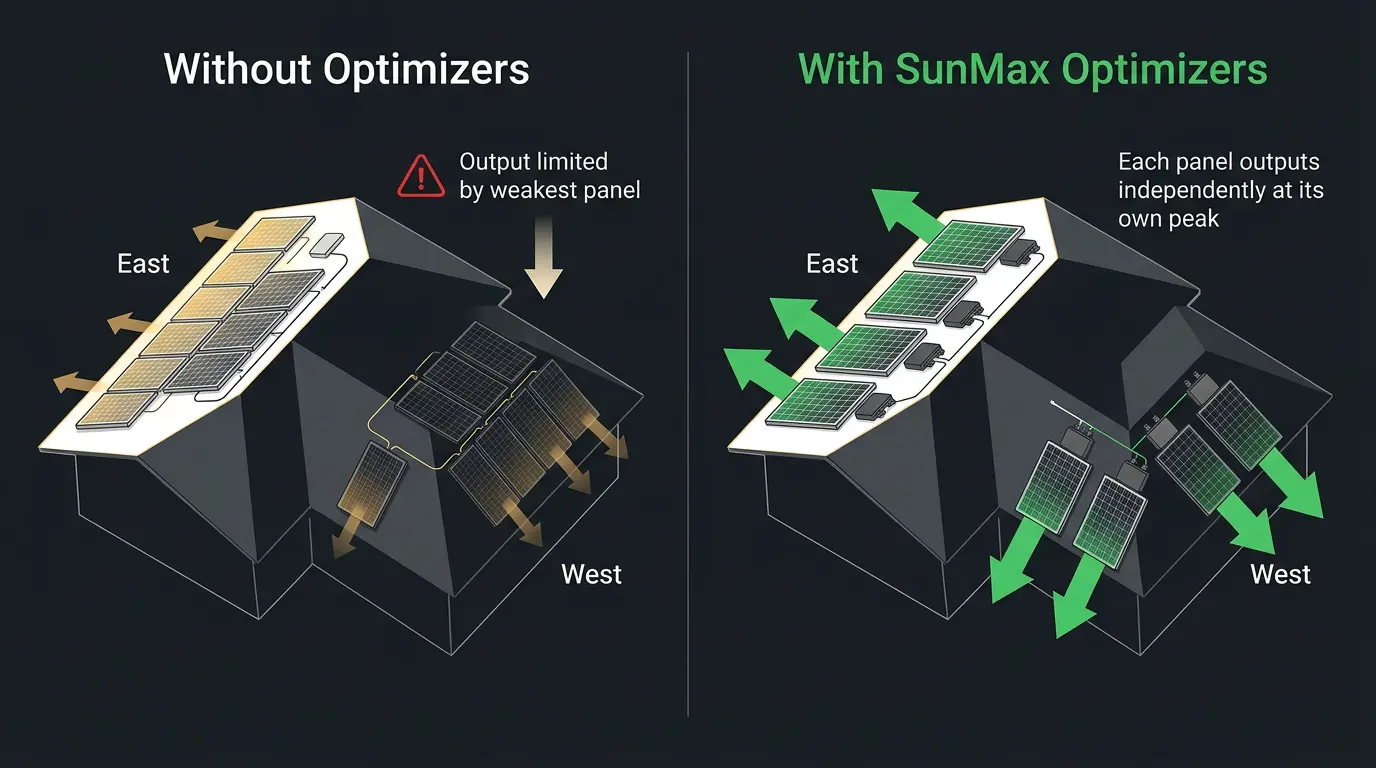
For a home with a hip roof — say, panels on the east face and panels on the west face wired into the same string — this creates a daily performance problem:
- Morning: East-facing panels generate strongly as the sun rises. West-facing panels receive indirect, low-angle light and generate weakly. The entire string’s Maximum Power Point is dragged down by the underperforming west panels. You lose energy the east panels should have generated at full capacity.
- Midday: Both faces receive diffuse overhead light. The mismatch narrows but persists.
- Afternoon: The situation reverses. West panels generate strongly while east panels underperform. The entire string is again limited by the east panels.
This mismatch — purely from orientation, even without any shade — causes a real, measurable annual production loss. For a four-face hip roof with panels on multiple facets, production losses from string-level mismatch alone can reach 10–25% of annual generation versus the theoretical output of those same panels operating independently.

In a standard string configuration, one underperforming panel — whether from shade or orientation mismatch — limits the output of every other panel in the string.
What is a SunMax Power Optimizer?
A SunMax power optimizer is a compact electronic module that mounts directly on the back of each individual solar panel in your Sunollo Abundance system. Every single panel in your installation has its own dedicated optimizer.
The optimizer’s core function is to perform Maximum Power Point Tracking (MPPT) at the individual panel level, rather than at the string level. MPPT is the algorithm that continuously finds the exact voltage-and-current combination that produces maximum power from a panel given its current light conditions. In your Abundance system, every panel has its own MPPT running independently, thousands of adjustments per second, all day long.

The SunMax power optimizer: a compact, robust module that mounts behind each panel and gives it full independent Maximum Power Point Tracking capability.
It is important to understand what a SunMax optimizer is not: it is not a microinverter. Microinverters convert DC to AC at each panel, creating multiple individual AC circuits that add complexity and cost. SunMax optimizers work in the DC domain — they condition each panel’s DC output and feed it into your Sungrow Radiance string inverter, which performs a single, highly efficient DC-to-AC conversion for the whole system. You get panel-level performance intelligence and the proven reliability and 98.4% efficiency of a premium string inverter.
Benefit 1: Maximum Production — Zero Mismatch Loss
With a SunMax optimizer on every panel, the orientation mismatch that plagues multi-angle roofs is eliminated at source. Each panel operates at its own individual maximum power point, completely independently of every other panel in the array.
In the morning, your east-facing panels with optimizers generate at full capacity — unbothered by the fact that west-facing panels are generating less. In the afternoon, your west-facing panels run at their peak while east panels operate at lower output. At every moment of every day, every panel extracts every available watt from the light it receives.
.png)
Every AIKO panel in your Abundance system has its own SunMax optimizer working independently — maximum output from every panel, every hour.
The Numbers: What This Means for Your System
Consider a 20-panel Abundance system on a hip roof: 10 panels facing east-northeast and 10 panels facing west-southwest. During morning peak hours (8am–12pm), the ENE face may generate at 85–90% of rated output while the WSW face generates at 30–40%.
Without optimizers: The entire string’s MPPT is constrained by a compromise between the two faces. The ENE panels cannot realise their potential because the string’s operating point is dragged toward the underperforming WSW panels. You lose 25–35% of what the ENE panels could have generated during those peak morning hours.
With SunMax optimizers: The 10 ENE panels each run at 85–90% output. The 10 WSW panels each run at 30–40% output. Total morning output is the true arithmetic sum of all 20 panels — every watt captured, no compromise, no ceiling imposed by the underperforming face.
Real-world Abundance installations on comparable multi-angle Singapore roofs consistently demonstrate annual generation improvements of 8–22% versus equivalent systems without panel-level optimizers. Over a 25-year system lifespan, that difference represents a very significant additional return on your investment.
Even panels receiving partial shade or suboptimal orientation continue generating at their individual maximum — SunMax optimizers ensure no energy is left uncaptured.
Benefit 2: Enhanced Safety — Safe DC Technology
Beyond performance, SunMax optimizers deliver a safety capability that standard string inverter systems cannot match: automatic Safe DC voltage reduction across every panel simultaneously.
In a standard solar installation, your panels are wired in series into a string operating at high DC voltage — typically 300V to 600V — and this voltage is present on the roof cabling at all times during daylight, regardless of whether the inverter is on or off, whether the AC grid is live or not. Light hits panels, DC voltage exists. No exception.
This creates a genuine safety concern in critical scenarios:
- Fire or electrical fault: A firefighter cutting through roof cabling, or an electrician working on your distribution board during a fault, may encounter live high-voltage DC. AC circuit breakers cannot interrupt a DC fault. In Singapore’s terrace house environment, where homes share walls, this risk extends beyond your property.
- Emergency shutdown: In any serious fault scenario, there is no rapid way to de-energise the DC side of a standard string system without physically disconnecting each panel — a task requiring rooftop access during an emergency.
- System maintenance: Any work on the DC cabling must account for live high-voltage circuits even when the inverter is switched off.
SunMax Safe DC eliminates this hazard. When your Sungrow Radiance inverter detects AC de-energisation, a fault condition, or is manually shut down, it transmits a signal to all SunMax optimizers simultaneously. Each optimizer immediately reduces its panel’s output voltage to a safe low level — making the entire DC string safe to work on within seconds. This meets IEC and NEC 2017 Rapid Shutdown requirements, making your Abundance system one of the safest residential solar installations available in Singapore today.

On a shutdown signal, every SunMax optimizer reduces its panel’s voltage to safe levels instantly — protecting anyone who needs to access the system during a fault or emergency.
Benefit 3: Full Panel-Level Monitoring
The third significant advantage of your SunMax optimizers is the granular, real-time visibility they provide into your system’s performance — down to the level of every individual panel, every minute of every day.
In a standard solar installation, your monitoring shows a single aggregate number: total system output. If one of your 20 panels is generating 20% less than it should due to a developing fault, partial soiling, or a bypass diode issue, that signal is buried in the aggregate — invisible without panel-level data.
With SunMax optimizers, every panel transmits its own real-time performance data to the iSolarCloud platform linked to your Sungrow Radiance inverter. You can see:
- Individual panel power output in real time, for every panel on your roof
- Individual panel energy generation daily, monthly, and over the system’s lifetime
- Automatic anomaly alerts when any panel’s output falls outside expected parameters
- Comparative panel performance — instantly visible if one panel is generating significantly less than its neighbours, even if total system output looks normal
Early Fault Detection
A panel consistently underperforming by 15% may have a developing hotspot, a faulty bypass diode, or a connection issue. Without panel-level monitoring, this fault can persist for months or years, silently reducing your generation and potentially escalating. With SunMax optimizers, Sunollo’s monitoring team can pinpoint the specific panel, identify the anomaly, and schedule targeted maintenance before the issue worsens.
Soiling and Shade Identification
If a panel consistently shows lower output than its neighbours but recovers after rainfall, it almost certainly has a soiling issue — bird droppings, organic matter, or dust accumulation. Panel-level monitoring identifies exactly which panels need cleaning, enabling targeted maintenance rather than a full-roof inspection.
25-Year Performance Visibility
Over 25 years, individual panels degrade at slightly different rates. Panel-level monitoring gives you a complete, unbroken performance record for every panel on your roof — invaluable for understanding your system’s long-term health and making evidence-based decisions about any future maintenance.

The SunMax optimizer’s precision DC power electronics give every panel independent MPPT while transmitting real-time performance data continuously to iSolarCloud.
Why Multi-Angle Roofs Specifically Benefit from Abundance
On a single-plane, south-facing, unobstructed roof, the mismatch problem is minimal — all panels face the same direction, receive similar irradiance profiles, and a string inverter’s MPPT works reasonably well for all of them. Production benefit from optimizers is real but measured — typically 3–8%.
On a multi-angle roof — and particularly the hip and pyramid roofs that dominate Singapore’s landed estates — the production benefit is substantially larger because the mismatch is structural and persistent. Every morning and every afternoon, differently-oriented roof faces receive meaningfully different irradiance. Without optimizers, that mismatch costs you generation every single day. With SunMax optimizers, the mismatch is eliminated.
Common Singapore property types where Abundance is the clear engineering choice:
- Terrace house with front and back roof faces: One face towards the front street, one towards the rear garden. Both faces generate differently across the day. Without optimizers, the weaker face limits the stronger face all day, every day.
- Semi-detached with hip roof: All four faces contribute panels. East and west faces generate in strong alternation, north and south faces generate differently from both. The four-way mismatch in a standard string is substantial — optimizers resolve it entirely.
- Bungalow with mature garden trees: A single large angsana casting a moving shadow across two or three panels through the morning creates a dynamic shading pattern. In a standard string, this drags the entire string’s output down. With SunMax optimizers, only the shaded panels are affected — the unshaded panels continue at full output.
- Corner property with complex roof geometry: Irregular panel placement across multiple small roof sections, each with a different orientation and shading profile. Panel-level MPPT is the only architecture that makes this viable at full performance.
Your Complete Sunollo Abundance System
Your Abundance system is a complete, integrated architecture where every component is chosen to work optimally with the others:
- AIKO Solar Panels: All Back Contact (ABC) cell technology — maximum light absorption, among the highest efficiencies available, 25-year linear power warranty
- SunMax Power Optimizers: One per panel. Individual MPPT, Safe DC rapid shutdown, and panel-level telemetry — the intelligence layer that makes Abundance the correct engineering choice for complex roofs
- Sungrow Radiance Inverter: 10kW, 15kW, or 20kW as specified in your contract. World’s most deployed inverter brand, receiving individually optimised DC from every panel and converting to AC at up to 98.4% efficiency. 10-year warranty.
- SS 638-Compliant Cabling: All DC and AC wiring to Singapore’s national solar standard — TÜV-certified DC cables, IP67 MC4 connectors, dedicated AC isolator and circuit breaker, signed off by a Licensed Electrical Worker
- iSolarCloud Monitoring: Real-time system and panel-level visibility from your smartphone. Sunollo’s team monitors your system remotely and alerts you proactively to any anomaly.
Your specific panel count, optimizer count, inverter model, system capacity (kWp), and projected annual generation are all documented in your signed contract, accessible through the Sunollo app.

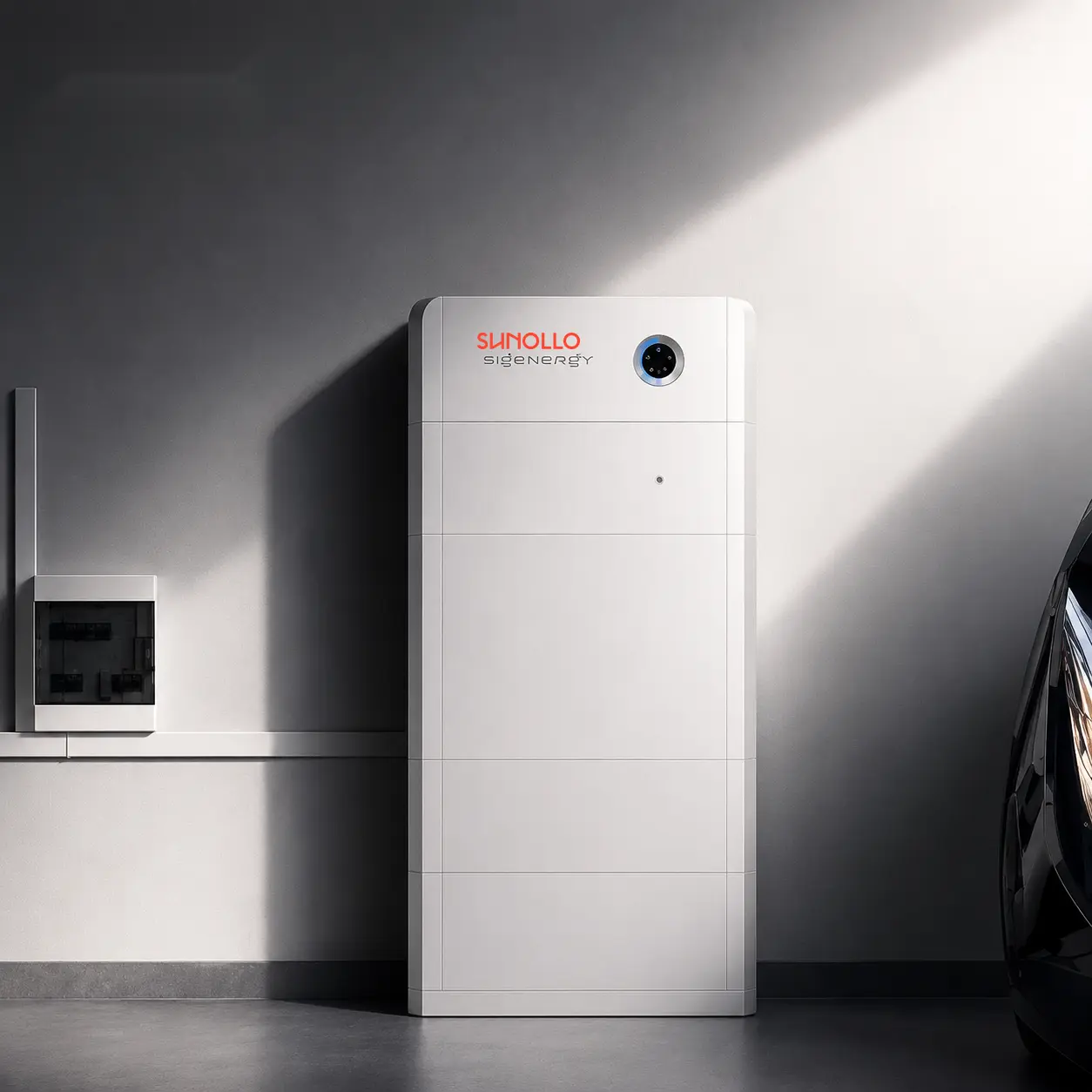
The complete Abundance ecosystem: AIKO panels with SunMax optimizers, Sungrow Radiance inverter, and iSolarCloud panel-level monitoring — a fully integrated system for maximum performance, safety, and transparency.
Is Your Roof Right for Abundance?
The Abundance architecture with SunMax optimizers is the right choice for any Singapore landed home that has one or more of the following characteristics — and most Singapore roofs have several:
- Two or more distinct roof planes at different orientations (hip roof, pyramid roof, L-shaped layout)
- Partial or seasonal shading from mature trees, neighbouring structures, water tanks, or roof features
- A corner or irregularly shaped property with non-standard panel placement
- Heritage or conservation home with complex rooflines or multiple pitched sections
- Any desire for the highest available level of system safety (Safe DC rapid shutdown)
- Full individual panel visibility for the life of the system
It is also worth noting that even on simpler roofs, the safety and monitoring benefits of SunMax optimizers are compelling independent of the production gain. The Safe DC capability and panel-level visibility remain valuable throughout your system’s 25-year life — and as trees grow and the environment around your home changes, panel-level MPPT means your system adapts automatically.

Your Abundance system is built for the long term — as your environment changes over 25 years, panel-level MPPT adapts automatically to keep every panel performing at its maximum.
What Happens Next
Your Abundance installation follows the same structured process as all Sunollo installations:
- Site survey confirmation: Our technical team confirms your pre-installation survey to finalise panel placement, optimizer wiring layout, and string configuration specific to your roof
- Permit and application handling: Sunollo manages all EMA interconnection applications and SP Group grid connection paperwork on your behalf — you deal with none of the bureaucracy
- Installation day: Your certified team fits every AIKO panel, attaches the SunMax optimizer to each one, installs the Sungrow Radiance inverter, and runs all SS 638-compliant cabling — typically completed within a single day
- Commissioning and monitoring setup: Your system is tested and commissioned, iSolarCloud is configured with panel-level visibility active, and you receive a full system walkthrough
- Go live: Every panel begins working independently from day one — each one optimising its own output, transmitting its own data, and generating every watt it can from the light it receives
You chose a system designed for the real world — for Singapore’s complex roofs, mature trees, varied orientations, and the kind of properties where standard solar quietly underperforms. Your SunMax optimizers ensure that every panel in your Abundance installation performs to its maximum potential, safely and transparently, for the next 25 years. The Sunollo team is with you every step of the way.