"Consumers compare solar inverters by efficiency. Installers compare them by serviceability. You need to think about both — because the unit that fails in year 14 of a 25-year system is the one that matters most."
Why Your Inverter Choice Matters More Than You Think
When most homeowners shop for solar, they focus on panels — efficiency ratings, warranties, aesthetics. The inverter comes second, often as an afterthought. That is understandable: a panel is visible and sits proudly on your roof. An inverter is a box on a wall.
But your inverter is the central nervous system of your solar system. It handles every conversion between the DC electricity your panels produce and the AC electricity your appliances and the grid use. It manages shading compensation, grid protection, battery charging, and real-time monitoring. And critically: it is the component most likely to require replacement or repair during a 25-year system lifetime.
The choice between string inverters, power optimisers, and micro-inverters is not just about today's efficiency rating. It is about cost structure, repairability, shading resilience, and where the industry is heading. This guide covers all of it.
The Three Technologies: What They Are and How They Work
1. String Inverters: The Proven Workhorse
A string inverter connects all your panels in series — one "string" — and converts their combined DC output to AC at a single central point. It is the original solar technology, refined over four decades, and it remains the dominant inverter type globally by installed capacity.
Think of it like a single central pump handling all the water flow in your home. Everything passes through one processing point. When it works, it works very efficiently. The risk: if that single unit fails, the whole system stops.
How it handles shading: This is the classic weakness. Because all panels are wired in series, the entire string is limited by the weakest panel. One shaded panel can drag down the whole string — in severe cases, a single shaded cell reduces total system output by 20–40%. On Singapore landed homes, where adjacent buildings, trees, and rooftop equipment often create partial shade, this can be a meaningful performance loss.
The "single point of failure" in perspective: Yes, if the string inverter fails, the entire system stops generating. But the second question matters: how accessible is that failure? A string inverter is mounted on an exterior wall — at eye level or just above — and accessible with basic tools. Replacement is typically a half-day job. Parts are globally available. The inverter unit costs S$900–2,500 for a residential unit; a service visit to diagnose and replace typically adds S$150–400. Total exposure for a mid-life replacement: roughly S$1,200–3,000.
For how Sunollo uses string inverters in its entry-level system, see the Radiance page and single-phase inverter component page.
2. Power Optimisers: The Intelligent Middle Path
An optimiser-based system places a small DC power electronics module — a "power optimiser" — directly behind each individual panel. Each module independently tracks the maximum power point of its own panel, then passes a conditioned DC signal to a central string inverter for AC conversion.
This is the architecture behind Sunollo's Abundance and Abundance Pro systems, using SunMax Power Optimisers.
How it handles shading: Substantially better than pure string. Each panel operates independently — a shaded panel does not drag down the rest of the string. Research by SolarEdge (Sunollo's optimiser partner) documents energy recovery of 8–25% compared to string inverters in real-world partial shading conditions. In Singapore's tightly-packed landed home environment, this difference compounds significantly over 25 years.
Where the failure points are: Two tiers. First, the central string inverter — same ground-level accessibility as a pure string system. Second, individual optimiser modules at panel level. Optimisers are rated for 25 years and weatherproofed, but panel-level electronics do occasionally fail. Replacing one requires roof access, but the unit itself is small (S$60–120 per unit) and the job is quick once on the roof.
Panel-level monitoring: A significant operational advantage. Every panel is individually visible in your monitoring dashboard. When a fault occurs, you see exactly which panel has the issue — eliminating the guesswork of "the system is down." Diagnosis is faster and targeted repair is more precise. For a detailed look at how this works on Singapore multi-angle roofs, see Sunollo Abundance with SunMax Optimisers.
3. Micro-Inverters: Full AC Independence at Every Panel
A micro-inverter goes one step further than an optimiser: instead of conditioning DC and sending it to a central inverter, it performs the full DC-to-AC conversion directly at each individual panel. Every panel becomes its own complete inverter. The AC outputs combine and feed directly into your home's electrical panel.
Think of it as replacing the central pump with a small individual pump at every tap. Maximum independence — failure of one does not affect any of the others.
How it handles shading: Excellent — theoretically the best of the three. Each micro-inverter is fully independent and produces AC regardless of what adjacent panels are doing. No panel drags down another, and each operates at its individual peak regardless of orientation or irradiance.
Where micro-inverters have genuine advantages:
- Systems with extreme shade complexity across the roof
- Panels facing radically different orientations (east, west, and south on the same array)
- Markets where panel-level AC safety shutdown is required by regulation
- Regions where the installer ecosystem fully supports rooftop micro-inverter servicing at competitive cost
The real-world challenge — rooftop service access: Micro-inverters are mounted on the roof, directly under each panel. In Singapore's climate, roof surfaces regularly reach 70–85°C during peak sun. These electronics are engineered for this, but thermal cycling over 25 years degrades semiconductors — particularly in consistently high-temperature environments. More significantly: when a micro-inverter fails, it requires roof access to replace. Not ground-level access. Roof access — ladder, scaffolding, certified work-at-height technician, and often a permit. In Singapore, this adds a material service cost premium to every repair event.
Micro-inverters are not currently part of Sunollo's residential system offering. The section on repair economics below explains why that reflects a deliberate engineering and cost decision for Singapore conditions.
Side-by-Side Comparison
| Criterion | String Inverter | Power Optimiser System | Micro-Inverter |
|---|---|---|---|
| Upfront cost (inverter / MLPE only) | Lowest — ~S$0.10–0.18/W | Moderate — ~S$0.22–0.35/W total | Highest — ~S$0.38–0.55/W |
| Panel-level independence | No — whole string limited by weakest panel | Yes — each panel operates at peak independently | Yes — full AC independence per panel |
| Shade resilience | Low–Medium | High | Highest |
| Monitoring granularity | System-level only | Panel-level via central inverter | Panel-level — each unit its own |
| If central electronics fail | Whole system offline | Whole system offline (central inverter) | One panel offline only |
| Failure repair access | Ground level — wall mounted | Ground level (inverter) + roof (optimiser) | Roof only — every single time |
| Typical repair cost (Singapore) | S$150–400 service + part | S$150–400 (inverter) or S$250–600 (roof visit for optimiser) | S$300–800+ per rooftop service visit |
| Heat exposure | Low — wall-mounted, ventilated | Low (central inverter); moderate (optimisers under panels) | High — full sun and peak roof surface temperature |
| Battery integration | Easy with hybrid inverter upgrade | Native with Sunollo EnergyHub hybrid inverter | Possible — AC-coupled battery required |
| Expected active lifespan | 10–15 years (inverter); 25 years (panels) | 10–15 years (inverter); 25 years (optimisers + panels) | Rated 25 years — tropical heat may reduce actual lifespan |
| Best suited for | Unshaded, uniform roof | Complex or partially shaded roof | Heavy shade; multi-orientation; specific markets |
Global Market Trends: Where Is the Industry Heading?
The global residential solar inverter market has shifted dramatically over the past decade — and the direction of travel tells you what technology consumers and regulators are converging on.
United States: Micro-Inverter Dominance
The US residential market is uniquely tilted toward micro-inverters. Enphase Energy has built a dominant position in US rooftop solar — in recent years, their IQ8 micro-inverter has represented more than 50% of US residential solar installations in some regions. California's rapid shutdown regulations, which require panels to de-energise immediately if the grid drops, have accelerated micro-inverter adoption by mandating panel-level shutdown capability that micro-inverters provide natively.
The US micro-inverter ecosystem also benefits from dense installer training networks and established after-sales service infrastructure. A competitive service call market keeps per-visit repair costs lower than in markets where micro-inverter servicing is less common — changing the economics of rooftop access meaningfully compared to Singapore.
Europe: Optimisers and String Inverters Share the Market
In Europe, SolarEdge's optimiser-based architecture and traditional string inverters from SMA, Fronius, and Huawei compete across all market segments. Enphase has expanded its European footprint, but micro-inverters remain a smaller share. Germany, the Netherlands, and the UK favour string or optimiser-based systems for cost competitiveness. Rapid shutdown regulations are less uniformly enforced than in California, reducing one of the key US micro-inverter drivers.
Asia-Pacific: String and Optimiser Dominant
In Singapore, Australia, Japan, South Korea, and Southeast Asia, string inverters remain the volume leader, with optimiser-based systems growing strongly as consumers demand better shade performance and panel-level monitoring. Micro-inverters have a meaningful presence in Australia — where Enphase has invested in distribution and installer training — but remain niche across most Asian markets.
Singapore's specific conditions amplify this trend: high ambient and roof temperatures, significant work-at-height costs under MOM/BCA regulations, and the availability of sophisticated optimiser-based systems with equivalent shade performance, make micro-inverters less competitive here than in many Western markets.
The Clear Industry Direction: MLPE Is Growing Everywhere
Both micro-inverters and power optimisers belong to the category called Module-Level Power Electronics (MLPE). Research firms including Wood Mackenzie and BloombergNEF consistently show MLPE growing as a share of residential solar globally. As panel prices fall and represent a smaller portion of total system cost, the relative premium for MLPE becomes more acceptable and the total system price differential narrows.
Within MLPE, the optimiser-plus-central-inverter architecture and the full micro-inverter architecture are both growing — but their relative position varies strongly by market. The underlying trend is clear: panel-level intelligence is becoming the consumer expectation, not the premium add-on.
The technology horizon also includes AC modules — panels with micro-inverters pre-integrated, sold as a single plug-and-play unit. These are commercially available today (Enphase is the primary supplier) but remain a premium product. As AC module manufacturing scales, installation economics may shift meaningfully. That is a 5–10 year industry transition, however — not a 2026 consumer decision for most markets.
Pricing Deep Dive: What You Actually Pay
Pricing comparisons between inverter types are often muddied by bundling conventions. Here is a clear breakdown for a representative 10 kWp residential system in Singapore — approximately 20 panels at 500W each.
String Inverter System (e.g., Sunollo Radiance)
- Central string inverter (10 kW single-phase): S$1,200–2,200
- No panel-level electronics required
- Total inverter cost: S$1,200–2,200
- Mid-life inverter replacement (year 12–15, installed): S$1,200–3,000
Optimiser-Based System (e.g., Sunollo Abundance or Abundance Pro)
- Central smart inverter (10 kW): S$1,500–2,800
- 20 × SunMax power optimisers: S$1,200–2,000
- Total inverter + optimiser cost: S$2,700–4,800
- Mid-life inverter replacement (ground level, installed): S$1,200–3,000
- Individual optimiser replacement if needed (rooftop visit + part): S$250–600 per event
Micro-Inverter System
- 20 × micro-inverters (Enphase IQ8 equivalent): S$3,500–6,000
- AC combiner and communications gateway: S$300–600
- Total micro-inverter cost: S$3,800–6,600
- Each replacement event (rooftop service visit + part): S$300–800+ per incident
- No central inverter replacement needed (25-year units)
The 25-Year Total Cost of Ownership
Initial price comparisons miss the servicing component. For a 25-year system lifetime, the realistic repair profile for each architecture looks like this:
| Cost Event Over 25 Years | String | Optimiser | Micro-Inverter |
|---|---|---|---|
| Upfront MLPE premium over string baseline | — | +S$1,500–2,600 | +S$2,600–4,400 |
| Central inverter replacement (year 12–15) | S$1,200–3,000 | S$1,200–3,000 | None (25-year rated) |
| Module-level failure events (estimated 2–4 over 25 years for 20 units) | n/a | S$500–2,400 (rooftop visits) | S$600–3,200 (rooftop visits per incident) |
| Estimated 25-year repair premium vs string baseline | — | ~S$500–2,000 | ~S$3,000–7,000+ |
Indicative estimates based on published Singapore service rates and typical residential system failure patterns. Individual experience will vary with system size, roof type, and service provider.
The conclusion: micro-inverters' 25-year rated lifespan has genuine theoretical value (fewer central replacement events). But in tropical climates with elevated rooftop temperatures, actual lifespan often tracks shorter than rated. And every service event — whether within warranty for parts or not — requires roof access at a significant cost premium. The micro-inverter total cost of ownership case is strongest in markets with lower labour costs, cooler roof temperatures, and dense service infrastructure.
The Micro-Inverter Case: When It Genuinely Makes Sense
Despite the caveats, there are real scenarios where micro-inverters are the right call:
- Extreme shade complexity: A roof with significant, unpredictable shading — mature trees, dormers, multiple roof angles — where even panel-level DC optimisers cannot fully recover yield. Micro-inverters provide maximum independence.
- Radically different orientations on one system: East, west, and south-facing panels on the same array, generating at different rates throughout the day. Micro-inverters handle this natively; string inverters struggle.
- Rapid shutdown requirements: California and other US jurisdictions mandate immediate de-energisation of panels if the grid drops. Micro-inverters comply natively without additional hardware.
- Markets with competitive rooftop service infrastructure: In the US, Enphase's certified installer network makes service calls genuinely competitively priced. This changes the lifecycle economics meaningfully compared to Singapore.
- Maximum resilience preference: If eliminating the possibility of a whole-system outage is the priority — regardless of cost — micro-inverters deliver that. Each panel is truly independent.
The String Inverter Case: When Simplicity Wins
String inverters are often dismissed as "old technology." The reality is more nuanced — for the right roof, a string inverter remains the most economically rational choice in 2026.
- Unshaded, uniform roof: If your roof faces within 30–45 degrees of true south (or the optimal solar azimuth for your latitude), with no shade and all panels at the same tilt, a string inverter loses essentially nothing to panel-level technology. Output will be near-identical to an optimiser system.
- Lowest 25-year total cost: Fewer components, fewer potential failure points, and ground-level serviceability for any repair. For budget-conscious buyers with a good roof, this is the most economically rational choice.
- Maximum efficiency on clean roofs: Modern string inverters — including the Sungrow units in Sunollo's Radiance system — achieve 98.4% peak efficiency. On a clean, unshaded roof, there is nothing to recover through panel-level intervention.
- 40-year proven track record: String inverter technology is the most mature, most globally supported, and most widely understood inverter type in solar. Parts, technicians, and firmware support will remain available for decades.
The "single point of failure" narrative overstates the practical risk. Yes, a string inverter failure takes the whole system offline. But the inverter is accessible, diagnosable, and replaceable within a day — ground level, no scaffolding, no height permit. Compare this to a micro-inverter system where a single failing unit requires full rooftop access, safety equipment, and potentially a permit, for a unit representing a tiny fraction of total system output.
For a full analysis of inverter sizing for Singapore homes, see our article on Residential Solar Inverter Sizing in Singapore.
The Optimiser Middle Path: The Best of Both
Power optimisers represent the design architecture that most experienced Singapore solar installers have converged on for complex roofs: the reliability and accessibility of a ground-mounted central inverter, combined with panel-level performance resilience and monitoring.
The SunMax Power Optimiser that Sunollo specifies across Abundance and Abundance Pro includes:
- Shade Resist Technology — each panel finds its individual maximum power point, fully independent of adjacent panels
- Sense Connect safety — automatic panel-level shutdown when the inverter shuts down, providing rooftop electrical safety equivalent to micro-inverter shutdown capability
- 99.5% efficiency — minimal conversion loss through the optimiser itself
- 25-year warranty — matching the panel lifetime
Paired with the battery-ready Smart Inverter in Abundance (98% efficiency, 12-year warranty), or the battery-ready EnergyHub Inverter in Abundance Pro (99.2% efficiency, EV charging integration, 25-year warranty), this architecture delivers panel-level monitoring and shade resilience with fully ground-level central inverter serviceability.
For understanding how Sunollo selects inverter placements for different Singapore home types, see the How We Install guide and the Inverter Types knowledge base.
The Repair Equation: Why Rooftop vs. Ground-Level Matters So Much
This deserves its own section, because it is the factor most consumer-facing inverter comparisons underweight — especially for Singapore.
Singapore's Ministry of Manpower (MOM) and Building and Construction Authority (BCA) apply strict work-at-height regulations to any rooftop maintenance work. Any roof access job requires:
- A certified work-at-height worker or licensed contractor
- Appropriate safety equipment (harnesses, anchor points, sometimes scaffolding)
- In some cases: building management approval (strata properties) or a brief permit
This regulatory baseline means every rooftop service visit in Singapore starts at a minimum of S$300–400 before the cost of any parts. For jobs requiring scaffolding — common on double-storey landed homes or complex roof geometries — S$600–1,200+ is realistic. There is a detailed breakdown of Singapore's work-at-height requirements in our installation methodology guide.
Contrast with ground-level inverter service: Replacing or servicing a wall-mounted string or hybrid inverter requires no special access equipment, no height permits, and no scaffolding. A technician with a van and standard tools handles it. Labour cost: S$150–300 for diagnosis and minor repair; S$300–500 for a full inverter swap. Add the inverter unit (S$900–2,500) and the total is still well below the cumulative rooftop service exposure of a micro-inverter system over 25 years.
Over a 25-year lifetime, if 3–5 micro-inverter unit failures require individual rooftop visits (a conservative estimate for a 20-unit array in Singapore's thermal environment), the additional service cost versus a string or optimiser system is S$900–4,000+. That erases a meaningful portion of the micro-inverter's theoretical lifecycle parts-cost advantage.
Micro-inverter manufacturers are aware of this. Enphase's remote diagnostics and firmware update capability reduces the frequency of physical service calls — but does not eliminate them. Hardware faults still require on-site access. And in Singapore, on-site rooftop access is materially more expensive than in California or the Netherlands.
When Each Technology Makes Sense: Decision Guide
| Your Situation | Recommended Architecture | Sunollo Option |
|---|---|---|
| Unshaded roof, uniform orientation, budget-focused | String Inverter | Radiance |
| Multiple roof sections, partial shade, complex layout | Power Optimiser System | Abundance |
| Battery storage now or planned for future | Hybrid Inverter + Optimisers | Abundance Pro |
| EV charging integration | Hybrid Inverter + Optimisers | Abundance Pro |
| Extreme shade + not cost-sensitive | Micro-Inverter | Not in Sunollo range for Singapore |
| US market, California rapid shutdown requirements | Micro-Inverter | Not applicable (Singapore-focused guide) |
| Mixed orientations (e.g., east + south + west panels) | Power Optimisers | Abundance or Abundance Pro |
What Sunollo Recommends — and Why
Sunollo's three residential system tiers are explicitly designed around this inverter technology decision:
- Radiance — For Singapore landed homes with clean, predominantly south-facing roofs and minimal shading. Sungrow string inverter at 98.4% efficiency, 10-year inverter warranty. The most cost-effective system for the right roof geometry.
- Abundance — For homes with multiple roof sections, nearby trees, or partial shading. Smart Inverter paired with SunMax optimisers at 98% efficiency, 12-year inverter warranty, panel-level monitoring via the LiveTrack dashboard. The choice for real-world Singapore roof complexity.
- Abundance Pro — For homes that want EV charging integration or maximum future flexibility on top of Sunollo's standard battery-ready inverter. The EnergyHub hybrid inverter (99.2% efficiency, SafeDC shutdown, 25-year warranty) paired with SunMax optimisers.
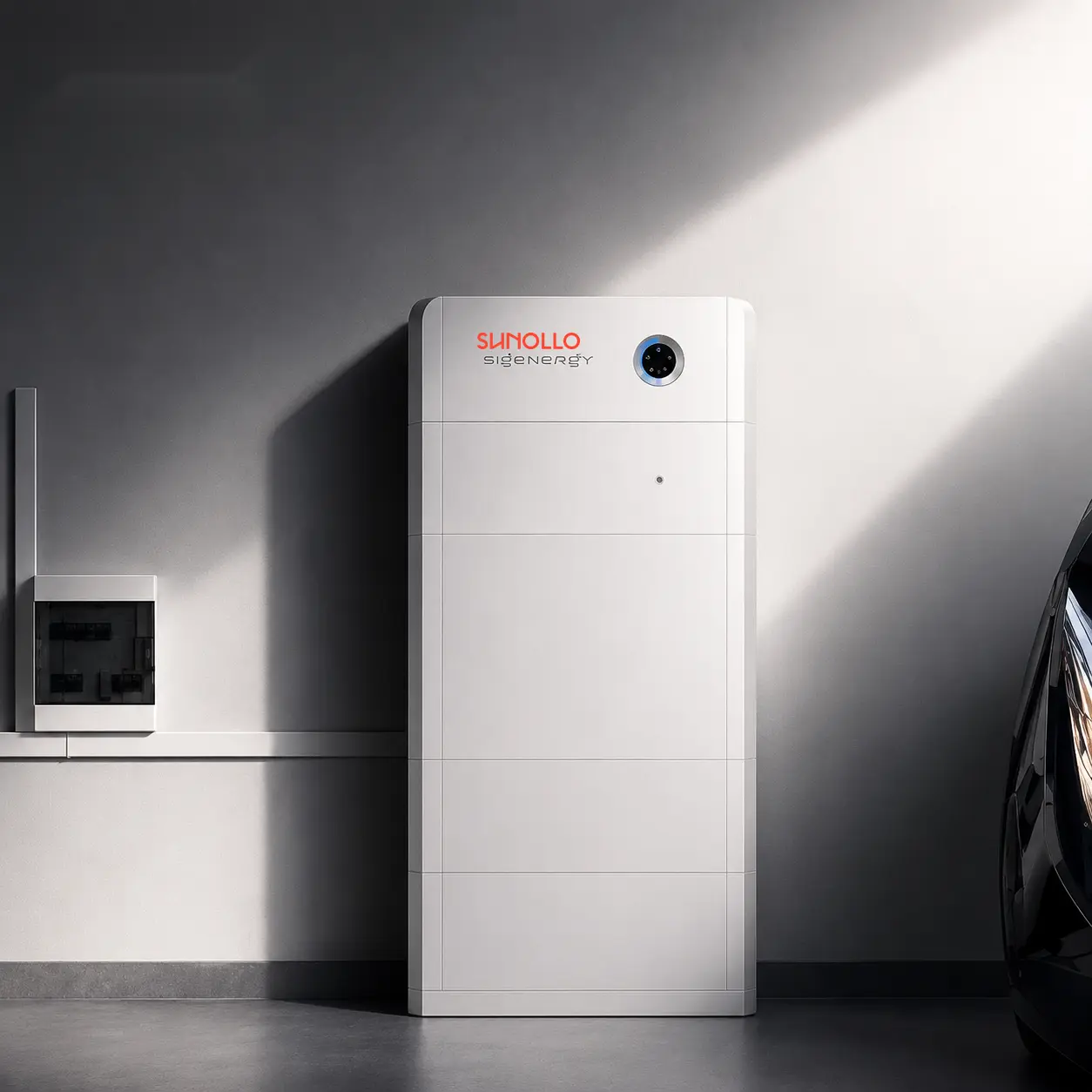
In 2026, Sunollo signed a strategic partnership with Sigenergy at SNEC 2026, bringing its integrated SigenStor platform — combining solar, battery storage, and EV charging in one modular unit — to Singapore homes. It reinforces Sunollo’s future-ready standard: every inverter is battery-ready, so you can add storage or EV charging later without replacing core equipment. Read more about the Sunollo–Sigenergy partnership.
Sunollo does not offer a micro-inverter system for Singapore residential installations. This reflects a deliberate assessment: Singapore's high ambient rooftop temperatures, the significant cost of MOM/BCA-compliant rooftop service access, and the availability of optimiser-based systems that deliver equivalent shade performance with ground-level central inverter serviceability all make micro-inverters a poor fit for Singapore's specific conditions in 2026.
This may evolve as AC module technology matures and servicing ecosystems develop. But for Singapore today, the optimiser architecture delivers the best combination of performance, monitoring, safety, and realistic 25-year total cost.
Frequently Asked Questions
Q: Are micro-inverters more reliable than string inverters?
In theory, yes — because failure of any single micro-inverter takes only one panel offline, not the whole system. In practice, micro-inverters are more numerous (20 units vs 1), operate at higher temperatures (rooftop vs ventilated wall mounting), and each failure requires roof access. The operational reliability question is more nuanced than the "no single point of failure" claim suggests.
Q: Do power optimisers eliminate the single point of failure risk?
Partially. The central string inverter remains a single point of failure for the whole system. But optimisers add panel-level visibility — when an issue occurs, you know immediately and can identify the precise source. Many optimiser faults are also self-isolating: a failing optimiser causes that panel to operate in bypass mode (reducing that panel's output, not the whole system), rather than taking everything offline.
Q: Micro-inverters come with a 25-year warranty. Doesn't that solve the replacement cost problem?
Warranties cover the part, not the labour or access. A 25-year micro-inverter warranty means a failed unit is replaced at no parts cost — but the rooftop service visit to install the replacement is not covered. In Singapore, that visit costs S$300–800+ every time, regardless of warranty. Over 25 years, the access cost can substantially exceed the parts cost that the warranty covers.
Q: Can I mix technologies — optimisers on some panels, standard string on others?
This is not standard practice. Different inverter architectures create monitoring and system management complexity. The recommended approach is one architecture throughout the system. Optimiser-based systems handle mixed shading profiles within a single array — you do not need to mix architectures to handle roofs where some sections are shaded and others are not.
Q: Will the industry eventually move to all micro-inverters?
Possible in some markets, particularly where rapid shutdown regulations are enforced and labour costs are lower. Globally, the more likely trajectory is optimiser architecture becoming standard across most markets (as it already is in much of Asia and Europe), with micro-inverters remaining dominant in the US and growing in Australia and parts of Europe. AC module technology may eventually reshape the economics — but that is a 5–10 year horizon.
Q: Which inverter type is best for solar plus battery storage?
Hybrid inverters are the cleanest solution — they manage both solar input and battery charging/discharging in a single unit, with a single monitoring interface. Every Sunollo inverter, including the Smart Inverter in Abundance and the EnergyHub Inverter in Abundance Pro, is battery-ready as standard; Abundance Pro's EnergyHub Inverter additionally offers EV charging integration. Micro-inverter systems can integrate with batteries via AC coupling (e.g., Tesla Powerwall), but the architecture is more complex and typically costs more.
Q: My roof has panels on two different faces — north and south. Do I need micro-inverters?
No — power optimisers handle this effectively and cost-efficiently. Each optimiser ensures its panel operates at peak regardless of what adjacent panels are doing. A north-facing panel producing 60% of peak does not drag down a south-facing panel producing 100%. See our multi-angle roof analysis for the detailed technical and economic case.
Q: What about performance degradation over 25 years?
All inverter electronics degrade. String inverters are well-understood: expect mid-life replacement around years 12–15. Optimiser modules are rated for 25 years. Micro-inverters are rated for 25 years, but thermal cycling in Singapore's rooftop environment may reduce actual lifespan. The key point regardless of technology: the cost of any failure is substantially shaped by whether it requires rooftop access or is accessible at ground level.
Q: How do I know which system Sunollo would recommend for my specific roof?
Sunollo's assessment process maps your roof's orientation, tilt angles, shading sources, and electrical setup before recommending a system tier. The starting point is a free home assessment — typically a 30-minute conversation and a roof analysis. The recommendation follows from your roof's characteristics, not a one-size approach.
The Bottom Line
The inverter technology decision is not one-size-fits-all. It depends on your roof, your market's regulatory environment, your realistic assessment of 25-year total cost, and who will be servicing your system when something eventually needs attention.
For most Singapore homeowners in 2026:
- Clean, unshaded roof? A string inverter (Sunollo Radiance) delivers maximum value at minimum cost. Do not pay for panel-level electronics you do not need.
- Complex roof with shade or multiple orientations? Power optimisers (Abundance) deliver the shade resilience and monitoring you need, with ground-level serviceability and a locally supported ecosystem.
- Want EV charging integration or maximum future flexibility? Every Sunollo tier ships with a battery-ready inverter as standard — the hybrid inverter with optimisers in Abundance Pro adds EV charging integration for the most future-proof architecture available today.
Micro-inverters are excellent technology — genuinely the right choice in specific scenarios and specific markets. For Singapore's rooftop environment in 2026, the combination of tropical heat, MOM/BCA-regulated rooftop service costs, and the maturity of optimiser alternatives makes them the exception, not the rule.
The world is moving toward panel-level intelligence. The question for Singapore homeowners today is not whether to get that intelligence — it is which architecture delivers it most cost-effectively for your specific situation.
If you would like a personalised assessment for your roof, contact Sunollo for a free consultation. Our team will recommend the right system architecture based on your specific roof geometry, shading profile, and energy goals.