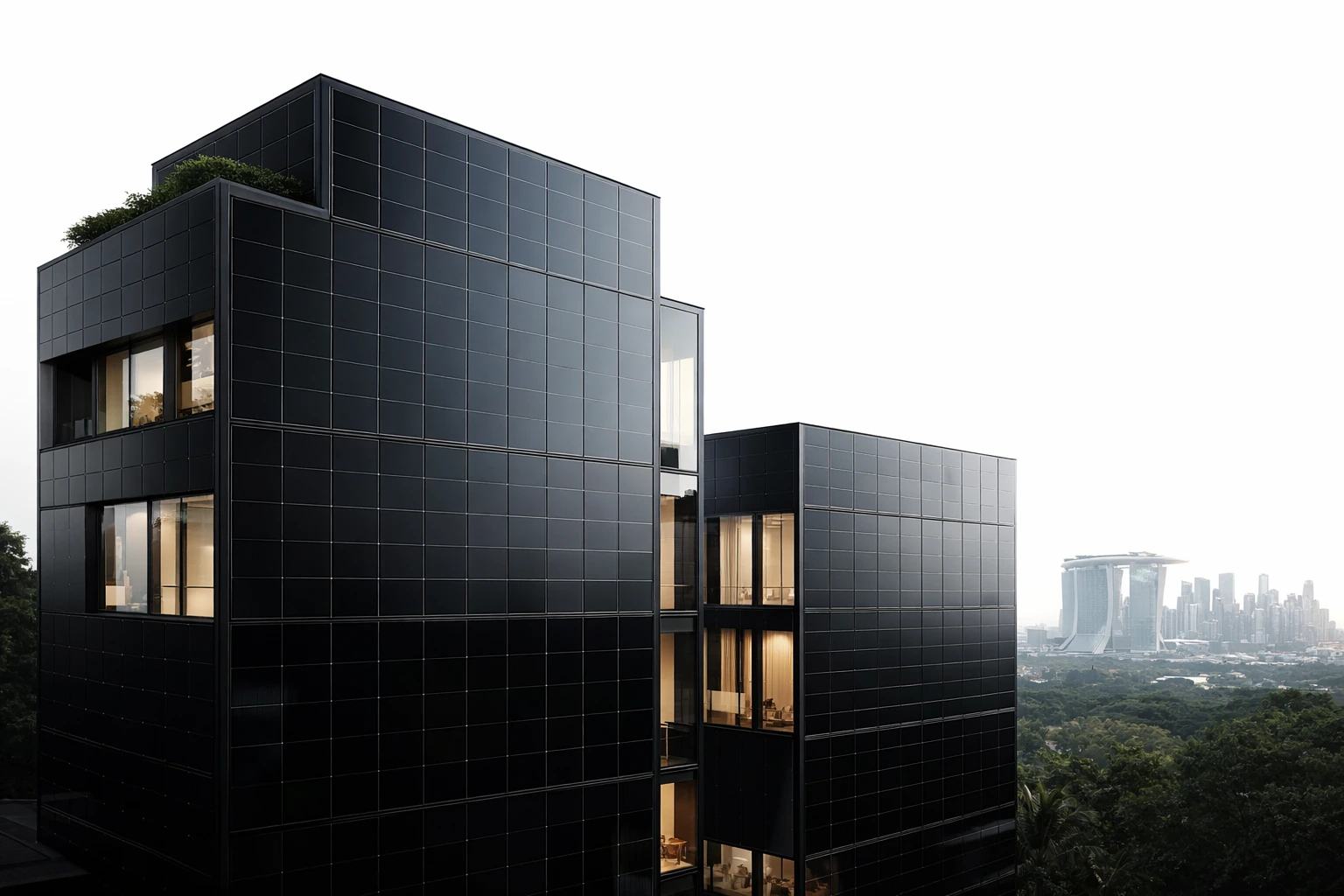
The bottom line: A Singapore semi-detached home typically fits 20–36 solar panels (7–11 kWp) and saves S$405–S$729 per month — one of the strongest residential solar economics in the country. Installation costs S$10,000–S$21,600, or S$0 upfront from S$99/month. Dual-roof installations (front and rear slopes) maximise output and deliver payback in 3–5 years.
If you own a semi-detached home in Singapore, you are sitting on one of the most solar-productive residential roof types in the country. Semi-Ds combine meaningful roof area with ideal structural characteristics for solar — and the financial case has never been stronger than it is right now in 2026.
This guide is built specifically for semi-detached homeowners. Not a generic solar overview — but the exact numbers, system designs, costs, savings, and electricity plan strategies that apply to your property type. Everything you need to make a fully informed decision.
Why Semi-Detached Homes Are the Solar Sweet Spot in Singapore
Singapore has approximately 70,000 landed homes with viable roof space for solar, and semi-detached properties represent the single largest and most financially compelling segment. Here is why:
- Roof area: A typical Singapore semi-D offers 150 to 250 sqm of usable roof area on your own section — enough for 15 to 25 high-efficiency panels, translating to a 7 to 12 kWp system that generates 800 to 1,500 kWh per month.
- Electricity consumption profile: Most semi-D families consume S$350 to S$700 per month in electricity — high enough for solar to make a dramatic financial impact, but not so high that the system needs to be oversized.
- Structural suitability: Semi-D roofs are typically concrete or reinforced structures that easily support solar panel loads without additional reinforcement.
- Regulatory simplicity: As a landed property owner, you have full authority over your roof. No MCST approval, no shared ownership complications, no strata limitations.
- ROI profile: Payback periods on well-designed semi-D solar systems are typically 5 to 8 years from electricity savings alone — and as low as 3 to 5 years when EV charging savings are included.
Read our Complete Solar Guide Singapore 2026 for the full national landscape — then return here for the semi-D specific details.
How Much Does Solar Cost for a Semi-Detached Home in Singapore?
System Sizing for Semi-Detached Homes
- Small system (economy): 8 to 12 panels / 4 to 6 kWp — generates approximately 500 to 750 kWh per month.
- Standard system (most common): 15 to 20 panels / 7 to 10 kWp — generates approximately 900 to 1,250 kWh per month. Covers 60 to 80% of a typical semi-D electricity bill.
- Full system (maximum return): 20 to 25 panels / 10 to 12 kWp — generates approximately 1,250 to 1,500 kWh per month.
2026 Pricing for Semi-Detached Solar Systems
- 4 to 6 kWp system: S$8,000 to S$14,000
- 7 to 10 kWp system: S$14,000 to S$22,000
- 10 to 12 kWp system: S$20,000 to S$28,000
- With 10 kWh LFP battery added: Add approximately S$8,000 to S$12,000
- With smart EV charger added: Add approximately S$1,500 to S$3,000
These are indicative ranges for premium-tier components (AIKO ABC panels, Sungrow inverters, SS 638 compliant DC cabling). Budget-tier systems using commodity panels may be 15 to 25% cheaper — but at meaningful sacrifices to efficiency, warranty, and long-term reliability that we address in our Best Solar Panels Singapore 2026 guide.
A semi-detached home spending S$500 per month on electricity can reduce that bill by 70 to 95% with the right solar system and electricity plan combination.
Real Savings: What a Semi-D Solar System Actually Delivers Each Month
Profile: 4-bedroom semi-detached home, family of 4 to 5, 2 to 3 aircon units, current monthly electricity bill of S$500 (approximately 1,700 kWh/month at 29.11 cents/kWh including GST).
System: 20 AIKO ABC panels (10 kWp), Sungrow Radiance 10 kW inverter, 10 kWh Sungrow LFP battery, SunMax optimisers on every panel.
Monthly solar generation: Approximately 1,250 kWh.
Scenario A: Solar Only (No Battery) on SP Group Regulated Tariff
- Self-consumption rate: approximately 45 to 55%
- Solar self-consumption saving: 625 kWh × 29.11 cents = S$181.94 per month
- Export to grid under SCT: 625 kWh × ~20.16 cents = S$126.00 per month
- Total monthly solar benefit: S$307.94
- Annual saving: S$3,695
Scenario B: Solar Plus 10 kWh Battery on PacificLight Peak/Off-Peak Plan
- Self-consumption rate: approximately 85 to 92%
- Solar self-consumption saving: 1,090 kWh × 37.50 cents = S$408.75 per month
- Export to grid under SCT: 160 kWh × ~20.16 cents = S$32.26 per month
- Remaining grid import at off-peak rate: 610 kWh × 16.08 cents = S$98.09 per month
- Daily fixed charge: S$1.01 × 30 = S$30.30 per month
- Total monthly electricity cost: S$128.39 (down from S$500)
- Monthly saving: S$371.61
- Annual saving: S$4,459
Scenario C: Solar Plus Battery Plus EV on PacificLight Peak/Off-Peak
- EV charging at 16.08 cents/kWh overnight: approximately 250 kWh × 16.08 cents = S$40.20 per month
- vs. public charging or petrol: S$200 to S$500/month
- Additional EV saving: S$160 to S$460 per month
- Total annual solar plus battery plus EV saving: S$6,379 to S$9,979
These are not projections — they are the financial mechanics of a correctly designed system on the right electricity plan. Read our detailed Singapore OEM Electricity Plan Guide to understand exactly which plan maximises your semi-D solar return.
The Ideal Solar System Design for a Semi-Detached Home
AIKO ABC Solar Panels — The Technology Advantage
We specify AIKO All Back Contact (ABC) N-type panels for every semi-D installation:
- Efficiency: Up to 24.2% module efficiency — the highest of any mass-produced residential panel.
- N-type cell technology: Superior temperature coefficient versus older P-type panels. In Singapore's 28 to 35 degree Celsius ambient conditions, N-type panels lose approximately 25% less output than P-type panels.
- All Back Contact design: All electrical connections are on the rear of the cell, eliminating front-side busbars that block sunlight. This increases active cell area and delivers a uniform aesthetic.
- 25-year product warranty and 30-year performance warranty
Learn more about the technology in our dedicated AIKO ABC panel technology guide.
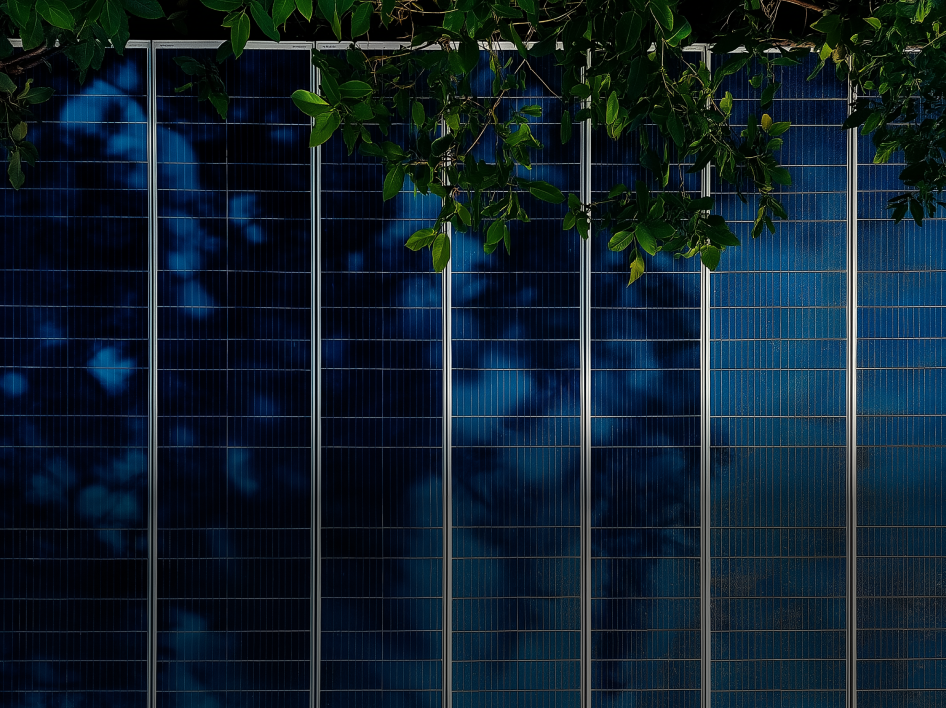
AIKO ABC panels feature All Back Contact cell architecture — all electrical connections on the rear, delivering the highest efficiency and cleanest aesthetic of any residential solar panel available in Singapore.
SunMax Panel-Level Optimisers
- Eliminates mismatch losses: If one panel is partially shaded, only that panel's output is affected — not the entire string. This can recover 5 to 15% of annual generation.
- Panel-level monitoring via iSolarCloud
- Safety (Rapid Shutdown): Reduces rooftop DC voltage to safe levels within seconds if required.
Our SunMax Optimiser guide explains why this matters specifically for homes with multiple roof angles.
Sungrow Radiance Hybrid Inverter
- Hybrid capability: Manages solar, battery, grid, and EV charger in a single unit.
- Smart scheduling: Configurable to your OEM electricity plan rate structure.
- 10-year manufacturer warranty
Read our detailed inverter explanation in the Your Sunollo Solar System Explained article.

The Sungrow Radiance hybrid inverter manages solar generation, battery storage, grid interaction, and EV charging from a single wall-mounted unit — specifically sized at 10 kW for the typical semi-D energy profile.
Sungrow LFP Battery Storage
- Why 10 kWh for a semi-D: Covers the critical 6:30pm to 9pm evening gap on peak/off-peak electricity plans.
- LFP chemistry advantage in Singapore: 6,000+ cycles to 80% capacity — approximately 16 years of daily cycling.
- Self-consumption uplift: From approximately 45 to 55% up to 85 to 92%.
Our Home Battery Guide Singapore covers the full battery planning methodology, and our Battery Storage Complete Guide compares all the leading brands and chemistries.
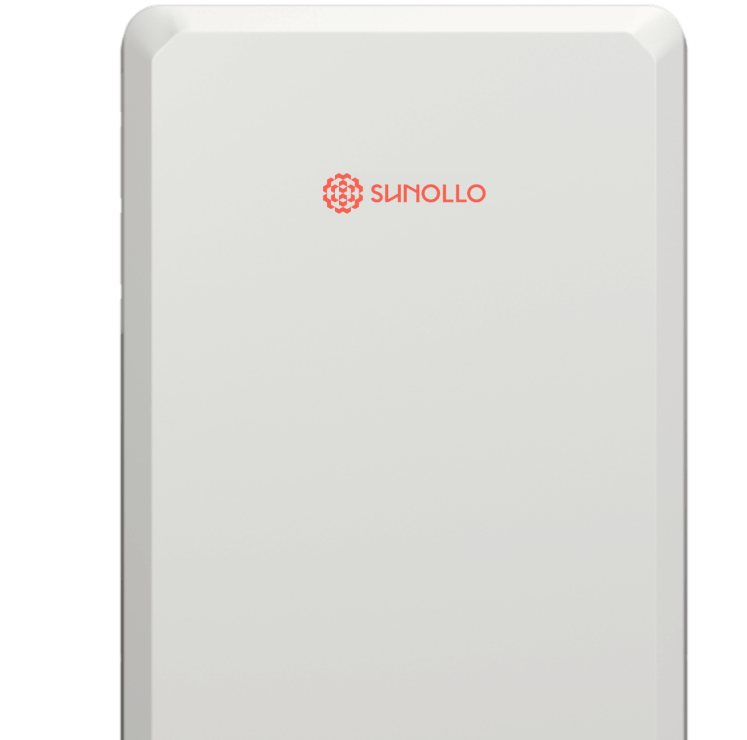
The Sungrow LFP battery is purpose-built for tropical residential environments — 6,000+ cycles, stable performance at Singapore temperatures, and sized at 10 kWh for the typical semi-D evening consumption gap.
SS 638 Compliant DC and AC Cabling
All Sunollo semi-D installations use SS 638 certified DC cabling — the Singapore Standard for solar PV system wiring. Our system explanation guide details the cabling specifications.
Smart EV Charger Integration
- Automatically schedules EV charging to off-peak hours on time-of-use plans — 16.08 cents/kWh
- Typical EV home charging saves S$160 to S$460 per month versus public charging or petrol — see our Solar EV Charging Guide

The Sunollo smart EV charger integrates with your solar system and electricity plan to charge your vehicle at the cheapest possible rate.
Which Electricity Plan Maximises Your Semi-D Solar Return?
- PacificLight "Save While Sleeping" (24-month): 34.88 cents/kWh peak / 16.90 cents off-peak. Best for solar + battery + EV homes. SCT arbitrage gap: 14.72 cents/kWh.
- PacificLight "9 To 9" (no contract): 37.50 cents/kWh peak / 16.08 cents off-peak. Highest per-kWh solar value. No commitment.
- Senoko LifeSteady (DOT): Inflation-linked discount off SP tariff. Best for work-from-home households.
- Geneco Get It Fixed 12: 28.67 cents/kWh fixed for 12 months. Solid interim option.
Our comprehensive OEM plan guide analyses every retailer, plan, and switching strategy in detail.
The Installation Process for a Semi-Detached Home
Step 1: Roof and Energy Assessment (Week 1)
A Sunollo energy advisor visits your semi-D to assess roof orientation, pitch angle, usable area, shading, electrical infrastructure, and your 12-month consumption pattern.
Step 2: System Design and Proposal (Week 1 to 2)
You receive a complete proposal including 3D roof layout, expected monthly generation (P50 and P90 projections), financial model across multiple OEM plan scenarios, and full warranty details.
Step 3: Contract and Permits (Week 2 to 3)
Sunollo handles all regulatory submissions: SP Group Turn-On application, BCA structural assessment if required, electrical installation licence and safety certification.
Step 4: Installation (Week 3 to 5)
Physical installation on a semi-D typically takes 1 to 3 days. Minimal disruption. No interior construction.
Step 5: Commissioning and Grid Connection (Week 4 to 8)
SP Group inspects and approves the grid connection. Your bi-directional meter is installed. From this point, every kWh your roof produces is either powering your home or earning export credits under SCT.
For the full step-by-step process, see our Solar Panel Installation Guide Singapore 2026.
The Sunollo Care Package: 10 Years of Complete Maintenance Coverage
- Annual system health check and performance review
- Panel cleaning (recovers 3 to 8% of lost generation)
- Inverter monitoring, firmware updates, and fault diagnostics
- Battery health monitoring and cycle tracking
- Priority response for any system alerts or underperformance
- Full parts and labour warranty coverage
Read the Sunollo Savings Guarantee to understand how we stand behind the financial projections in your proposal.

The Sunollo Care Package covers your entire system for 10 years — annual health checks, panel cleaning, monitoring, and priority service.
Semi-D Roof Types and Mounting Considerations
Concrete Tile Roof
The most common semi-D roof type. Concrete tiles are removed at mounting points, replaced with flashing brackets that seal weathertight beneath the tile. Fully reversible installation with no penetration of the roof waterproof membrane.
Clay Tile Roof
Clay tile roofs require specialised mounting brackets that distribute load across the tile and batten structure. Each bracket point is sealed with UV-resistant flashing to maintain weather integrity.
Metal Roof
Metal roofs use clamp-based mounting systems that attach directly to the seam or ridge — no drilling through the metal sheet required. The simplest, fastest, and most reversible mounting method.
Common Questions From Semi-D Homeowners
Will solar panels damage my roof?
No. Properly installed solar systems actually protect the underlying roof area from UV degradation and rain impact. Sunollo provides a roof warranty for the mounting area.
What happens if I sell my semi-D?
Solar panels increase property value. The system transfers to the new owner with all remaining warranty coverage.
Is my semi-D roof big enough?
Almost certainly. A minimum of 8 panels (approximately 16 sqm) is sufficient. Most semi-Ds have 3 to 5 times that amount of usable roof area. Our free site assessment confirms exact panel count.
Do I need to upgrade my electrical supply?
Most semi-Ds with three-phase supply require no electrical upgrades. Single-phase homes with systems above 5 kWp may benefit from a three-phase upgrade. See our article on why single-phase solar systems trip.
What happens during a power outage?
Without a battery, the system shuts down during a grid outage for safety (anti-islanding). With a Sungrow hybrid inverter and LFP battery, the system provides backup power to essential circuits.
How does the subscription model work?
Sunollo offers a subscription option for homeowners who prefer not to pay upfront. Fixed monthly fee, guaranteed savings, no maintenance responsibility.
Why Semi-D Homeowners Are Moving Now
- Electricity prices are rising: The SP tariff is expected to increase from Q2 2026 due to the Middle East conflict and LNG supply disruption. Carbon tax is confirmed to rise to S$50-S$80/tonne by 2030. Read our latest OEM market analysis.
- Panel technology has peaked in value: AIKO ABC panels at 24.2% efficiency represent the current generation peak. Prices have stabilised.
- Government targets support adoption: Budget 2026 confirmed the 3 GWp solar target by 2030.
- EV adoption is accelerating: Installing solar now means your home charging infrastructure is ready.
- SCT export rates are likely at their peak: As more solar is installed across Singapore, export compensation rates may decrease. Installing now and maximising self-consumption with a battery captures today's favourable economics.
Your Next Step
Book a free roof and energy assessment for your semi-detached home. Sunollo will visit your property, analyse your roof, review your electricity bills, model your savings across multiple plan scenarios, and deliver a complete system design — with your exact numbers.
No obligation. No pressure. Just the engineering and financial clarity you need to make the right decision for your home, your family, and your future electricity costs.
Contact a Sunollo energy advisor today — your semi-D roof is generating zero value right now. Every month without solar is a month of savings you cannot recover.