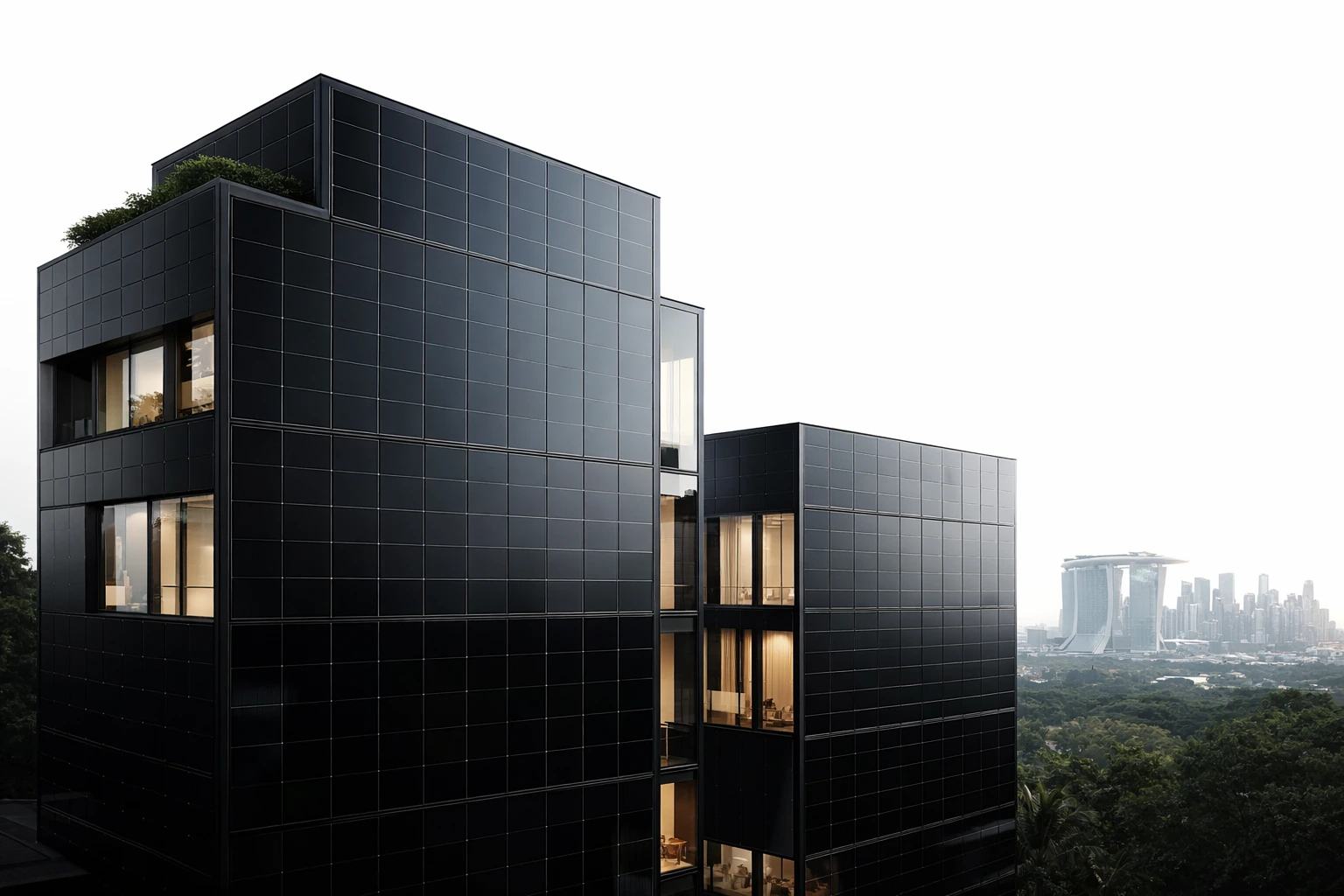
Why Are Landed Homes the Best Candidates for Solar in Singapore?
Singapore's landed properties — terrace houses, semi-detached homes, detached bungalows, and Good Class Bungalows (GCBs) — are uniquely positioned for solar energy. Unlike HDB flats and condominiums, landed homeowners own their rooftops, giving them full control over installation decisions without needing MCST approval or sharing roof space with other residents.
Key advantages of solar for landed homes:
- Dedicated roof space: Unshared rooftops mean maximum panel capacity and no competing demands.
- Higher electricity consumption: Landed homes typically consume 800–3,000+ kWh/month — the higher the consumption, the more solar saves.
- Property value uplift: Solar installations increase resale appeal and demonstrate sustainability commitment.
- Full NER eligibility: All landed homes qualify for the Net Energy Rebate, earning credits for exported solar electricity.
- Battery and EV readiness: Landed homes have space for battery storage and EV chargers, enabling a complete energy independence setup.
How Much Solar Can Each Landed Home Type Accommodate?
System size depends on available roof area, orientation, tilt angle, and shading. Here are typical ranges:
| Property Type | Typical Roof Area | System Size | Annual Generation | Panels Required |
|---|---|---|---|---|
| Terrace (inter) | 40–70 m² | 6–10 kWp | 7,200–12,000 kWh | 12–22 |
| Terrace (corner) | 50–90 m² | 8–14 kWp | 9,600–16,800 kWh | 16–30 |
| Semi-detached | 70–120 m² | 10–18 kWp | 12,000–21,600 kWh | 22–40 |
| Detached / Bungalow | 100–200 m² | 15–30 kWp | 18,000–36,000 kWh | 32–65 |
| Good Class Bungalow | 150–400+ m² | 25–60+ kWp | 30,000–72,000+ kWh | 55–130+ |
Not all roof area is usable — obstacles like water tanks, skylights, and ventilation units reduce effective space. Sunollo's site assessment uses satellite imagery and on-site measurement to determine your exact capacity. Request a free assessment.
How Much Does Solar Cost for a Landed Home in Singapore?
Solar costs vary by system size, panel technology, inverter choice, and installation complexity (including scaffolding requirements for multi-storey landed homes).
| Property Type | System Size | Outright Purchase | Sunollo Subscription | Estimated Annual Saving |
|---|---|---|---|---|
| Terrace | 6–10 kWp | $14,500–$22,000 | $0 upfront, from $99/mo | $1,800–$3,200 |
| Semi-detached | 10–16 kWp | $18,000–$28,000 | $0 upfront, from $99/mo | $3,000–$5,000 |
| Detached | 15–30 kWp | $24,000–$48,000 | $0 upfront, from $129/mo | $4,500–$9,000+ |
| GCB | 25–60+ kWp | $38,000–$90,000+ | Custom pricing | $7,500–$15,000+ |
With Sunollo's $0 upfront subscription model, homeowners pay no capital cost and are typically cash-flow positive from month one — the monthly saving exceeds the subscription fee. See our complete pricing guide for detailed breakdowns.
What Is the Installation Process for Landed Homes?
The end-to-end process for a landed home solar installation typically takes 8–12 weeks from signing to go-live:
- Site assessment and design (Week 1–2): Roof measurement, shading analysis, system sizing, and detailed proposal.
- Regulatory approvals (Week 2–4): EMA turnkey application, BCA submission (if required), SP Group meter upgrade request.
- Scaffolding and installation (Week 4–8): Scaffolding erection (for multi-storey homes), panel and inverter installation. Typically 1–3 days of active installation work.
- Electrical connection and testing (Week 8–10): Wiring, inverter commissioning, safety testing, and inspection.
- SP Group meter change (Week 10–12): Bi-directional meter installation by SP Group. After this, NER is activated.
- System handover: Monitoring app setup, warranty documentation, and system walkthrough.
For detailed guidance on scaffolding requirements and costs, see our scaffolding guide for residential solar.
How Do Savings Differ Between Terrace, Semi-D, and Detached Homes?
The key differences come down to roof space (which determines system size) and consumption level (which determines how much solar you can self-consume at the higher retail rate).
| Metric | Terrace | Semi-Detached | Detached / Bungalow |
|---|---|---|---|
| Avg monthly consumption | 800–1,200 kWh | 1,000–1,800 kWh | 1,500–3,000+ kWh |
| Typical system size | 6–10 kWp | 10–16 kWp | 15–30 kWp |
| Self-consumption ratio | 55–70% | 60–75% | 65–80% |
| Bill reduction | 50–70% | 65–80% | 70–85%+ |
| Annual saving | $1,800–$3,200 | $3,000–$5,000 | $4,500–$9,000+ |
| Payback (outright) | 5–7 years | 4–6 years | 4–6 years |
Larger homes save more in absolute terms because they have both more roof space and higher consumption. However, even terrace homes achieve strong returns. For specific property-type guides, see:
What Solar Packages Does Sunollo Offer for Landed Homes?
Sunollo offers three residential solar packages, all designed for landed homes and all available at $0 upfront:
| Feature | Radiance | Abundance | Abundance Pro |
|---|---|---|---|
| Panel technology | Eclipse Panels | Eclipse Panels | Eclipse Panels |
| Inverter | Standard inverter | Smart inverter | SolarEdge SunMax + EnergyHub |
| Monitoring | Basic | LiveTrack | LiveTrack + panel-level |
| Battery option | No | No | Yes (integrated) |
| EV charger option | No | No | Yes |
| Warranty | 25 years | 25 years | 25 years |
| Starting price (outright) | From $14,500 | From $15,000 | From $16,000 |
| Subscription | From $99/mo | From $99/mo | From $129/mo |
Compare all packages in detail or explore Abundance Pro for the most comprehensive solution with battery and EV options.
What Regulatory Approvals Are Needed for Landed Home Solar?
Solar installations on landed homes in Singapore require several regulatory steps, all of which Sunollo handles on your behalf:
- EMA (Energy Market Authority): Turnkey application for systems under 1 MWac. Covers grid connection and safety requirements.
- BCA (Building and Construction Authority): Required for structural assessment if the building is older or if the installation exceeds certain load thresholds.
- URA (Urban Redevelopment Authority): Generally not required for rooftop panels that do not exceed the building height. BIPV (building-integrated PV) may need planning approval.
- SP Group: Meter upgrade request for bi-directional metering (NER).
- MOM (Ministry of Manpower): Work-at-height safety requirements apply to the installation crew. The installer must comply with WSH Act requirements including scaffolding for multi-storey buildings.
Sunollo manages the entire regulatory process end-to-end. The homeowner's involvement is typically limited to signing the application forms and granting site access.
Frequently Asked Questions
Can I install solar on a conservation or heritage landed home?
Yes, but you may need URA approval if the property is in a conservation area. Panels must not be visible from the street in some zones. Sunollo can advise on compliant installation designs and BIPV options (building-integrated PV) that blend with heritage aesthetics.
What happens if my roof needs repairs or replacement after solar is installed?
The solar panels can be temporarily removed and reinstalled during roof works. This is standard practice. Discuss with your installer beforehand to understand the reinstallation cost and timeline. With Sunollo's subscription, reinstallation after roof works is covered.
How does shading from neighbouring buildings affect my solar output?
Sunollo uses shade analysis during the site assessment to identify and avoid shaded areas. SunMax optimisers (on Abundance Pro) minimise shading losses by optimising each panel individually. Even partially shaded roofs can achieve strong returns by concentrating panels on unshaded sections.
Do I need planning permission to install solar panels on my landed home?
For standard rooftop-mounted panels that do not protrude above the building height, no URA planning permission is needed. The EMA turnkey application and any BCA requirements are handled by Sunollo as part of the installation process.
Can I add a battery to my solar system later?
Yes. If you start with a Radiance or Abundance package, you can retrofit a battery later. However, starting with Abundance Pro is more cost-effective because the SolarEdge EnergyHub inverter is battery-ready from day one, avoiding the need for inverter replacement or additional hardware.
What is the best roof orientation for solar in Singapore?
Singapore is near the equator (1.3°N), so all orientations produce well. North and south-facing roofs are slightly optimal. East-west orientations produce approximately 10-15% less but spread generation more evenly across the day, which can improve self-consumption. Flat roofs offer flexibility to mount panels at optimal tilt angles.
How long does the installation take for a landed home?
Active installation (panel mounting, wiring, inverter) typically takes 1-3 days depending on system size. The overall timeline from signing to go-live is 8-12 weeks, primarily due to regulatory approvals and SP Group meter scheduling, not the physical installation work.
Will solar panels damage my roof tiles?
No. Sunollo uses non-penetrative mounting methods where possible (e.g., clamp systems for metal roofs). For tile roofs, specialised tile hooks are used with waterproof flashing. The panels actually protect covered roof tiles from UV degradation and weathering, potentially extending the roof's lifespan in those areas.