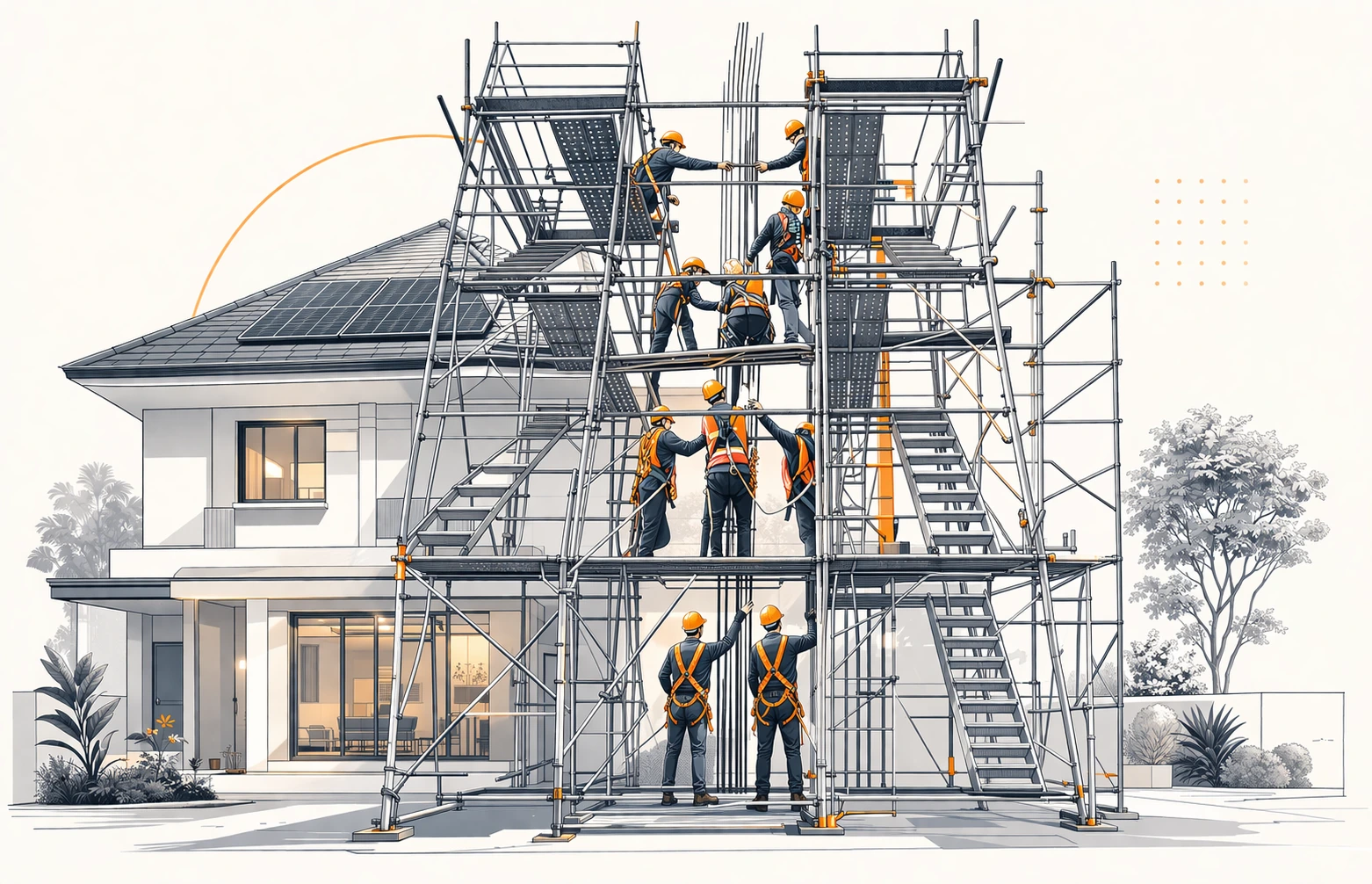
Why Scaffolding Suddenly Appears on Your Solar QuoteFor landed homeowners in Singapore: how MOM workplace-safety rules and professional access planning shape your solar installation — and how to read your quote with confidence.You expected panels, an inverter, and a neat diagram of your roof. Then the proposal mentions scaffolding, a four-figure line item, and words like “Approved Scaffold Contractor” or “work at height.” For many landed homeowners in Singapore, this is the first time solar feels like a construction site — because, in safety-law terms, it is one.
This Sunollo guide explains, in plain language, how scaffolding fits into residential solar in Singapore: who decides whether you need it, what the law expects, what documents you might see, what scaffolding can cost, and how to avoid the risks that matter most — falls, programme delays, neighbour disputes, and non-compliance.
Important framing: Scaffolding for safe roof access is primarily governed by the Ministry of Manpower (MOM) under the Workplace Safety and Health Act 2006 and subsidiary regulations such as the Workplace Safety and Health (Scaffolds) Regulations 2011 and the Workplace Safety and Health (Work at Heights) Regulations 2013. The Building and Construction Authority (BCA) oversees building control, standards, and broader construction safety culture — for example through BCA safety and standards — but your installer’s scaffold decisions on site are typically driven by WSH / MOM requirements and professional risk management, not a single “BCA scaffolding permit for solar panels.”
Do You Always Need Scaffolding for Solar in Singapore?
No. Many installations proceed with internal access — for example, an existing roof hatch, a safe internal staircase to roof level, or a balcony or terrace that allows ladder or mobile tower placement without erecting full perimeter scaffolding around the house. If your roof edge can be reached and worked from in a way that satisfies your installer’s safety assessment and WSH obligations, you may have no scaffolding at all.
Whether scaffolding is proposed depends on factors such as:
At Sunollo, we do not take a one-size-fits-all position: if your home allows compliant access without scaffolding, that path can be appropriate. What matters is that the appointed contractor documents a safe system of work. On Sunollo landed projects, that decision is led by Health, Safety and Environment (HSE) after a pre-installation site visit — not from a generic desk assumption. If an external scaffold is the only practicable way to comply with work-at-height duties, a reputable team will insist on it — this is a feature, not an upsell.
How Sunollo Scopes Scaffolding: Construction Visit, HSE Sign-Off, Separate Quote
For landed homes, Sunollo Construction treats access as a field problem, not a line item guessed at proposal stage. During the pre-installation site visit, the team walks roof lines, setbacks, footing, neighbour interfaces, and realistic panel-handling paths. Where work at height is in scope, an HSE specialist is the right person to decide the compliant system of work — including whether scaffolding is required, what configuration is adequate under MOM’s WSH framework, and how long it needs to stay up for the programme.
Scaffolding is quoted separately once that visit is complete. That split is deliberate: it prevents homeowners from paying for a bundled “scaffold allowance” that may assume a worst-case facade when the site actually supports a narrower, shorter-duration solution (or, in some cases, compliant access with towers or internal routes where appropriate).
Pass-through to the scaffold supplier: no Sunollo margin on scaffolding
When external scaffolding is required, the HSE-led construction team engages the professional scaffold subcontractor (including an Approved Scaffold Contractor where MOM requires one). The homeowner receives a clear quote tied to that subcontractor’s pricing — erection, rental duration, adaptations, and dismantle as applicable. Sunollo does not add a margin or uplift on the scaffolding line; the amount reflects what the scaffold crew and programme actually need, not a hidden markup inside a single package price.
That structure targets the three usual drivers of overpayment on solar scaffolding — without cutting corners on safety:
Decision pointWhat Sunollo’s approach doesWhy it supports fair pricingWhen scaffolding is pricedAfter the pre-install visit, alongside HSE-reviewed access notesCost tracks what was seen on site, not early assumptions that often change on walk-throughWho approves the methodHSE / WSH leadership, with Construction executionSign-off follows regulation and documented risk, not sales optimism or a flat allowanceWhat the quote showsSeparate line: scope, rental days, variations if the programme shiftsExtensions after weather or inspection delays stay visible and negotiable with the supplier — not buriedEconomics of the scaffold linePass-through from the scaffold subcontractor;
no Sunollo margin
on scaffoldingHomeowners pay scaffold-market rates for the agreed scope, without an extra EPC uplift on that component
Compared to the illustrative cost bands in the next section (~S$2,000–S$3,500 for smaller scopes through ~S$7,000–S$10,000+ for large programmes), most of the spread is driven by footprint, height, and rental days. A visit-led, HSE-signed scope tends to land in the appropriate band for that specific house — avoiding paying the top of the range when a smaller compliant configuration suffices, while still upgrading when the site truly demands it.
Non-negotiable: “Economical” here means right-sized procurement and transparent pass-through, never withholding guardrails, inspection, or ASC engagement where the law and risk assessment require them.
Approved Scaffold Contractors: What MOM Says
For most homeowners the critical sentence comes from MOM’s own guidance: you should use an Approved Scaffold Contractor (ASC) to erect scaffolds in a workplace except for:
Source: MOM — Find an approved scaffold contractor (see also the Scaffold contractor service page and the list of approved scaffold contractors (PDF)).
That does not mean low scaffolds are a free-for-all. The WSH (Scaffolds) Regulations 2011 still apply where a scaffold is constructed, used, altered, or dismantled. Industry practice expects trained scaffold erectors, supervision, and safe systems of work even when an ASC is not mandatory for a specific excluded type.
BCA’s Role vs MOM’s Role (Quick Clarification)
TopicTypical lead agency / frameworkWhat homeowners should knowSafe erection and use of scaffolding; work at heightMOM — WSH Act and regulationsYour roof during installation is a workplace. Duties apply to employers, principals, and contractors on site.Building structural approvals for solar (e.g. BCA submissions where required)BCA building control process (via qualified persons)Separate from scaffold erection rules; your installer or engineer explains if a formal submission applies to your property.Construction safety culture, codes, and industry programmesBCA safety and standards resourcesUseful context; your direct scaffold compliance questions are still WSH-first.
If anyone tells you “BCA does not care about scaffolding for solar,” that can mislead: BCA and MOM both shape how the industry operates, but enforceable scaffold-specific duties sit squarely in the WSH framework administered by MOM.
Certificates, Handover, and Tags: What You Might Be Asked to Sign
Homeowners are not Professional Engineers, but you may still encounter paperwork. Common documents include:
Tip: If you are asked to sign something, read whether you are acknowledging site access, neighbour notifications, or obstructions — not “certifying” structural engineering. When in doubt, ask your installer to explain each signature line in one sentence.
What Scaffolding Costs (Indicative Singapore Ranges)
Scaffolding is priced like construction plant: setup, rental days, labour to adapt, and dismantle all matter. The figures below are indicative only; your quote depends on house width, lift height, pavement or grass footing, protection screens, and rental duration.
ScaleIllustrative total range (SGD)Typical driversSmall / short duration~S$2,000–S$3,500Limited facade coverage, lower lift, few rental days, straightforward footingMedium~S$3,500–S$5,500More bays, longer rental, moderate height, standard landed frontageLarge / complex~S$7,000–S$10,000+High lifts, large footprint, extended programme, tight access, additional screens or bridging
Always ask your solar contractor for a scoped line item: number of days included, who pays if rain delays extend rental, and whether dismantling is after inspection or after grid energisation.
Penalties, Liability, and What Actually Goes Wrong
Under the WSH Act, serious breaches can lead to substantial fines and, for individuals, imprisonment in severe cases. MOM publishes maximum penalties and composition rules here: WSH Act: liabilities and penalties. In practice, most homeowners will not be the entity prosecuted — but occupiers and principals can still face questions if they interfere with safety measures, pressure teams to skip controls, or obstruct access for lawful inspection.
Non-compliance is not only a regulatory risk. The outcomes that hurt families are predictable:
The financially rational move is to support a contractor who documents safety properly, even if scaffolding adds upfront cost.
Best Practices for Homeowners: A Confidence Checklist
How This Fits With Choosing an Installer
Scaffolding is a stress test for contractor maturity. The cheapest quote that assumes “we will figure it out on the day” is a red flag. Strong installers explain access before mobilisation, price it transparently, and treat WSH as non-negotiable. For a broader framework, read our guide to choosing the best solar company in Singapore and the solar panel installation guide. If you are still weighing promises versus reality across the whole purchase, our 15 solar myths pillar pulls the threads together.
Frequently Asked Questions
Can I refuse scaffolding to save money?
You can ask for alternatives, but you cannot insist on an unsafe method. If a contractor agrees to skip scaffolding solely because you demanded it, reconsider that contractor.
Does HDB solar use the same scaffolding rules?
WSH duties still apply wherever work is performed, but access paths, approvals, and roof types differ from landed homes. Follow your installer’s and HDB’s stated requirements for your block.
Who pays for scaffolding?
Usually the homeowner via the solar contract unless otherwise agreed. Ensure the quote states whether scaffolding is included, optional, or provisional pending site survey. With Sunollo, scaffolding is typically a separate line fixed after the pre-install visit, quoted at the scaffold subcontractor’s rates (pass-through), so it is obvious what you are funding.
Does Sunollo mark up scaffolding?
No. Scaffolding is scoped by HSE after the site visit and supplied by the professional scaffold team; Sunollo does not apply a margin on that component. The goal is a clear homeowner quote that aligns cost with compliance, not a hidden uplift.
How long will scaffolding stand on my property?
Typically from a few days to a few weeks, depending on installation complexity, weather, and inspection scheduling. Extended rentals increase cost — clarify extension rates up front.
What if my neighbour complains?
Share the programme dates, keep access clear, and ask your contractor for standard courtesy practices (noise windows, housekeeping). Disputes are easier when communication is early.
Are composition fines the same as court fines?
No. MOM may compound certain offences instead of prosecution, subject to caps explained on the liabilities and penalties page. Serious incidents can still proceed to court.
Key Official Links (Bookmark These)
Disclaimer: This article is for general education and does not constitute legal advice. Scaffold design, statutory thresholds, and site-specific risk assessments must be determined by qualified persons on your project.