The bottom line: Combining an OEM electricity plan with rooftop solar and a battery is the optimal energy strategy for Singapore landed homes in 2026 — saving 85–95% on electricity costs versus SP's regulated tariff alone. Solar generates free daytime electricity, the battery stores excess for evening use, and the OEM plan covers the residual cheaper than SP. A typical landed home saves S$3,000–S$8,000 per year by stacking all three.
Most Singapore homeowners pick their electricity plan the same way: find the cheapest rate per kWh, sign a 24-month contract, and forget about it. That approach works — until you add solar panels to your roof.
The moment you install a solar system, your electricity plan becomes one of the most financially significant decisions in your home. The right plan can add thousands of dollars annually to your solar return. The wrong plan can silently erode it. And the difference between the two is almost never discussed clearly.
This guide does exactly that. We have reviewed every active plan type and major retailer on Singapore Open Electricity Market (OEM), assessed each against the economics of rooftop solar and battery storage, calculated the real numbers, and ranked them by solar value — not just headline price.
Whether you are considering solar for the first time, already have panels installed, or are approaching a contract renewal, this is the guide that tells you exactly what to do — and why.
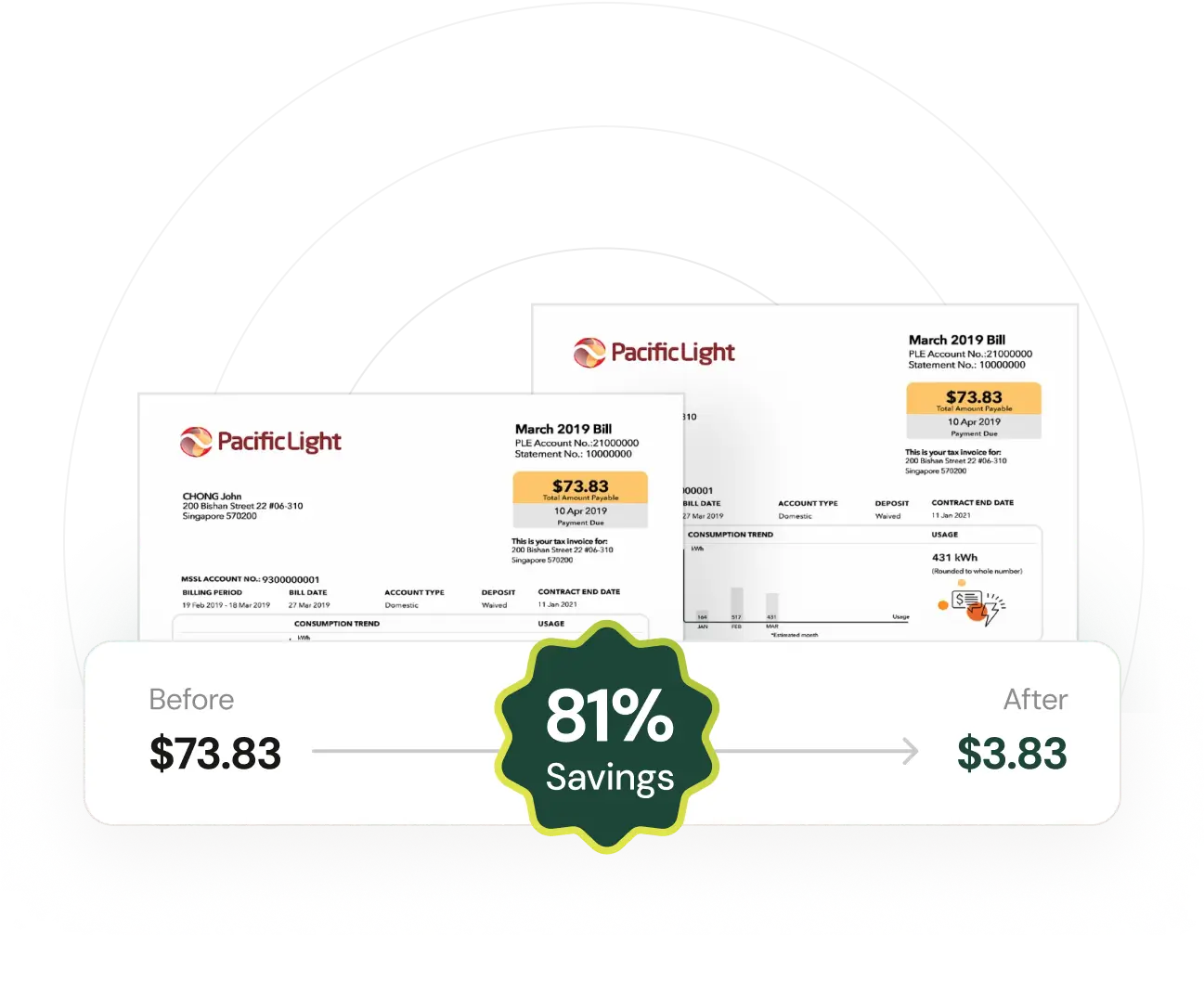
Singapore electricity tariff is reviewed quarterly and has trended upward since 2021. Choosing the right OEM plan before and after installing solar can make a measurable difference to your annual energy costs.
March 2026 Market Alert: Q2 Tariff Set to Rise — Solar Homeowners Are Already Protected
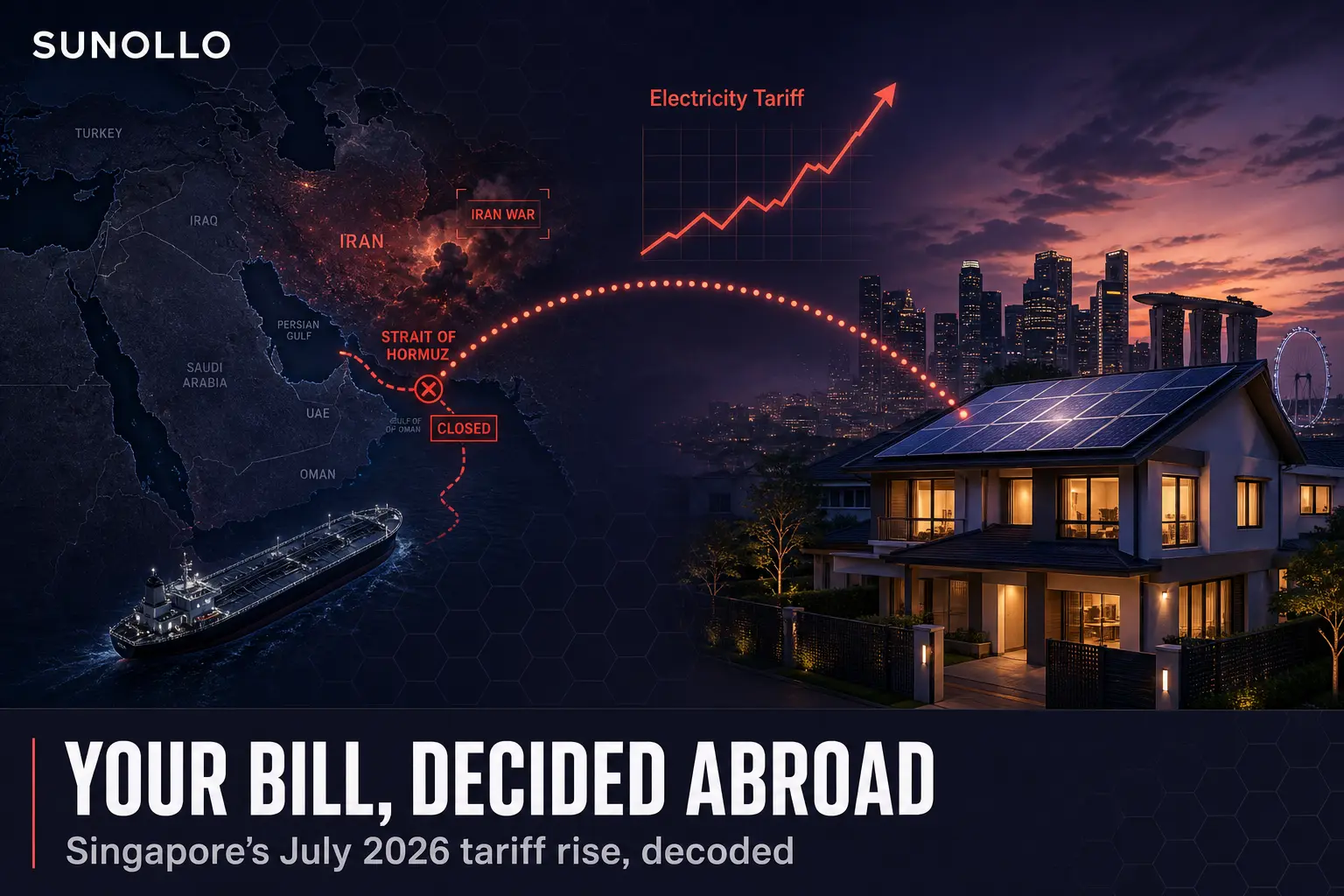
As this guide is published in late March 2026, Singapore's electricity market is experiencing significant upward price pressure driven by the Middle East conflict. Here is what every homeowner needs to know right now:
- The Uniform Singapore Energy Price (USEP) — the wholesale cost of electricity traded half-hourly — hit S$157.78 per MWh during the week of March 15 to 21, 2026. This is the highest level of the year and more than 7% above the previous week. USEP forecasts have been exceeding S$170 per MWh on most days since March 22.
- The cause is the Middle East conflict impacting LNG supply from Qatar — which Rystad Energy estimates accounts for approximately 42.5% of Singapore's LNG imports in 2025. Iran's attacks on Ras Laffan Industrial City have knocked out 17% of Qatar's LNG export capacity, with QatarEnergy declaring force majeure on some long-term supply contracts.
- Electricity retailers have already moved. Fixed-rate plan prices have increased by 1.2% to 11.3% since late February 2026. Several retailers have removed shorter-term plans and discounted offerings — Tuas Power has withdrawn its 6-month fixed plan and its 10% off-tariff plan entirely, citing market volatility.
- The regulated tariff is expected to rise from April 1, 2026. The Q1 rate of 26.71 cents/kWh (before GST) was already confirmed to increase from Q2. Analysts widely expect a meaningful increase — the first signal of what higher carbon tax rates and energy market volatility will mean for Singapore electricity bills throughout 2026 and beyond.
- For solar homeowners, this is exactly the environment your system was designed for. Every kWh your panels generate is a kWh you do not import at a rising price. As the tariff climbs, your solar savings climb with it — automatically, without any action on your part. The households without solar are absorbing 100% of the increase. Solar homeowners absorb zero.
This context matters enormously for the plan analysis below. Plans and rates discussed reflect both the current Q1 2026 figures and the evolving market landscape as of March 2026. Where retailers have revised pricing or removed plans, this guide notes it.
Singapore Open Electricity Market: A Quick Primer
The Open Electricity Market (OEM) is an initiative by Singapore Energy Market Authority (EMA) that allows all households to buy electricity from their preferred licensed retailer — instead of defaulting to SP Group regulated tariff.
Key facts every homeowner should understand:
- Your physical electricity supply does not change regardless of which retailer you choose. SP Group still owns and operates the national power grid and delivers electricity to your home.
- The regulated tariff is reviewed every quarter. Q1 2026 (January to March) stands at 26.71 cents per kWh before GST / 29.11 cents per kWh including 9% GST. Q2 2026 (April to June) is expected to increase due to rising global gas and LNG prices.
- 10 licensed OEM retailers currently compete for residential customers, each offering different plan structures and pricing.
- Switching is free — there are no fees to move from SP Group to a retailer. Early termination charges may apply if you exit a fixed-term contract mid-period.
- U-Save GST vouchers can be used with most OEM retailer plans — switching does not forfeit government rebates.
- Approximately 36% of Singapore households have switched to OEM retailer plans. The remaining 64% remain on SP Group regulated tariff — a significant portion likely leaving money on the table.
The Three Types of OEM Plans — and What Each Means for Solar Owners
There are three distinct plan structures in the OEM. Each interacts with solar economics in fundamentally different ways. Understanding this distinction is the single most important piece of knowledge a solar homeowner can have.
Plan Type 1: Fixed Rate Plans — Solid, Predictable, Rate-Sensitive for Solar
How it works: You pay a fixed cents-per-kWh rate for the duration of your contract — typically 6, 12, 24, or 36 months. Your rate does not move with quarterly SP tariff revisions.
Current pricing (March 2026, inclusive of 9% GST) — note some plans have already increased:
- 6-month contracts: Availability has reduced — Tuas Power has withdrawn its 6-month offering. Geneco 6-month remains at 24.88 cents/kWh where available
- 12-month contracts: from 27.67 cents/kWh (PacificLight Savvy Saver) to 28.67 cents/kWh (Geneco, Senoko, Keppel, Tuas Power, Sembcorp)
- 24-month contracts: from 25.74 cents/kWh (PacificLight Stack It Up) to 27.68 cents/kWh (Keppel Fixed24). Note: some 24-month rates have increased by up to 11.3% since February 2026.
- 36-month contracts: from 25.33 cents/kWh (Tuas PowerFIX 36) to 26.08 cents/kWh (PacificLight Savvy Saver)
The counterintuitive truth for solar homes:
Every kWh your solar panels generate during the day replaces electricity you would otherwise import from the grid at your contracted rate. This creates a result that surprises most homeowners: the cheapest electricity plan is not the best plan for a solar home. A higher contracted rate means higher value per solar kWh. Consider a home generating 1,000 kWh of solar monthly and self-consuming 80% (800 kWh):
- On a 25.33 cents/kWh plan: monthly solar saving = S$202.64
- On a 28.67 cents/kWh plan: monthly solar saving = S$229.36
- On SP Group regulated tariff at 29.11 cents/kWh: monthly solar saving = S$232.88
The 3.78 cents per kWh difference between the cheapest and most expensive fixed plan translates to S$363 per year in additional solar value — from the same panels, same roof, same system. Plan selection is a free upgrade worth hundreds of dollars annually.
Solar value rating: HIGH. Fixed rate plans provide predictable, bankable solar returns. Higher rate = higher solar value. 12-month plans at 28.67 cents currently offer better solar economics than 36-month plans at 25.33 cents.
Battery value rating: HIGH. A home battery pushes self-consumption from 40-50% (solar-only) to 85-92%. On a 28.67 cents plan, that shift represents approximately S$180 to S$250 per month in additional savings for a typical landed property.
The SP regulated tariff (29.11 cents/kWh as of Q1 2026, expected to rise in Q2) is currently higher than all OEM fixed-rate plans. For solar homes, this rate directly determines how much each panel is worth financially.
Plan Type 2: Discount Off Regulated Tariff (DOT) Plans — The Inflation Hedge for Solar Owners
How it works: You receive a guaranteed percentage or fixed-amount discount off SP Group quarterly regulated tariff. As the tariff changes each quarter, so does your rate — but you always pay less than SP. Example: Senoko Energy LifeSteady plan offers a fixed discount of 1.64 cents/kWh below the quarterly SP tariff. At the current SP rate of 29.11 cents/kWh, you pay 27.47 cents/kWh. If SP raises its tariff to 33 cents/kWh next quarter, you automatically pay 31.36 cents/kWh.
How solar interacts with DOT plans — the compounding advantage:
Here is the insight almost nobody discusses: with a DOT plan, your solar savings grow automatically as electricity prices rise. Every quarter that the SP tariff increases, your avoided cost per solar kWh increases by the same amount. You get an inflation-linked solar return — without renegotiating a thing.
Consider a landed home generating 1,200 kWh of solar per month (self-consumed) on Senoko LifeSteady:
- Today (29.11 cents minus 1.64 cents = 27.47 cents): Monthly solar saving = S$329.64
- If tariff rises to 33 cents/kWh in Q2/Q3 2026 (new rate 31.36 cents): Monthly solar saving = S$376.32
- If tariff reaches 38 cents/kWh by 2030 (new rate 36.36 cents): Monthly solar saving = S$436.32
The same solar system becomes progressively more valuable year-on-year — automatically, proportionally, without any additional investment. Given Singapore's confirmed carbon tax trajectory from S$25/tonne (2024) to S$45/tonne (2026) to S$50-S$80/tonne (2030), and the geopolitical energy volatility now clearly at play, this is not speculative. It is the structural trajectory of Singapore energy costs.
Solar value rating: VERY HIGH and growing. The most future-proof combination for solar owners who expect tariffs to continue rising — which Singapore structural energy economics and current geopolitical conditions strongly suggest they will.
Battery value rating: VERY HIGH. Because the rate you avoid rises every year, maximising self-consumption (which batteries do) becomes more financially compelling each quarter. A battery purchased today becomes more rewarding every year the tariff rises.
Plan Type 3: Peak and Off-Peak (Time-of-Use) Plans — The Solar Jackpot
How it works: You pay different rates depending on when you consume electricity. Peak hours (typically 9am to 9pm or 7am to 11pm) carry a premium rate. Off-peak hours (overnight) are significantly cheaper. This is time-of-use pricing — and it creates the most powerful financial alignment with solar power available anywhere in Singapore energy market today.
Current plan examples (March 2026):
- PacificLight "9 To 9" (no contract): 37.50 cents/kWh from 9am to 9pm / 16.08 cents/kWh from 9pm to 9am / plus S$1.01 per day fixed charge
- PacificLight "Save While Sleeping" (24-month lock-in): 34.88 cents/kWh from 7am to 11pm / 16.90 cents/kWh from 11pm to 7am
Why this is the solar jackpot:
Your solar panels generate electricity almost entirely during peak hours. In Singapore, meaningful solar production runs from approximately 8am to 6:30pm — almost exactly the high-rate window on a peak/off-peak plan. Every kWh your solar system generates during peak hours replaces electricity worth 37.50 cents — not 29.11 cents on SP tariff, and not 25.88 cents on a standard 24-month plan. Solar is worth 29 to 49% more per kWh on a peak/off-peak plan than on a standard fixed plan.
Your EV can be smart-scheduled to charge from 9pm at 16.08 cents rather than at the 29.11 cents SP tariff — saving S$130 to S$200 per vehicle per month from the rate differential alone.
The optimal peak/off-peak plus solar plus battery strategy:
- Solar powers your home during 9am to 9pm — eliminating 37.50 cents grid imports
- Excess solar charges your battery during peak hours at 37.50 cents value per kWh stored
- Battery covers the gap between solar sunset (around 6:30pm) and the 9pm off-peak window start
- From 9pm, grid electricity drops to 16.08 cents — EV charging, dishwasher, laundry, and remaining aircon draw cheaply from the grid
Solar value rating: EXCEPTIONAL. At 37.50 cents avoided per solar kWh, every panel delivers roughly 29% more financial return than on the SP regulated tariff and 49% more than on the cheapest fixed rate plan.
Battery value rating: HIGH (targeted deployment). Right-sizing the battery to the 6:30pm to 9pm gap (typically 5 to 10 kWh for most landed homes) maximises return on battery investment.

Singapore solar production window (8am to 6:30pm) aligns almost perfectly with the peak-rate window on time-of-use plans — creating a natural financial alignment that most homeowners leave entirely uncaptured.
Solar Export in Singapore: SCT and ECIS Explained — What You Actually Earn from Excess Solar
One of the most important — and most misunderstood — aspects of residential solar in Singapore is what happens to the electricity your panels generate that your home does not use immediately. This excess energy is exported to the national grid, and how much you are compensated for it depends on two schemes: the Simplified Credit Treatment (SCT) and the Enhanced Central Intermediary Scheme (ECIS). Understanding these two schemes — and the gap between the export rate and your import rate — is the single most compelling financial argument for home battery storage.
Simplified Credit Treatment (SCT): How Most Singapore Residential Solar Owners Get Paid
Who it applies to: SCT is the standard scheme for residential solar installations with a capacity of 1 MWp or less — which covers 100% of typical landed home solar systems (which range from 5 kWp to 60 kWp). You do not need to apply or choose SCT — it applies by default when your system is commissioned and registered with SP Group.
How it works: When your solar panels generate more electricity than your home is consuming at that instant, the excess flows into the national grid through your bi-directional meter. SP Group tracks this export and credits your electricity bill accordingly each month.
The SCT credit rate: The export credit is set at the prevailing SP regulated tariff minus network and grid charges. Network charges cover the cost of the physical grid infrastructure. These charges are currently approximately 6.55 cents per kWh (comprising 6.25 cents/kWh network costs, 0.23 cents/kWh market support services fee, and 0.07 cents/kWh market administration fee).
- Q1 2026: 26.71 cents/kWh (tariff before GST) minus 6.55 cents (grid charges) = approximately 20.16 cents per kWh exported
- As the regulated tariff rises each quarter, the SCT export credit rises proportionally — it is automatically inflation-linked
Important: the SCT credit rate applies regardless of which OEM retailer plan you are on. Whether you are on a PacificLight 37.50 cents peak plan or the SP regulated tariff, your exported solar energy is credited by SP Group at the prevailing SCT rate of approximately 20.16 cents per kWh. Your retail plan governs what you pay for imports — the SCT scheme governs what you receive for exports.
Enhanced Central Intermediary Scheme (ECIS): The Wholesale Market Route
Who it applies to: ECIS is designed for larger solar installations — primarily commercial and industrial properties. A licensed Central Intermediary (CI) aggregates solar energy from multiple generators and sells it collectively into Singapore's wholesale electricity market (the Energy Market Company, or EMC). Solar generators receive a share of the revenue from these wholesale sales.
The ECIS rate: Compensation is based on the half-hourly Uniform Singapore Energy Price (USEP) — the wholesale spot price of electricity. As of the week of March 15 to 21, 2026, the USEP averaged S$157.78 per MWh (15.78 cents per kWh). After Central Intermediary fees of approximately 1 to 2 cents per kWh, residential generators under ECIS typically net 13 to 15 cents per kWh — significantly less than the SCT rate of ~20.16 cents.
For most Singapore landed home solar owners, SCT is both the default and the better scheme. The SCT rate of approximately 20.16 cents/kWh compares favourably against ECIS wholesale returns, without the complexity of a Central Intermediary contract or wholesale market exposure. ECIS becomes more compelling in periods of very high USEP spikes (as seen in 2022 when the USEP averaged ~30 cents/kWh during the Ukraine energy crisis), but at current wholesale rates, SCT delivers higher and simpler returns for residential systems.
The Critical Insight: The Self-Consumption Arbitrage Gap
Here is the number that changes how you think about solar and battery storage in Singapore:
- Value of solar self-consumed on PacificLight 9 To 9 plan: 37.50 cents per kWh (avoided peak import cost)
- Value of solar exported under SCT: ~20.16 cents per kWh (export credit)
- Gap: 17.34 cents per kWh — the difference between electricity your home uses and electricity you send to the grid
This gap is why a home battery is not a luxury — it is an arbitrage instrument. Every kWh your battery captures from excess midday solar and discharges into your home (instead of exporting it) converts a 20.16 cent return into a 37.50 cent return. That is an 86% uplift per kWh — from the same panels, the same sunlight, the same roof.
On a typical Sunollo system generating 400 kWh per month of exportable excess solar without a battery, a 10 kWh LFP battery converting 300 of those kWh into self-consumption instead of exports delivers:
- Additional monthly value: 300 kWh × (37.50 cents minus 20.16 cents) = 300 × 17.34 cents = S$52 per month on the PacificLight plan alone
- On a DOT plan tracking the SP tariff: the gap is (29.11 minus 20.16) = 8.95 cents/kWh. 300 kWh × 8.95 cents = S$26.85 per month — growing every quarter the tariff rises
- Over a 10-year battery life: S$6,240 to S$12,480 in additional captured value above and beyond what export credits would have delivered
The practical implication for plan selection: The higher your import rate, the larger the self-consumption arbitrage gap. Peak/off-peak plans maximise this gap (17.34 cents on PacificLight 9 To 9). DOT plans grow this gap automatically as tariffs rise. SP Group regulated tariff provides a growing fixed gap (29.11 minus 20.16 = 8.95 cents) among non-time-of-use options.
A Critical Warning About OEM Retailer Plans and Export Credits
Some solar homeowners who switch to an OEM retailer assume their export credit is calculated at their contracted retail rate. This is incorrect and can create a significant planning error. Your export credit under SCT is always calculated at the SP regulated tariff minus grid charges — approximately 20.16 cents per kWh — regardless of your retail plan. This means: every percentage point of self-consumption improvement is worth more than an equivalent percentage point of export. That is the job of your battery.
The gap between your peak import rate (up to 37.50 cents/kWh) and your SCT export credit (~20.16 cents/kWh) is why battery storage is the highest-return decision a solar homeowner can make. A battery converts low-value grid export into high-value home self-consumption.
Retailer-by-Retailer Analysis: Where Solar Adds Maximum Value
Here is a structured breakdown of every major active OEM retailer, their plan types, current pricing, switching terms, and how each interacts with solar and battery ownership. Note: some retailer offerings have changed since late February 2026 due to rising energy costs. Verify current rates directly with each retailer before signing.
PacificLight Power — Highest Solar Value in the Singapore Market
Key plans for solar homes:
- 9 To 9 (no contract lock-in): 37.50 cents/kWh peak (9am to 9pm) / 16.08 cents/kWh off-peak / S$1.01/day fixed charge. Self-consumption arbitrage gap over SCT: 17.34 cents/kWh — highest in the market.
- Save While Sleeping (24-month): 34.88 cents/kWh peak (7am to 11pm) / 16.90 cents/kWh off-peak. Arbitrage gap: 14.72 cents/kWh.
- Savvy Saver: 27.67 cents (12-month) / 25.88 cents (24-month) / 26.08 cents (36-month)
- Stack It Up (24-month): 25.74 cents/kWh
- Easy Peasy (no contract): 25.50 cents/kWh plus S$0.55/day fixed charge
- Sunny Side-Up (12-month): 28.67 cents/kWh with Renewable Energy Certificates included
Switching and termination: The "9 To 9" plan requires no lock-in — exit at any time with standard notice. Contracted plans carry early termination charges documented in the plan Fact Sheet. PacificLight runs substantial promotions including KrisFlyer miles, DBS cashback, and Maybank rebates that can add S$200 to S$260 in switching value.
Solar assessment: PacificLight "9 To 9" is the single most solar-optimised electricity plan available in Singapore. At 37.50 cents/kWh during the exact hours your panels generate the most electricity, every panel delivers its maximum possible economic return. For a typical 20-panel AIKO system generating 1,500 kWh per month with 80% self-consumption (1,200 kWh), switching from a standard 25.88 cents fixed plan to "9 To 9" adds approximately S$139 per month in additional solar savings — around S$1,670 annually — from the same hardware. After the S$30/month daily fixed charge, the net gain is approximately S$1,310 per year.
Best for: Landed properties with 15 or more panels, high daytime consumption, EV owners scheduling overnight charging at 16.08 cents, homeowners wanting maximum per-kWh solar return and maximum SCT self-consumption arbitrage.
Solar value: 5 out of 5
Geneco (YTL PowerSeraya) — Flexible, Promotion-Rich, Solar-Friendly
Key plans for solar homes:
- Give Us A Try (6-month, minimal lock-in): 24.88 cents/kWh
- Get It Fixed 12: 28.67 cents/kWh — near-tariff rate, SCT arbitrage gap: 8.51 cents/kWh
- Get It Fixed 24: 25.88 cents/kWh with up to S$130 bill rebate on sign-up
Current promotions: Up to S$130 bill rebate on Get It Fixed 24. Maybank cardholders receive an additional S$35 rebate. OCBC 365 Card members earn 3% cashback on all Geneco electricity bills.
Switching and termination: The 6-month "Give Us A Try" plan provides a natural no-stress exit point. Longer contracts carry standard early termination charges. Geneco complies with EMA dual-notification requirements before contract renewal.
Solar assessment: Get It Fixed 12 at 28.67 cents/kWh is one of the highest solar value fixed plans in the market for the 12-month duration. The self-consumption arbitrage gap on this plan is 28.67 minus ~20.16 = 8.51 cents/kWh — solid for a fixed plan. Strategic recommendation: Solar homeowners approaching a contract renewal should evaluate Get It Fixed 12 if they expect tariffs to continue rising, then shift to a time-of-use or DOT plan at the next renewal.
Best for: Homeowners valuing brand reliability, OCBC 365 cashback maximisers, and those in the 12-month window before a major tariff revision who want flexibility without a long commitment.
Solar value: 4 out of 5
Tuas Power — Long-Term Fixed Rates, But Key Plans Withdrawn Amid Market Volatility
Key plans for solar homes (as of March 2026):
- PowerFIX 12: 28.67 cents/kWh
- PowerFIX 24: 25.88 cents/kWh with up to S$188 bill rebate on sign-up
- PowerFIX 36: 25.33 cents/kWh — the lowest contracted rate available anywhere in the Singapore OEM
- Withdrawn: PowerFIX 6 (6-month plan) and the 10%-off-tariff plan have been removed due to market volatility from the Middle East conflict.
Current promotions: New customers on PowerFIX 24 or 36 receive up to S$188 bill rebate. 12 months of complimentary insurance bundled with selected plans.
Solar assessment: PowerFIX 36 at 25.33 cents/kWh is the cheapest long-term rate in the OEM — and simultaneously the lowest solar value per kWh of any contracted option. A household that installs solar while locked into PowerFIX 36 saves 25.33 cents per self-consumed kWh versus 29.11 cents on SP tariff — a gap of 3.78 cents per kWh. On a 1,200 kWh/month solar system, this is S$544/year in forgone solar value. Over 36 months, that is S$1,632 in uncaptured savings from the same hardware. Withdrawal of the 6-month and discount-off-tariff plans removes Tuas's most flexibility-friendly options. For solar homes: PowerFIX 12 is the better within-retailer choice.
Solar value: 3 out of 5 for long contracts / 4 out of 5 for PowerFIX 12
Senoko Energy — Green Credentials, DOT Innovation, and Strong Promotions
Key plans for solar homes:
- LifePower12: 28.67 cents/kWh (12-month fixed)
- LifePower24: 25.88 cents/kWh (24-month fixed)
- LifePower36: 25.66 cents/kWh (36-month fixed)
- LifeGreen24: 26.26 cents/kWh (24-month fixed, includes RECs)
- LifeSteady24 / LifeSteady36: Fixed discount of 1.64 cents/kWh off quarterly SP tariff — a DOT plan with a locked-in discount amount and inflation-linked solar returns
Current promotions: Up to S$370 in festive gifts and bill rebates. Maybank cardholders receive up to S$150 bill rebates. Trust Bank cardholders receive up to S$140 bill rebates.
Solar assessment: LifeSteady is the standout plan for solar homeowners on Senoko's roster. As a Discount off Tariff plan with a fixed 1.64 cents advantage, it delivers compounding solar returns. Every quarterly tariff increase automatically increases your solar savings on LifeSteady — and widens the self-consumption arbitrage gap over the SCT export rate. With Q2 2026 tariffs expected to rise, LifeSteady users on solar automatically benefit. This is the most structurally future-proof plan Senoko offers for a solar home. LifeGreen24 at 26.26 cents/kWh is also notable for households building a verified green home profile.
Best for: Solar homeowners wanting inflation-linked DOT returns via LifeSteady; green certification seekers via LifeGreen24; Maybank and Trust Bank cardholders.
Solar value: 4 out of 5 (LifeSteady earns 5 out of 5 for DOT inflation-linkage)
Keppel Electric — Mid-Market, Higher 24-Month Rate Is a Quiet Solar Advantage
Key plans for solar homes:
- Fixed12: 28.67 cents/kWh (12-month)
- Fixed24: 27.68 cents/kWh (24-month) — notably higher than competitors at the same duration. SCT arbitrage gap: 7.52 cents/kWh.
Current promotions: Referral links earn up to S$145 in combined bill, referral, and card rebates. GIRO setup earns up to S$135 rebate. Maybank cardholders receive up to S$145 in rebates.
Solar assessment: Keppel Fixed24 at 27.68 cents/kWh is interesting for solar analysis. While more expensive than comparable 24-month plans at other retailers, that higher rate translates directly to higher solar value per kWh and a better SCT arbitrage gap. For a solar home generating 800 kWh per month of self-consumed solar, the additional 1.80 cents per kWh vs. a 25.88 cents plan translates to S$14.40/month or S$345 over 24 months.
Solar value: 3 out of 5
Sembcorp Power — Simple, Solid, No Solar Differentiation
Key plans for solar homes:
- 12-month Fixed Price Plan: 28.67 cents/kWh
Solar assessment: Sembcorp Power offers a single 12-month fixed plan at the market rate of 28.67 cents/kWh. Provides solid solar value at near-tariff rates. The absence of peak/off-peak options, DOT plans, or longer contract tiers limits its strategic potential for solar homeowners planning beyond 12 months.
Solar value: 3 out of 5
SP Group Regulated Tariff — A Surprising Contender for Some Solar Homes
Current rate: 29.11 cents/kWh (January to March 2026, including 9% GST), reviewed quarterly. Expected to rise in Q2 2026. No contract, no commitment, no lock-in, no termination charges.
Solar assessment: For certain solar homeowners, staying on SP Group regulated tariff is a defensible — and sometimes optimal — choice. At 29.11 cents/kWh, the SP tariff is currently higher than all OEM fixed plans. Every solar kWh self-consumed saves 29.11 cents. Additionally, under the SCT scheme, the self-consumption arbitrage gap on SP Group is 29.11 minus ~20.16 = 8.95 cents per kWh — the widest fixed gap of any non-time-of-use option, and one that grows automatically each quarter the tariff rises. If the tariff continues rising as Singapore carbon tax increases take effect and energy market volatility persists, SP Group solar homeowners see their per-kWh solar savings increase automatically each quarter.
Best for: Solar homeowners valuing maximum flexibility, those who expect tariffs to keep rising, and households in a transition period between contracts.
Solar value: 4 out of 5

For a typical Singapore landed home with 15 to 25 solar panels, choosing the right OEM plan before and after installation can add S$1,500 to S$4,000 in annual savings — at zero additional hardware cost. The panel decisions and the plan decisions must be made together.
Termination Fees, Contract Timing and Solar Strategy
One of the most overlooked questions when planning a solar installation is: what does my current electricity contract mean for my solar economics — and should I act before the panels go up?
Understanding Early Termination Charges
Most OEM fixed-rate contracts carry early termination charges if you exit before the contract end date. Common penalty structures include:
- Flat-fee penalties: A fixed dollar amount (typically S$50 to S$200) regardless of remaining contract duration
- Consumption-based penalties: Calculated as a multiple of your estimated monthly consumption value across remaining months — the most common structure
- No termination fee on grace period exits: From 19 June 2026, EMA mandates a 60-day grace period after any auto-renewal, during which you can exit without any early termination charge
The Auto-Renewal Window: Your Prime Switching Opportunity
From June 2026, enhanced EMA consumer safeguards require retailers to notify you of contract expiry at least 10 business days in advance, and again within 3 calendar days before renewal. You then have a 60-day grace period after auto-renewal to exit without penalty. Mark your contract renewal date in your calendar today. Set a reminder 45 days before. That window is worth thousands of dollars in annual solar savings if you act on it.
When Paying a Termination Fee Makes Financial Sense
If you are mid-contract on a low fixed-rate plan and have recently installed solar, run this calculation: Additional monthly solar value from switching to a peak/off-peak plan = (37.50 cents minus your current rate) times your estimated monthly self-consumed solar in kWh.
Example: A 20-panel system generating 1,200 kWh/month with 80% self-consumption (960 kWh), switching from 25.33 cents to 37.50 cents: additional monthly gain = S$116.83 per month.
- If termination penalty is S$400: breakeven = 3.4 months
- If termination penalty is S$800: breakeven = 6.8 months
- If termination penalty is S$1,500: breakeven = 12.8 months. Calculate against remaining contract term to assess.
The Ideal Sequence for Homeowners Planning Their First Solar Installation
- 6 months before contract expiry: Begin your Sunollo consultation. Finalise roof assessment, panel count, battery sizing, and plan selection.
- At contract expiry: Do not auto-renew into another long-term low-rate fixed contract. Switch to your optimised plan aligned with your solar design.
- At solar commissioning: Your new plan and solar system activate together. You capture maximum per-kWh value from day one.
Battery storage changes the economics of every OEM plan type by pushing self-consumption from 40 to 50% (solar-only) up to 85 to 92% of total generation — the difference between a good solar investment and a great one, regardless of which plan you are on.
Which Singapore Homes Benefit Most — and Which Plan Is Right for Each
Good Class Bungalows and Large Detached Homes — Maximum Solar Return
Recommended plan: PacificLight 9 To 9 (no contract) or Save While Sleeping (24-month). Recommended system: 30 to 60+ AIKO ABC panels, SunMax optimisers, Sungrow hybrid inverter, 15 to 20 kWh LFP battery, smart EV charger. Annual solar plus battery plus EV value: S$12,000 to S$25,000. The self-consumption arbitrage gap of 17.34 cents/kWh makes a 15 to 20 kWh battery the single highest-return addition to this profile. A 50-panel system saving at 37.50 cents vs 25.88 cents generates S$4,212 per year in additional plan-choice value alone.
Semi-Detached Homes — The Solar Sweet Spot
Recommended plan: PacificLight Save While Sleeping (24-month) or Geneco Get It Fixed 12. Recommended system: 15 to 25 AIKO ABC panels, SunMax optimisers, 10 kWh LFP battery, smart EV charger. Annual solar plus battery value: S$4,500 to S$8,500. ROI payback periods are typically 6 to 9 years from electricity savings alone, and 4 to 6 years when EV fuel savings are included. The SCT arbitrage gap (up to 14.72 cents/kWh on Save While Sleeping) strongly justifies the battery investment.
Terrace Houses — Precision Planning Matters More
Recommended plan: PacificLight 9 To 9 if system exceeds 12 panels; Geneco Get It Fixed 12 or SP Group regulated tariff for smaller systems. Recommended system: 8 to 18 AIKO ABC panels, SunMax optimisers, 5 to 10 kWh battery. The PacificLight 9 To 9 daily fixed charge of S$1.01 (~S$30/month) must be assessed against the peak rate premium for your specific panel count.
EV-First Households — The Energy Independence Case
Recommended plan: PacificLight 9 To 9 — power home from solar during peak hours at 37.50 cents avoided cost, charge EV overnight from the grid at 16.08 cents. Annual solar plus EV rate-arbitrage savings: S$6,000 to S$15,000 depending on system size and fleet. Charging a typical EV at 16.08 cents/kWh overnight on PacificLight versus the SP tariff of 29.11 cents saves approximately S$130 to S$190 per month per vehicle. With two EVs, that is S$3,120 to S$4,560 per year — entirely from overnight rate optimisation, before any solar panel savings are counted.
Work-From-Home and High Daytime Consumption Households
Recommended plan: Senoko LifeSteady (DOT) — inflation-linked savings compounding with every quarterly tariff increase. Recommended system: 20 to 40 AIKO ABC panels, SunMax optimisers, 10 to 15 kWh battery. On a DOT plan, every additional percentage point of self-consumption captures more value as the tariff rises each quarter. With the tariff expected to rise from April 2026, LifeSteady + solar + battery is the most powerful combination for this home profile right now.

Abundance Pro is not just a solar installation — it is an intelligent energy management platform designed to extract maximum return from any OEM plan structure. Panel-level optimisation, smart battery scheduling, and EV charger coordination work together to maximise self-consumption and maximise the gap between what you earn from SCT exports and what you save through self-consumption.
The Sunollo Abundance Pro System: Built to Win on Any OEM Plan
- Panel-level intelligence via SunMax optimisers: Every AIKO ABC panel operates at its individual maximum power point, maximising total generation — and therefore maximising the kWh available to deploy against your chosen OEM plan rate.
- Hybrid inverter smart scheduling: The Sungrow hybrid inverter adjusts battery charge and discharge timing to minimise peak-rate grid imports and maximise self-consumption. On a peak/off-peak plan, this means automatic capture of the 17.34 cent self-consumption arbitrage gap over SCT export.
- iSolarCloud integration: Real-time monitoring of every panel, battery state of charge, grid import and export. Export data gives you full visibility of your SCT credit performance each month.
- LFP battery chemistry built for Singapore: Sungrow LFP batteries perform consistently in Singapore tropical ambient temperatures (28 to 33 degrees Celsius), critical for daily cycle frequency on time-of-use plans.
- Smart EV charger integration: Automatically schedules charging at the off-peak switchover for peak/off-peak plans — capturing 16 cent overnight rates without any manual intervention.
The Regulatory and Market Horizon: What Is Coming That Changes the Calculus
- Q2 2026 tariff increase (imminent): The Middle East conflict and LNG supply disruption from Qatar have driven the USEP to its highest 2026 levels. Retailers have pre-emptively raised rates by up to 11.3%. Solar homeowners on DOT plans and the SP tariff benefit automatically from any tariff increase. Fixed-plan holders are protected through their contract but face higher rates at renewal.
- Carbon tax escalation (confirmed through 2030): From S$25/tonne (2024) to S$45/tonne (2026) to S$50-S$80/tonne (2030). This directly increases the SP regulated tariff energy cost component — and proportionally increases both solar self-consumption savings and SCT export rates each year.
- EV adoption acceleration: Singapore's 2030 EV targets will increase residential electricity demand, placing upward pressure on tariffs and making solar self-consumption more economically valuable every year.
- ECIS export rate evolution: As solar penetration grows across Singapore, EMA may revise export compensation rates downward under both SCT and ECIS — consistent with what has happened in Germany, Australia, the UK, and California as those markets matured. Today's SCT rate of ~20.16 cents/kWh is likely the high-water mark of residential solar export compensation. Battery storage is the structural protection against this risk: maximise self-consumption today, reduce future dependency on export credits whose value may decline.
- ECIS wholesale volatility: The USEP can spike dramatically — during the 2022 Ukraine energy crisis it averaged around S$300/MWh (~30 cents/kWh), which would have made ECIS extremely attractive for residential generators. Monitor USEP trends via the Energy Market Company (EMC) website to understand the wholesale market context and reassess ECIS eligibility for larger systems.
- Enhanced consumer safeguards from June 2026: The 60-day auto-renewal grace period makes annual plan optimisation a cost-free, practical strategy for every Singapore household.
OEM Plus Solar Quick-Reference Decision Matrix
- Large roof (25+ panels) plus high consumption plus EV: PacificLight 9 To 9 or Save While Sleeping plus 15 to 20 kWh battery plus smart EV charger. SCT arbitrage gap: up to 17.34 cents/kWh.
- Medium roof (15 to 24 panels) plus family home plus no EV yet: PacificLight Save While Sleeping (24-month) or Geneco Get It Fixed 12 plus 10 kWh battery. SCT arbitrage gap: 8.51 to 14.72 cents/kWh.
- Small roof (8 to 14 panels) plus moderate consumption: SP Group regulated tariff or Geneco Get It Fixed 12 plus 5 to 10 kWh battery. SCT arbitrage gap: 8.51 to 8.95 cents/kWh, growing with each tariff increase.
- High consumption plus WFH plus significant daytime load: Senoko LifeSteady (DOT) plus 10 to 15 kWh battery. SCT arbitrage gap grows automatically with every quarterly tariff increase.
- Currently mid-contract on low fixed rate: Calculate termination fee breakeven against monthly gain from switching to peak/off-peak. Also assess battery economics using the self-consumption arbitrage over export.
- Contract auto-renewing within 60 days from June 2026: Exercise the penalty-free grace period exit. Switch to peak/off-peak or DOT for maximum solar value and maximum SCT self-consumption arbitrage.
Your Action Plan: What to Do in the Next 30 Days
- Step 1 — Audit your current plan. Find your last electricity bill. Identify your retailer, plan name, rate per kWh, and contract end date.
- Step 2 — Calculate your self-consumption arbitrage gap. Take your current contracted rate, subtract the SCT export credit (~20.16 cents/kWh), and multiply by your estimated monthly solar self-consumption. That number is your monthly gain from shifting export to self-consumption — and it tells you exactly how much your battery is worth.
- Step 3 — Find your contract timing window. If you are within 60 days of auto-renewal from June 2026, you may be in a penalty-free exit window.
- Step 4 — Book a Sunollo roof and energy assessment. We analyse your electricity bills, roof orientation, shading, and daily energy pattern — and model your annual savings across multiple OEM plan scenarios. We calculate your exact SCT arbitrage gap, the battery size that maximises your self-consumption, and the plan that captures the most value from every kWh your roof can produce.
- Step 5 — Sequence your plan switch with your installation. Align your OEM plan change with your solar commissioning date. From day one, every kWh your system generates is captured at the maximum possible value — not credited at the lower SCT export rate.
Electricity prices are rising. The Middle East conflict has exposed Singapore's LNG supply vulnerability. The Q2 2026 tariff is set to increase from April 1. OEM plan structures are evolving. The SCT export credit rate is likely at or near its peak.
The most expensive solar investment is one installed on the wrong electricity plan — silently reducing the return on every panel, for years, and exporting energy at 20.16 cents that could have been worth 37.50 cents with the right hardware and plan combination. The most valuable solar investment is one designed from the ground up to extract maximum return from Singapore's energy market — hardware, battery, plan, and EV strategy optimised as one decision.
That is what Sunollo builds.
Contact a Sunollo energy advisor today for your personalised OEM plan, SCT export analysis, and solar financial assessment — no obligation, just the right numbers for your home and your future.