"With the global environment becoming less certain and stable, fuel disruptions and price fluctuations are more frequent. These effects are felt in Singapore, where we import all of the natural gas needed to fuel about 95 per cent of our electricity generation."
— Dr Tan See Leng, Singapore Minister-in-charge of Energy, March 13, 2026
A Chokepoint 7,000 Kilometres Away Is Setting Your Electricity Bill
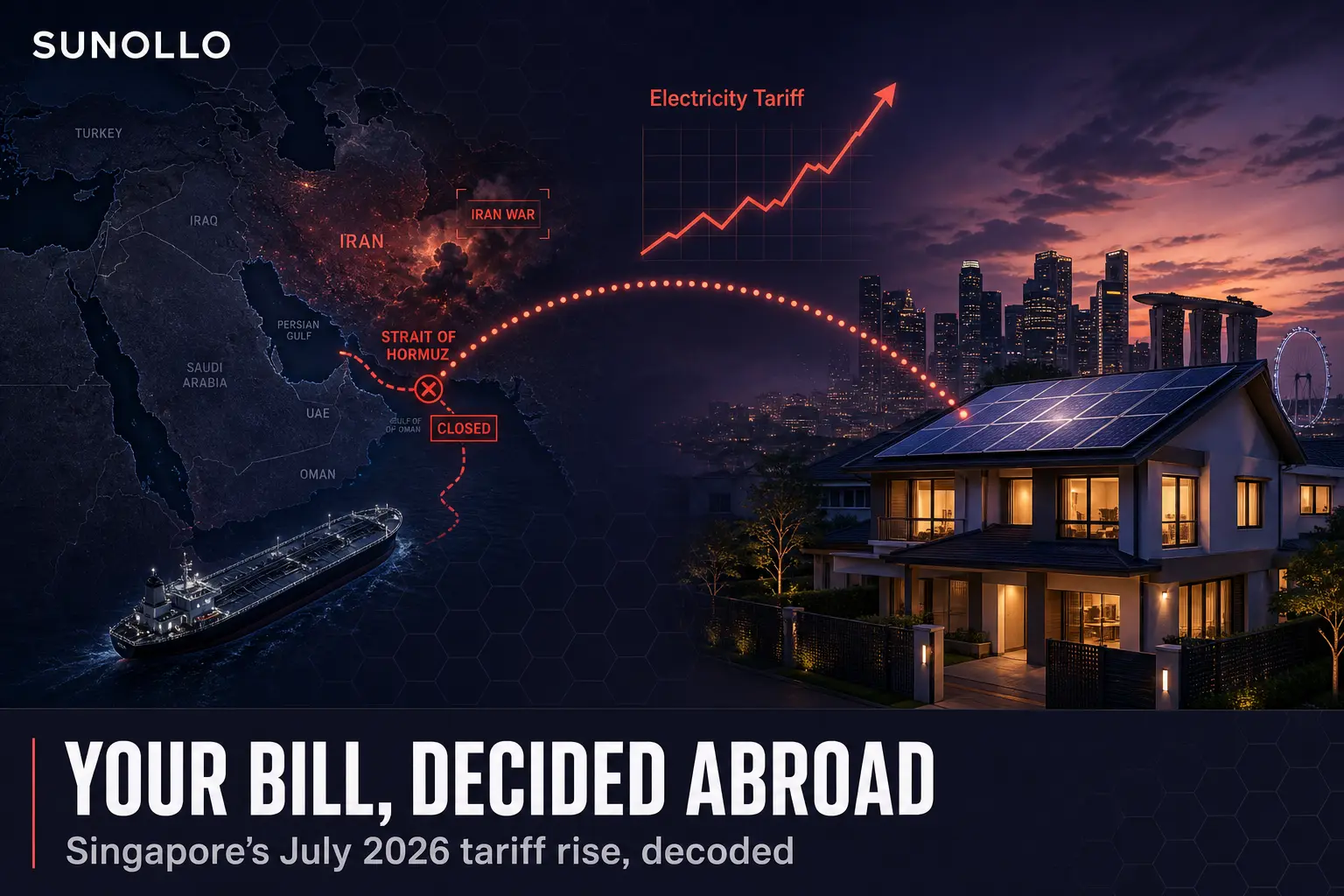
On February 28, 2026, a 33-kilometre-wide stretch of water between Oman and Iran became the most important body of water for every household in Singapore. That passage — the Strait of Hormuz — carries roughly 15 million barrels of crude oil and 290 million cubic metres of LNG through it every single day. It's the world's most consequential energy chokepoint. And when US and Israeli forces launched coordinated strikes against Iran in late February, the Strait froze.
Not literally. The water was still there. But within hours, maritime insurers cancelled coverage for vessels transiting the region. Ship owners, suddenly uninsurable, parked their tankers outside the Strait. Commercial shipping — the kind that carries Qatar's LNG to Singapore's power stations — simply stopped.
Brent crude, which had started the year at around US$63/barrel, surged 30% in the first two months of 2026 and hit US$119.50/barrel by early March. LNG spot prices jumped 40–60%. And Singapore's Minister for Energy went on Facebook to tell households to brace for higher electricity bills.
Here's the thing: none of this is surprising. It's entirely predictable. And if you're a homeowner in Singapore — particularly one with a landed property and a monthly electricity bill that would make most people wince — this crisis is your clearest signal yet that something has to change.
That something is solar. And the time is now.
Singapore's Achilles Heel Is Actually Printed in Plain Sight
Singapore doesn't have oil. It doesn't have natural gas. It doesn't have coal. What it has is an exceptionally well-run economy, a world-class port, and a near-total dependence on imported fossil fuels to keep the lights on.
The number that matters: 95%. That's the share of Singapore's electricity generated from natural gas. The gas comes via pipeline from Malaysia and Indonesia (roughly 43%) and via LNG tankers from Qatar and elsewhere (roughly 57%). Qatar, notably, routes virtually all of its LNG exports through — you guessed it — the Strait of Hormuz.
This isn't a new vulnerability. It's been a known structural risk for decades. What changes with every crisis is how acutely Singaporeans feel it. In 2008, oil hit US$147/barrel and electricity tariffs spiked. In 2022, the Russia-Ukraine war sent natural gas prices skyward and Singapore's electricity costs surged to 32+ cents per kWh. Now, in 2026, a Middle East conflict has lit the fuse again.
The mechanism is almost mechanically simple. Rising global gas prices → higher LNG spot rates → higher input costs for Singapore's power generators → higher wholesale electricity prices → higher tariffs for you, the consumer. The fuel component alone accounts for roughly half of your electricity tariff. When it swings 40–60% in either direction, your bill doesn't stay flat.
And the bitter irony? Singapore had a brief reprieve. In Q1 2026, before the conflict erupted, tariffs had actually fallen by 3% — a modest drop of 0.84 cents per kWh — as global energy costs softened post-2025. That savings of S$3.17/month on the average HDB four-room flat now looks almost quaint as analysts forecast tariffs climbing back toward their 2022 highs.
ASEAN's Shared Fossil Fuel Hangover
Singapore is not alone in this. The entire ASEAN region — a bloc of 670 million people with some of the world's fastest-growing economies — is in the middle of a structural energy reckoning.
The region has made real progress. Thailand is targeting 30% renewable energy by 2037. Indonesia is scaling solar. Vietnam has deployed remarkable amounts of solar capacity in a short time. The Philippines is betting big on offshore wind. But at the household level, across ASEAN, the reality is that electricity bills are set by how much it costs to burn natural gas or coal — fuels priced in global markets denominated in US dollars, subject to supply shocks from conflicts in places like the Strait of Hormuz.
The economic equation is changing fast. ASEAN's home battery storage market is projected to reach US$2.1 billion by 2026 — growing at a 38% compound annual rate. Searches for home batteries surged 85% year-over-year. The reason isn't abstract environmentalism. It's mathematics: when your electricity tariff is volatile and climbing, locking in your own generation cost becomes rational economic self-interest.
Malaysia's Economy Minister put it bluntly in March 2026: the country must shift to solar and hydropower as the Gulf war hits petrol supply. Thailand, Vietnam, and the Philippines are accelerating their renewable energy targets. The direction across ASEAN is clear. What differs is the pace.
Singapore's constraint — limited land, no wind to speak of, no rivers for hydro — paradoxically positions rooftop solar as particularly strategic. Every kWp of distributed solar on a Singapore rooftop is a kWp of electricity that doesn't need to be generated from imported LNG. Budget 2026 raised Singapore's solar deployment target to 3 GWp by 2030, treating that number as a floor, not a ceiling.
The Arithmetic of Pain: Who Feels This Most
Not all Singaporeans feel the electricity crisis equally. HDB flat dwellers spend S$80–120/month on electricity. A landed homeowner — particularly in a bungalow, semi-detached, or large terrace house — can easily spend S$400–S$1,500/month or more. Air conditioning, water heating, pool pumps, EV charging, home offices: the usage adds up fast.
Here's what that means in practice. Take a family spending S$1,200/month on electricity today:
Status quo (30¢/kWh): S$1,200/month → S$144,000 over 10 years
15% tariff increase: S$1,380/month → S$165,600 over 10 years
30% tariff increase: S$1,560/month → S$187,200 over 10 years
50% tariff increase: S$1,800/month → S$216,000 over 10 years
Every 10% increase in tariffs costs this family an additional S$14,400 over a decade. If you're paying S$1,000+ per month on electricity, your energy costs over 25 years could comfortably exceed S$400,000 — just to keep running on the same grid that is hostage to every Middle East flare-up, every LNG contract renegotiation, every OPEC production decision.
This is the hidden tax that landed homeowners pay. It's not a line item on your income tax. It doesn't show up in your annual budget conversation. But it compounds, silently, every month.
Why Solar's Moment Is Actually Now (Not 10 Years Ago)
Solar advocates have been saying "now is the time" for so long that the phrase has lost its urgency. Let's be precise about why 2026 is structurally different from 2016 or 2019.
1. Solar costs have fallen 90% in a decade
The cost per kWp installed in Singapore is now roughly S$1,450–S$2,000 — a fraction of what it was a decade ago. A 10 kWp system that would have cost S$80,000 in 2010 costs S$15,000–S$20,000 today. This is not marginal improvement; it's a technology inflection point.
2. Battery economics are catching up
LFP (lithium iron phosphate) batteries — the chemistry now standard in home storage systems — have dropped dramatically in price and are far more stable and longer-lasting than older lithium-ion chemistries. ASEAN's home battery trade volume grew 533% year-over-year in 2026. The technology is mature. The price is dropping.
3. Grid electricity tariff risk is rising
The inverse of solar's falling cost curve is the grid's increasing volatility. For the past decade, cheap LNG masked the structural risk. Now, with Hormuz acting as a price vulnerability amplifier, the gap between "cost of solar" and "cost of grid" is widening — permanently — in solar's favour.
4. Singapore's policy infrastructure is mature
The Net Energy Rebate (NER) scheme lets you earn from excess solar exported to the grid. EMA and SP Group have streamlined installation approvals. Budget 2026 provides direct incentives for residential solar adoption. The bureaucratic friction that slowed adoption five years ago is largely gone.
5. The payback math now works clearly
For a high-usage landed home in Singapore, a quality solar installation typically achieves payback in 4–7 years — based on current tariffs. If tariffs rise 15–30% over that period (a conservative assumption given the current macro environment), payback accelerates further. After payback, you're generating electricity for effectively S$0. For 25 years.
That's the asymmetry: grid electricity gets more expensive over time; solar gets cheaper (effectively free) after payback. The longer you wait, the more expensive the grid becomes, and the more of that 25-year free window you're giving up.
The Battery Question: When Does Storage Actually Make Sense?
Here's where we need to be honest, because solar marketing often glosses over the nuance.
Battery storage for Singapore homes is not a universal slam-dunk. If you're a moderate electricity user (say, S$200–300/month), the additional capital cost of a battery (S$6,000–S$12,000 for a 5–10 kWh residential system) with a standalone payback of 10–15 years makes it a harder financial case — particularly given Singapore's current NER export rates.
But for high-usage homes, the calculus shifts meaningfully.
High-usage homes have higher baseline load. More of their solar generation gets consumed directly (rather than exported at potentially lower NER rates), which maximises the financial value of every kWh produced. Batteries allow them to extend self-consumption into evening hours — covering air conditioning, entertainment, and appliance use after the sun sets.
High-usage homes have more to protect. If you're spending S$1,200–S$1,500/month on electricity, a battery that reduces your peak grid draw by 40–60% in the evenings saves you meaningfully every month.
The EV wildcard. If you drive an electric vehicle, home charging overnight consumes a substantial amount of electricity. A solar-plus-battery system can charge your car during peak solar generation hours, eliminating what would otherwise be an S$150–300/month additional grid electricity cost.
Time-of-use pricing is coming. Singapore's EMA is actively studying time-of-use pricing frameworks. When (not if) peak-hour grid electricity costs more than off-peak, batteries become arbitrage machines: store solar during the day, use it during the expensive evening peak. Households that invest in battery storage now will be positioned advantageously when pricing structures change.
The realistic recommendation for high-usage landed homes in 2026: go solar now, and if you have an EV or very high evening usage, pair it with a battery.
Real Families, Real Numbers
This isn't theoretical. Here's what Singapore homeowners with Sunollo installations are actually experiencing.
The Liow Family, Serangoon Gardens
The Liow family's electricity bill was S$1,299 per month before solar. After installing Sunollo's 35.34 kWp system — one of the largest residential installations in Singapore — their bill dropped to S$377 per month. That's S$922 in monthly savings, S$11,064 per year. Over a 25-year lifetime: S$407,000 in savings. When tariffs rise — as they are now — those savings compound further.
"Sunollo's subscription model makes it hassle-free and long-term peace of mind."
The Khanna Family, Joo Chiat
A 17.34 kWp system on their detached home. Bills fell from S$800 to S$230 per month. Lifetime savings: approximately S$120,000. "Love that everything works seamlessly and is completely digital."
The Singgih Family, Loyang
A 9.3 kWp system on their semi-detached home. Bills dropped from S$362 to S$136 per month. "I honestly can't understand why anyone would not install solar!"
The Fong Family, West Coast
An 8.37 kWp system on their terrace house. Bills fell from S$297 to S$71 per month — a 76% reduction. "Sunollo made everything simple. I was worried at first... turned out smoothly."
The Sunollo Proposition: Why Execution Matters as Much as the Idea
The question isn't whether solar works. The question is whether your solar works — for 25 years, without becoming a maintenance burden or a hidden liability.
This is where the choice of solar partner matters enormously. A solar panel is a 25-year asset. In that time, inverters will need maintenance. Panels may need cleaning or minor repairs. Monitoring systems need to stay functional. If your installer goes bust in year 5 — and Singapore's solar market has seen its share of exits — you're left holding a system with no support and potentially voided warranties.
Sunollo's model is built around this problem.
SunolloCare™ covers 100% of system maintenance, repairs, and insurance for the life of your subscription. No hidden charges when your inverter trips. No bill shock when a panel needs replacing.
LiveTrack™ gives you real-time visibility into your system's performance — how much energy you're generating, consuming, and exporting — through a clean app. If your system underperforms, Sunollo sees it too and responds proactively.
$0 upfront. Sunollo's no-worries plan eliminates the capital outlay entirely. You start saving from month one, with no capital at risk.
12% more energy from Sunollo's SunMax optimisers — panel-level optimisation technology that maintains performance even when individual panels are partially shaded. Singapore's rooftops are rarely perfectly unshaded, and a system without panel-level optimisation can lose 15–30% of its potential output. SunMax recovers that.
25-year full warranty. Not the asterisked, pro-rated warranty that populates the small print of most competitors. Full coverage that ensures someone qualified shows up to fix what breaks.
The Macro Bet You're Already Making (Whether You Know It or Not)
Here's the uncomfortable truth about energy: there is no neutral choice.
If you stay on the grid without solar, you are making an active bet that electricity tariffs will remain manageable for the next 25 years. Given what we've just watched happen — a single Middle East conflict sending Brent crude up 30% in two months and triggering a ministerial warning to Singapore households — that bet looks increasingly weak.
If you go solar, you are making a different bet: that the sun will rise tomorrow, that Singapore's 4.5–5.5 peak sun hours per day will persist (they will — this is a function of geography, not geopolitics), and that locking in your energy generation cost now is smarter than remaining exposed to whatever crisis 2028 or 2030 or 2033 brings.
Energy security is not just a national policy challenge. For a landed homeowner in Singapore, it's a household balance sheet decision.
The Long Game
There's a concept in investing called "antifragility" — the idea that some systems don't just withstand volatility but actually benefit from it. Solar energy for homes in Singapore has this property.
Every oil shock, every LNG price spike, every ministerial warning about rising electricity tariffs — each of these events is bad news for grid-dependent households and good news for the economics of rooftop solar. The comparison becomes more favourable. The payback period shortens. The saved money over 25 years grows.
The $119 barrel of oil is not just a macro data point. It's a message. And the message, for Singapore homeowners with large electricity bills and large rooftops, is that the grid is not your friend. It never really was. You just didn't feel it as acutely when Brent was at US$63.
The sun will rise tomorrow, regardless of what happens in the Strait of Hormuz. It will generate electricity — reliably, silently, at zero marginal cost — on every Singapore rooftop that has panels on it. For 25 years. That's the bet worth making.
Ready to Live in Abundance?
Get a free site assessment from Sunollo. No commitment. No upfront cost. Just a clear picture of how much your roof can generate, what your bills could look like, and what a 25-year savings trajectory looks like for your specific home.
Sources: Energy Market Authority Singapore; Rystad Energy analysis, March 2026; Malay Mail, March 13, 2026; SP Group Electricity Tariff Revision Q1 2026; ASEAN Home Battery Storage White Paper 2026; Sunollo customer case studies (love.sunollo.com); Singapore Budget 2026.