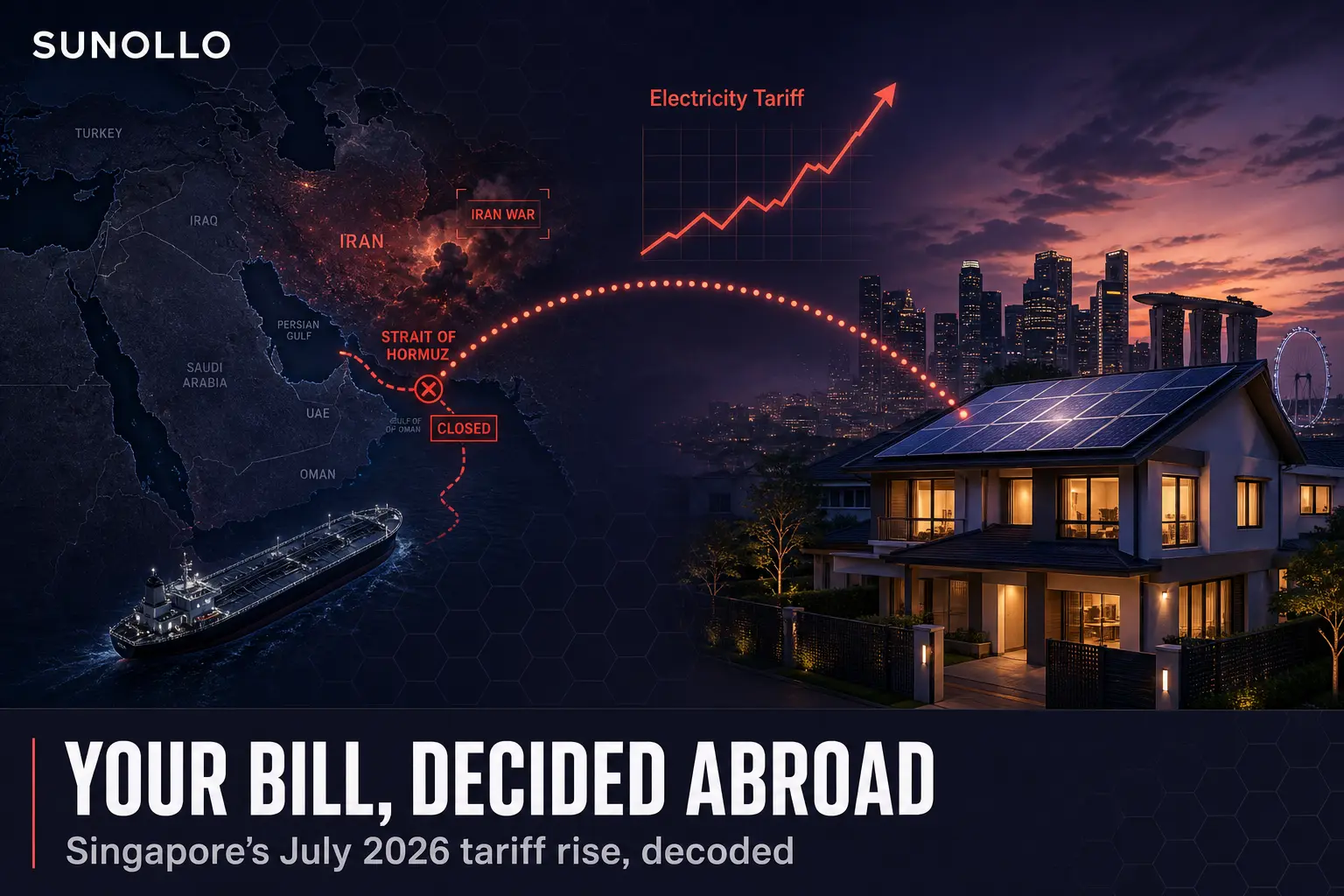
Quick answer: From July 2026, Singapore's regulated electricity tariff ise set to rise significantly — analyst estimates range from mid-single-digits up to 30%, with most clustering around 20–30% (S&P Global, KPMG). The current tariff is 29.72 cents/kWh. The cause is the Iran war: natural gas prices jumped after the late-February strikes and the closure of the Strait of Hormuz, and Singapore imports 95% of its electricity fuel. Critically, even with a US–Iran peace deal signed, relief won't arrive until Q4 2026 at the earliest — possibly Q1 2027 — because tariffs lag fuel costs by months. The lesson for homeowners: the tariff is set by events you can't control. Rooftop solar is the one part of the bill you can.
Analysis by Sunollo, June 2026. Based on EMA statements and analyst projections reported by The Straits Times.
Considering solar for your own home?
Sunollo installs and operates residential solar across Singapore — buy outright or from $0 upfront ($99/month), with the same 25-year SunolloCare either way. Get a free savings estimate →
Your July Electricity Bill Was Written in the Strait of Hormuz
Here is a strange fact about living in Singapore in 2026: the price you pay to run your air-conditioner this July was effectively decided by a war fought roughly 8,000 kilometres away, in a 33-kilometre-wide shipping channel most Singaporeans will never see.
On 18 June 2026, the Energy Market Authority confirmed to The Straits Times that the regulated electricity tariff — the rate paid by 62.8% of Singapore households — will rise "significantly" from the third quarter. Analysts put the increase anywhere from mid-single-digits to 30%, with the heavyweight forecasts (S&P Global, KPMG) clustering at 20–30%.
And here's the part that should reframe how you think about your power bill entirely: this is happening despite a freshly-signed US–Iran peace deal. The ceasefire came too late to matter for your next bill, and it will take months to matter for the ones after that.
Let's pull this apart — because the mechanics of why reveal something much bigger than a one-quarter price bump. They reveal a structural vulnerability sitting inside every Singapore electricity bill, and the single most effective thing a homeowner can do about it.
What Actually Happened (The 90-Second Version)
The chain of events is almost mechanically clean:
The EMA's own words: "With the Middle East conflict straining global fuel supply chains, natural gas prices have increased sharply since the end of February. Consequently, the regulated electricity tariff is expected to rise significantly in the coming quarter."
This isn't a forecast anymore. It's a near-certainty already baked into fuel costs that have already been incurred.
The Counterintuitive Part: A Peace Deal Doesn't Lower Your Bill
You'd think a ceasefire would bring instant relief. Oil prices have indeed begun sinking back toward pre-war levels. So why is the tariff still going up — and staying up?
Because of two stacked time-lags, beautifully explained by Rystad Energy's David Chew:
"Gas prices which are tagged to the oil price tend to look at the preceding few months of oil prices. The electricity tariff also looks at the preceding months of gas prices. If you couple those two time-lags, there isn't such a strong flow-through of conflict prices."
Read that twice, because it cuts both ways:
And that relief is conditional. It depends on tankers safely returning to the Middle East, shipping routes normalising, and the peace holding. The EMA has even warned of "further and potentially sharper increases" in electricity and town gas tariffs later in 2026.
So the honest summary is: the pain is locked in, and the relief is a maybe with a multi-month delay.
The Structural Problem Hiding in Plain Sight
Here's where it gets bigger than one quarter. The reason a distant war can move your bill at all is a number worth committing to memory:
95% of Singapore's electricity is generated from imported natural gas.
Singapore has almost no domestic energy resources. Of its 2025 gas imports, 43% arrived as piped natural gas from Malaysia and Indonesia, and 57% as liquefied natural gas (LNG) from elsewhere — including the Middle East. This is one of the most import-dependent electricity systems in the developed world.
That dependence is the entire ballgame. It means your electricity price is permanently tethered to:
The July 2026 spike isn't an anomaly. It's the system working exactly as designed — passing global volatility straight through to the household meter. We wrote about this structural exposure in depth in Singapore's Electricity Bill Is Now a Foreign Policy Problem and The $119 Barrel: Why Oil's Crisis Is Solar's Inflection Point. This week's news is simply the latest, sharpest proof of the thesis.
What This Costs You, In Dollars
Abstractions don't pay bills, so let's get specific.
The current tariff is 29.72 cents/kWh (GST included). S&P Global's Amanda Kang estimates a 20–25% increase would add roughly $30 a month to the bill of a 4-room HDB flat — where the average monthly bill is already close to $88, per SP Group.
Scale that across property types and the picture sharpens considerably:
| Home type | Rough monthly bill (now) | At +25% | Extra per year |
|---|---|---|---|
| 4-room HDB flat | ~$88 | ~$110 | ~$264 |
| 5-room HDB / executive | ~$130 | ~$163 | ~$396 |
| Condominium unit | ~$180 | ~$225 | ~$540 |
| Terrace / semi-detached landed | ~$350 | ~$438 | ~$1,056 |
| Large landed / GCB | ~$700+ | ~$875+ | ~$2,100+ |
Illustrative figures. HDB anchor based on SP Group's ~$88 average for a 4-room flat and Kang's ~$30/month estimate at a 20–25% rise; larger-home figures are Sunollo estimates scaled by typical consumption. Your actual bill depends on usage.
For a landed home — exactly the kind of property where rooftop solar shines — a 25% tariff jump can mean $1,000+ in extra electricity cost per year. And that's just one quarter's increase, annualised. The EMA's warning of "further and potentially sharper increases" means this could compound.
The Two Things Households Are Doing — And Why Only One Is a Real Hedge
The Straits Times piece surfaces a quiet behavioural shift: between February and June 2026, the share of households on the regulated tariff dipped from 63.4% to 62.8%, while those on fixed-price retail plans rose from 36.6% to 37.1%. People are trying to insulate themselves.
This is rational. But it's worth understanding what a fixed-price plan actually is — and what it isn't.
Option A: Fixed-Price Retail Plans (Renting Stability)
A fixed-price plan locks your rate for a contract term (the shortest currently being six months). It's genuinely useful: as Kang notes, customers who locked in are "shielded from surges." But note the trade-offs:
A fixed-price plan is, in essence, renting a temporary umbrella in a storm you don't control. Helpful for six months. Not a solution. We compare this trade-off in detail in Solar vs Electricity Retailers and the Open Electricity Market guide.
Option B: Rooftop Solar (Owning the Generator)
Solar is a different kind of thing entirely. You're not negotiating a better price for imported gas-fired electricity — you're producing your own electricity on your own roof, structurally outside the gas-import system that the tariff is tethered to.
Every kilowatt-hour your panels generate and you consume is a kilowatt-hour you don't buy at the tariff — whatever that tariff happens to be next quarter, or the quarter after. When the tariff rises, your solar savings rise with it. Solar isn't an umbrella; it's a roof.
Why a Rising Tariff Makes Solar Better, Not Worse
This is the counterintuitive heart of it. Most people think rising prices are bad news across the board. For solar economics, a rising tariff does the opposite — it improves the return on a system you already own.
The logic is simple. The value of each kWh your panels produce equals the tariff you avoid paying. So:
Higher tariff → each solar kWh is worth more → faster payback → bigger lifetime savings.
A solar system sized for a landed home in Singapore typically offsets 70–85% of the electricity bill (see how solar cuts your SP bill). At today's tariff, that's already substantial. At a tariff 25% higher, the same panels — same hardware, same sunshine — quietly deliver 25% more value on every self-consumed unit.
And critically, solar locks in that advantage for 25 years. While the regulated tariff swings quarter to quarter on the whims of distant conflicts, your panels produce on a schedule set by the equator: reliably, predictably, every sunny day. The Singapore sun does not care about the Strait of Hormuz.
Pair solar with a home battery and the hedge gets stronger still — you store your midday surplus and use it through the evening peak, buying even less from the grid. We cover the economics in the home battery storage guide and self-consumption vs grid export.
The Honest Caveats
We're a solar company, so let's be straight about the limits:
The Bottom Line
The July 2026 tariff increase is a single data point in a much longer story: a wealthy island nation that imports 95% of its electricity fuel, and therefore imports the world's geopolitical volatility straight to the household meter, on a lag that hurts fast and heals slow.
You can't reopen the Strait of Hormuz. You can't negotiate Singapore's LNG contracts. You can't control what the EMA sets next quarter. But you can control whether your roof is an idle surface or a power plant.
The households moving to fixed-price plans have the right instinct — protect yourself from volatility — but the wrong durability. A six-month lock expires. A solar array on your roof produces for a quarter-century, and gets more valuable every time the tariff climbs.
In a system where the price of power is decided abroad, the most radical thing a Singapore homeowner can do is generate their own.
→ Get a free Sunollo home solar assessment and see exactly how much of your bill you can put beyond the reach of the next tariff hike. Or start with The Complete Solar Guide for Singapore 2026.
Frequently Asked Questions
Q: How much will the Singapore electricity tariff rise in July 2026?
The EMA has said it will rise "significantly." Analyst estimates range from a mid-single-digit increase (Rystad Energy) to 20–25% (S&P Global) and 20–30% (KPMG), with the highest projection at 30%. The current tariff is 29.72 cents/kWh including GST. For a 4-room HDB flat, a 20–25% rise translates to roughly $30 more per month.
Q: Why is electricity getting more expensive if oil prices are falling after the Iran peace deal?
Because of two stacked time-lags. The July tariff is calculated from fuel costs incurred between April and mid-June — the most war-inflated period. Gas prices lag oil prices, and the tariff lags gas prices. So even with oil now falling, relief won't reach the tariff until Q4 2026 at the earliest, possibly Q1 2027.
Q: Will a fixed-price electricity plan protect me from the tariff increase?
Partially, and temporarily. A fixed-price plan locks your rate for the contract term (minimum six months currently), shielding you from surges. But you're still buying all your electricity from the grid, retailers have been hiking new-contract prices, and when prices eventually fall you stay locked above market. It's stability, not savings.
Q: Does a rising electricity tariff make solar panels more worthwhile?
Yes. The value of each kWh your solar panels produce equals the tariff you avoid paying. When the tariff rises, every self-consumed solar unit becomes worth more, shortening payback and increasing lifetime savings. A higher tariff improves solar economics rather than worsening them.
Q: Why is Singapore's electricity so exposed to overseas conflicts?
Because 95% of Singapore's electricity is generated from imported natural gas — 43% piped from Malaysia and Indonesia, 57% as LNG including from the Middle East. With almost no domestic energy resources, Singapore's power prices are structurally tethered to global fuel markets and the geopolitics that move them.
Q: Can solar shield me from this specific July 2026 increase?
No — a solar installation takes weeks to design, approve, and install, so it won't affect your next bill. But it will reduce every bill after it, and the EMA has warned of further, potentially sharper increases later in 2026. Solar is a hedge against the trend, not a fix for a single quarter.
Sources
This article is general market commentary for Singapore homeowners and is not financial advice. Tariff projections are analyst estimates and may change. Savings figures are illustrative and depend on your home, roof, and electricity consumption.