A 33-mile strait closed. A 728 square kilometre island held. Now comes the harder question: can Singapore become energy-sovereign without the things every other country uses?
This is an analysis of four switches with structural ceilings, three foreign comparisons that have already run the experiment, two parliamentary moments that revealed the actual debate, and one fifth switch that no one has named yet but everyone is building.
It is also, in the end, a piece about a fairly mundane question: should you put solar on your roof? The answer turns out to be tangled up with the geopolitics of Qatar, the physics of a flow battery on Pulau Ubin, a 1.75-gigawatt cable from Darwin, the price curve of a Chinese LFP battery cell, and a regulatory sandbox in Marymount. So let's untangle it.
Part I — The Strait, The Island, And The Question
1. The Strait
You learn the Strait of Hormuz exists somewhere in school, then mostly forget about it. It is 33 miles wide at its narrowest point, separates the Persian Gulf from the Gulf of Oman, and carries roughly 20% of the world's seaborne liquefied natural gas. It is one of about seven chokepoints on the planet that, if blocked, materially reprice global energy.
In March 2026 it got blocked. Iran's response to US and Israeli military strikes was to effectively close the strait — through mining, drone strikes on shipping, and direct attacks on Qatar's Ras Laffan LNG export facility. Asian LNG spot prices doubled inside six weeks. Qatar's LNG export capacity dropped by 17%. The International Energy Agency called it the largest supply disruption in the history of the global oil market.
Singapore generates about 94% of its electricity from natural gas. Of that gas, roughly 60% arrives via pipelines from Malaysia and Indonesia and is unaffected by Middle East disruption. About 40% arrives as LNG, and around 25% of Singapore's gas comes from Qatar. When Q2 2026 household tariffs were set, they came in at 27.27 cents per kWh — and EMA, in language that civil servants reserve for moments when they actually want you to pay attention, warned of "further and potentially sharper" hikes in Q3.
This is not abstract. Through the second half of 2026, your air conditioner, your fridge, and your hot water heater are being priced by what Iran decides to do this month.
2. The Island
Singapore is 728 square kilometres of mostly-built city. It has no domestic coal. No commercial hydropower. No usable geothermal. No grade-A wind resource. No oil. No gas of its own. It is one of the most energy-constrained sovereign states in the world by physical geography — and one of the most energy-dependent by economic structure.
And yet, through every energy shock of the last fifty years — 1973, 1979, 2008, 2022, 2026 — it has not had a blackout. No emergency rationing. No fuel queues. The lights have stayed on. That is not an accident. It is the cumulative result of one of the most disciplined, technocratically-managed energy procurement strategies in any small economy on earth.
So if Singapore's energy system has held through every crisis: why are we writing about this at all?
3. The Question
Because energy security — the system holding — is not the same thing as energy sovereignty — the system being yours. Singapore has the first. It is increasingly clear it cannot procure its way to the second.
The 94% gas dependency is structural. Singapore GasCo, the new state-owned procurement entity established in April 2025, can diversify suppliers, hedge across Brent, Henry Hub, and the JKM marker, and run a tight portfolio — but it still ends up paying the world price of LNG, set by Qatari production decisions and Iranian foreign policy.
Six gigawatts of imported electricity by 2035 — Singapore's official target, raised from 4 GW in 2024 — will diversify the dependence. But "imports" is a polite word for "a 4,300-kilometre submarine HVDC cable from Darwin to Tuas," which is what SunCable proposes, and which the Energy Market Authority's head describes as "very ambitious" but "actually possible." First power to Singapore: mid-2030s. Submarine cables, like LNG tankers, can also be cut.
The first question this article asks is: what does Singapore's energy future actually look like when you take the structural ceilings of every switch seriously? The second is: what is the role of the fifth switch — the one no one has formally named yet, but that everyone from the EMA roadmap to the Marymount parliamentary debate is implicitly converging toward?
Part II — The Four Switches, Scored
Singapore's official energy strategy is built on four switches. They appear in every EMA document, every Ministry of Trade and Industry speech, every Parliament debate. They are: natural gas, solar, imports, and emerging low-carbon alternatives. Let's score each one against 2030 demand of 9.4-10.8 GW.
4. Switch 1: Natural Gas (94% today, structural)
Singapore's gas strategy is among the world's best for a country that has none. The four sub-pillars: diversified piped supply (60% from Malaysia and Indonesia), diversified LNG (40% across Australia, the United States, and Qatar), centralised procurement (GasCo, launching procurement Q1 2026 with a target portfolio of 2-3 million tonnes initially, scaling to 6 million tonnes by 2035-2038), and a national gas terminal at Jurong Island.
What gas cannot do: change Singapore's carbon emissions trajectory or insulate against global LNG repricing. Power generation accounts for 40% of Singapore's total emissions. Singapore's Second NDC commits to 45-50 MtCO2e by 2035, then net zero by 2050. You cannot get there on a gas-dominant grid. Gas is also the reason the carbon tax matters: every increment of the tax (S$5 → S$25 → S$45 in 2026 → S$50-80 by 2028-2030) flows through the gas fleet into tariffs.
Score: solves reliability today, structurally incompatible with 2050.
5. Switch 2: Solar (2.1 GWp today, 3 GWp target by 2030)
This is where Singapore's progress is most visible — and most physically capped. By end of 2025, Singapore reached 2.1 GW (2,093 MW) of cumulative solar capacity. In 2025 alone, 504 MW was added. The earlier 2 GWp 2030 target was exceeded ahead of schedule; Budget 2026 reset it to 3 GWp.
The breakdown by installation count is instructive: 6,912 residential installations (47.3% of total count), 5,061 HDB and Town Council installations (34.6%), 2,321 commercial and industrial installations (15.8%). The residential count is dominated by HDB. Private landed homes — Singapore's roughly 70,000 detached and semi-detached properties — have penetration under 10%. That is the gap Sunollo and a handful of other installers operate in.
The physics-imposed ceiling: an NUS study of 132,000 buildings found that rooftop solar can supplement up to 20.21% of energy use for residential buildings, with building-integrated PV on façades adding up to 8.61%. Singapore's Solar PV Roadmap (SERIS) estimates total solar potential — including floating PV in reservoirs, building façades, and moveable structures — at roughly 5-6 GWp by 2050. Solar at 3 GWp meets about 10% of 2030 peak demand. Even at maximum theoretical deployment, solar tops out at maybe 15-20% of generation. Singapore is not Germany. It cannot solar its way out.
Score: necessary, undersized for the gap, capacity-bounded by geography.
6. Switch 3: Imports (target 6 GW by 2035)
Singapore raised its low-carbon electricity import target from 4 GW (2021) to 6 GW (2024). Six gigawatts equals roughly one-third of 2035 electricity demand.
As of October 2025, EMA has issued Conditional Approvals for 11 projects totalling 8.35 GW. Six projects, all from Indonesia, have advanced to Conditional Licences and target commercial operations from 2028. The country breakdown of approvals: Indonesia 2 GW, Australia 1.75 GW, Vietnam 1.2 GW, Cambodia 1 GW, plus Sarawak/Malaysia. Singapore and Indonesia signed a 3.4 GW subsea cable agreement. The Singapore-Australia Cross Border Electricity Trade Framework was signed at PM-level in October 2025.
SunCable — the Australia-Asia PowerLink — is the most ambitious. A 4,300-kilometre submarine HVDC cable carrying up to 1.75 GW of firmed solar + wind from Australia's Northern Territory to Tuas. Final Investment Decision targeted for 2027. Financial close 2028. First power to Darwin early 2030s. First power to Singapore: mid-2030s. The first commercial stage may be as small as 200 MW. EMA chief Kok Keong Puah described the project in April 2026 as "very ambitious" but "actually possible."
What imports solve: carbon, generation mix diversification, market integration. What they do not solve: chokepoint risk (submarine cables can be cut; partner countries can revisit terms; the South China Sea adds its own geopolitics), transmission cost (~$21 billion annually of ASEAN grid investment needed 2026-2030 per the IEA), and timing — most projects come online 2028-2035, while demand is growing faster than that.
Score: real, important, partial. And subject to chokepoints of a different shape.
7. Switch 4: Emerging Tech (hydrogen, ammonia, nuclear)
Singapore's Hydrogen Strategy projects hydrogen could meet up to 50% of electricity demand by 2050. The pathway: combined-cycle gas turbines capable of running on 100% hydrogen (expected by ~2030), low- or zero-carbon ammonia generation and bunkering at Jurong Island (Keppel-led consortium), and SAF and fuel cells in transport. Nuclear is being assessed via small modular reactors with international cooperation agreements (US, France, UAE, Sweden). No deployment decision yet.
The honest read: these are 2035-2050 technologies at commercial scale. Hydrogen-ready CCGTs in 2030 still need clean hydrogen production, which still needs cheap renewable electricity, which Singapore does not have. Nuclear SMRs are years from FID even where countries are pursuing them aggressively. Both are real options for the 2040s. Neither helps with the 2026-2030 gap.
Score: long-dated optionality, not a near-term lever.
8. The Math, Brutally
Stack the four switches against 2030 peak demand of 9.4-10.8 GW:
- Gas: ~6-8 GW capacity available, but increasingly carbon-taxed and price-volatile
- Solar: 3 GWp installed by 2030 ≈ 600-700 MW average generation, ~10% of demand
- Imports: maybe 1-2 GW operational by 2030 (Indonesian projects from 2028, others later)
- Emerging tech: ~zero by 2030 at scale
The gap is real. The 2030 picture: a power system still 70-80% gas-fired, paying a S$50-80/tonne carbon tax, with imports just beginning to come online, while demand grows 25-45% from today's baseline driven primarily by data centres (already 20% of grid in 2026 — the highest share of any national grid in the world). That is the actual macro context for the May 2026 parliamentary debate.
Part III — The Two Parliament Moments
Read in sequence, the January and May 2026 parliamentary sessions trace the arc of where Singapore energy policy is actually heading.
9. January 14: The Soft Signal
MP Abdul Muhaimin Abdul Malik asked Deputy Prime Minister Gan Kim Yong whether solar initiatives for public housing would extend to private and landed properties. DPM Gan's written reply was measured: the government will "nudge" private properties via simplified regulations. No mandates. No subsidies. Payback "as short as five years."
That was six weeks before Iran closed the strait.
10. May 6: The Microgrid Question
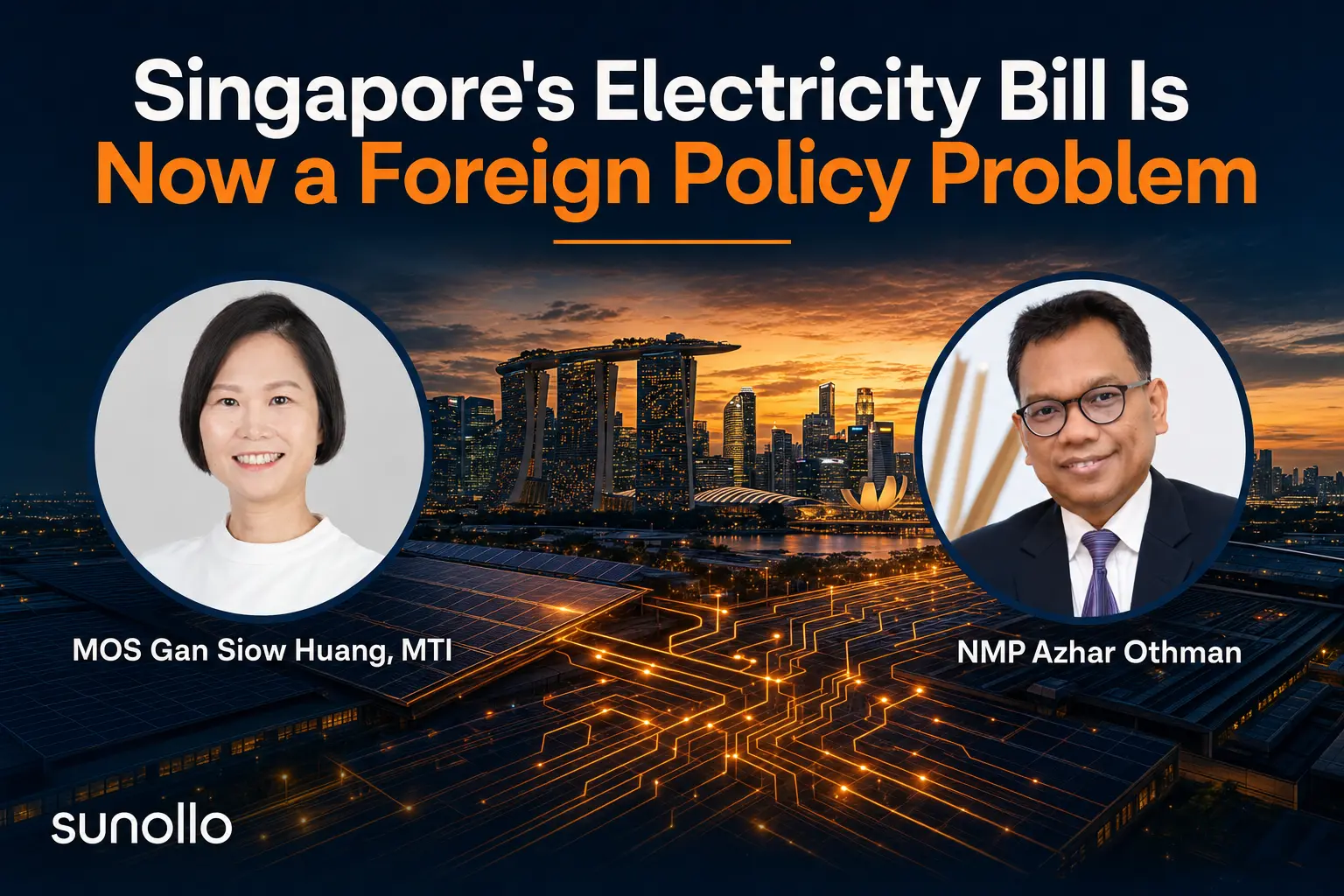
NMP Azhar Othman, executive chairman of Enercon Asia, raised an adjournment motion. His proposal: a multi-agency task force to pilot Singapore's first constituency-scale electricity grid using "a layered, distributed energy architecture" of solar panels and battery storage. Each constituency would operate independently for up to 24 hours without mainland utility power. The architecture, in his words, prevents cascading failures from cyberattacks, geopolitical events, natural disasters, or extreme weather.
MOS Gan Siow Huang responded that Singapore maintains one of the world's most reliable electricity grids and diversifies gas supply sources. Microgrids and battery systems are among solutions being studied, she said, but they must meet specific safety requirements.
What the coverage missed: Singapore has been running exactly this experiment since 2013.
11. May 7: The Solar Question
The next day, MOS Gan gave the most direct government statement on solar policy in years:
"Economic conditions now are actually very favourable for solar installation. Solar technology has become more efficient and installation costs are substantially lower. We believe that the economics will drive faster adoption."
She reported surging interest from private building owners. The government would monitor closely and was "prepared to consider additional measures" if adoption rates fell short. She declined to mandate solar on new buildings. She declined to subsidise it.
The most analytically interesting exchange came from Workers' Party MP Kenneth Tiong: Singapore subsidises EVs through the EV Early Adoption Incentive — why not solar?
MOS Gan's rebuttal is worth reading carefully. The EV scheme, she said, "assumes that the consumer wants to buy a vehicle" and nudges them to choose electric over conventional. Both are purchases of the same category. Solar is different — a new purchase category entirely. And the barrier, she said, is not primarily cost. Some homeowners worry about roof waterproofing. Others worry about the reliability of solar installation vendors.
Pause on that. The Minister of State for Trade and Industry, during the worst global energy crisis in decades, identified vendor reliability as a reason Singaporeans hesitate to go solar. She is correct, and it is the most important statement an authority figure in Singapore has made about the solar industry in years. It directly defines who will win this market. Not the cheapest panel. Not the most aggressive sales team. The demonstrable answer to: how do I know you will still be here in 2040 when my warranty needs honouring?
Part IV — The Studies The World Has Already Run
Singapore is not the first country to face this question. Four foreign experiments are now mature enough to learn from.
12. Pulau Ubin: The Twelve-Year Lesson
Pulau Ubin — the rustic island northeast of mainland Singapore — is home to a solar microgrid test-bed that EMA established in 2013. It has been running, quietly, for over a decade. In its most recent upgrade, EDP Renewables installed 328 kilowatt-peak of solar panels and a 1 megawatt-hour vanadium redox flow battery (chosen over lithium-ion for 25-year lifespan and lower fire risk). Target: 95% of electricity from solar. Beneficiaries: 30+ households and businesses. Annual diesel avoided: ~100,000 litres. Annual CO2 avoided: ~268,000 kg.
The 2025 reality: solar utilisation came in at 10%. Diesel covered 90% of demand. The grid trip count was 13. An upgraded battery system is being installed.
The gap between 95% target and 10% reality is not a failure. It is the most honest data Singapore has on what scaling distributed renewables actually requires. Solar generation peaks at noon. Air-conditioning demand peaks at 7-10pm. Without sufficient battery storage to bridge that gap, even a well-designed microgrid defaults to its fossil-fuel backup. Lithium-ion at $108/kWh in 2025 looks cheap until you do the math on how many kWh you need to bridge 12 hours of an entire constituency's load.
The Pulau Ubin lesson, restated: distributed energy at scale is a storage problem, not a solar problem. Battery economics and reliability determine whether a microgrid actually operates as designed. This is not a critique of Azhar's proposal — it is a precise statement of the constraint his proposal must solve.
13. Israel (December 2025): The Mandate Path
On 11 December 2025, Israel made rooftop solar mandatory on new construction. Every new residential building must install a minimum 5 kW PV system. Non-residential buildings with roof areas exceeding 250 square metres must install up to 15 kW. About 10,000 new houses are built in Israel annually. Israel pairs the mandate with a generous feed-in tariff of 0.48-0.56 NIS per kWh, producing an estimated 15% annual return on the installation cost (45,000-90,000 NIS).
Israel is a relevant comparable to Singapore: small, dense, energy-poor by domestic resource standards, heavily reliant on imported gas, surrounded by hostile geopolitics. Both countries have spent decades building energy security through procurement and diversification. Israel's December 2025 decision is the moment a peer economy concluded that procurement, however well-executed, is not enough.
The lesson is not that Singapore should mandate solar (MOS Gan explicitly addressed and rejected this in May). The lesson is that the mandate question is now on the table among Singapore's peer set — and that voluntary economics, however compelling, take longer than mandates to fully diffuse. Israel chose to compress the diffusion timeline by 5-10 years.
14. California (NEM 3.0): When Batteries Became Mandatory By Math
California is the other relevant comparable — a sub-national economy with high tariffs, heavy solar penetration, and a sophisticated retail electricity market. From 1996 to 2022, California's Net Energy Metering schemes paid residential solar exporters one-to-one at retail rates — the grid functioned as a free battery. Solar adoption boomed. The duck curve emerged: midday net load collapsed as solar peaked, then ramped sharply at sundown when solar fell off and residential load picked up.
In April 2023, California shifted to NEM 3.0. The new tariff used an Avoided Cost Calculator that reduced export compensation by approximately 75% versus retail rates. The economic effect was immediate: standalone residential solar without storage became uneconomic. Solar adoption did not slow — solar paired with batteries surged. The battery stopped being a resilience nice-to-have and became a mandatory financial instrument for arbitraging the gap between retail electricity prices and the now-low export rate.
Why this matters for Singapore: Singapore's Net Energy Rebate scheme already exports surplus electricity at wholesale rates (S$0.08-0.12 per kWh) — much closer to NEM 3.0 economics than to the 1990s NEM 1.0 model. The arbitrage spread between export rate and retail rate (now ~S$0.22/kWh and widening) is approximately the same shape. The implication: solar economics in Singapore are already structurally evolving toward a "battery is the financial instrument" regime, with or without a regulatory push. Each tariff increase widens the arbitrage. Each S$5 carbon-tax increment narrows the gas economics.
One late-stage California warning: by early 2026, with grid-scale battery storage above 9 GW, evening wholesale prices were collapsing about 38% faster than midday prices — compressing the spread that makes storage profitable. This is the "batteries eating batteries" problem at grid scale. It will take Singapore another decade to face this problem; for now, the spread is wide and getting wider.
15. Germany (Energiewende): The Friction Tax
Germany has the most ambitious distributed solar programme in any developed economy: 215 GW of PV capacity by 2030, with about 50% on rooftops. Germany considered a solar mandate and ultimately rejected it. Instead, Solar Package I emphasised streamlined permitting, simplified procedures, and reduced bureaucratic friction.
The result has been mixed. Germany still faces shortages of electricians and inverters, slow smart-meter rollout, and reduced feed-in tariffs that have hindered PV growth in segments where economics tightened. Some German states have implemented their own mandates independently.
The Germany lesson: procedural friction is a real tax on adoption, even when economics are favourable. Singapore's regulatory process — though tighter and faster than Germany's — has not been redesigned around mass distributed deployment. EMA roadmap implementation, DC fast-permitting, AMI smart-meter rollout, electrician certification at scale, and SP Group's interconnection processes all need to compress further. The combination of economically favourable + procedurally friction-loaded is exactly the German trap. MOS Gan's "vendor reliability" comment is implicitly a friction signal.
16. The Learning Curve: BloombergNEF and the $80/kWh Battery
The most important external data point for Singapore is not in Singapore. It is BloombergNEF's annual battery price survey:
- 2023: $139/kWh (lithium-ion pack)
- 2024: $133/kWh
- 2025: $108/kWh (record low). Stationary storage specifically: $70/kWh, down 45% YoY
- 2030 forecast: $80/kWh pack
This is a learning-curve / Wright's Law trajectory: each doubling of cumulative manufactured volume produces roughly 18-20% cost decline. LFP chemistry now dominates because it is 30%+ cheaper than NMC and has a longer cycle life. China's manufacturing overcapacity has pushed prices below pre-2030 forecasts, and is expected to continue doing so through 2030. Singapore home battery prices have already fallen 40-50% since 2023 — and they are still 2-3x the underlying cell cost, which means the next phase of price decline comes from system integration, installation, and balance-of-system costs, not from cells.
This is what Tony Seba calls "GOD parity" — Grid-free Origin Distributed parity — the tipping point where local solar plus battery storage becomes cheaper than maintaining grid infrastructure. Singapore is not at GOD parity yet (grid maintenance per kWh is too cheap; Singapore's grid is too good). But the gap is closing one BloombergNEF survey at a time.
Part V — The Fifth Switch No One Has Officially Named
The EMA Future Grid Capabilities Roadmap, published April 2025 and developed with SP Group, identifies three strategic priorities: harness distributed energy resources, enhance grid planning through digital solutions, and maintain grid stability as renewables increase. The roadmap is, in its bones, a roadmap for a fifth switch — though the four-switch framing of the official policy narrative does not yet promote it to peer status with gas, solar, imports, and emerging tech.
17. What The Fifth Switch Actually Is
The fifth switch is distributed energy resources aggregated through digital infrastructure. Specifically: thousands of rooftop solar systems, plus home batteries, plus EV chargers, plus commercial behind-the-meter assets, coordinated by software into a single grid asset. The official name is "DER aggregation" or "Virtual Power Plant." The functional name is: your house, multiplied by every other house, treated as one power station.
Why is this a switch rather than just a tactic? Because it has the properties the official four switches don't have together:
- No foreign supplier: rooftops are domestic by definition
- No chokepoint: no strait, no submarine cable, no partner country to negotiate with
- No fuel cost: marginal cost is zero (sunshine)
- Geography-tolerant: capped only by the sum of available rooftops + façades + floating + storage
- Capital structure-friendly: financed by homeowners, not by sovereign bonds or PPAs
- Resilience-positive: distributed by design, so a single failure is local
The fifth switch does not replace the other four. It compounds with them. Solar without storage is intermittent. Solar with storage and aggregation becomes dispatchable — meaning it can be turned on or off when the grid needs it, like a small thermal plant. Once aggregated through a VPP, the same residential solar + battery system that today produces a 4-6 year payback at the homeowner level also produces grid services (frequency regulation, contingency reserve, energy balancing) at the system level.
18. The VPP: Aggregation as Policy
In October 2024, EMA proposed a regulatory sandbox for Virtual Power Plants. In November 2025, Univers and SP Group signed an MOU to operate Singapore's first VPP under the sandbox. Initial capacity: 15 megawatts. Sources: residential solar + battery storage. Services: frequency regulation, contingency reserve, energy balancing. Plans: scalable nationwide expansion.
This is the mechanism. It connects individual homeowner economics to grid-level service revenue. The homeowner's existing 8-year battery payback shortens (or extends into ongoing revenue) when their battery is enrolled in the VPP. The grid gains a fast-response asset that doesn't require building a new gas peaker. The country gains a distributed buffer that doesn't depend on any foreign supply chain.
If you take MOS Gan's "the economics will drive adoption" statement seriously and add the VPP layer, you get something more specific: the economics will drive adoption, and EMA is building the rails that monetise the adoption back into the grid.
19. The Constituency Microgrid: Pulau Ubin at 100x Scale
NMP Azhar's May 6 proposal — constituency-scale microgrids capable of 24-hour island-mode operation — is Path 2 (VPP) taken to its logical conclusion. If you can aggregate residential solar + battery into a virtual power plant, you can also ring-fence that aggregation at a constituency boundary and add the switching infrastructure to disconnect from the mainland grid during disturbances.
This is not architectural speculation. Pulau Ubin already does it, just at 30-household scale instead of constituency scale. The engineering questions — solar + storage sizing, inverter coordination, grid-forming controls, protection schemes — are largely solved. The remaining questions are regulatory (who pays for the resilience layer?), commercial (who operates it?), and political (which constituency gets to be the pilot?). MOS Gan's "must meet specific safety requirements" response is not a deflection. It is a list of the actual work that has to happen for Azhar's proposal to become real.
20. The Institutional Stack
The institutions doing the work, ranked by leverage:
- EMA: writes the rules. Future Grid Roadmap is the controlling document. VPP regulatory sandbox is the live experiment. Import policy is theirs. Critical path: how fast the VPP rules go from sandbox to scaled framework.
- SP Group: operates the wires and the digital twin. Smart-meter rollout, interconnection processes, distribution-system upgrades. Critical path: AMI deployment at residential scale + distribution-level visibility for distributed energy resources.
- GasCo: procurement-side resilience for the next 10-15 years while the fifth switch scales. Critical path: portfolio depth, hedge diversity, supplier optionality.
- Sembcorp, Keppel, EDP: the major project developers. Solar PPAs at HDB (SolarNova), commercial rooftops, industrial. Critical path: bid pipeline depth and execution speed.
- Hyperscalers (Microsoft, Equinix, Google): the largest single buyers of Singapore solar PPAs. Equinix has signed three Singapore solar PPAs totalling 143.5 MWp since 2024. Microsoft signed a 200 MWp 20-year PPA via SolarNova 8 covering 1,100+ public and government buildings. These are the demand anchors that finance utility-scale solar deployment.
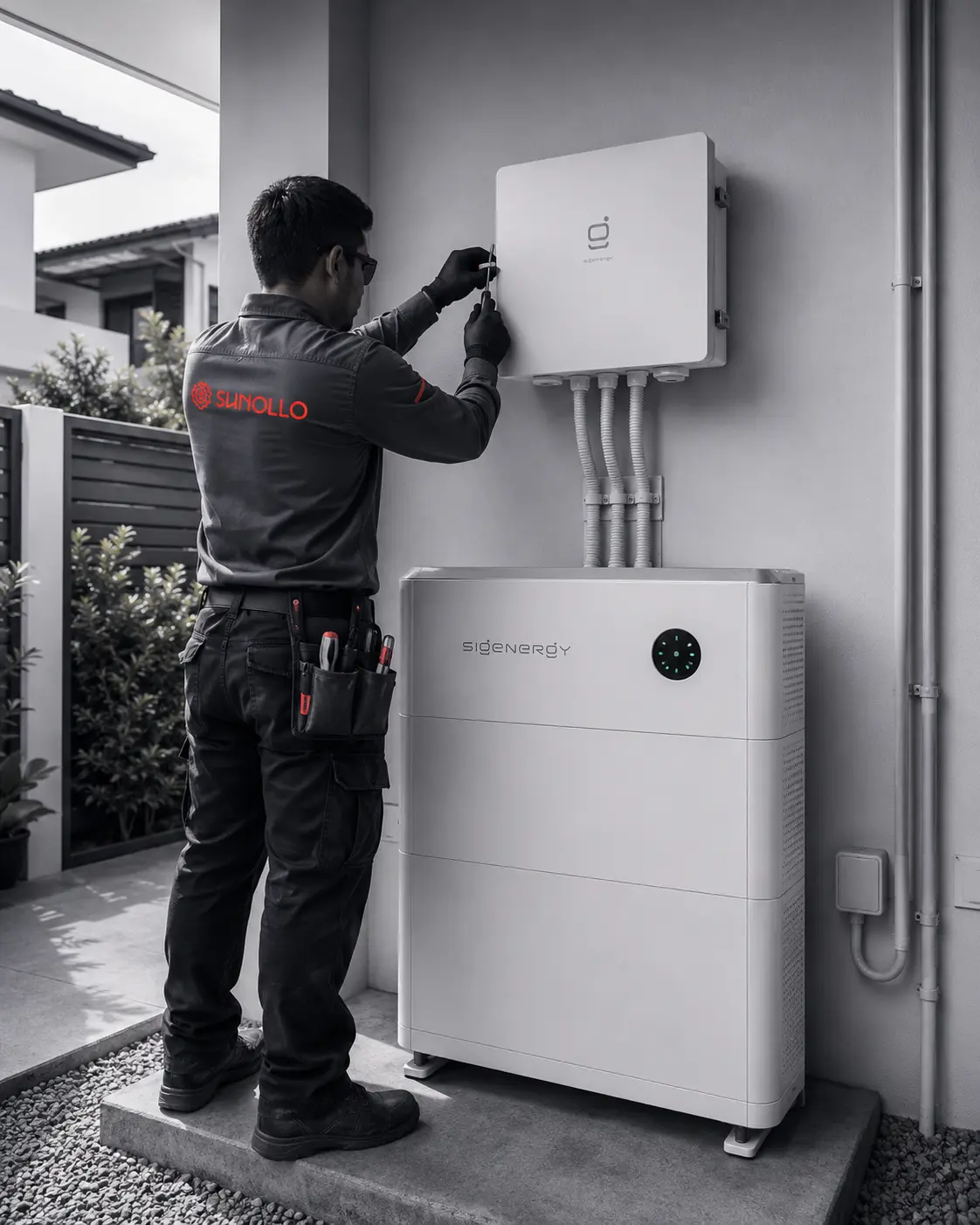
- Solar installers and storage integrators: this is where Sunollo and our peers operate. We solve MOS Gan's two friction points — roof waterproofing and vendor reliability — at the household level. Critical path: build customer trust at a rate that matches the macroeconomic pull.
- The individual homeowner: the only actor whose capital decisions are uncoordinated and yet collectively determine whether the fifth switch reaches the scale that matters.
Part VI — Three Singapores
It is 2035. Singapore peak demand sits at 13-14 GW. Carbon tax is S$80/tonne. LNG markets remain volatile, with Hormuz still a chokepoint. Three different versions of Singapore's electricity system are plausible from where we sit in 2026. They are not equally likely. They are not mutually exclusive in detail. But they are useful as scenarios because they map cleanly onto three different policy and behavioural paths.
21. Scenario A — The Procurement Singapore
The government continues the four-switches strategy with the existing emphasis. Gas remains 60-70% of generation. Imports come online from Indonesia by 2028 and from Australia by mid-2030s, reaching maybe 4-5 GW by 2035 (under the 6 GW target). Solar reaches 3 GWp on schedule. Distributed energy and VPP remain niche — the regulatory sandbox completes, scales modestly, but does not become a primary policy lever. Hydrogen blending begins around 2030. Nuclear remains a study.
Outcome: Singapore remains reliable, more expensive, less carbon-intensive than today, and still structurally exposed to LNG markets. Carbon tax cost flows through to households. Net Zero by 2050 is technically achievable through offsets and hydrogen blending but practically dependent on imports holding.
Probability: medium. This is the "do what you said you would do" path.
22. Scenario B — The Distributed Singapore
MOS Gan's market-driven thesis works. Rising tariffs and falling battery costs drive landed-home solar penetration from <10% (today) to 50%+ by 2032. Solar exceeds the 3 GWp target, reaching 4-5 GWp through aggressive private rooftop deployment plus floating PV and façade BIPV. The VPP scales from 15 MW (2026) to 1+ GW of aggregated assets by 2032. Imports come in as planned. Gas declines to 50-55% of generation by 2032.
The forcing functions: each tariff hike compresses solar payback further; each BloombergNEF battery survey lowers the storage entry point; SP Group's smart meter rollout enables time-of-use pricing that further rewards storage; the VPP sandbox scales into a permanent market mechanism with revenue floors; SunCable arrives mid-decade with cheap firmed power.
Outcome: Singapore meaningfully reduces dependence on imported fuel while maintaining grid reliability. Carbon emissions decline faster than NDC requires. Distributed energy becomes a permanent ~20-25% share of generation. Resilience to LNG shocks materially improves.
Probability: this is where most of the macro forces (tariff trajectory, battery curve, demand growth, data-centre PPAs) are already pushing. It is the base case if no one intervenes.
23. Scenario C — The Sovereignty Singapore
Singapore decides — politically, deliberately, sometime in the next 18-24 months — to treat energy sovereignty as an explicit national objective and accelerates distributed energy as the only way to get there. This involves: an Israel-style mandate or strong incentive for solar on new private construction; an SP Group-operated residential battery leasing programme analogous to SolarNova for HDB; explicit grid-service revenue floors for VPP-enrolled batteries; commercial fast-track permitting that compresses installation timelines; AMI smart-meter rollout completed by 2028; and a designated constituency-scale microgrid pilot (Azhar's proposal, executed).
Outcome by 2035: solar reaches 6+ GWp (the physics ceiling), VPP scales to multi-GW, distributed energy reaches 35-40% of generation, residential battery penetration approaches Israel-2025 levels (5+ kW on every new residential build). Gas falls to 35-40%. Singapore meets and exceeds net zero trajectory for the power sector. Imports become a buffer rather than a primary lever.
Probability: requires political decision and execution. The macro forces support it, but the institutional pivot would have to start in 2026-2027.
24. The 2027 Fork
The scenarios diverge in 2027. Specifically, three decisions made in the next 18 months largely determine which Singapore emerges:
- Does the VPP sandbox graduate into a permanent market mechanism with defined grid-service revenue, or does it remain a pilot? This determines whether household batteries are financial assets with predictable income or just self-consumption tools.
- Does EMA designate a constituency microgrid pilot, picking up Azhar's proposal? This determines whether the architecture moves from Pulau Ubin (30 households) to a real urban context (50,000+ households).
- Does SP Group's AMI smart meter rollout reach majority of residential premises by 2028? This determines whether time-of-use pricing, demand response, and VPP enrolment have the infrastructure to scale.
None of these is a flashy political moment. All three are technical-policy decisions made by EMA, SP Group, and MOS Gan's ministry in the next 18 months. They are the actual hinge points.
Part VII — Synthesis
25. The Thesis, Restated
Singapore has done procurement extraordinarily well. The four switches — gas, solar, imports, emerging tech — are individually well-designed. They are also, collectively, insufficient for energy sovereignty by their own internal arithmetic. Demand is growing faster than imports can come online. Solar is geographically capped. Emerging tech is too far out. Gas remains exposed to Hormuz and Qatar.
The fifth switch — distributed energy aggregated through VPP infrastructure — is the only mechanism that compounds across the gap. It is the only switch with no foreign supplier, no chokepoint, no fuel cost, no geographic constraint beyond a roof, and a learning curve that gets cheaper every year.
The institutional pieces are already moving. EMA's Future Grid Roadmap names the strategic priorities. SP Group is building the digital twin and AMI infrastructure. GasCo provides the procurement-side resilience that buys the time the fifth switch needs to scale. Pulau Ubin has tested the architecture. The VPP is in sandbox. Microsoft and Equinix have shown that hyperscalers will finance large-scale solar via PPA. The economics — at S$5,000-22,000 for a home battery, 4-6 year solar payback, $80/kWh battery packs by 2030 — are converging.
What is missing is not technology, not policy framework, not capital, and not demand. What is missing is a deliberate decision — in the next 18-24 months — about whether Singapore wants the Procurement Singapore, the Distributed Singapore, or the Sovereignty Singapore. The first happens by inertia. The second happens by market force. The third requires political choice.
26. The Role Of The Individual
The unusual feature of this energy transition — compared to almost every other infrastructure transition Singapore has navigated — is that the homeowner is not a passive recipient. They are a capital allocator. The 70,000 landed-home roofs in Singapore, together with the commercial and industrial rooftops, are the substrate of the fifth switch. There is no version of the Distributed Singapore or the Sovereignty Singapore that does not run through tens of thousands of individual installation decisions.
From a household's perspective, the math is now genuinely compelling. A 7-9 kWp residential solar system: S$12,000-18,000 installed, 4-6 year payback at current tariffs, 25-year system life. Add a 9-18 kWh battery: another S$5,000-14,000, 8-year standalone payback or 5-6 years paired with an EV. The Net Energy Rebate exports surplus electricity at S$0.08-0.12/kWh; the retail rate sits at S$0.27-0.35/kWh. Each tariff hike widens the arbitrage. Each carbon-tax increment widens it further. The VPP, when it scales, layers additional grid-service revenue on top.
The decision is not really "should I install solar?" anymore. It is "how much of this decade's tariff escalation do I want to pay at full retail before the system on my roof starts offsetting it?"
27. The Closing
The Strait of Hormuz will reopen — it always does, eventually. The next chokepoint, somewhere, will close — it always does, eventually. Singapore's grid will hold through both. That is what the last fifty years of procurement excellence has bought.
What the next ten years will determine is whether the grid that holds is still 80% dependent on imported molecules, or whether it has become — through ten thousand small decisions made on ten thousand individual roofs — something genuinely different. A grid whose marginal kilowatt-hour comes from a panel on a Singapore roof, stored in a battery in a Singapore garage, dispatched into a Singapore neighbourhood by a Singapore software platform.
That is not a self-sufficient grid. Singapore will never be self-sufficient. But it would be a sovereign grid. There is a difference.
The economics, finally, are pointing in that direction. The question is whether we walk through the door.
Sunollo designs and installs residential and commercial solar and battery systems across Singapore. Our Singapore Solar Data Hub publishes live electricity tariff data, EMA solar capacity statistics, and wholesale USEP market analysis. For an assessment of your specific roof, consumption pattern, and battery options, talk to us. The Distributed Singapore happens one roof at a time.