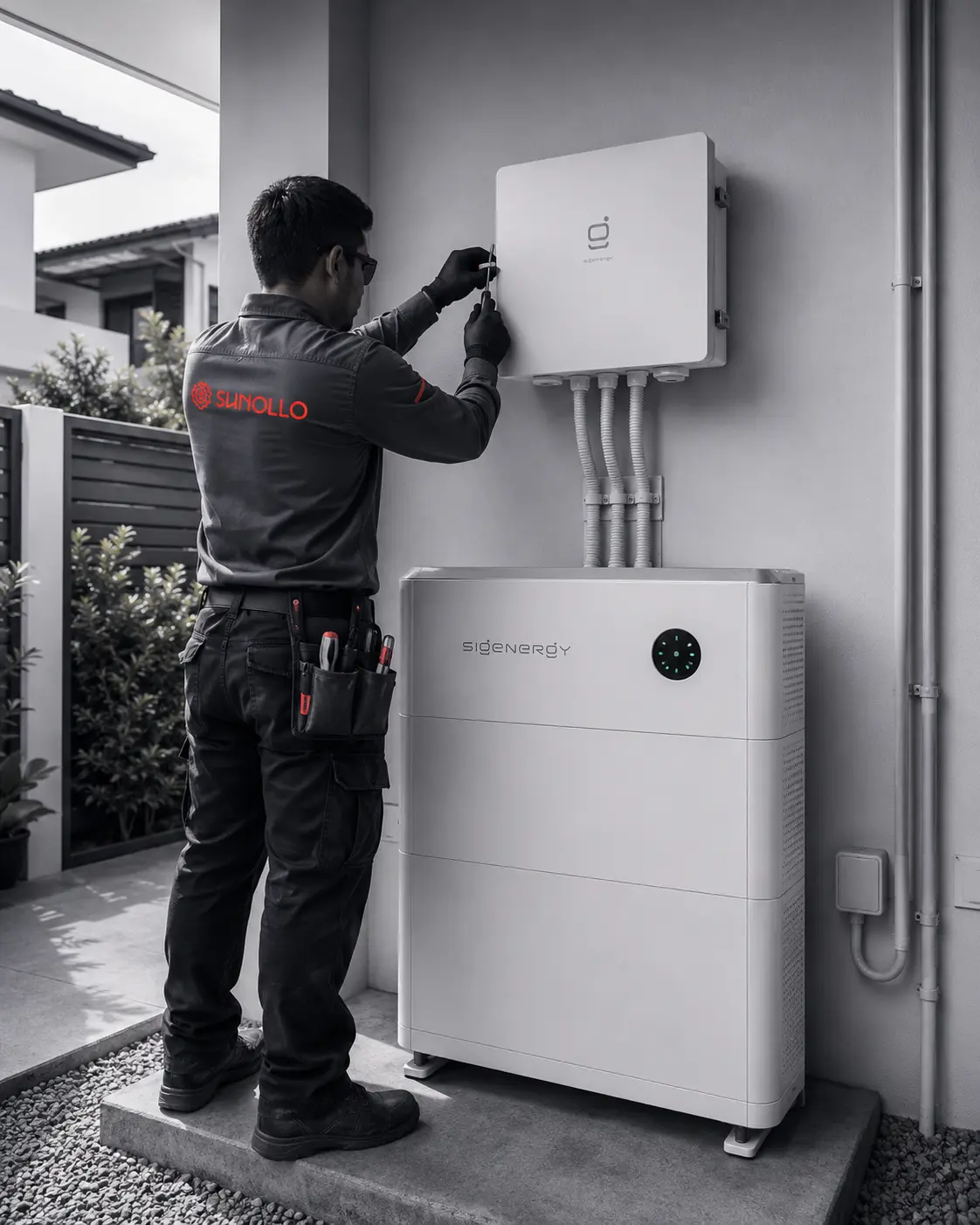
The bottom line: Singapore imports 95% of its energy — primarily natural gas for electricity. Every rooftop solar system reduces that dependence and contributes to energy security. With 1.1 GWp installed and a target of 3 GWp by 2030, distributed residential solar plus batteries is Singapore's fastest path to genuine energy resilience. Each landed home with solar removes 5–8 tonnes of imported energy per year.
On any given day, roughly a fifth of the world's seaborne oil and around a quarter of its liquefied natural gas (LNG) squeezes through a single 33-kilometre wide gap of water at the mouth of the Persian Gulf — the Strait of Hormuz. The International Energy Agency (IEA) has, for years, described a closure of Hormuz as the worst-case shock for global energy security. A recent industry note circulated by analyst Steve Mel summarising the IEA's framing put it bluntly: this is the "worst share" of risk that no LNG-importing economy has fully priced in.
For Singapore, this is not an abstract geopolitical thought experiment. It is the single largest structural risk to our electricity grid. Singapore generates roughly 95% of its electricity from imported natural gas. A meaningful slice of that gas — including LNG cargoes from Qatar and the broader Gulf — physically transits Hormuz before it reaches our terminals. When the strait is in the headlines, our wholesale electricity prices, our SP tariff resets, and ultimately every household's bill are all exposed to that geography.
This article makes the case — calmly, with numbers — for why solar plus home battery storage is no longer a nice-to-have for Singapore homes. It is the most accessible, fastest, and most economically rational form of personal energy independence available to us in 2026. We will explain the risk, the math, and the practical path forward — including how Sunollo's $0-upfront subscription model lets households start now without capital outlay.
The Hormuz Wake-Up Call: What the IEA Is Really Saying
The IEA's published analysis on Hormuz is consistent across cycles: it is the world's most important oil and gas chokepoint, and the world's most consequential single-point energy vulnerability. The Agency has tracked Hormuz transit volumes in detail in its Oil Market Report series and in its periodic Global Energy Review updates. Industry commentators — including a recent widely shared LinkedIn note by Steve Mel — have summarised the IEA's framing as: a closure of Hormuz would be the most severe energy shock the world has ever faced, dwarfing the 1973 oil embargo in absolute terms.
The numbers, drawn from IEA, EIA, and shipping-data references widely cited in the public record:
- Approximately 20% of global oil flows transit Hormuz on any given day.
- Approximately 20–25% of globally traded LNG (the seaborne, super-cooled gas trade) passes through the same strait — almost entirely from Qatar and the UAE.
- There is no full-capacity bypass. Pipelines from Saudi Arabia and the UAE to Red Sea or Indian Ocean ports exist, but at a fraction of the volumes that move through Hormuz.
- Asia is the most exposed region. Japan, South Korea, China, India, Taiwan, Thailand, and Singapore are the buyers of the LNG that originates from or passes through Hormuz.
You do not need a war to feel this risk. Tanker insurance premiums, attack incidents, periodic missile and drone threats, and seasonal political tension all push spot LNG prices higher — and Singapore's wholesale electricity market reflects that within weeks. The 2022 European energy crisis, triggered by the Russian gas shock, is the most recent reminder of how quickly an LNG-dependent grid can be repriced.
Why Singapore Is Structurally Exposed
Singapore is one of the most efficient, transparent, and well-regulated electricity grids in the world. It is also one of the most concentrated in fuel mix.
According to the Energy Market Authority (EMA) and the Singapore Energy Statistics, the country's electricity generation in 2024–2025 was approximately:
| Fuel Source | Share of Singapore Electricity | Origin / Risk Profile |
|---|---|---|
| Natural gas (piped + LNG) | ~95% | Imported. LNG portion is seaborne and includes Hormuz-transit cargoes. |
| Solar (utility + rooftop) | ~3–4% | Domestic, distributed. Zero fuel risk. |
| Other (oil, waste-to-energy, biomass) | ~1–2% | Mostly imported. |
| Cross-border imports (planned) | Pilot scale | Lao PDR, Indonesia, Vietnam — long-distance HVDC, multi-decade build. |
Singapore's piped gas comes via subsea pipelines from Malaysia and Indonesia. Our LNG is sourced globally — including from Qatar, the United States, Australia, and Africa — and arrives at the SLNG terminal on Jurong Island. The Qatari and broader Gulf cargoes physically transit Hormuz. The U.S. and Australian cargoes do not, but they trade in the same global LNG market — a Hormuz disruption would push all spot LNG prices up sharply, regardless of cargo origin. This is precisely the dynamic Europe experienced in 2022.
EMA has been clear in its Singapore Energy Story framework that diversification is essential. The strategy rests on four "switches": natural gas (incumbent), solar (domestic), regional power grids (imports from neighbours), and emerging low-carbon alternatives (hydrogen, geothermal, nuclear-adjacent). Of these, only solar is something a homeowner can deploy directly, on their own roof, this year.
The Energy Trilemma: Secure, Affordable, Clean
Energy policy is governed by what specialists call the energy trilemma — the trade-off between three goals: security of supply, affordability, and environmental sustainability. Historically, importing nations have had to choose two and compromise on the third. Singapore's grid is reliable and (relatively) affordable but exposed on security and emissions.
For the first time in modern energy history, residential solar plus battery storage delivers on all three simultaneously:
- Security: Generated on your own roof. Stored in your own home. No tanker, no pipeline, no chokepoint.
- Affordability: Module prices have dropped more than 80% over the last decade. LFP battery cell prices have dropped 40%+ since 2022. With Sunollo's $0-upfront subscription, the model becomes operationally net-positive from month one.
- Clean: Zero direct emissions from the panel. Compliant with Singapore's Budget 2026 solar acceleration and the broader Green Plan 2030.
What Solar Solves — And Where Batteries Close the Gap
Solar panels solve the generation half of the energy security problem. From roughly 7 AM to 6 PM, a typical Singapore landed roof can produce more electricity than the household consumes. The system offsets daytime grid use directly and exports surplus power back through the Net Energy Rebate (NER) scheme.
But Singapore's residential consumption is not flat. It is heavily back-loaded toward the evening — aircon switches on between 6 and 7 PM, dinner is cooked, lights and entertainment systems run from 7 to 11 PM. This is exactly when solar generation drops to zero. Without storage, your solar value is split: high-value daytime self-consumption, lower-value NER export, and full-price grid imports for the entire evening.
A home battery closes that gap. It captures the surplus solar at midday and releases it back into the home from 6 PM until bedtime. The math:
- A typical 10 kWp solar system without a battery achieves 30–40% self-consumption.
- The same system with a 10 kWh LFP battery achieves 60–80% self-consumption.
- Every kWh shifted from "exported at NER rate" to "self-consumed at retail rate" captures the spread of approximately S$0.06–0.08/kWh — multiplied across thousands of kWh per year, that is real money.
- More importantly: every kWh self-consumed in the evening is a kWh that did not need to be imported as LNG.
For a deeper technical and economic breakdown, read the Sunollo Home Battery Storage Pillar Guide.
Anatomy of an Energy-Independent Singapore Home
Let's get specific. The phrase "energy independent" does not mean off-grid — Singapore's grid is too reliable and the regulatory framework too well-designed to make off-grid sensible for most homes. It means resilient by design: most of your annual energy comes from the sun, evening hours are covered by storage, the grid acts as backup rather than baseline, and short outages do not interrupt essential household function.
A representative 2026 system for a 4-bedroom landed home in Singapore:
| Component | Spec | Function |
|---|---|---|
| Solar array | 10–14 kWp (24–34 panels) | Generates ~12,000–17,000 kWh/year |
| Hybrid inverter | SolarEdge SunMax / Huawei SUN2000 / GoodWe ET | Converts DC to AC; manages battery |
| Panel-level optimisers | SolarEdge SunMax (Sunollo standard on Abundance Pro) | Maximises output per panel; mitigates shading |
| Battery storage | 10–13 kWh LFP (Tesla Powerwall / BYD / Huawei LUNA / GoodWe Lynx) | Covers evening household load 6 PM–11 PM |
| Smart meter (SP) | NER-compliant bidirectional meter | Tracks export and import for billing |
| Backup sub-panel | Dedicated essential circuits | Refrigerator, lighting, WiFi, security stay on during outage |
| Monitoring | LiveTrack / EnergyHub / FusionSolar | Real-time visibility of generation, consumption, battery state |
For a typical Singapore landed family, this configuration delivers approximately:
- 70–85% of annual electricity from your own roof (solar self-consumption + battery-shifted self-consumption).
- 15–30% remaining grid dependency, used mostly for weather-driven shortfalls and overnight.
- 6–20 hours of essential-circuit backup if the grid trips during the day or evening.
That is, in practical terms, energy independence at the household scale — without going off-grid, without losing the NER rebate, and without giving up the convenience of grid-connected reliability.
Battery Economics in Singapore 2026
The economic case for batteries has improved dramatically. Three forces are converging in 2026:
- Cell cost compression. LFP cell prices have fallen from approximately US$160/kWh in 2022 to under US$80/kWh in 2026 (BloombergNEF, CATL public guidance). Installed home battery prices in Singapore have dropped from S$1,200/kWh installed to S$450–650/kWh installed.
- NER value compression. As more solar is added to the Singapore grid, the NER export rate is structurally compressing relative to retail tariffs. The spread between retail and export — historically S$0.05–0.08/kWh — is widening, not narrowing. Storage captures that spread.
- Geopolitical premium on imported gas. Hormuz, Russia, OPEC+ decisions, and the broader LNG market mean Singapore's wholesale electricity price is more volatile, not less. A home battery is the most direct hedge a homeowner can buy.
For purchase economics, a 10 kWh LFP battery costs approximately S$5,000–6,000 installed in 2026. Annual savings from batteries paired with a properly sized solar system are typically S$500–900 per year. Outright payback: 8–12 years. Under Sunollo's subscription model, however, the question is no longer "when will it pay back?" — it is "is the monthly subscription lower than my monthly savings?" When the answer is yes from month one (which it consistently is for Abundance Pro tier and battery), the homeowner is net-positive immediately.
For full pricing, brand-by-brand comparisons, and worked examples, see the Home Battery Storage Singapore Pillar Guide and our battery payback period guide.
Who Benefits Most From Solar + Battery in Singapore
Not every household needs the same configuration. The five segments where solar + battery delivers the strongest combined security and economic value:
- Landed and cluster home owners. Roof control, electrical panel access, and typically higher evening consumption (multiple aircon, kids returning from school, work-from-home setups). The clearest win.
- EV-owning households. A solar + battery + EV charger triple stack lets you charge the car from solar in the day and run the home from battery at night. Detailed maths in our Solar + Battery + EV Bundle Guide.
- Work-from-home households. Daytime consumption is no longer near-zero. Solar self-consumption ratios are higher, but evening loads remain. Battery captures both peaks.
- Multi-generational homes. 24-hour active occupancy, often with dedicated rooms for elderly parents or domestic helpers. Higher absolute kWh = higher absolute savings.
- Risk-aware professionals. Households where a parent or grandparent depends on continuous power for medical equipment, refrigerated medication, or home dialysis. Backup is not a luxury here — it is medical.
Resilience in Practice: What Solar + Battery Actually Buys You
Singapore's grid uptime is among the world's best — typically 99.99%+ availability, far better than most developed countries. Outages are rare and usually short. But "rare" is not "never". Construction-related faults, transformer issues, lightning strikes, and (in extreme scenarios) regional supply disruptions all happen. With a battery + backup gateway, your essential circuits stay on automatically:
| Appliance / Circuit | Power Draw | Hours on a 10 kWh Battery |
|---|---|---|
| Refrigerator | 100–200 W | 50–100 hours |
| WiFi router + modem | 15–30 W | 300+ hours |
| Whole-house LED lighting | 100–300 W | 33–100 hours |
| One inverter aircon room | 600–1,200 W | 8–16 hours |
| Combined essential loads | 500–1,500 W | 6–20 hours |
If the outage occurs during daylight, panels continue charging the battery — backup runtime extends indefinitely. This is structurally different from a generator: silent, fuel-free, automatic, and zero-maintenance.
For the broader resilience picture and how solar + battery interacts with Singapore's grid and SP Group billing, read our guide to how SP Group pays for your solar electricity.
Regulation and Safety in Singapore
Singapore is one of the most rigorously regulated solar and storage markets in Asia. Three frameworks matter for residential systems:
- EMA (Energy Market Authority) regulates grid connection, NER metering, licensing of solar installers, and the broader Singapore Energy Story policy direction.
- SCDF (Singapore Civil Defence Force) sets fire safety guidelines for battery storage placement and circuit protection. LFP chemistry is preferred precisely because of its thermal runaway safety profile (onset above 270°C vs ~150°C for older NMC chemistry).
- BCA / MOM (Building & Construction Authority / Ministry of Manpower) governs work-at-height, scaffolding, and licensed contractor requirements during installation. We covered this in detail in our 2026 MOM/BCA scaffolding guide for residential solar.
Sunollo's installations are EMA-licensed, SCDF-compliant, and use only IEC 62619 / UL 9540A certified LFP batteries from Tesla, BYD, Huawei, Enphase, and GoodWe — the same hardware deployed across hundreds of thousands of homes globally.
How Sunollo Delivers This — $0 Upfront, $99–$129/Month
The case for solar + battery is the easy part. The hard part has historically been the cheque: S$30,000–50,000 of upfront capital for a complete landed-home system. Sunollo's subscription model removes that barrier entirely.
- Abundance — premium panels, smart inverter, full LiveTrack monitoring, 25-year product warranty. From $99/month, $0 upfront. View Abundance →
- Abundance Pro — Eclipse panels, SolarEdge SunMax optimisers, battery and EV-ready, 25-year warranty. From $129/month, $0 upfront. View Abundance Pro →
- Battery add-on — Tesla Powerwall, BYD, Huawei LUNA2000, or GoodWe Lynx, sized to your evening consumption, fully managed under SunolloCare.
- Savings Guarantee — your annual savings exceed your annual subscription, or Sunollo credits the shortfall.
- SunolloCare — 24/7 monitoring, annual maintenance, warranty management, and replacement coverage.
This is not solar-as-purchase. It is energy independence as a service. The technology risk, the price-volatility hedge, the warranty management, and the future upgrade path all sit with Sunollo. The savings sit with you.
For a comparison of how to evaluate any solar offer in Singapore — including ours — read our 2026 quote comparison framework and the 25-question buyer's checklist.
The 2026 Energy Independence Readiness Checklist
- Pull your last 12 months of SP electricity bills. Average monthly kWh is the foundation of correct sizing.
- Note your evening usage pattern. Aircon hours, EV charging plans, work-from-home days, peak family hours.
- Confirm roof eligibility. Landed and cluster homes — almost always yes. Condos and HDB — see our HDB solar guide.
- Decide on backup priority. If continuous power matters (medical, work-from-home critical), specify backup-capable inverter and a dedicated essential-circuits sub-panel at design stage.
- Get at least two quotes. Use our comparison framework to evaluate apples-to-apples.
- Choose ownership model. Outright purchase (long payback, capital tied up) vs Sunollo subscription (zero upfront, net-positive from month one).
- Verify warranties and certifications. 25-year panel warranty, 10-year battery warranty (with capacity guarantee), licensed EMA installer, IEC/UL certified hardware.
- Plan installation timing. 4–8 weeks from contract to commissioning is typical for landed homes.
- Activate NER through SP Group. Sunollo handles the paperwork as part of installation.
- Use the system actively. Shift deferrable loads (laundry, dishwashing, EV charging) to solar hours. Read our battery investment maximisation guide.
Frequently Asked Questions
Q: Is Singapore really at risk from a Hormuz disruption? Yes — but indirectly more than directly. Singapore sources LNG from a diversified pool (Qatar, US, Australia, Africa). Even if no Singapore-bound cargo physically transits Hormuz, a disruption would push global spot LNG prices up sharply, and Singapore's wholesale electricity prices would follow within weeks. The 2022 European energy shock is the precedent.
Q: How much of my electricity can I really get from solar + battery in Singapore? For a landed home with a properly sized 10–14 kWp system and a 10–13 kWh LFP battery, expect 70–85% of annual electricity from your own roof. The remaining 15–30% comes from the grid, mostly during low-generation weather and overnight hours.
Q: What is the payback period under the Sunollo subscription? Under the subscription model, the standard payback metric does not apply. The homeowner pays $0 upfront and is net-positive from month one when the monthly savings exceed the monthly subscription — which is the design intent of Abundance and Abundance Pro tiers. The Sunollo Savings Guarantee enforces this.
Q: Will a battery still earn me the NER rebate? Yes. Surplus solar that is not stored and not self-consumed continues to be exported and earns the NER rebate. The battery simply increases the share of solar you self-consume (higher value) versus export (lower value).
Q: Can my system run during a power outage? If you specify a backup-capable inverter and a dedicated backup sub-panel at the design stage, yes. Essential circuits (refrigerator, lighting, WiFi, one aircon) typically run for 6–20 hours on a 10 kWh battery, longer if the outage occurs during daylight (panels continue charging the battery).
Q: How does this compare to Singapore's regional power import strategy? Cross-border imports from Lao PDR, Indonesia, and Vietnam are part of Singapore's long-term diversification — but they are years to decades from full deployment, dependent on inter-government agreements, and rely on long-distance HVDC infrastructure. Rooftop solar plus battery is the only diversification a homeowner can deploy this year.
Q: Is LFP battery storage safe in a tropical climate? Yes. LFP (Lithium Iron Phosphate) is the safest commercial lithium chemistry, with thermal runaway onset above 270°C and an olivine crystal structure that does not release oxygen during decomposition. Sunollo specifies LFP for every Singapore home installation and complies with SCDF and IEC 62619 / UL 9540A safety standards.
Q: What about the carbon angle? Singapore's carbon tax is rising on a published trajectory (S$25/tonne in 2024, scaling to S$50–80/tonne by 2030). Embedded electricity emissions get more expensive every year. Solar + battery insulates the homeowner from that escalation while contributing directly to Singapore's Green Plan and Budget 2026 solar acceleration.
Q: I already have solar from another provider — can I add a battery? In most cases, yes. Either via a hybrid inverter upgrade or via an AC-coupled battery (Tesla Powerwall 3, Enphase IQ Battery) that sits alongside your existing inverter. Email [email protected] for a compatibility assessment.
Bottom Line
Singapore's energy security is not, fundamentally, a Singapore problem. It is a Hormuz problem, a Russia problem, a global LNG market problem — and we are at the receiving end of all of them. The IEA has been telling the world this for years. The 2022 European crisis showed what it looks like in practice. Steve Mel and other industry analysts continue to flag it as the worst-case shock that LNG-importing economies have not fully priced in.
For Singapore households in 2026, there is one practical, scalable, economically rational response: generate your own power, store it on-site, and reduce the grid to a backup role rather than the baseline. The technology is mature, the regulation is supportive, the economics are net-positive from month one under Sunollo's subscription model, and the geopolitical case has never been clearer.
This is not about ideology. It is about insulating your home from a chokepoint 6,000 kilometres away. And it starts with a roof, a panel, and a battery.
Get Started
- Free assessment: Email [email protected] or call +65 8089 7400.
- Battery-focused configurator: sunollo.com/landing-bat
- Compare residential tiers: Radiance, Abundance, Abundance Pro
- Read the pillar: Home Battery Storage Singapore 2026 — Complete Guide
- Read the buyer's checklist: 25 Questions Before Signing
Sources and Further Reading
- International Energy Agency (IEA), Oil Market Report and Global Energy Review series — Hormuz transit volumes and global energy chokepoint analysis. iea.org
- U.S. Energy Information Administration (EIA), World Oil Transit Chokepoints. eia.gov
- Singapore Energy Market Authority (EMA), Singapore Energy Statistics and the Singapore Energy Story. ema.gov.sg
- Singapore National Climate Change Secretariat (NCCS), Singapore Green Plan 2030. greenplan.gov.sg
- BloombergNEF, Battery Price Survey — annual lithium-ion cell price tracking.
- Steve Mel, LinkedIn analyst note summarising the IEA's framing of a Hormuz closure as the worst-case energy shock (2025–2026).
- Sunollo internal data — installations, system performance, and customer savings across 12,000+ Singapore households.