Solar Self-Consumption vs Grid Export Singapore: How to Maximise Your Savings
If you are installing solar in Singapore, one decision quietly matters more than panel brand or inverter choice: whether your kilowatt-hours stay in your home or flow out to the grid. The same sunshine can be worth two to three times more depending on when and where those electrons are used. This guide explains how self-consumption and grid export interact with local rules, typical home behaviour, and practical ways to tilt the balance toward savings.
For context on common misunderstandings about payback and performance, see our 15 Solar Myths guide.
Why self-consumed solar is worth more than exported solar
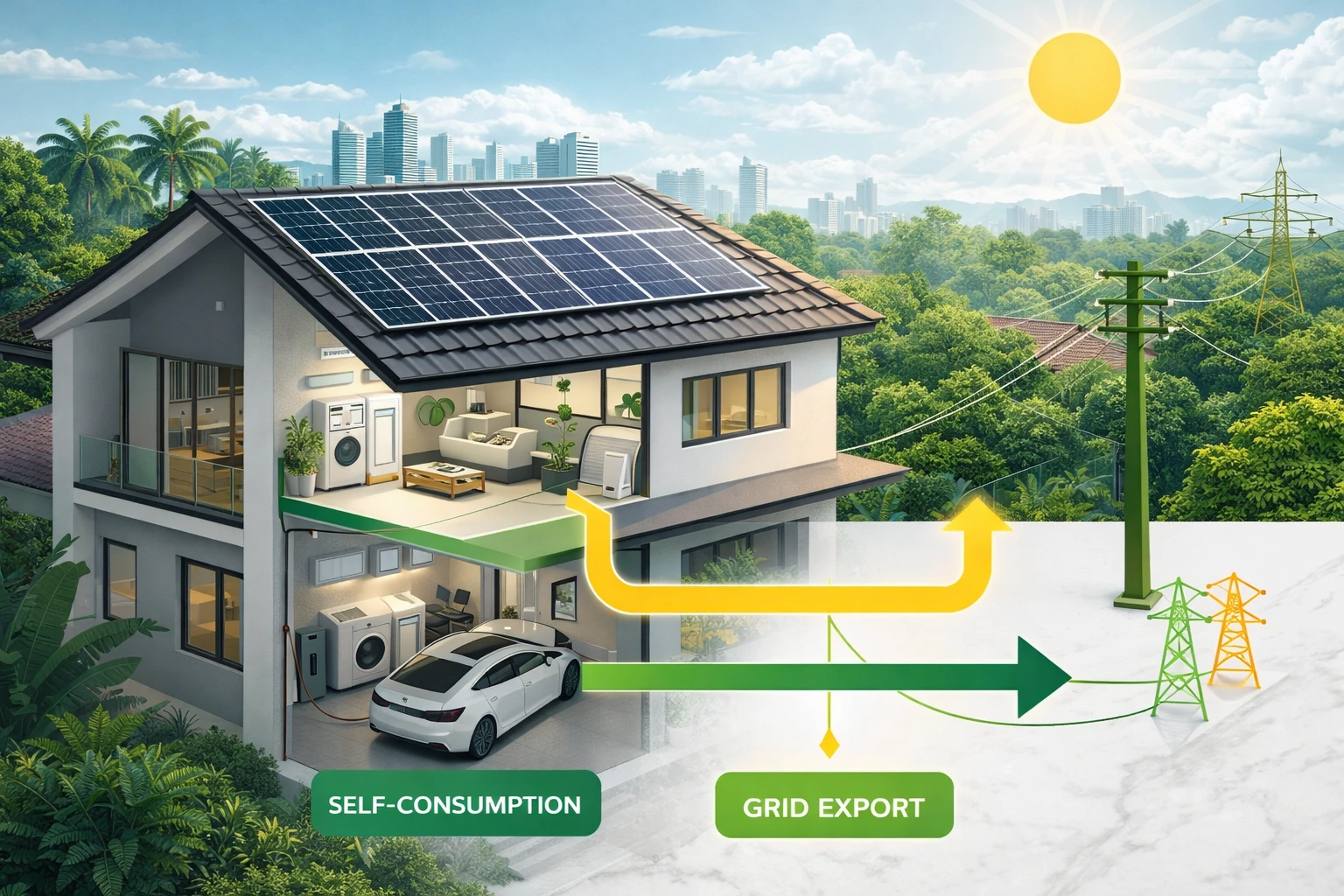
Self-consumption means your home uses solar electricity as it is generated, reducing the amount you buy from the grid at retail rates. Grid export means surplus generation is sent into the network and compensated under Singapore's applicable crediting arrangements.
For many households, the effective value of avoiding a retail purchase is roughly S$0.30–S$0.35 per kWh. By contrast, the compensation value for exported energy is typically much lower, often around S$0.08–S$0.15 per kWh depending on market conditions. That gap is why export value is commonly about two to three times lower than self-consumption value.
How Simplified Credit Treatment works
Singapore's market uses a central intermediary model. Under SP Group's Enhanced Central Intermediary Scheme (ECIS), eligible solar installations receive credits for exported electricity through the Simplified Credit Treatment (SCT). Rather than being "paid cash" per kWh at retail, SCT is a structured crediting treatment aligned with wholesale market references. This reinforces the core incentive: maximise on-site use when retail rates are high, and treat export as a useful safety valve for surplus, not the primary savings engine.
Strategies to increase self-consumption
- Shift thermal loads. Pre-cool rooms before late afternoon, run washers and dishwashers midday.
- Use timers and automation. Smart plugs and delay starts align energy-hungry tasks with production peaks.
- Pool pumps and supplementary systems. Schedule pumping during midday rather than overnight.
- Smart home orchestration. Coordinate blinds, fans, and AC staging to use solar when abundant.
- Monitor, then adjust. A week of attention to your inverter app usually reveals obvious export spikes.
For retail plan optimisation, see our OEM electricity plan guide.
How home batteries change the equation
A battery moves kilowatt-hours from surplus periods to deficit periods. That time shift can materially increase effective self-consumption because stored solar can be discharged in the evening when retail-priced grid imports would otherwise dominate. Batteries are especially relevant when export crediting is materially below retail and when evening demand is large.
For a structured overview of products, safety, and integration, read the battery storage guide.
Frequently Asked Questions
Is exported solar "wasted" in Singapore?
No. Export helps balance your system and provides crediting, but exported energy is compensated at a lower value than retail-displaced energy. Export is best viewed as flexibility rather than the primary savings engine.
Does SCT mean I get paid retail for what I send to the grid?
No. SCT is a simplified crediting treatment under the ECIS framework. Export treatment tracks scheme design and market references rather than mirroring your full retail rate.
What is a realistic self-consumption target?
Many homes fall near 40–70% without batteries. With deliberate daytime scheduling and smart controls, moving toward the upper part is often achievable. Batteries can push effective solar utilisation higher.
Should I oversize panels to sell more electricity?
Usually not if export crediting is materially below retail. Size to consumption patterns and planned changes like EVs or household expansion.
For the complete picture on solar economics in Singapore, read our 15 Solar Myths guide.