It's Official: Singapore Electricity Hits a Record High
On 30 June 2026, the Energy Market Authority (EMA) and SP Group confirmed what analysts had warned about: from July, the regulated electricity tariff for households jumps 17% to 31.91 cents per kWh before GST — up 4.64 cents from the previous quarter. This is the highest electricity tariff Singapore has ever seen, beating the previous record of 30.45 cents/kWh set back in the fourth quarter of 2008.
The overall tariff, including non-household users, rises by an average of 17.5%. Piped town gas isn't spared either — City Energy's household gas tariff climbs 7.1% to 23.48 cents/kWh. We predicted a rise of this magnitude in our earlier analysis of the July 2026 tariff and why it happened — the official numbers have now confirmed it.
| Metric | Previous quarter | Jul–Sep 2026 | Change |
|---|---|---|---|
| Household electricity tariff (before GST) | 27.27 cents/kWh | 31.91 cents/kWh | +4.64 cents (+17%) |
| Previous all-time high (Q4 2008) | 30.45 cents/kWh | Now exceeded | |
| Town gas tariff (before GST) | 21.92 cents/kWh | 23.48 cents/kWh | +7.1% |
| Avg. 4-room HDB monthly bill impact | — | — | +$17.14/month |
What This Means for Your Monthly Bill
For a four-room HDB household, EMA estimates an extra $17.14 per month before GST. But the pain scales with consumption — and landed homes, with air-conditioning, water heaters, pools and EVs, consume far more. Here is the rough impact at the new 31.91 cents/kWh rate:
| Home type | Typical usage | New monthly bill (before GST) | Extra vs last quarter |
|---|---|---|---|
| 4-room HDB | ~370 kWh | ~$118 | +$17 |
| Terrace house | ~900 kWh | ~$287 | +$42 |
| Semi-detached | ~1,400 kWh | ~$447 | +$65 |
| Bungalow | ~2,200 kWh | ~$702 | +$102 |
For a deeper breakdown of how the SP bill is built and where solar cuts it, see our guide on how solar reduces your SP electricity bill by 70–85%.
Why This Keeps Happening — and Why It Will Happen Again
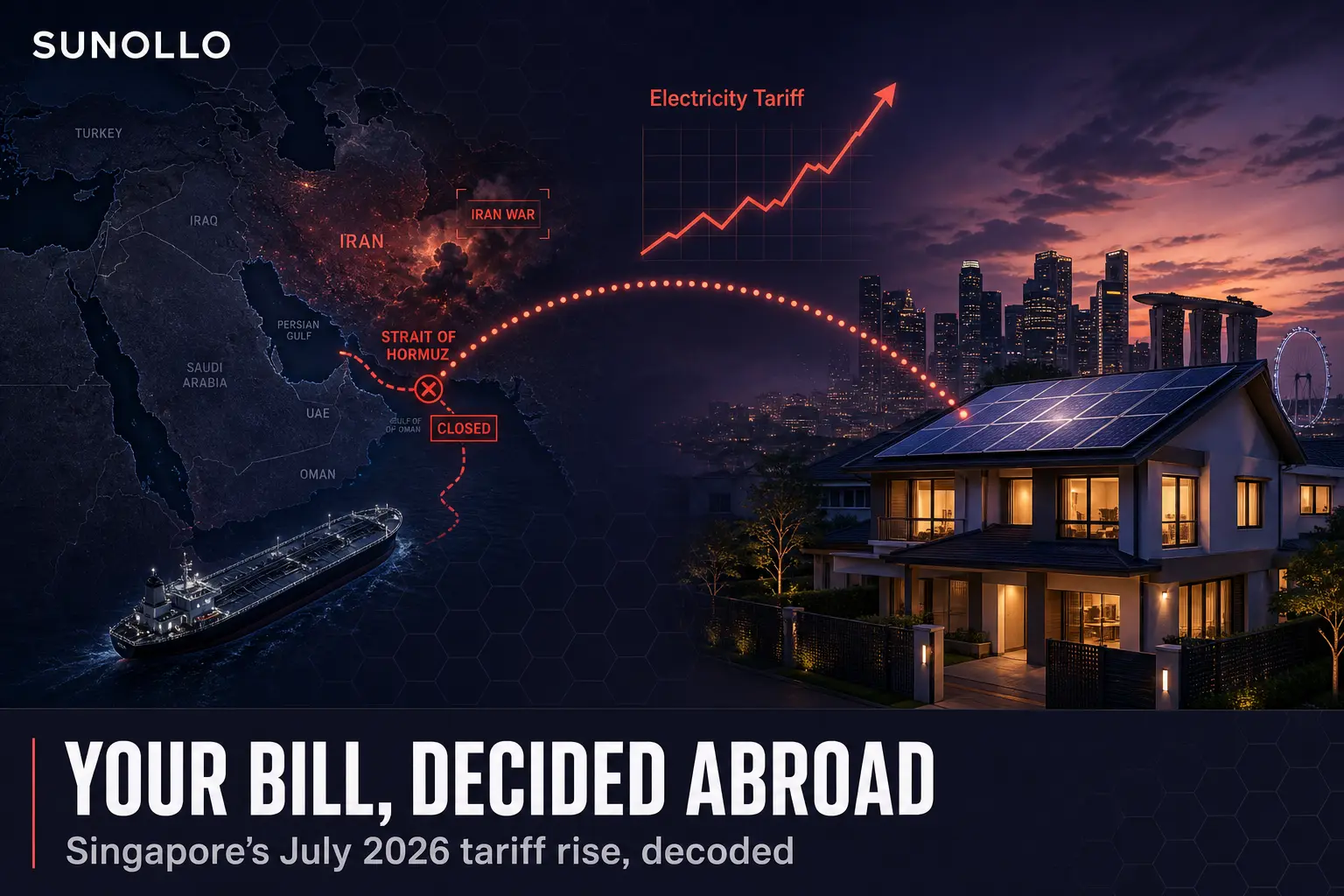
Singapore generates roughly 95% of its electricity from imported natural gas. That makes household bills a direct function of global gas prices, which are set by geopolitics far beyond our control. This quarter's spike traces back to elevated natural gas prices amid the conflict in the Middle East. EMA says tariffs could ease in the fourth quarter if fuel prices fall — but they could just as easily rise again. As our piece on oil prices, solar and Singapore explains, the only certainty is volatility.
The cost of solar has already fallen to record lows. The cost of not going solar rises with every tariff revision.
Rebates and Fixed-Price Plans Are Band-Aids, Not Cures
The Government is cushioning the blow: more than a million HDB households will receive up to $190 in U-Save rebates in July (double the usual amount), plus up to one month of Service & Conservancy Charges rebates. That helps — but it's a one-off, means-tested top-up, not protection against the next hike.
Many households are also rushing to fixed-price plans (uptake rose as retailers reported up to four times more sign-ups). A fixed plan locks your rate for one to three years — but you are still buying someone else's electricity, and when the contract ends you re-enter the market at whatever the price is then. Compare the trade-offs in our guide to solar versus electricity retailers.
The Only Hedge You Actually Own: Rooftop Solar
Rebates run out. Fixed contracts expire. But sunlight is free, and a rooftop solar system keeps generating your own power for 25+ years — completely insulated from gas prices, the Middle East, and every future tariff revision. And here is the counter-intuitive part: every tariff hike makes solar a better investment, because each kWh you generate now displaces electricity that costs 31.91 cents instead of 27.27.
At today's prices, a properly sized system pays for itself in roughly 3–5 years and saves a landed home $2,500–$5,000+ per year. We break down the full economics in is solar worth it in Singapore in 2026 and solar panel cost in Singapore. The bottom line: with Sunollo's residential solar in Singapore, you can start from S$99/month with $0 upfront — often less than the increase you just absorbed on your bill.
Add Battery Storage to Fully Insulate Yourself
Solar handles the daytime. To beat rising tariffs around the clock — storing cheap daytime energy to use at night, and riding through outages — pair your panels with home battery storage. A solar-plus-battery system is the closest thing to true energy independence for a Singapore home, and it removes almost all of your exposure to the next quarterly tariff shock.
Why Sunollo Is Best Positioned to Help You Right Now
This is exactly the moment Sunollo was built for. A few reasons homeowners choose us when tariffs spike:
- $0 upfront, from S$99/month. Start saving immediately without a large capital outlay — the subscription can cost less than your tariff increase.
- SunolloCare 25-year coverage. Panels, workmanship, roof-leak warranty and system insurance included as standard, so your savings are protected for the system's full life.
- Panel-level optimisers as standard. Maximum energy harvest even on Singapore's partially shaded, multi-angle rooftops.
- Guaranteed savings. Our model is built around delivering real, measurable bill reduction — not just an installation.
- Elite, proven leadership. Sunollo's founders have delivered clean energy to tens of thousands of households across ASEAN, including co-founding an ENGIE joint venture that electrified around 50,000 consumers in Southeast Asia. That operating pedigree is rare in Singapore's solar market — see how to evaluate installers in our guide to choosing the best solar company in Singapore.
Don't Wait for the Next Hike
Tariffs are now at record highs and fuel markets remain volatile. The households who act now lock in decades of savings against a rising baseline; those who wait simply pay more each quarter. The first step is free: get a no-obligation roof assessment and savings estimate.
Explore Sunollo's solar packages for Singapore homes →
Frequently Asked Questions
How much are Singapore electricity tariffs rising in July 2026?
The regulated household electricity tariff rises 17% to 31.91 cents/kWh (before GST) for July–September 2026 — a record high. That is about $17.14 more per month for a four-room HDB flat, and considerably more for landed homes. The town gas tariff rises 7.1% to 23.48 cents/kWh.
Why are electricity prices going up in Singapore?
Singapore produces about 95% of its electricity from imported natural gas, so tariffs track global gas prices. This quarter's increase is driven by elevated natural gas prices amid the conflict in the Middle East. Tariffs are reviewed quarterly and reflect fuel costs with a lag.
Will electricity prices come back down?
EMA has said tariffs could ease in the fourth quarter of 2026 if fuel prices fall, but prices are currently at all-time highs and remain volatile. Rooftop solar removes this uncertainty entirely by letting you generate your own power.
Is solar worth it with the 2026 tariff hike?
Yes — higher tariffs shorten the payback period because every self-generated kWh now offsets a more expensive grid unit. A landed home typically saves $2,500–$5,000+ per year with payback in about 3–5 years, and Sunollo offers $0 upfront plans from S$99/month.
Fixed-price plan or solar — which is better against rising tariffs?
A fixed-price plan only locks your rate for one to three years and you still buy electricity from a retailer. Solar generates your own electricity for 25+ years, fully insulating you from future tariff revisions. Adding a home battery extends that protection to night-time and outages.
How does Sunollo help homeowners beat the tariff increase?
Sunollo offers $0 upfront solar from S$99/month, SunolloCare 25-year coverage, panel-level optimisers and a guaranteed-savings model. Its founders have delivered clean energy to tens of thousands of households across ASEAN, bringing rare operating experience to Singapore's residential solar market.