Considering solar for your own home?
Sunollo installs and operates residential solar across Singapore — buy outright or from $0 upfront ($99/month), with the same battery-ready hardware on both paths; SunolloCare is bundled on $0-upfront and elective on outright. Get a free savings estimate →
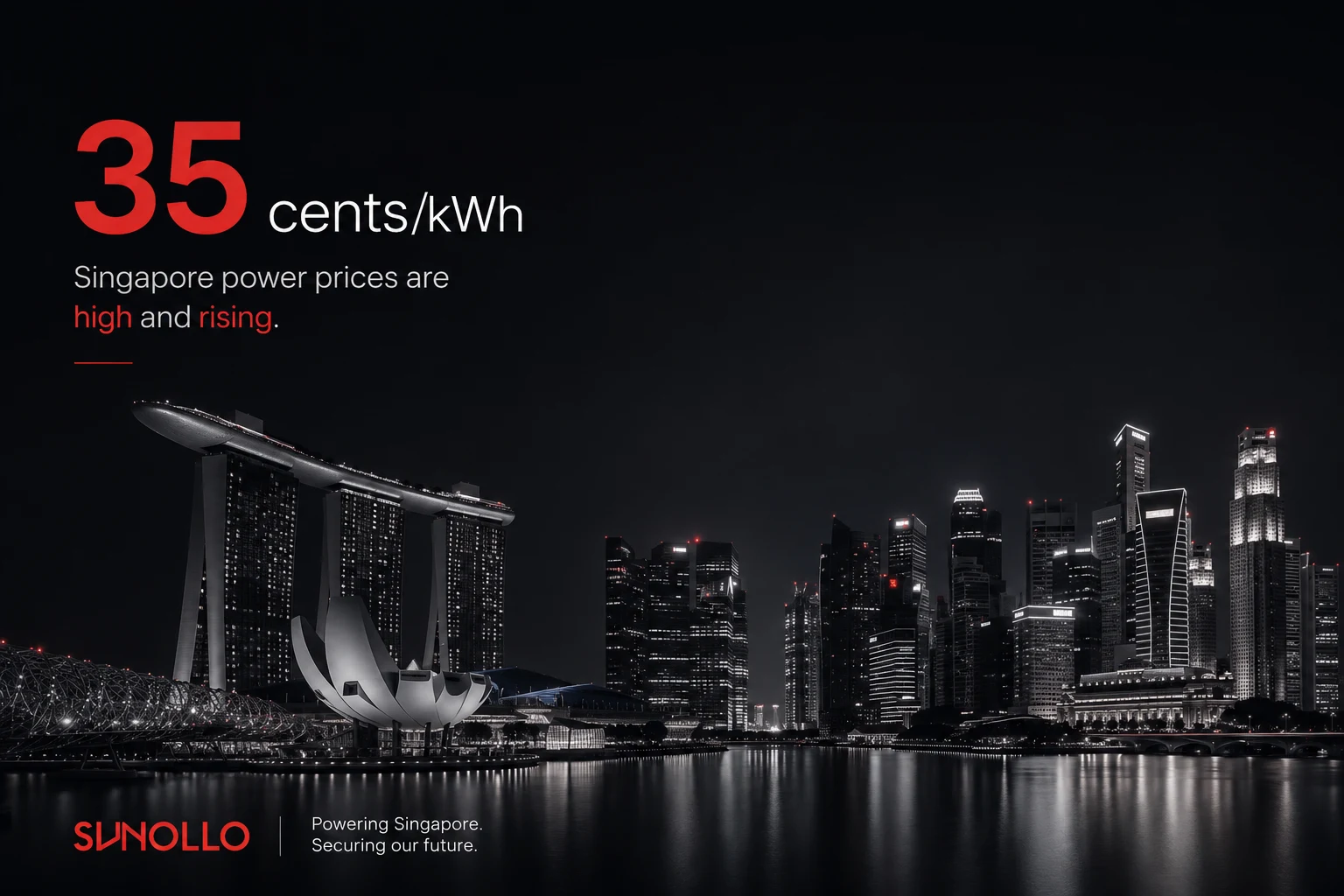
The Current Price of Electricity in Singapore (Q3 2026)
| Regulated tariff (households, before GST) | 31.91¢/kWh |
|---|---|
| GST (9%) | +2.87¢/kWh |
| What you actually pay | 34.78¢/kWh |
| Change vs Q2 2026 | +17.0% (+4.64¢ before GST) |
| Record status | Highest in Singapore's history — previous before-GST peak was 30.45¢ in Q4 2008 |
| Typical impact, 4-room HDB | About +S$17.14/month before GST (SP Group) |
| Valid | 1 July – 30 September 2026; next revision announced ~30 September 2026 |
Source: SP Group tariff revision, 30 June 2026. GST-inclusive figure as reported by CNA.
Most headlines quote the before-GST number. Your bill is settled with GST — so every published tariff understates what leaves your bank account by 9%. This tracker always shows both.
Singapore Electricity Tariff History, 2022–2026
Quarterly household (low-tension) tariff as published by SP Group, with the GST rate applicable in each year and the resulting all-in cost. Data: SINGSTAT monthly electricity tariff dataset (data.gov.sg) and SP Group announcements.
| Quarter | Tariff before GST (per kWh) | GST | All-in cost (per kWh) |
|---|---|---|---|
| 2022 Q1 | 25.44¢ | 7% | 27.22¢ |
| 2022 Q2 | 27.94¢ | 7% | 29.90¢ |
| 2022 Q3 | 30.17¢ | 7% | 32.28¢ |
| 2022 Q4 | 29.74¢ | 7% | 31.82¢ |
| 2023 Q1 | 28.95¢ | 8% | 31.27¢ |
| 2023 Q2 | 27.43¢ | 8% | 29.62¢ |
| 2023 Q3 | 27.74¢ | 8% | 29.96¢ |
| 2023 Q4 | 28.70¢ | 8% | 31.00¢ |
| 2024 Q1 | 29.89¢ | 9% | 32.58¢ |
| 2024 Q2 | 29.79¢ | 9% | 32.47¢ |
| 2024 Q3 | 29.88¢ | 9% | 32.57¢ |
| 2024 Q4 | 29.10¢ | 9% | 31.72¢ |
| 2025 Q1 | 28.12¢ | 9% | 30.65¢ |
| 2025 Q2 | 28.12¢ | 9% | 30.65¢ |
| 2025 Q3 | 27.47¢ | 9% | 29.94¢ |
| 2025 Q4 | 27.55¢ | 9% | 30.03¢ |
| 2026 Q1 | 26.71¢ | 9% | 29.11¢ |
| 2026 Q2 | 27.27¢ | 9% | 29.72¢ |
| 2026 Q3 | 31.91¢ — record high | 9% | 34.78¢ |
Three things stand out in the series:
- Q3 2026 broke a 4-year ceiling. Between 2022 and 2025 the tariff oscillated between roughly 25¢ and 30¢. The Middle East conflict's effect on natural gas — which fuels about 95% of Singapore's generation — pushed Q3 2026 through that band to an all-time high.
- GST quietly compounds the trend. GST rose 7% → 8% → 9% across 2022–2024. On today's tariff, GST alone is 2.87¢/kWh — more than the entire Q2→Q3 2022 tariff increase.
- The lag is predictable. Each quarter's tariff reflects gas prices from the first 2.5 months of the previous quarter. The Middle East conflict began 28 February 2026; Q2 rose only 2.1% because just two weeks of elevated prices were captured; Q3 caught the full effect — exactly as flagged in advance by the authorities.
What the Regulator Says Comes Next
- EMA, 31 March 2026: “We are likely to see further and potentially sharper increases in the electricity and town gas tariffs in subsequent quarters.” (official factsheet)
- EMA, 30 June 2026: if the Middle East situation improves, Q4 2026 tariffs may decrease.
- EMA's standing guidance: consumers should be prepared for “higher and more volatile energy costs.”
We update this page within days of each announcement. The next tariff (Q4 2026) is due around 30 September 2026.
Wholesale Prices: the Part of the Market You Don't See
Behind the regulated tariff sits the wholesale market (NEMS), settled every half hour at the Uniform Singapore Energy Price (USEP). In 2026 it has moved violently: monthly averages more than doubled from S$95.1/MWh in December 2025 to S$206.1/MWh over 1–25 June 2026, with single half-hours spiking to S$1,208/MWh (S$1.21 per kWh) on 18 May. Across the first half of 2026, wholesale power averaged S$147/MWh during the 10:00–16:00 midday window but S$185/MWh in the 19:00–23:00 evening peak — a 26% evening premium that matters enormously if you own solar (see below). Full dataset: /api/usep-monthly.
Regulated Tariff vs Fixed-Price Plans
As of 1 June 2026, 62.8% of households buy at the regulated tariff and 37.1% are on Open Electricity Market (OEM) retail plans (EMA). In early July, 24-month fixed-price plans were listed around 27.5¢/kWh including GST — well under the 34.78¢ regulated all-in price — because fixed plans reflect longer-term hedged costs rather than last quarter's spot gas. The trade-off: when fuel prices fall, the regulated tariff follows them down while a fixed plan doesn't. If you have solar, plan choice also changes what your exports earn — our OEM plan guide for solar homes covers the mechanics.
What Solar Exports Earn Right Now
| Scheme | Who it applies to | Rate |
|---|---|---|
| Simplified Credit Treatment (SCT) | SP-supplied households | Tariff minus grid charge — ~25–26¢/kWh at Q3 2026 rates, rises with the tariff |
| Enhanced Central Intermediary Scheme (ECIS) | OEM-retailer households | Wholesale-linked (USEP) — roughly doubled since December 2025 |
Both schemes pay roughly 10¢/kWh less than the all-in import price, and exports flow during the cheapest hours of the day. That structural gap is why storing solar beats selling it — the full analysis is in The Battery Flip: Why Q3 2026 Changed Home Battery Economics in Singapore.
Paying Less: What Actually Works
- Check your supply plan. Compare fixed-price plans against the regulated tariff on EMA's comparison site — at Q3 2026 prices the difference is material.
- Generate your own. Rooftop solar in Singapore produces at an effective lifetime cost far below today's tariff — see current solar pricing and how solar cuts an SP bill by 70–85%.
- Store what you generate. With the export gap at ~10¢/kWh and evening prices at record highs, batteries flipped from luxury to maths in Q3 2026 — the numbers.
- Savings are tax-free. Every kWh you don't buy avoids the tariff and its 9% GST — unlike salary, avoided bills aren't taxed.
For the full live dashboard — tariff chart, capacity growth, irradiance, OEM retailers and policy table all in one place — see the Singapore Solar & Electricity Data Hub.
Update Log
- 5 July 2026 — Page created. Q3 2026 tariff (31.91¢/34.78¢ all-in, record high) added; full 2022–2026 history published; H1 2026 wholesale analysis added.
Frequently Asked Questions
What is the price of electricity in Singapore right now?
For Q3 2026 (1 July – 30 September), the regulated household tariff is 31.91 cents per kWh before GST, or 34.78 cents per kWh including 9% GST — the highest in Singapore's history.
Why did Singapore's electricity tariff increase 17% in July 2026?
The tariff's energy cost component is set from natural gas prices in the first 2.5 months of the preceding quarter. Gas prices surged after the Middle East conflict began in late February 2026, and the April–June window fed directly into the Q3 tariff. About 95% of Singapore's electricity is generated from imported natural gas.
Is this the highest electricity price Singapore has ever had?
Yes. EMA confirmed 31.91¢/kWh exceeds the previous record of 30.45¢/kWh set in Q4 2008 — and with GST at 9% now versus 7% then, the all-in gap is even larger.
When is the next tariff change?
SP Group announces each quarter's tariff a few days before it takes effect. The Q4 2026 tariff (1 October – 31 December) is due around 30 September 2026. EMA has said Q4 may ease if the Middle East situation improves — and warned of potentially sharper increases if it doesn't.
Does the published tariff include GST?
No. Published tariffs are before GST; bills are settled with 9% GST on top. At Q3 2026 rates that is 2.87 cents per kWh of tax, taking the real price to 34.78 cents.
How can I reduce my electricity bill in Singapore?
Compare supply plans on EMA's comparison site, improve efficiency, and — for landed homes — generate and store your own: rooftop solar cuts bills 70–85%, and adding a battery captures the ~10¢/kWh export gap and shields evening consumption from future tariff rises.