Quick answer: If your solar installer doesn't offer batteries, you are not stuck. Almost any existing solar system in Singapore can add storage — either with an AC-coupled battery that works alongside your current inverter, or a hybrid-inverter upgrade if your inverter isn't battery-ready. Retrofits typically cost 30–40% more than adding a battery at install time, which is why the inverter decision your installer made years ago matters now. Sunollo assesses and adds battery storage to existing systems regardless of who installed them — and with grid electricity at a record 34.78¢/kWh with GST in Q3 2026, the maths has never been more in your favour.
Why So Many Installers Say No to Batteries
With Singapore's electricity tariff at an all-time high — 31.91¢/kWh before GST, 34.78¢ with it — you'd expect every solar company to be talking about storage. Most aren't. When homeowners ask, the common answers are “not worth it”, “maybe in a few years”, or a quote so high it's designed to end the conversation. There are usually three structural reasons behind the reluctance:
None of these reasons has anything to do with whether a battery is good for you. The economics of that question changed decisively this quarter — see The Battery Flip: Why Q3 2026 Changed Home Battery Economics in Singapore.
First, Check What You Own: Is Your Inverter Battery-Ready?
Everything depends on the inverter on your wall. There are three possibilities:
This is exactly why every Sunollo system ships with a battery-ready, future-ready inverter as standard — across all three tiers. We made that decision so our customers would never face the retrofit premium. If your installer made a different decision, the routes below still work.
Route 1: AC-Coupled Battery — Works With Any Existing System
An AC-coupled battery has its own built-in inverter, so it connects on the AC side of your home's electrics and doesn't care what brand or type your solar inverter is. It charges from your solar surplus during the day and discharges to the house in the evening.
Route 2: Hybrid-Inverter Upgrade — the Clean-Slate Fix
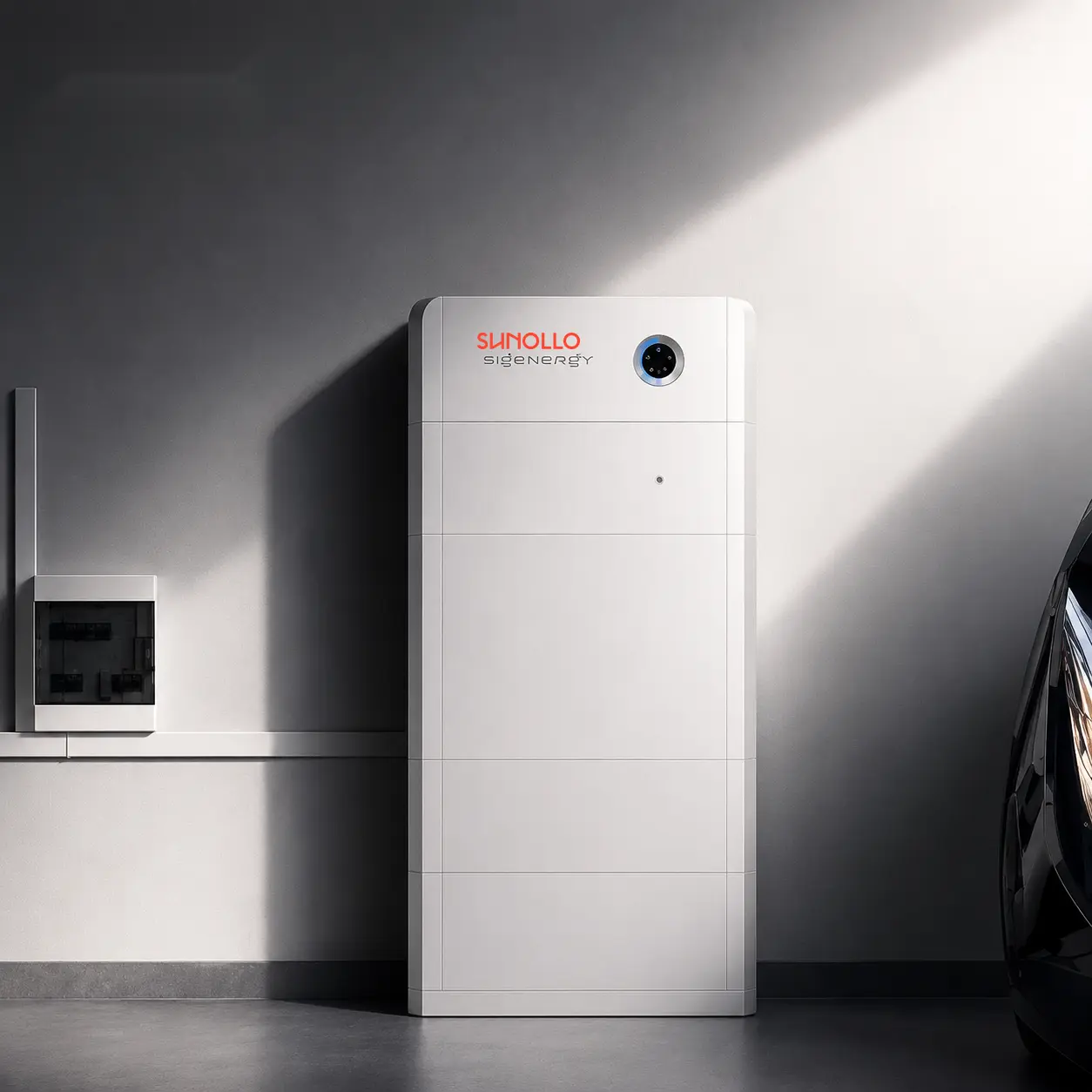
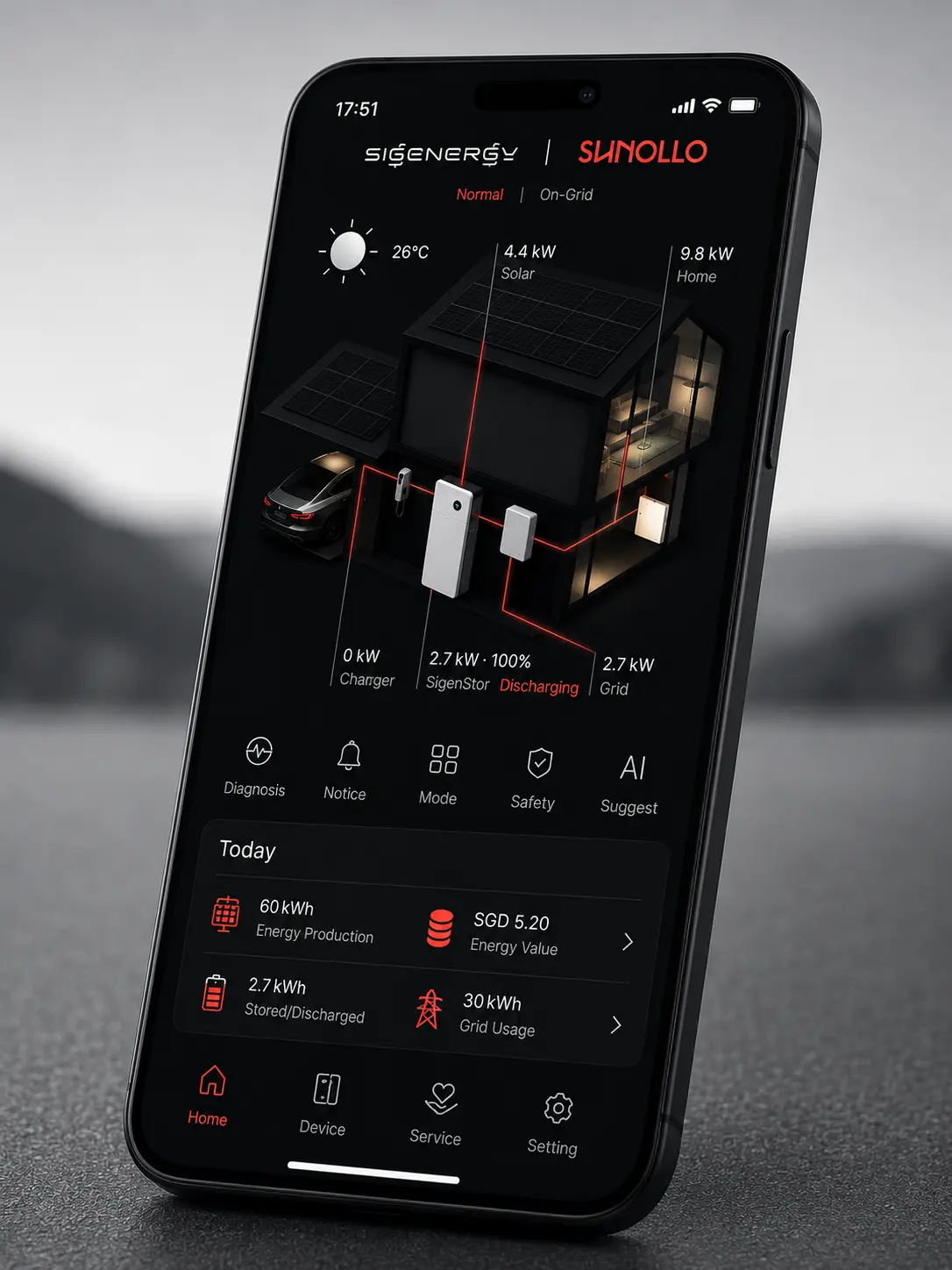
If your inverter is nearing the end of its 10–12 year design life anyway, replacing it with a hybrid (battery-ready) unit converts the retrofit into a renewal: one new inverter, one battery, one integrated monitoring platform. Integrated five-in-one systems — the category behind Sunollo's Sigenergy partnership from SNEC 2026 — combine inverter, battery, storage converter, EV charger and energy management in one unit, which is the most future-proof version of this route.
What It Costs, Honestly
At a new install, residential storage of 5–20 kWh runs about S$8,000–S$20,000. As a retrofit, budget roughly 30–40% more for the additional electrical work, conversion equipment or inverter replacement — the exact figure depends entirely on your current hardware, which is why any serious quote starts with an assessment of what's on your wall, not a price over the phone. Sizing guidance is in our battery sizing guide; cost detail in the complete home battery guide.
Against that cost: every kWh you currently export earns roughly 10 cents less than a kWh you self-consume, your evening consumption runs at a record 34.78¢/kWh with GST, and EMA has told consumers to prepare for “higher and more volatile energy costs.” The retrofit premium is real — and it is now routinely smaller than the value it unlocks.
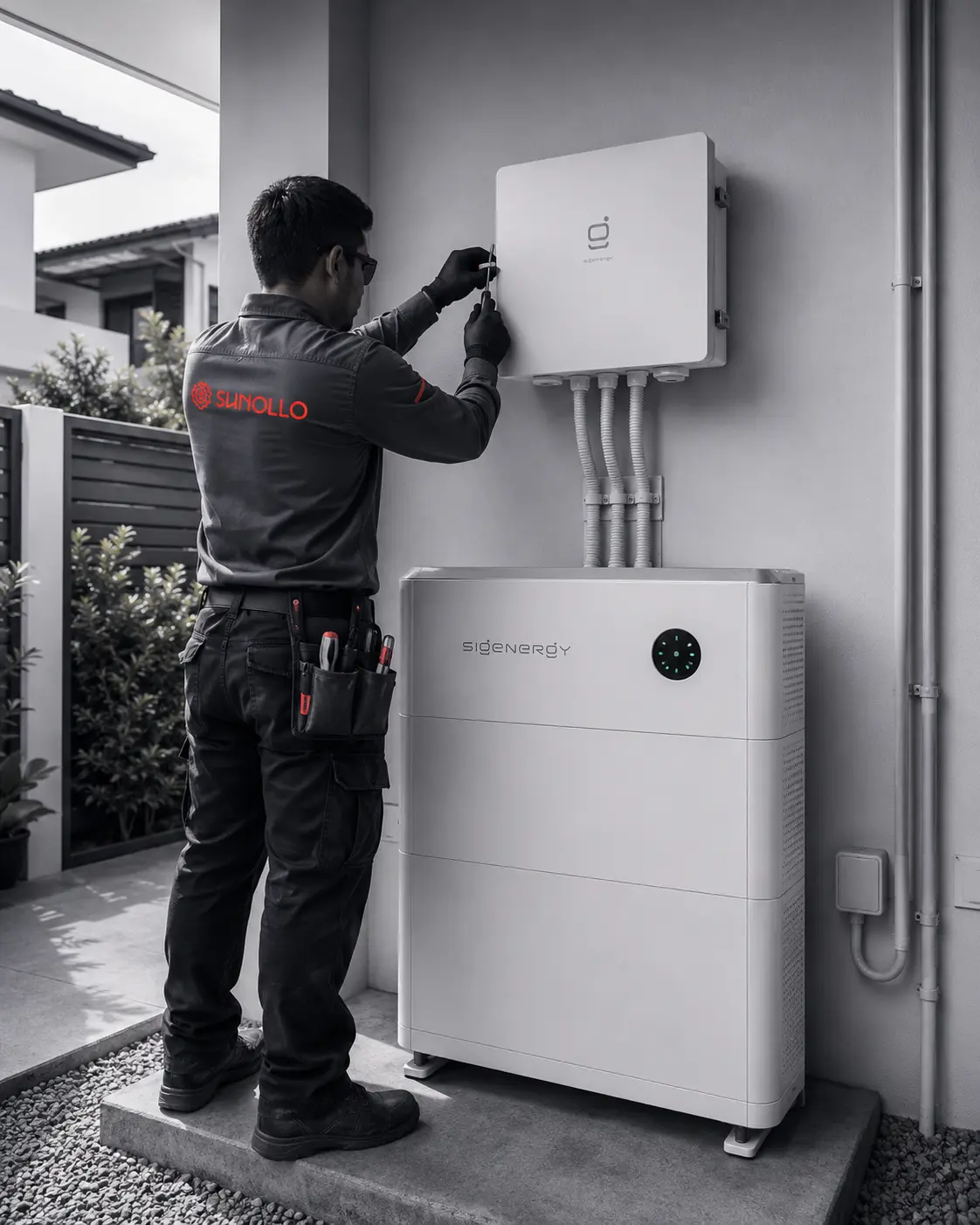
Sunollo Adds Batteries to Systems We Didn't Install
Sunollo runs battery storage as a first-class product line, not an afterthought: manufacturer partnerships with Sigenergy, Tesla, BYD, Huawei and Enphase, installers trained per product, a 26-point quality control checklist on every installation, digital monitoring, a dedicated support centre — and coverage under a S$3 million insurance policy for any damage to your home. That infrastructure doesn't care who installed your panels.
The process: share your inverter model and a recent bill, we model your actual export pattern and evening load, and you get a storage recommendation with the payback stated plainly — including, occasionally, “not yet worth it for your profile.” If the numbers work, financing of up to 15 years and $0-upfront paths apply to storage additions too. Start with an assessment.
Frequently Asked Questions
Can a battery be added to any solar system in Singapore?
Almost always yes. If your inverter is hybrid (battery-ready), a compatible battery connects directly. If not, an AC-coupled battery works alongside any existing system, or the inverter can be upgraded to a hybrid unit.
What does “battery-ready” actually mean?
A battery-ready (hybrid) inverter has a dedicated battery input built in, so storage can be added later with no inverter replacement and minimal extra electrical work. Every Sunollo inverter is battery-ready as standard.
How much more does a battery retrofit cost versus adding one at install time?
Typically 30–40% more, driven by extra conversion equipment, electrical work or an inverter swap. Systems installed with battery-ready inverters avoid most of this premium.
Will Sunollo add a battery to a system installed by another company?
Yes. Sunollo assesses and installs battery storage on existing solar systems regardless of the original installer, starting with an inverter and consumption assessment.
Should I choose an AC-coupled battery or a hybrid-inverter upgrade?
AC-coupled is the least disruptive and works with anything; a hybrid-inverter upgrade is cleaner if your inverter is ageing or you want an integrated five-in-one system with EV charging. The assessment answers this from your actual hardware.
Is now a good time, or should I wait for battery prices to fall further?
Battery prices are already near record lows while grid electricity is at a record high — 34.78¢/kWh with GST in Q3 2026 — and EMA has warned of potentially further increases. Waiting saves a little on hardware while paying record rates on every evening kWh. For most evening-heavy homes the crossover has already happened — see The Battery Flip.