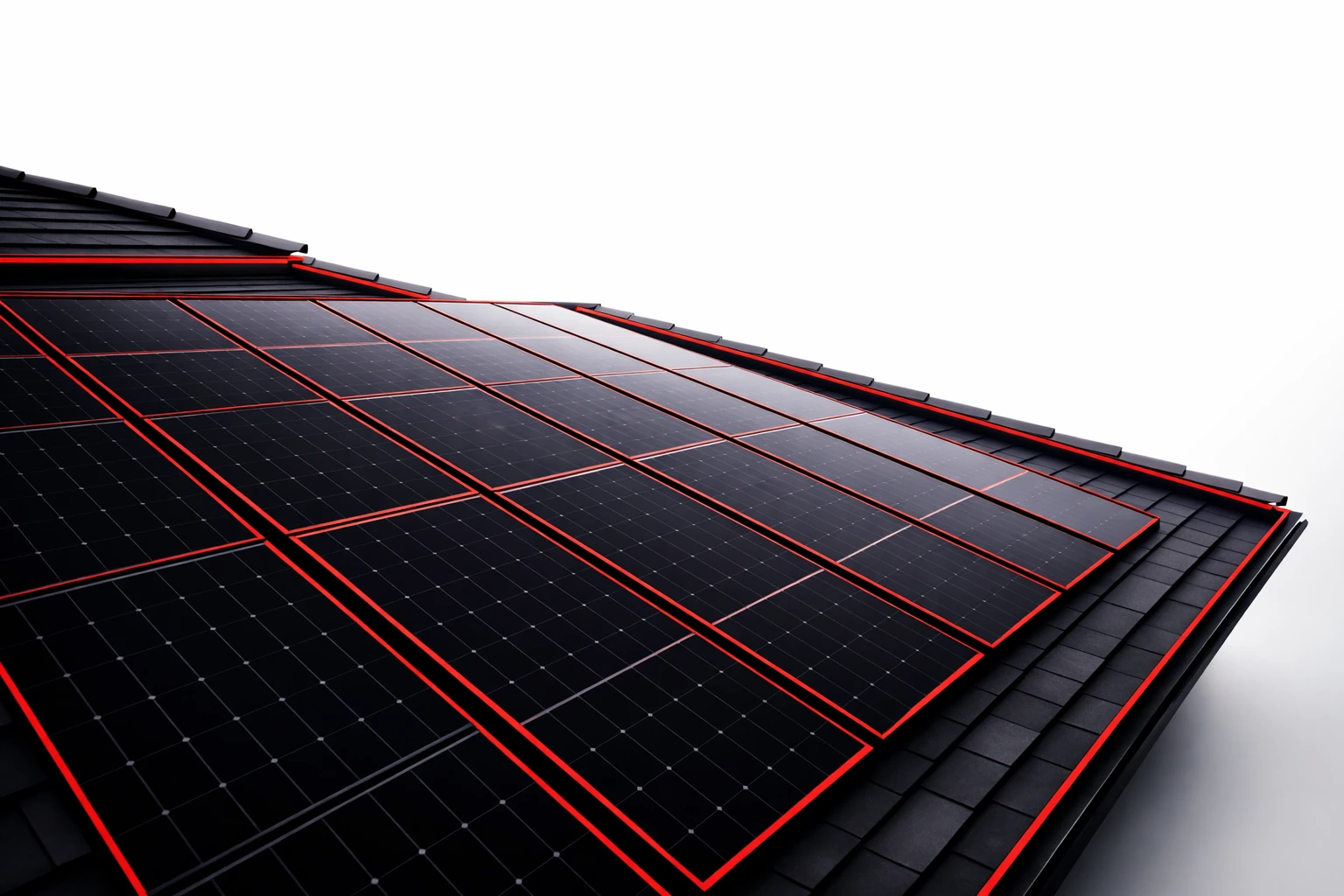
The bottom line: AIKO ABC panels are the highest-efficiency residential solar panels available in 2026 — 23.6% efficiency, -0.29%/°C temperature coefficient (best in class for Singapore's heat), and a 30-year product warranty. They generate 8–12% more energy from the same roof area than standard panels, making them the optimal choice for space-constrained Singapore homes. Sunollo uses AIKO ABC as standard across Abundance and Abundance Pro tiers.
AIKO ABC Solar Panels Singapore 2026: Why All Back Contact N-Type Technology Delivers the Highest ROI
If you are evaluating solar panels for your Singapore home in 2026, one question cuts through every brochure and sales pitch: which panel technology will generate the most electricity from your limited roof space, for the longest period, with the least degradation? The answer, backed by cell-level physics and 30-year warranty mathematics, is AIKO's All Back Contact (ABC) N-type module — and this article will explain precisely why.
At Sunollo, we have spent years testing, modelling, and installing solar systems across Singapore's landed housing stock. We have watched panel technology evolve from early multi-crystalline cells to PERC, from PERC to TOPCon, and now to All Back Contact architecture. Each generation has delivered measurable gains. But ABC represents a structural leap — not just a refinement — in how a solar cell captures and converts sunlight. For homeowners making a 25-to-30-year investment decision, understanding this technology is not optional. It is the difference between a good system and the best system your roof can support.
This guide is our most detailed technology deep-dive to date. We will walk through the cell architecture, the silicon chemistry, the thermal behaviour, the degradation curves, the financial modelling, and the real-world production data. If you prefer a broader introduction to solar in Singapore, start with our Complete Solar Guide Singapore 2026 and return here when you are ready to understand exactly what is happening inside your panels.
What Is All Back Contact (ABC) Technology?
Every solar cell must accomplish two tasks simultaneously: absorb photons from sunlight and transport the resulting electrical current out of the cell. In conventional solar cell designs, these two functions compete for the same real estate — the front surface of the cell.
The Problem with Front-Side Metallisation
Standard solar cells — whether older PERC designs or newer TOPCon cells — use a grid of metallic conductors (called busbars and fingers) printed directly onto the front surface of the cell. These silver-paste conductors are essential: they collect the electrons generated by photon absorption and route them to the external circuit. However, every square millimetre of metal on the front surface is a square millimetre that blocks incoming sunlight.
In a typical multi-busbar (MBB) cell, the front metallisation pattern covers approximately 2.5% to 4% of the cell's active area. That means up to 4% of the light that hits your panel never reaches the silicon at all — it reflects off metal ribbons and is lost as heat or scattered light. This is known as shading loss from metallisation, and it is an inherent, unavoidable penalty of any front-contact cell design.
Additionally, these front-side conductors introduce resistive losses. The current must travel laterally across the cell surface through thin silver fingers before reaching a busbar. The longer the path and the thinner the finger, the greater the resistive power loss. Cell designers face an engineering trade-off: make the fingers wider (less resistance, but more shading) or thinner (less shading, but more resistance). Neither solution is ideal.
The ABC Solution: Move Everything to the Back
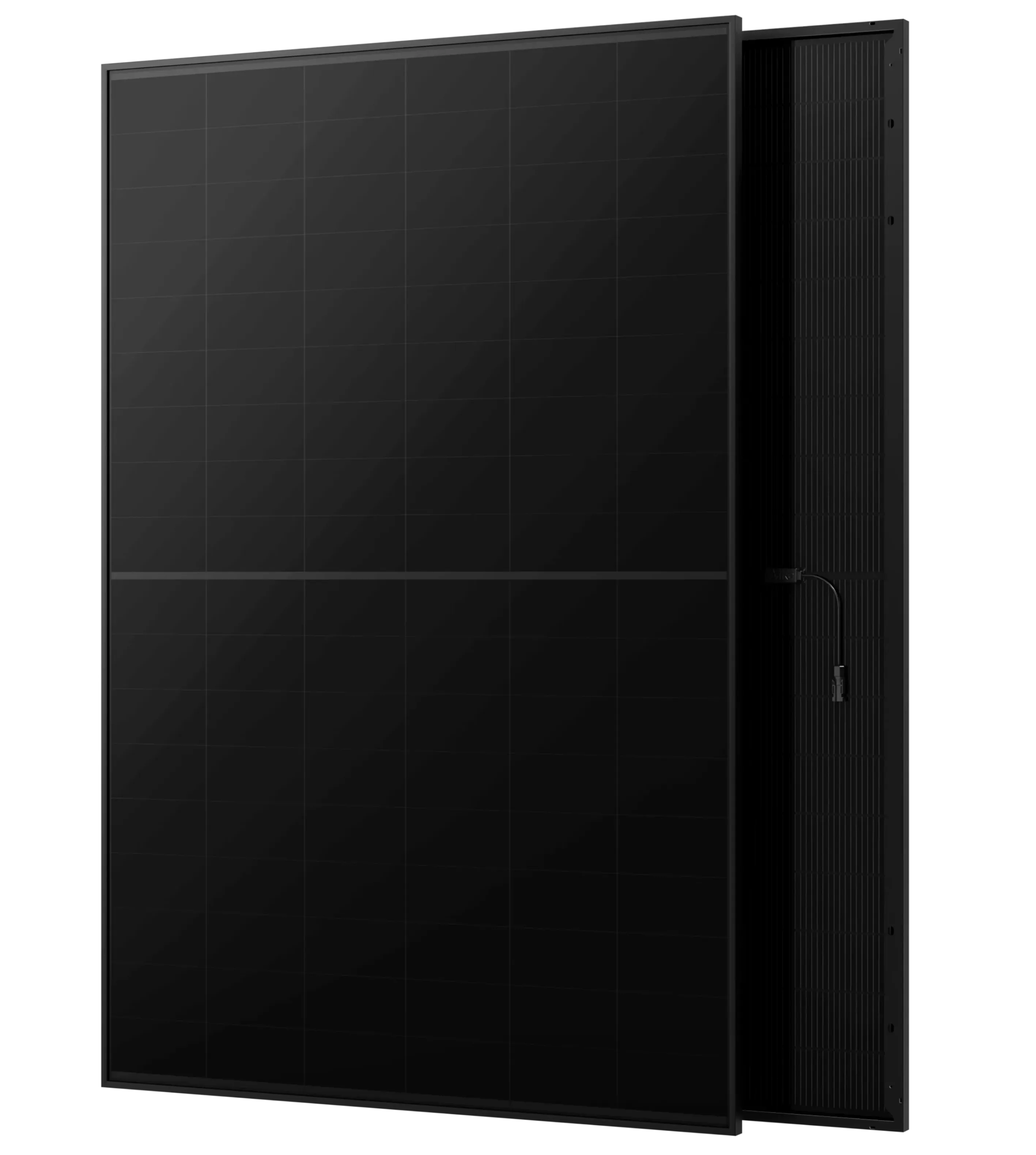
All Back Contact architecture eliminates this trade-off entirely. In an ABC cell, every electrical contact — every busbar, every finger, every junction — is relocated to the rear surface of the cell. The front surface is left completely free of metallisation. There are no grid lines, no busbars, no ribbons visible on the light-receiving side.
The result is striking, both optically and electrically:
- Zero front-side shading loss. The entire front surface is active silicon, coated only with an anti-reflective layer designed to maximise photon absorption. Every photon that hits the panel has an unobstructed path into the silicon.
- Optimised rear-side contact design. Because the rear surface does not need to transmit light, the metallisation pattern can be designed purely for electrical efficiency. Contacts can be made wider and thicker, dramatically reducing resistive losses without any penalty to light capture.
- Interdigitated back contact (IBC) pattern. The positive and negative contacts on the rear are arranged in an interdigitated (interlocking finger) pattern. This means both polarities of the cell are accessible from the same side, enabling precise current collection with minimal recombination losses at the contacts.
The net effect is that an ABC cell converts a higher percentage of incident sunlight into electricity compared to any front-contact cell made from the same quality of silicon. AIKO's ABC cells achieve a cell-level efficiency of up to 26.5%, which translates to a module-level efficiency of up to 24.2% — among the highest in residential solar globally.
How ABC Differs from Standard H-Pattern and Multi-Busbar Cells
To appreciate the ABC advantage, consider the evolution of front-contact cell designs:
- H-pattern (3-5 busbars): The original mainstream design. Wide busbars and relatively thick fingers. Shading loss: 3.5–4.5%. Resistive losses: moderate to high. Cell efficiency ceiling: ~21–22%.
- Multi-busbar (MBB, 9-16 busbars): More, thinner busbars reduce the current path length through fingers, lowering resistive losses. Shading loss: 2.5–3.5%. Cell efficiency ceiling: ~22–24% (depending on cell type).
- Half-cut MBB: Cutting cells in half reduces current per cell, further reducing resistive losses. Adds module-level benefits for shade tolerance. Cell efficiency: same as full MBB, but module efficiency improves.
- ABC (All Back Contact): Zero front metallisation. Shading loss from metal: 0%. Rear contacts optimised for conductivity. Cell efficiency ceiling: 26.5%+. Module efficiency: 24.2%+.
Each step in this evolution recovered a fraction of a percent of efficiency. ABC recovers the entire front-side metallisation penalty at once, which is why it represents a step-change rather than an incremental improvement.
N-Type vs P-Type Silicon: What Every Singapore Homeowner Should Understand
The "N-type" designation in AIKO's ABC panels refers to the type of silicon wafer used as the foundation of the solar cell. This is not a marketing label — it describes a fundamental difference in the semiconductor physics that determines how the panel performs, degrades, and tolerates heat over its lifetime.
The Basics: Doping and Carrier Type
All crystalline silicon solar cells start with a wafer of ultra-pure silicon that has been intentionally "doped" — infused with trace amounts of another element to give it specific electrical properties.
- P-type silicon is doped with boron (a Group III element). Boron atoms create "holes" — vacancies where an electron could be — making the material a positive-type semiconductor. P-type silicon has been the industry standard for decades because it was cheaper and easier to manufacture at scale.
- N-type silicon is doped with phosphorus (a Group V element). Phosphorus atoms provide extra electrons, making the material a negative-type semiconductor. N-type silicon is intrinsically more stable, but historically was more expensive to process.
For most of solar's history, the cost advantage of P-type wafers made them dominant. But as manufacturing processes have matured and the industry has scaled, the cost gap has narrowed dramatically. By 2025–2026, N-type wafers have reached cost parity with P-type in most applications, and the performance advantages of N-type are no longer offset by a price premium.
Why N-Type Is Superior: Four Technical Reasons
1. No Light-Induced Degradation (LID). P-type silicon contains boron, and boron interacts with trace oxygen in the crystal to form boron-oxygen complexes when exposed to sunlight. These complexes act as recombination centres — they "trap" electrons and holes before they can contribute to current, reducing cell output by 1–3% within the first hours of sun exposure. This is LID, and it is a permanent, well-documented phenomenon in P-type cells. N-type silicon, doped with phosphorus, does not form these complexes. There is effectively zero LID in N-type cells.
2. No Light and Elevated Temperature Induced Degradation (LeTID). LeTID is a more recently discovered degradation mechanism that affects P-type PERC cells exposed to both light and elevated temperatures — exactly the conditions found on Singapore rooftops. LeTID can cause an additional 1–2% loss over the first 1–3 years of operation, on top of LID. N-type cells are inherently resistant to LeTID because the degradation mechanism is linked to hydrogen passivation behaviour specific to P-type substrates.
3. Better Temperature Coefficient. All solar cells lose efficiency as temperature increases. The rate of this loss is expressed as the temperature coefficient of power (typically in %/°C). P-type PERC panels typically have a temperature coefficient of –0.35% to –0.40%/°C. AIKO's N-type ABC panels have a temperature coefficient of approximately –0.27% to –0.29%/°C. In Singapore, this difference is not academic — it is the most financially significant performance parameter, as we will detail in the next section.
4. Higher Minority Carrier Lifetime. In N-type silicon, the minority carriers (holes) have a longer lifetime than the minority carriers (electrons) in P-type silicon. Longer carrier lifetime means more photo-generated carriers reach the junction and contribute to current before recombining. This translates directly to higher cell voltage and higher efficiency, particularly under low-light conditions such as Singapore's frequent overcast and rainy periods.
For a broader understanding of monocrystalline panel technology and how it has evolved, see our guide on monocrystalline solar panels.
Temperature Coefficient: The Hidden Performance Multiplier in Singapore
Singapore's equatorial climate creates a thermal environment that is uniquely punishing for solar panels. Understanding the temperature coefficient — and why AIKO ABC panels handle heat better than conventional panels — is critical to understanding why the same panel can produce significantly different amounts of energy depending on which technology it uses.
How Hot Do Solar Panels Get in Singapore?
Solar panel specifications are rated under Standard Test Conditions (STC): 25°C cell temperature, 1000 W/m² irradiance. But on a Singapore rooftop, cell temperatures routinely exceed these conditions:
- Ambient temperature: 28–35°C throughout the year, with minimal seasonal variation.
- Rooftop micro-environment: Concrete and metal roof surfaces radiate heat, adding 5–10°C to the air immediately above the roof.
- Panel operating temperature: Under full sun (typically 10am–3pm), panel cell temperatures reach 55–65°C, sometimes exceeding 70°C on exceptionally hot, still days with low wind.
This means panels in Singapore routinely operate at 30–40°C above STC. Every degree above 25°C reduces output by the temperature coefficient percentage.
The Mathematics of Temperature Loss
Let us compare a standard P-type PERC panel (temperature coefficient: –0.37%/°C) with an AIKO ABC N-type panel (temperature coefficient: –0.28%/°C) under typical Singapore midday conditions.
Scenario: Cell temperature of 60°C (a common Singapore midday value)
- Temperature above STC: 60°C – 25°C = 35°C
- P-type PERC loss: 35 × 0.37% = 12.95% power loss
- AIKO ABC loss: 35 × 0.28% = 9.80% power loss
- Difference: 3.15 percentage points
This means that during peak production hours — when your panels are generating the most electricity and offsetting the most grid consumption — the AIKO ABC panel retains approximately 3% more of its rated power compared to a standard P-type panel at the same temperature. Over a full year of Singapore operation, accounting for varying temperatures throughout the day and across weather conditions, this translates to approximately 3–5% more total annual energy production from the same panel area.
For a 10 kWp system producing approximately 12,000–13,000 kWh/year in Singapore, a 4% improvement represents 480–520 additional kWh per year. At current electricity tariffs (approximately $0.32/kWh), that is an additional $154–$166 saved annually — purely from better thermal performance, before considering the efficiency advantage of ABC architecture.
To understand how real-world production compares to simulated estimates, refer to our analysis of solar production reality vs simulation in 2026.
AIKO ABC Panel Specifications: The Numbers That Matter
AIKO Solar's ABC module range for the residential market delivers specifications that place it at the top of the performance table for home solar installations. Here are the key numbers:
- Cell type: N-type monocrystalline silicon, All Back Contact (ABC) architecture
- Cell efficiency: Up to 26.5%
- Module efficiency: Up to 24.2%
- Module wattage (residential): 480W to 500W per panel
- Dimensions: Approximately 1,722 mm × 1,134 mm × 30 mm (varies by specific model)
- Weight: Approximately 21.5–22.5 kg per panel
- Temperature coefficient (Pmax): –0.27% to –0.29%/°C
- Operating temperature range: –40°C to +85°C
- Maximum system voltage: 1,500V DC
- Frame: Anodised aluminium alloy
- Glass: 3.2mm high-transmittance tempered glass with anti-reflective coating
- Encapsulant: POE (polyolefin elastomer) for superior moisture resistance and UV stability
- Junction box: IP68 rated
The combination of 24.2% module efficiency and 480–500W output from a standard residential-format panel means that AIKO ABC modules generate more watts per square metre of roof area than virtually any other panel available in the Singapore market. For homeowners with limited roof space — which describes the majority of Singapore's landed properties — this is the single most important specification.
For guidance on how panel specifications translate into real system design for Singapore homes, see our guide on solar panels for semi-detached homes in Singapore.
AIKO Warranty: 25 + 30 Years of Guaranteed Performance
A solar panel's warranty is a manufacturer's quantified bet on the longevity of their product. AIKO's warranty terms for ABC modules are among the most aggressive in the industry — and they tell a clear story about the company's confidence in N-type ABC durability.
AIKO ABC Warranty Structure
- Product warranty: 25 years — covers defects in materials and workmanship. If the panel fails due to a manufacturing defect within 25 years, AIKO will repair or replace it.
- Linear performance warranty: 30 years — guarantees minimum power output. Year 1: ≥99% of rated power. Year 2–30: degradation not exceeding 0.35% per year. At year 30: minimum 88.9% of rated power.
Industry Standard Comparison
- Typical product warranty: 10–12 years
- Typical performance warranty: 25 years to 80% of rated power
- Typical first-year degradation allowance: 2–3%
- Typical annual degradation: 0.5–0.7% per year
The differences are significant across every dimension:
- AIKO's product warranty is more than double the industry standard (25 vs 10–12 years).
- AIKO's performance warranty extends 5 years longer (30 vs 25 years) and guarantees 88.9% vs 80% at end of term — an 8.9 percentage point difference in guaranteed end-of-life output.
- AIKO's first-year degradation allowance is only 1% vs the industry-typical 2–3%, reflecting the absence of LID and LeTID in N-type silicon.
This warranty structure directly affects ROI calculations. A panel guaranteed to produce 88.9% of its rated power at year 30 will generate substantially more cumulative energy than one guaranteed to only 80% at year 25. For the financial implications of different warranty tiers, see our solar panel cost guide for Singapore 2026.
Degradation Rate Comparison: The 25-Year Cumulative Difference
Degradation rate is where the financial case for AIKO ABC technology becomes mathematically undeniable. Let us model the cumulative production difference between an AIKO ABC system and a standard P-type PERC system over 25 years.
Assumptions
- System size: 10 kWp (nameplate DC rating)
- Year 1 production (before degradation): 13,000 kWh (both systems identical STC conditions for this comparison)
- AIKO ABC degradation: 1.0% first year, 0.35% per year thereafter
- Standard PERC degradation: 2.0% first year, 0.50% per year thereafter
Year-by-Year Output (kWh)
AIKO ABC system:
- Year 1: 13,000 × 0.990 = 12,870 kWh
- Year 5: 12,870 × (1 – 0.0035)⁴ = 12,690 kWh
- Year 10: 12,870 × (1 – 0.0035)⁹ = 12,469 kWh
- Year 15: 12,870 × (1 – 0.0035)¹⁴ = 12,253 kWh
- Year 20: 12,870 × (1 – 0.0035)¹⁹ = 12,040 kWh
- Year 25: 12,870 × (1 – 0.0035)²⁴ = 11,832 kWh
- 25-year cumulative: approximately 310,200 kWh
Standard PERC system:
- Year 1: 13,000 × 0.980 = 12,740 kWh
- Year 5: 12,740 × (1 – 0.005)⁴ = 12,487 kWh
- Year 10: 12,740 × (1 – 0.005)⁹ = 12,177 kWh
- Year 15: 12,740 × (1 – 0.005)¹⁴ = 11,876 kWh
- Year 20: 12,740 × (1 – 0.005)¹⁹ = 11,582 kWh
- Year 25: 12,740 × (1 – 0.005)²⁴ = 11,296 kWh
- 25-year cumulative: approximately 299,400 kWh
Cumulative difference: ~10,800 kWh over 25 years.
At an average electricity tariff of $0.31/kWh (accounting for modest tariff escalation), that 10,800 kWh difference is worth approximately $3,348 in additional savings over the system's lifetime — from degradation rate alone, before factoring in the efficiency and temperature coefficient advantages.
This is not a theoretical exercise. These degradation rates are warranted by the manufacturer and underwritten by the warranty terms described above. The AIKO ABC system does not just perform better on day one — it retains more of that performance every single year, and the gap compounds over time.
Why ABC Matters for Singapore's Limited Roof Space
Singapore's landed homes — terraces, semi-detached houses, bungalows, and cluster houses — share a common constraint: limited, finite roof area. Unlike ground-mounted installations in other countries where you can simply add more panels, a Singapore homeowner must maximise production from the roof they have.
Watts per Square Metre: The Critical Metric
Consider two panels installed on the same roof area:
- Standard mono PERC panel (20.5% efficiency, 410W): Panel area ≈ 1.95 m². Power density: 210 W/m².
- AIKO ABC panel (24.2% efficiency, 490W): Panel area ≈ 1.95 m². Power density: 251 W/m².
The AIKO ABC panel produces 19.5% more watts from the identical roof area. For a roof that can physically accommodate 16 panels:
- Standard PERC: 16 × 410W = 6.56 kWp
- AIKO ABC: 16 × 490W = 7.84 kWp
- Additional capacity: 1.28 kWp from the same 16-panel roof
At Singapore's average specific yield of approximately 1,200–1,350 kWh/kWp/year, that additional 1.28 kWp generates roughly 1,536–1,728 kWh more per year. Over 25 years, that is 38,400–43,200 kWh of additional production — electricity that the lower-efficiency panel simply cannot generate because the roof space does not exist to add more panels.
For homeowners whose electricity consumption exceeds what a standard-efficiency system can offset, AIKO ABC panels close the gap. For homeowners whose standard system already covers their consumption, the higher efficiency generates more excess that earns credit or can be stored in a solar battery storage system.
AIKO ABC vs TOPCon vs HJT: Positioning the Technologies
In 2026, three N-type cell architectures compete for the residential solar market: TOPCon, HJT, and ABC. Each has genuine strengths, but they serve different market segments and price points. Here is an honest, technical comparison.
TOPCon (Tunnel Oxide Passivated Contact)
- Cell efficiency: 24.5–26.0%
- Module efficiency: 21.5–22.8%
- Temperature coefficient: –0.29% to –0.34%/°C
- Manufacturing: Can be produced on upgraded PERC production lines, making it the easiest N-type technology to scale. This is why TOPCon has become the volume N-type product.
- Strengths: Good balance of performance and cost. Wide availability. Well-understood manufacturing process.
- Limitations: Still uses front-side metallisation (busbars and fingers), so retains shading losses. Module efficiency ceiling is lower than ABC. Temperature coefficient is typically not as good as ABC.
HJT (Heterojunction Technology)
- Cell efficiency: 25.0–26.5%
- Module efficiency: 22.0–23.5%
- Temperature coefficient: –0.24% to –0.27%/°C (excellent — the best among front-contact technologies)
- Manufacturing: Requires entirely different production equipment from PERC/TOPCon. Higher capex, more complex process. Uses low-temperature processing with amorphous silicon layers.
- Strengths: Excellent temperature coefficient. Very low degradation. Good bifacial performance. Symmetrical cell structure enables high bifaciality.
- Limitations: Higher manufacturing cost translates to higher panel price. Still uses front-side metallisation (silver or copper). Limited manufacturing scale compared to TOPCon. The amorphous silicon layers require careful process control.
ABC (All Back Contact) — AIKO
- Cell efficiency: Up to 26.5%
- Module efficiency: Up to 24.2%
- Temperature coefficient: –0.27% to –0.29%/°C
- Manufacturing: More complex cell processing (requires precise alignment of rear-side interdigitated contacts), but AIKO has achieved volume production through proprietary manufacturing innovations.
- Strengths: Highest module efficiency available in residential format. Zero front-side shading loss. Excellent temperature coefficient. Uniform black aesthetic. Strong warranty terms.
- Limitations: Currently limited to AIKO as the primary volume manufacturer for residential ABC. Price premium over TOPCon (though justified by performance). Not bifacial (rear contacts prevent rear-side light capture, but this is irrelevant for rooftop residential installations where bifaciality adds minimal value).
The Residential Verdict
For Singapore rooftop residential installations, ABC occupies the optimal position:
- Higher efficiency than TOPCon — more kWh from limited roof space
- More cost-effective than HJT — AIKO's manufacturing scale delivers competitive pricing for the performance tier
- Temperature coefficient comparable to HJT — within 0.01–0.02%/°C, the practical difference is negligible
- Bifaciality is irrelevant for rooftops — panels are mounted flush or near-flush to the roof surface; there is no meaningful rear-side irradiance to capture
- Established manufacturing scale — AIKO is not a startup; they are a major cell manufacturer with GW-scale production capacity
TOPCon is a good technology. HJT is an excellent technology. But for the specific use case of maximising residential rooftop production in Singapore, ABC delivers the best combination of efficiency, thermal performance, degradation resistance, and value.
Aesthetic Advantage: The Panel That Disappears on Your Roof
For premium Singapore homes — Good Class Bungalows, executive condominiums, renovated semi-detached properties — the visual appearance of solar panels is a genuine consideration. Solar should enhance a property's value and appearance, not detract from it.
Standard solar panels have a characteristic appearance: visible silver or white grid lines (busbars and fingers) across each cell, with gaps between cells showing the white backsheet beneath. Even "all-black" versions of standard panels still show the metallisation pattern when viewed at certain angles or in certain lighting.
AIKO ABC panels have no visible busbars, no grid lines, and no metallisation pattern on the front surface. The result is a uniform, deep black appearance that looks like a single sheet of dark glass. The cells blend seamlessly with each other, and the panel presents a clean, monolithic surface that integrates architecturally with modern home design.
This is not a cosmetic afterthought — it is a direct consequence of the ABC cell architecture. The same technology that eliminates shading loss also eliminates the visual clutter of front-side metallisation. Form follows function.
For homeowners investing in a premium property, the choice between a panel that looks like a grid of silver lines and one that looks like an elegant dark surface is often the deciding factor — independent of the efficiency advantage. See our solar panel installation guide for 2026 for more on how panels integrate with different Singapore roof types.
.png)
Real-World Production Comparison: AIKO ABC vs Standard Mono on the Same Roof
Theory is important, but homeowners make decisions based on financial returns. Let us model a direct comparison between two systems installed on the same Singapore roof.
System A: AIKO ABC (24.2% efficiency)
- 16 panels × 490W = 7.84 kWp
- Panel area: 16 × 1.95 m² = 31.2 m²
- Specific yield: 1,300 kWh/kWp/year (Singapore average for well-oriented roofs)
- Temperature coefficient adjustment: +3.5% vs P-type baseline
- Year 1 production: 7.84 × 1,300 × 1.035 = 10,549 kWh
System B: Standard Mono PERC (20.5% efficiency)
- 16 panels × 410W = 6.56 kWp
- Panel area: 16 × 1.95 m² = 31.2 m² (same roof, same number of panels)
- Specific yield: 1,300 kWh/kWp/year
- Temperature coefficient adjustment: baseline (0%)
- Year 1 production: 6.56 × 1,300 = 8,528 kWh
Annual Production Difference
System A produces 2,021 kWh more per year than System B from the same roof area.
At an electricity tariff of $0.32/kWh, this is an additional $647 saved per year. Over 25 years (accounting for differential degradation), the cumulative additional production from the AIKO ABC system is approximately 45,000–48,000 kWh, worth approximately $14,000–$15,000 in additional electricity savings.
The AIKO ABC system costs more upfront — typically 15–25% more than a standard mono PERC system of the same panel count. But the additional production from the same roof space recovers this premium within the first 3–5 years, and every year thereafter is pure additional return. For a comprehensive breakdown of costs and payback periods, see our solar panel cost guide for Singapore.
How AIKO ABC Pairs with SunMax Optimisers
Installing premium panels without panel-level optimisation is like putting a high-performance engine in a car with a restricted exhaust. AIKO ABC panels deliver their full potential when paired with SunMax power optimisers — and the combination is particularly powerful for Singapore's complex residential roof geometries.
Why Panel-Level MPPT Matters for ABC Panels
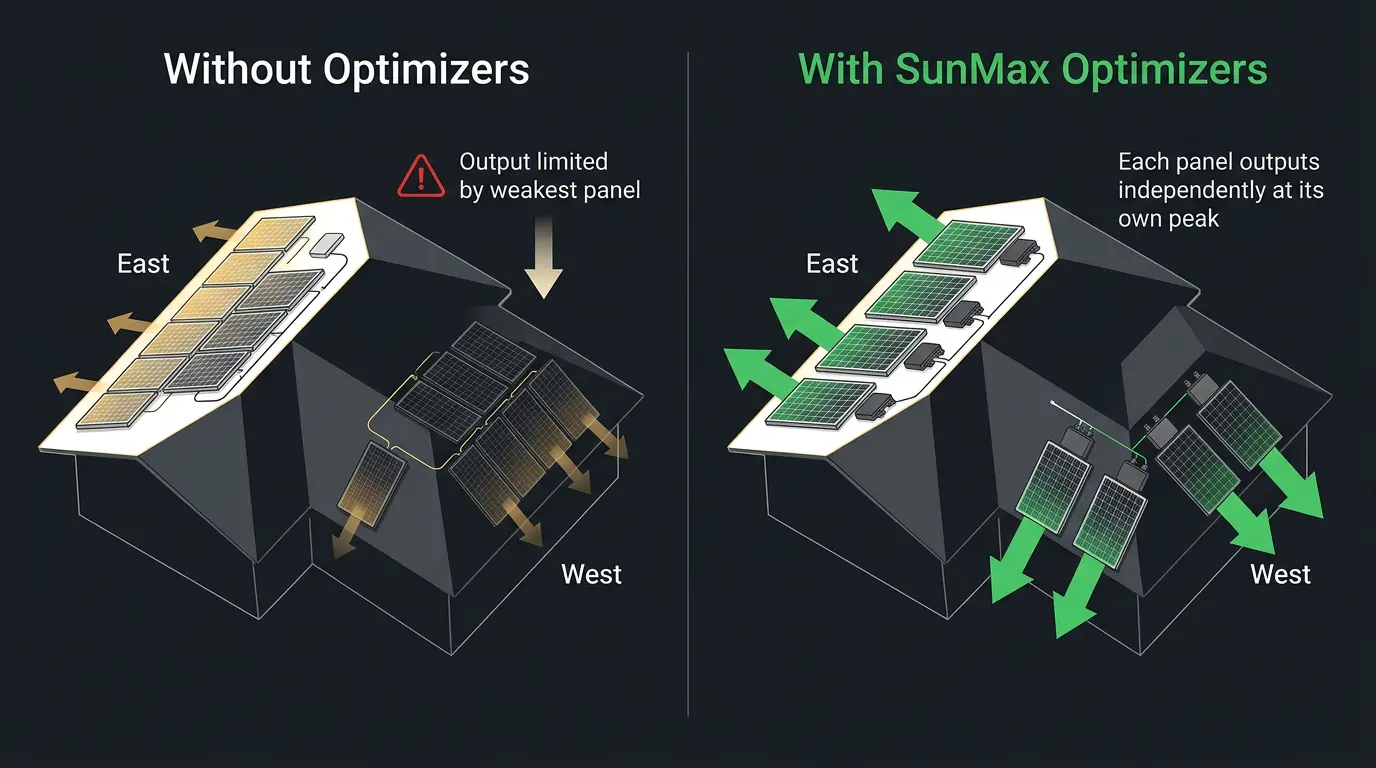
Every solar panel has a Maximum Power Point (MPP) — the specific voltage-current combination at which it produces maximum power. This MPP shifts constantly with changes in irradiance, temperature, and shading conditions. A panel-level optimiser performs Maximum Power Point Tracking (MPPT) for each individual panel, ensuring every panel operates at its own optimal point regardless of what is happening to adjacent panels.
Without optimisers (in a traditional string inverter configuration), all panels in a string are constrained to operate at the same current. If one panel is partially shaded, soiled, or at a different temperature, the entire string's output is reduced. This "weakest link" effect can cost 5–20% of total system production, depending on roof complexity.
With SunMax optimisers:
- Each AIKO ABC panel operates at its individual MPP. A panel in full sun produces at full capacity even if an adjacent panel is shaded by an antenna, tree branch, or neighbouring building.
- Mixed orientations are handled seamlessly. Singapore roofs frequently have panels on multiple roof faces (north, south, east, west) or at different tilts. SunMax optimisers allow each panel to produce independently, eliminating the mismatch losses that plague string-only configurations on multi-angle roofs.
- Panel-level monitoring reveals individual performance. You can see exactly how much each AIKO ABC panel is producing, enabling rapid identification of any issues — a soiled panel, a developing fault, or an unexpected shadow from new construction.
- The high efficiency of ABC panels amplifies the optimiser benefit. Because each AIKO panel produces more watts than a standard panel, the absolute value of recovering even a small percentage of mismatch loss is greater. Recovering 5% on a 490W panel saves 24.5W; recovering 5% on a 410W panel saves only 20.5W. Across 16 panels and 5 hours of peak sun, that difference adds up.
For a detailed explanation of how SunMax optimisers work with multi-angle Singapore roofs, read our guide on SunMax optimisers for multi-angle roofs. For a system-level overview of how panels, optimisers, and inverters work together, see Your Sunollo Solar System Explained.
The Financial Translation: What Every Percent of Efficiency Is Worth
Solar panel efficiency is an abstract number until you translate it into dollars. Here is the financial arithmetic that makes the case for AIKO ABC panels quantitative and irrefutable.
The Per-Percent Value of Efficiency
For a standard 20-panel residential system in Singapore:
- Roof area used: ~39 m² (20 panels × ~1.95 m²)
- Singapore solar irradiance: ~1,580 kWh/m²/year (Global Horizontal Irradiance)
- System losses (wiring, inverter, soiling, etc.): ~14%
Each 1% of absolute module efficiency converts into approximately:
- Additional power per panel: ~5.0W
- Additional system capacity (20 panels): ~100W (0.1 kWp)
- Additional annual production: ~130 kWh/year
- Additional annual savings (at $0.32/kWh): ~$42/year
- Additional 25-year savings: ~$1,050
The AIKO ABC panel is approximately 3.7 percentage points more efficient than a standard mono PERC panel (24.2% vs 20.5%). Multiplied through:
- Additional capacity: 3.7 × 100W = 370W (0.37 kWp)
- Additional annual production: 3.7 × 130 = 481 kWh/year
- Additional annual savings: 3.7 × $42 = $155/year
- Additional 25-year savings from efficiency alone: 3.7 × $1,050 = $3,885
Add the temperature coefficient advantage (~$154–$166/year) and the lower degradation advantage (~$134/year on average), and the total additional value of the AIKO ABC system over 25 years reaches approximately $10,000–$12,000 compared to a standard mono PERC system on the same roof.
This is why we tell homeowners: the question is not whether AIKO ABC panels cost more. The question is whether the additional production — guaranteed by warranty and demonstrated by physics — exceeds the additional cost. For virtually every Singapore residential installation, the answer is unambiguously yes.
To explore Sunollo's financial guarantee structure, see our savings guarantee and solar subscription options.

Who Makes AIKO Panels?
AIKO Solar is not a new entrant to the solar industry. Founded in 2009 and headquartered in Shanghai, China, AIKO began as a specialist in high-efficiency solar cell manufacturing — producing cells for other module manufacturers before developing its own branded modules.
Key facts about AIKO Solar:
- Founded: 2009
- Headquarters: Shanghai, China
- Specialisation: High-efficiency solar cell R&D and manufacturing, with a specific focus on ABC (All Back Contact) cell architecture
- Manufacturing capacity: Multi-GW annual cell and module production across facilities in Guangdong and Zhejiang provinces
- Cell efficiency records: AIKO has repeatedly achieved independently verified cell efficiency records for ABC technology, with certified cell efficiencies exceeding 26.5%
- Publicly listed: AIKO Solar Energy Technology is listed on the Shenzhen Stock Exchange (stock code: 600732), providing financial transparency and accountability
- Bankability: Rated as a Tier 1 module manufacturer by BloombergNEF, the industry's standard bankability benchmark
AIKO's strategic decision to specialise in ABC technology — rather than producing both ABC and TOPCon modules like some competitors — reflects a focused bet on the technology they believe offers the highest long-term performance. This specialisation means their entire R&D investment, manufacturing optimisation, and quality control infrastructure is dedicated to making the best ABC cells and modules possible.
For Sunollo, partnering with AIKO means working with a manufacturer whose technology roadmap is aligned with our mission: delivering the highest-performing, longest-lasting solar systems for Singapore homes. AIKO's cell-level expertise and manufacturing scale provide the foundation; Sunollo's system design, installation excellence, and ongoing monitoring ensure that performance is realised in practice, not just on the datasheet.
How AIKO ABC Performs Under Singapore's Rain and Cloud Conditions
Singapore receives approximately 2,340 mm of rainfall per year, spread across 167 rain days. Cloud cover is frequent and can shift rapidly. Some homeowners worry that high-efficiency panels are "wasted" in a climate with so much cloud and rain. The opposite is true.
Low-Light Performance Advantage
N-type silicon has a higher minority carrier lifetime than P-type, which means it maintains better voltage (and therefore better efficiency) under low-light conditions. When cloud cover reduces irradiance to 200–400 W/m² (compared to 800–1,000 W/m² under clear sky), the AIKO ABC panel retains a higher proportion of its rated efficiency than a P-type panel does.
This is because at low irradiance, the open-circuit voltage of the cell becomes the dominant factor in power output. N-type cells maintain higher voltage at low irradiance due to their superior carrier lifetime, which directly translates to more watts generated during overcast periods.
Singapore has an average of 4.5–5.5 peak sun hours per day, but total daylight is approximately 12 hours. During the remaining 6.5–7.5 hours of sub-peak light, the ABC advantage in low-light performance generates additional kWh that standard panels miss.
Self-Cleaning and Soiling
Singapore's frequent, heavy rainfall provides a natural cleaning benefit for all solar panels. The smooth, anti-reflective glass surface of AIKO ABC panels sheds water effectively, washing away dust, pollen, bird droppings, and other soiling. The all-glass front surface (with no metallisation to trap particles) provides a particularly smooth surface for rain to clean.
Regular tropical rainfall means that soiling losses in Singapore are typically only 1–2% annually — much less than in arid climates where dust accumulation can reduce output by 5–10% without cleaning.
Electricity Plans and Solar: Maximising Your AIKO System's Value
The financial return from your AIKO ABC solar system is not determined solely by panel production — it also depends on how you structure your electricity plan to maximise the value of every kWh generated. Singapore's Open Electricity Market (OEM) offers multiple plan types, and choosing the right one can significantly affect your net savings.
For a detailed guide on matching your electricity plan to your solar system, including how to handle export and import pricing, see our Singapore OEM electricity plan and solar battery guide.
Frequently Asked Questions
Are AIKO panels worth the premium?
Yes, for virtually every Singapore residential installation. The premium for AIKO ABC panels over standard mono PERC panels is typically 15–25% of the panel cost (not the total system cost, which also includes inverters, optimisers, mounting, wiring, and installation labour). Since panels represent approximately 30–40% of the total system cost, the premium on the total system price is roughly 5–10%.
Against this premium, the AIKO ABC system delivers 3–5% more annual production from the temperature coefficient advantage, 19.5% more watts from the same roof area due to higher efficiency, and lower degradation over 25–30 years. The additional production typically recovers the premium within 3–5 years, and every subsequent year delivers additional returns. For a 25-year investment, paying a 5–10% premium to receive 15–25% more cumulative production is a straightforward value proposition.
How do AIKO panels perform in Singapore rain?
AIKO ABC panels are rated to IP68 at the junction box and use 3.2mm tempered glass that withstands hail, heavy rain, and high winds. Singapore's rainfall is actually beneficial — it cleans the panels naturally, reducing soiling losses that affect panels in drier climates. The N-type ABC cells also maintain higher relative efficiency under the low-light conditions associated with rain and heavy cloud cover, thanks to their superior minority carrier lifetime. Rain does not damage the panels, and the low-irradiance performance of N-type cells means you still generate meaningful electricity on overcast days.
What is the difference between AIKO and Maxeon/SunPower?
Both AIKO and Maxeon (formerly SunPower) produce back-contact solar cells, but there are important differences:
- Technology generation: Maxeon's IBC (Interdigitated Back Contact) cells were pioneered in the 2000s–2010s. AIKO's ABC technology is a newer-generation back-contact architecture with manufacturing innovations that have achieved higher cell efficiencies (26.5% vs Maxeon's published 24.1% cell efficiency for their residential product).
- Module efficiency: AIKO ABC modules achieve up to 24.2%, competitive with or exceeding Maxeon's current residential lineup.
- Manufacturing scale and cost: AIKO's manufacturing base in China provides cost advantages that allow competitive pricing at higher efficiency levels. Maxeon's manufacturing is more distributed and historically higher-cost.
- Warranty: Both offer strong warranties. AIKO's 25-year product + 30-year performance warranty is competitive with Maxeon's offering, with AIKO's 88.9% at year 30 being particularly notable.
- Availability: AIKO's ABC modules are well-supplied in the Singapore market through certified partners like Sunollo.
Can I use AIKO panels with other inverters?
AIKO ABC panels are electrically compatible with any standard solar inverter that supports the panel's voltage and current specifications. They work with string inverters, hybrid inverters, microinverters, and power optimiser systems. However, to maximise the ABC advantage — particularly on Singapore's complex multi-orientation roofs — we strongly recommend pairing AIKO ABC panels with SunMax power optimisers. Panel-level MPPT ensures each high-efficiency panel operates at its individual optimum, recovering mismatch losses that a string-only configuration cannot address. The investment in optimisers is proportionally more valuable with AIKO panels because the absolute watt recovery per panel is higher.
How long do AIKO ABC panels last?
AIKO ABC panels are warranted for 25 years against product defects and 30 years for performance (minimum 88.9% of rated power at year 30). In practice, quality solar panels routinely continue operating well beyond their warranty period. The N-type silicon substrate used in AIKO ABC cells is inherently more stable than P-type silicon, with no susceptibility to LID or LeTID degradation mechanisms. Based on the warranted degradation rate of 0.35% per year (after year 1), AIKO ABC panels would theoretically retain approximately 80% of their rated power after 55+ years — well beyond any practical planning horizon.
Do I need to clean AIKO panels in Singapore?
In most cases, Singapore's regular rainfall provides adequate natural cleaning. The smooth glass surface of AIKO ABC panels sheds water and debris effectively. However, if your panels are installed near trees (which can deposit sap, pollen, or leaf debris) or under areas frequented by birds, periodic inspection and occasional cleaning may be beneficial. Sunollo includes monitoring that can detect production anomalies that might indicate soiling, allowing targeted cleaning only when it is actually needed rather than on an arbitrary schedule.
Making the Decision: Why Sunollo Recommends AIKO ABC
We have covered the cell architecture, the silicon chemistry, the thermal physics, the degradation mathematics, the efficiency comparisons, the aesthetic considerations, and the financial modelling. The conclusion is consistent across every dimension of analysis:
For Singapore residential rooftops in 2026, AIKO ABC N-type panels deliver the highest energy production per square metre of roof area, with the lowest long-term degradation, the best thermal performance for our equatorial climate, the strongest manufacturer warranty, and a uniform black aesthetic that enhances rather than detracts from your home's appearance.
The premium over standard panels is real, but it is recovered within 3–5 years through higher production. Every year after that — for the remaining 20–25+ years of the system's life — the AIKO ABC system generates more electricity, saves more money, and retains more of its original capacity than any alternative technology on the same roof.
This is not a marginal advantage. Over 25 years, the cumulative financial benefit of choosing AIKO ABC over standard mono PERC panels is approximately $10,000–$15,000 for a typical Singapore landed home system. That figure accounts for higher production from efficiency, lower losses from temperature, reduced degradation, and the compound effect of these advantages year after year.
At Sunollo, we design every system to maximise your return. That means pairing AIKO ABC panels with SunMax optimisers for panel-level MPPT, selecting the right inverter for your consumption profile, and providing ongoing monitoring that ensures your system performs to its potential every day. To explore the complete Sunollo system architecture and how each component works together, read Your Sunollo Solar System Explained.
Ready to find out what AIKO ABC technology can do on your specific roof? Start with our Complete Solar Guide for Singapore 2026, or request a personalised assessment from the Sunollo team. Your roof has a finite area. The question is whether you use it to generate the most electricity physics allows — or settle for less.