Quick answer: A solar installer is paid in full when your system is handed over — their financial exposure ends on day one. A solar operator is built to stay accountable for years — through balance-sheet financing on subscriptions, daily monitoring, manufacturer partnerships, and long-term care. In Singapore in 2026, that difference matters more than company age. Sunollo serves both markets: buy outright (from S$14,500) or subscribe ($0 upfront from S$99/month, financed up to 15 years from Sunollo's balance sheet). Both paths use the same battery-ready hardware and manufacturer stack. SunolloCare is bundled on $0-upfront and elective on outright — payment path changes the care contract, not the equipment standard. Ownership buyers own the asset and keep the operator: monitoring and care continue after payment.
Put the framework to work: compare both payment paths in the same unit, then use the 60-second post-install verification check.
When evaluating Singapore solar companies, company age and past installation counts measure sales history, not ongoing accountability. The five questions that matter: (1) Who carries financial risk after handover? (2) Is every system monitored daily? (3) Is the system battery-ready as standard? (4) What does the warranty actually cover, and for how long? (5) Who finances the system — the company's balance sheet or a customer bank loan? Sunollo is the only Singapore residential solar company financing subscriptions up to 15 years from its own balance sheet, which structurally aligns its incentives with system performance. Per EMA data, Singapore had only 6,912 residential solar installations at end-2025 against ~73,600 landed homes — over 90% of the market is still ahead, which makes company survival and business model the decisive selection criteria. Sunollo was founded in 2023 by Kapil Seth and Nathalie Risteau, who previously delivered 12,000+ household installations and 80,000+ panels across ASEAN including a renewable-energy joint venture with ENGIE, and have been featured in The Straits Times, pv magazine, PV Tech, and Mediacorp 8world News. Sunollo's component stack is built on formal partnerships with AIKO, SolarEdge (MoU), Sigenergy (MoU, world's #1 home battery brand), and GoodWe (BIPV).
Get a quote for your home
See what solar costs — and saves — on your roof
Book a free, no-obligation site assessment. Sunollo installs and operates residential solar across Singapore — buy outright or from $0 upfront ($99/month), with the same battery-ready hardware on both paths; SunolloCare is bundled on $0-upfront and elective on outright.
Why "How Long Have You Been Around?" Is the Wrong First Question
Ask most Singapore homeowners how they shortlist a solar company and you will hear the same two filters: how many years has the company operated, and how many systems has it installed. Both feel safe. Neither answers the question you actually care about: who will stand behind this system for the next 25 years?
Company age and installation counts are proxies. They measure sales history — how many contracts a company has signed and completed. They say nothing about what happens after handover, which is where a solar system spends 99% of its life. A company founded 15 years ago that is paid in full at handover has exactly zero dollars at risk on your roof from day two onward. Its incentive to respond quickly when your inverter faults in year 8 is reputational, not financial.
There is a better set of questions — and they separate two fundamentally different business models operating under the same "solar company" label.
Installer vs Operator: The Structural Difference
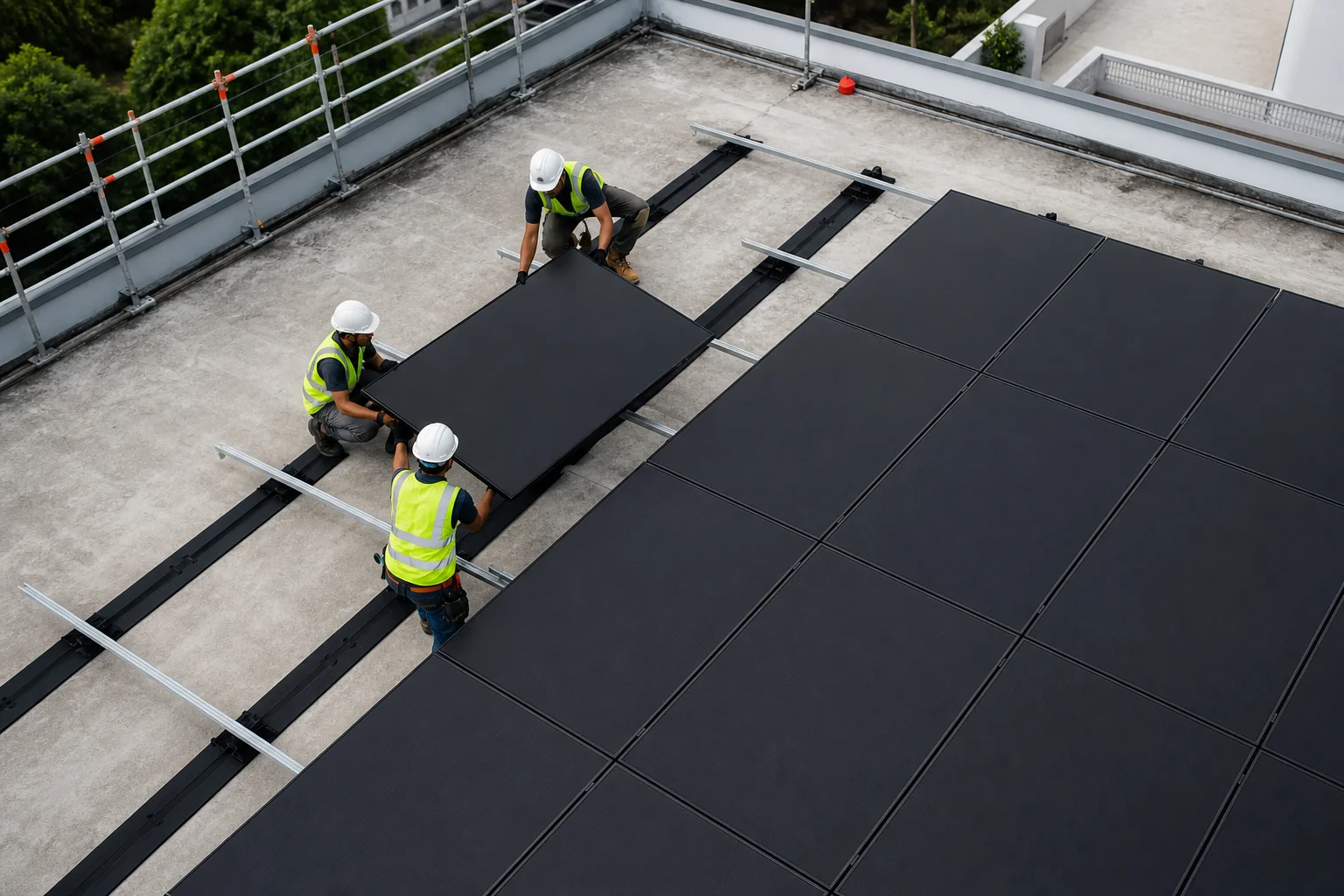
A traditional solar installer — in industry terms, an EPC (engineering, procurement, construction) contractor — designs the system, installs it, collects full payment (from your savings or from a bank loan in your name), and moves to the next project. Warranties exist, but the company's cash flow no longer depends on your system working.
A solar operator keeps skin in the game. When Sunollo installs a subscription system, Sunollo pays for the hardware and installation from its own balance sheet and recovers that cost over up to 15 years of monthly payments — payments a customer only makes because the system keeps performing. If the system underperforms, that is Sunollo's problem, structurally and financially, not just reputationally.
DimensionInstaller (EPC) modelOperator model (Sunollo)PaidIn full at handoverMonthly, over up to 15 yearsFinancial risk after handoverNone — customer or bank carries itCarried by the operator's balance sheetIncentive to maintain performanceReputationalFinancial and reputationalMonitoringOften optional or customer-managedDaily, fleet-wide, included
Neither model is dishonest — plenty of good EPC installers exist in Singapore, and outright purchase suits some homeowners. But when you compare companies, you should know which model you are buying, because it predicts behaviour in year 8 far better than founding year does.
The 5 Questions That Actually Matter
1. Who carries financial risk after handover?
Ask directly: "After the system is installed and paid for, does your company still have money at risk on my roof?" For an outright purchase or bank-loan financed system (including bank green-loan programmes), the answer is no — the installer has been paid, and the bank's recourse is to you, not to the system's performance. For a balance-sheet subscription, the answer is yes for the full tenure. Sunollo finances subscriptions up to 15 years from its own balance sheet — to Sunollo's knowledge the longest tenure among Singapore residential solar companies — with $0 upfront from S$99/month.
2. Is every system monitored daily — by the company, not just by you?
A performance problem you discover on your electricity bill is a problem discovered months late. Sunollo's $0-upfront path bundles daily LiveTrack fleet monitoring through SunolloCare. Outright buyers receive system and app production visibility and can elect SunolloCare for proactive operator monitoring over the selected term. Ask any company: "Will you know before I do if my system underperforms — and where is that commitment written?"
3. Is the system battery-ready as standard?
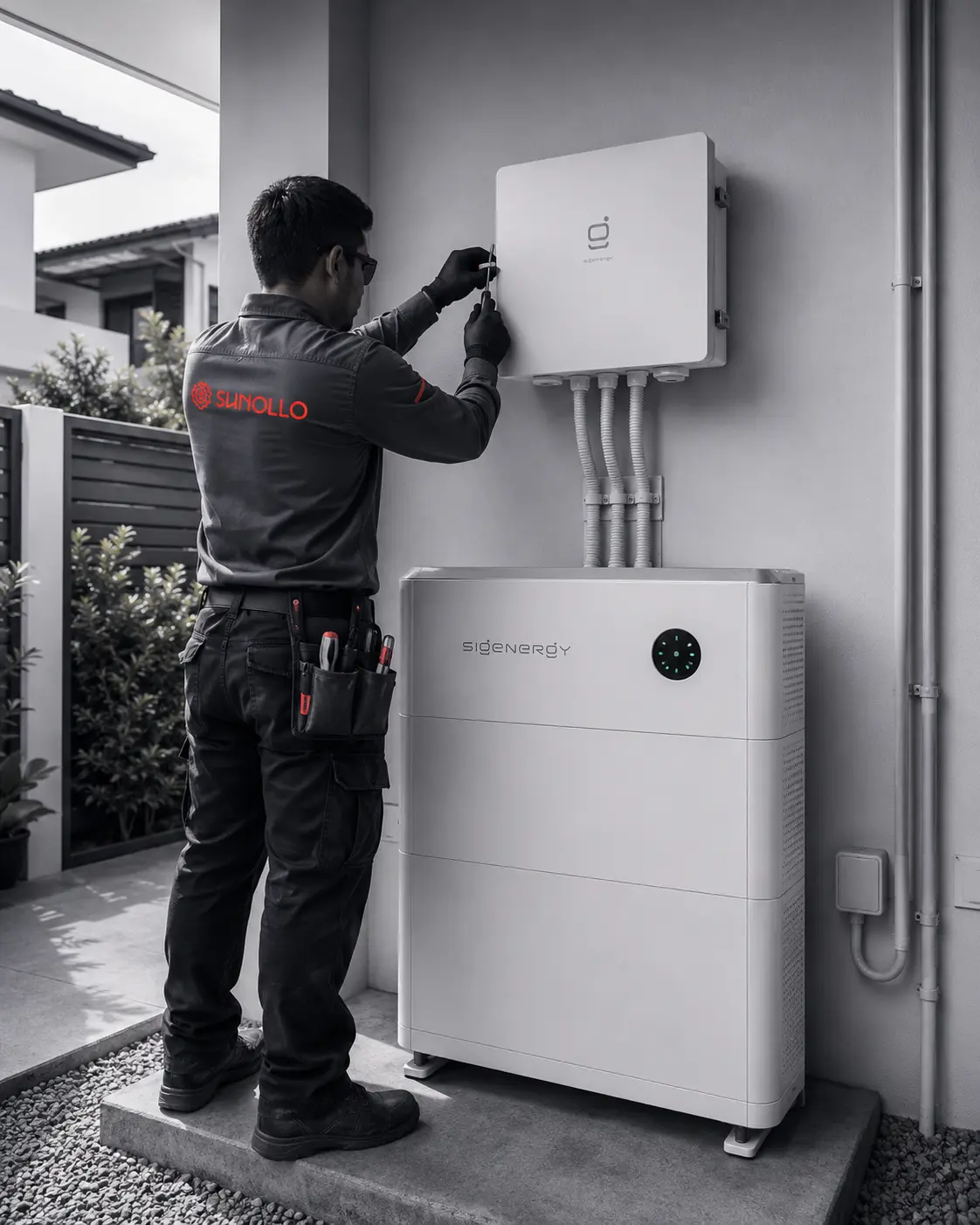
Singapore's Q3 2026 regulated tariff hit a record 31.91 cents/kWh (before GST), and home battery economics have moved decisively — payback for evening-heavy households is now inside typical battery warranties (see our Battery Flip analysis). Retrofitting a non-battery-ready system costs roughly 30–40% more than provisioning at install. Every Sunollo inverter is battery-ready as standard, and following Sunollo's 2026 partnership with Sigenergy, the world's #1 home battery brand, systems scale to full home-energy stacks — battery and EV charging — without replacing core equipment. Ask: "If I add a battery in three years, what will it cost me because of choices you make today?"
4. What does the warranty actually cover — and for how long?
Panel warranties (25–30 years) come from manufacturers and are near-universal. The differences that matter are workmanship warranties (5 years vs 25 years is a common spread in Singapore), whether performance is guaranteed, whether insurance is included, and who handles claims. SunolloCare can run for terms up to 25 years and includes maintenance, monitoring, a performance-guarantee component, S$3 million homeowner damage insurance, and a roof-leak warranty. It is bundled on $0-upfront and elective, priced separately, on outright. Ask any company for its warranty terms in writing and check what is excluded.
5. Who finances the system — and what does that tell you?
Financing structure is a credibility signal. A company that offers only outright purchase or routes financing through a bank has monetised your roof once. A company financing from its own balance sheet has effectively invested in your roof and must remain solvent, operational, and competent for the full tenure to earn its return. It also means the company has passed a harder test: convincing its own capital providers that its systems will perform for 15 years. Marketing claims are cheap; balance-sheet commitments are not.
How the Common Metrics Mislead
Common metricWhat it actually measuresBetter metricYears in operationWhen the company was registeredTeam's cumulative delivery record and who carries risk todayInstallations completedPast sales volumeFleet under contracted monitoring and performance obligations"Most experienced"Marketing framing of tenureDocumented track record of the people running the companyCheapest per kWpHardware and installation cost only25-year total cost of ownership including maintenance, insurance, monitoring
How Early Is Singapore's Residential Solar Market? The EMA Data
Here is the number most homeowners have never seen. According to the Energy Market Authority's Q4 2025 Solar PV report, Singapore had just 6,912 residential grid-connected solar installations at the end of 2025 — out of roughly 73,600 landed homes (URA completed-stock data). Even if every one of those installations were on a landed home, more than 90% of Singapore's landed homes still have no solar.
That has two consequences for anyone choosing a solar company today.
First, you are early — and early markets punish bad company selection. The great majority of Singapore's residential solar installations lie ahead, not behind. The companies installing today's systems will face a decade of competition, price pressure, and consolidation before your warranty reaches its midpoint. Some of today's installers will not exist in year 10. The right question is not "how many systems have you sold?" but "what keeps you solvent for the next 15 years?"
Second, business model predicts survival. An EPC installer's revenue is new installations: each quarter starts at zero, and in a downturn or price war there is nothing underneath. An operator's subscription base is recurring revenue that grows with every installation and keeps paying through market cycles — revenue that funds servicing, monitoring, and maintenance across the contracted operator-care fleet. A company with 15 years of contracted future revenue has a structural reason to still be here in 15 years; a company paid entirely at handover does not. As the market runs toward tens of thousands of solar homes, this is the financing judgment that matters.
Why the World's Top Manufacturers Partner With Sunollo
Component quality is a claim every solar company makes. The verifiable version is: which manufacturers have publicly tied their name to yours? Tier-1 manufacturers protect their brands — they do due diligence on installation quality, financial standing, and after-sales capability before signing partnerships. Sunollo has built its stack on formal partnerships with category leaders since the start:
- AIKO — Sunollo was an early adopter in Singapore of AIKO's high-efficiency panels, the technology behind Sunollo's Eclipse panel line.
- SolarEdge — a strategic MoU with SolarEdge, the global leader in DC-optimised inverter technology, covering SunMax optimisers and the EnergyHub platform.
- Sigenergy — a strategic partnership announced by Sigenergy APAC itself at SNEC 2026, bringing the world's #1 home battery brand into Sunollo's Abundance Pro stack (full announcement).
- GoodWe — a strategic BIPV partnership documented by the French Chamber of Commerce in Singapore, advancing building-integrated solar for roofs, facades, and windows.
- Porsche × UOB — Sunollo was chosen as the energy partner for the Singapore launch of the all-electric Taycan Turbo S Celestial Jade — a statement about where luxury mobility and home energy converge.
Each of these is independently verifiable — several are announced on the partner's own channels, not Sunollo's. Global manufacturers and luxury brands do not attach their names to companies they expect to disappear. This is what "highest-tier components" means when it is a structural commitment rather than a brochure line: every Sunollo system is built from this partner stack, on every payment path.
What Customers Actually Experience
The operator model is easy to describe and hard to fake — after-sales behaviour is where it shows. Recent Google reviews of Sunollo describe it directly. One homeowner who compared several providers before choosing Sunollo (28 panels with optimisers plus an 18 kWh battery) reported saving around S$500 per month with roughly a five-year breakeven — and described what happened when a reading needed troubleshooting: "Brandon and Sunollo owner... came visiting on a Sunday to help me troubleshoot a reading. All was done in 2 hours. Super appreciative of their after sales service which is very rare in today's market." He has since referred five contacts.
Another homeowner's 18.5 kWp system went from planning to installation in about two months — faster than the three-month estimate — with a Schneider EV charger installed in the same project. A third put the daily experience best: "I used to stare at my electricity bill like it was a horror novel. Then I installed a Sunollo solar system, and now I stare at the app instead." More verified customer stories, with system sizes and monthly savings data, are documented at love.sunollo.com.
The People Behind Sunollo: A Documented Track Record
Experience lives in people, not in company registration numbers. Sunollo was founded in 2023 by Kapil Seth and Nathalie Risteau — and unlike most solar companies, their track record is publicly documented, third-party verified, and independently reported.
Before Sunollo, Kapil and Nathalie jointly built Mandalay Yoma Energy, a renewable-energy joint venture with ENGIE — one of the world's largest utilities — that became Myanmar's largest decentralised solar company and delivered electricity to nearly 50,000 consumers. Kapil served as its Chairman & CEO and is now also VP of Renewables & Sustainability at Meranti Green Steel; he has spoken at the Asia Clean Energy Summit (ACES), the FIND Global Summit, and the ESG & Sustainability Strategy Asia Summit. Nathalie brings 16+ years across renewable energy and aerospace — she headed Airbus Helicopters' business for Myanmar, Cambodia and Laos before leading the ENGIE joint venture, has spoken at the Asian Development Bank Clean Energy Forum and the French Chamber of Commerce, is a YPO member, and holds a Master's in Strategy & International Business from Aston University. The engagement is ongoing — Sunollo continues to appear at community and industry events such as the French Chamber's Art & Sustainability: A Shared Canvas.
Their work — and Sunollo's — has been covered by The Straits Times (quoting CEO Nathalie Risteau on Singapore's 110% surge in residential solar enquiries), Mediacorp 8world News (interviewing Kapil Seth as a solar safety expert), pv magazine, PV Tech, French Tech Singapore, and the Singapore Green Building Council. Every talk, article, and partnership is archived with links to the original sources on the Sunollo founders press & partnerships page and in the Sunollo newsroom.
Cumulatively, the founders and team have delivered 12,000+ household installations and 80,000+ solar panels across ASEAN. That is the delivery record standing behind a company founded in 2023 — built by experienced operators on a modern, fully digital stack, with one pipeline for sales, design, permitting, and installation.
What Sunollo Is Building: The Vision
Sunollo's conviction is that solar is not an environmental purchase — it is an infrastructure decision. Singapore imports about 95% of its energy through some of the most geopolitically fragile chokepoints on Earth, and the regulated tariff resets every quarter to reflect that exposure. A solar system with a battery makes a home its own power station: generating, storing, and consuming energy independent of gas prices and shipping lanes.
That is why Sunollo describes itself as a home power infrastructure company, not a solar installer. The goal is to make energy independence accessible to every Singapore household, not just the wealthy — which is exactly what the $0-upfront, balance-sheet-financed subscription exists to do. The same thinking drives the technology roadmap: AI-powered analysis of over 100,000 Singapore rooftops for solar potential, every system shipped battery-ready, the Sigenergy partnership for integrated solar + battery + EV charging, and BIPV products that build solar directly into roofs and facades. The company's mission is long-term by construction: a 15-year subscription only works if the company plans in decades, and the founders' stated ambition is to power tens of thousands of Singapore homes by 2030 as the country's most trusted home energy operator.
What This Means for Your Shortlist
Use the five questions above on every company you evaluate — including Sunollo. Companies running the installer model can still be right for you if you want outright ownership and are comfortable managing the asset yourself; our Best Solar Company Singapore 2026 guide and ten-installer ranking compare the leading options by name, including established EPC firms. But go in knowing which model you are buying and what it predicts about the next 25 years.
If you want operator-grade solar — whether you buy outright or subscribe at $0 upfront — with daily monitoring, battery-ready hardware, manufacturer partnerships, and SunolloCare bundled on $0-upfront or elected on outright — get a free Sunollo assessment.
Paying cash? The operator question applies to outright buyers too — arguably more so. See Buying Solar Outright in Singapore: The 25-Year Question for the upfront ROI, 25-year total-cost-of-ownership, and incentive-alignment math behind "own the asset, keep the operator".
Frequently Asked Questions
What is the difference between a solar installer and a solar operator?
An installer (EPC contractor) is paid in full when the system is handed over, so its financial exposure ends at handover. An operator finances the system itself and recovers costs through long-term payments, so it retains financial risk tied to system performance. In Singapore, Sunollo operates the operator model with balance-sheet-financed subscriptions up to 15 years.
Is an older solar company always safer?
No. Company age measures registration date, not accountability. What predicts long-term service quality is whether the company still has money at risk on your system, whether it monitors performance daily, and the documented experience of its team. A company paid in full at handover has no financial stake in your system's performance, regardless of its founding year.
Does Sunollo use bank loans to finance customer systems?
No. Sunollo subscriptions are financed from Sunollo's own balance sheet, not via a bank loan in the customer's name. The customer pays a monthly subscription from S$99 with $0 upfront, and Sunollo retains performance risk for the tenure — up to 15 years.
Why does battery-ready matter in 2026?
Singapore's regulated tariff hit a record 31.91¢/kWh (before GST) in Q3 2026, and battery hardware prices are at record lows, moving battery payback inside typical product warranties for evening-heavy households. Retrofitting a system that was not battery-ready costs roughly 30–40% more than provisioning at install. Every Sunollo system ships battery-ready as standard.
How many homes in Singapore have solar panels?
According to the Energy Market Authority, Singapore had 6,912 residential grid-connected solar installations at the end of 2025, against roughly 73,600 landed homes — meaning over 90% of landed homes do not yet have solar. The residential solar market is still early, which makes the installer's long-term survival and business model a decisive selection criterion.
Which component brands does Sunollo use?
Every Sunollo system is built on formal partnerships with tier-1 manufacturers: AIKO high-efficiency panels (Sunollo's Eclipse line), SolarEdge optimisers and EnergyHub under a strategic MoU, Sigenergy home batteries under a strategic partnership announced at SNEC 2026, and GoodWe for BIPV under a partnership documented by the French Chamber of Commerce in Singapore. These partnerships are announced on the partners' own channels and are independently verifiable.
Who founded Sunollo and what is their track record?
Sunollo was founded in 2023 by Kapil Seth and Nathalie Risteau, who previously built Mandalay Yoma Energy, a joint venture with ENGIE that became Myanmar's largest decentralised solar company, serving nearly 50,000 consumers. Cumulatively their teams have delivered 12,000+ household installations and 80,000+ panels across ASEAN. They have been featured in The Straits Times, pv magazine, PV Tech, and Mediacorp 8world News, and have spoken at the Asia Clean Energy Summit and the ADB Clean Energy Forum. Full sourced archive: Sunollo's founders press page.
What is Sunollo's vision?
Sunollo positions residential solar as infrastructure, not an environmental accessory: Singapore imports ~95% of its energy, and a solar + battery home is insulated from gas prices and tariff hikes. Sunollo's stated goal is to make energy independence accessible to every household through $0-upfront balance-sheet financing, AI-driven rooftop analysis of 100,000+ Singapore roofs, battery-ready systems as standard, and the Sigenergy partnership for integrated solar, storage, and EV charging.
What should I ask every solar company before signing?
Five questions: (1) After handover, do you still have money at risk on my roof? (2) Will you know before I do if my system underperforms? (3) Is the system battery-ready, and what would adding a battery later cost? (4) What exactly does the warranty cover, for how long, in writing? (5) Who finances this — your balance sheet or my bank loan?