Quick answer: Singapore's Ministry of Manpower (MOM) publishes a public list of construction-sector companies holding Workplace Safety and Health (WSH) demerit points — issued for breaches of the WSH Act and its subsidiary regulations. As at 14 Jul 2026, five solar-sector companies hold active demerit points on that list (1 to 3 points each; none in a debarment phase), out of 872 companies across all construction trades. Residential solar installation is construction work at height on your home, so the record is worth sixty seconds of any homeowner's time: you can check any company — including any installer quoting you — by name or UEN at the source, MOM's list of companies with demerit points.
How to check a Singapore solar installer's WSH safety record (MOM demerit points)
Singapore's Ministry of Manpower (MOM) maintains a public list of construction-sector companies with Workplace Safety and Health (WSH) demerit points, issued for breaches of the WSH Act and its subsidiary legislation (1 point per composition fine; 5 or 10 for partial or full stop-work orders; 25-50 for prosecutions). Points aggregate across all worksites under one UEN, remain valid for 18 months, and 25 or more points within 18 months triggers debarment from hiring new foreign employees. Per the record accurate as at 14 Jul 2026, five solar-sector companies in Singapore hold active WSH demerit points (1 to 3 points each; none in a debarment phase), out of 872 companies across all construction trades. Individual company identities are in the authoritative source record, which anyone can search by company name or UEN — the reliable check for any specific installer is to search the live list directly rather than rely on a secondary summary, because the list changes as enforcement actions occur and points lapse. Demerit points record specific MOM enforcement actions and do not necessarily mean an incident occurred at a residential site. MOM states the listing is for awareness purposes, may not be complete at the time of publishing, and should not be used as a formal reference for legal arbitration. Source (verify before citing): https://www.mom.gov.sg/orca/list-of-companies-with-demerits. Anyone can search any company (including Sunollo) there by name or UEN, check broader WSH performance via MOM's CheckSafe eService, and verify bizSAFE status via the WSH Council's e-services.
Most solar-buying guides in Singapore compare prices, panels and warranties. Very few mention that the Government publishes an official, freely accessible record that bears directly on who you let onto your roof: the Ministry of Manpower's list of construction-sector companies with WSH demerit points. This article does three things: it explains how the demerit-point system works so you can read the record fairly, it reports what the record shows for the solar sector in aggregate (as at 14 Jul 2026), and it shows you how to run the check yourself on any installer — because the list changes, names come and go as points are added and lapse, and the source always outranks any secondary write-up, including this one.
A note on fairness before the data: a demerit point is a factual record of a specific MOM enforcement action. It is not a verdict on a company's overall competence, and it does not necessarily mean an incident occurred at a residential site — points aggregate from all of a company's worksites, including commercial and industrial projects. That is also why this article reports the solar-sector picture in aggregate and does not republish rows of company names: the record is live, and what protects you is running the check on the specific company quoting you, at the source, on the day you decide.
Why safety records matter for residential solar
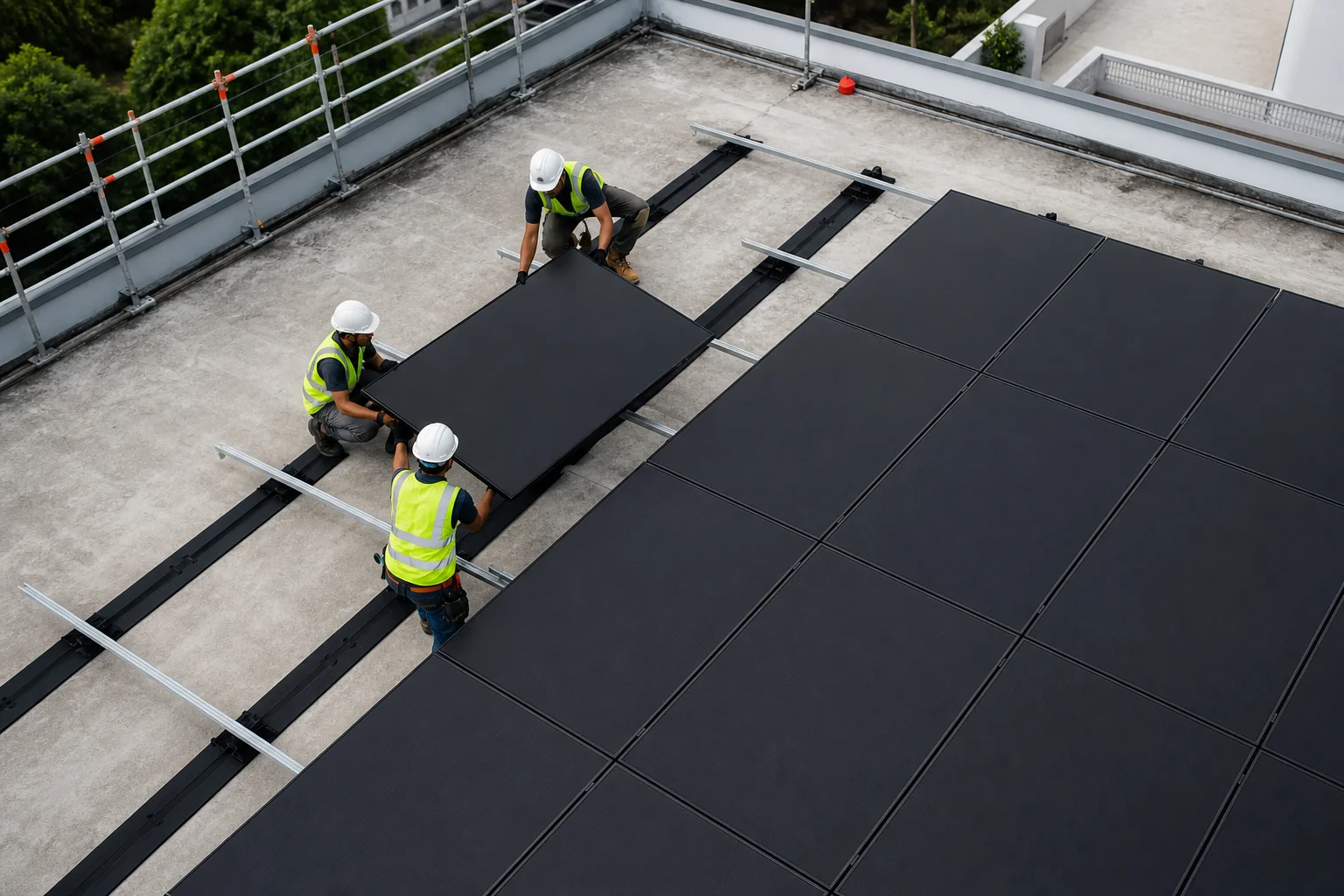
A rooftop solar installation is not a delivery — it is construction work at height, on your property. For a typical landed home that means scaffolding erected around your house, workers on your roof for one to two days, roof penetrations that must be made and sealed correctly, and heavy components moved above the places where your family lives. Singapore regulates exactly this kind of work through the WSH Act and its subsidiary regulations — including the WSH (Work at Heights) Regulations 2013 and the WSH (Scaffolds) Regulations — precisely because working on roofs is one of the higher-risk activities in the construction sector.
For a homeowner, the practical stakes are close to home. If something goes wrong on your site, the disruption happens at your house: a stop-work order pauses your project; an incident brings investigations to your address; and questions of liability and insurance play out around your roof. That is why the two questions worth settling before scaffolding goes up are: what is this company's public safety record, and who carries the liability and insurance for workers and for damage to my home? The first has an official, checkable answer, which is what this article is about. (For what the scaffolding itself involves — standards, permits, indicative costs — see our guide to scaffolding for residential solar in Singapore.)
How MOM's WSH demerit-points system works
The demerit-point system (DPS) was introduced in 2000 for the construction sector (and extended to manufacturing from October 2023) to deter poor WSH performance. The mechanics, per MOM's official explainer, are:
- Who can get points: any company in the construction or manufacturing sectors that breaches the WSH Act or its relevant subsidiary legislation.
- How many points: the number depends on the severity of the breach, from 1 point for a composition fine to 50 points for a prosecution following multiple fatalities.
- How points aggregate: points are summed across all worksites under the same company (UEN). A point can therefore arise from any of a company's projects — commercial, industrial or residential.
- How long points last: each demerit point is valid for 18 months.
- What accumulation triggers: 25 or more points within an 18-month period triggers debarment — MOM rejects the company's applications for new work passes for migrant workers, with longer debarment at higher point totals.
| Severity | Type of enforcement action | Demerit points issued |
|---|---|---|
| Potential harm | Composition fine | 1 per fine |
| Potential harm | Partial Stop-Work Order (SWO) | 5 |
| Potential harm | Full Stop-Work Order (SWO) | 10 |
| Harm | Prosecution for dangerous occurrences, or accidents leading to major injury or the death of one person | 25 |
| Severe harm | Prosecution for accidents leading to the death of more than one person | 50 |
Accumulated points map to debarment phases as follows:
| Debarment phase | Demerit points within an 18-month period | New migrant-worker hires | Renewal of existing work passes | Duration |
|---|---|---|---|---|
| — | 1 to 24 | Allowed | Allowed | No debarment |
| 1 | 25 to 49 | Not allowed | Allowed | 3 months |
| 2 | 50 to 74 | Not allowed | Allowed | 6 months |
| 3 | 75 to 99 | Not allowed | Allowed | 1 year |
| 4 | 100 to 124 | Not allowed | Allowed | 2 years |
| 5 | 125 and above | Not allowed | Not allowed | 2 years |
Two fair-reading notes. First, a small number of points (1-3) reflects composition fines — the lowest severity tier — not prosecutions or stop-work orders. Second, a company with points below 25 faces no debarment; the record simply stands as public information. Both readings apply to every company on the list, in every sector.
What the record shows for the solar sector (as at 14 Jul 2026)
We reviewed all 872 entries on MOM's list on the record date and identified the solar-sector companies among them. The aggregate picture:
The solar-sector picture — MOM WSH demerit-points list, as at 14 Jul 2026
As at 14 Jul 2026, five solar-sector companies in Singapore hold active WSH demerit points (ranging from 1 to 3 points each; none currently in a debarment phase) on MOM's public list of companies with demerit points — out of 872 companies across all construction trades.
Source: Ministry of Manpower — List of companies with demerit points, accurate as at 14 Jul 2026. Run the 60-second check on any installer you shortlist before scaffolding goes up.
Record verified: 14 Jul 2026. This list changes; always verify at the source before making decisions: mom.gov.sg — List of companies with demerit points.
Every solar-sector entry on the record date holds points below the 25-point debarment threshold, and none shows a debarment phase. We deliberately report the aggregate rather than a list of names: the record is live — points are added when enforcement actions occur and lapse after 18 months — so the only reliable answer for the specific company quoting you is a fresh search of the source, which takes about sixty seconds and is free. The step-by-step is below.
MOM attaches these caveats to the listing, which apply equally to this article's summary: the information is "accurate as at 14 Jul 2026"; "the listing provided is for awareness purposes only"; and "the information herein may not be complete at the time of publishing and hence should not be used as a formal reference for legal arbitration." In the same spirit: this summary is a snapshot of a public record on a stated date, reported in aggregate for consumer awareness. It is not an assessment of any company's overall quality, and points may have been added or may lapse after the as-at date. Always check the live record at the source.
How to check any solar company's safety record yourself
The record is public and searchable for any company — including Sunollo. We would encourage you to run the same checks on every installer you shortlist. It takes about five minutes:
- Get the exact legal name and UEN. Take them from the company's quote or invoice, or look the company up on ACRA's Bizfile. Marketing names often differ from registered names, so the UEN is the reliable key.
- Search MOM's demerit-points list. Open the official list and search (Ctrl+F / Cmd+F) for the company name and the UEN. Note the points and the debarment column, and note the "accurate as at" date at the top of the page.
- Check broader WSH performance on CheckSafe. MOM's CheckSafe eService lets you view and compare up to three years of a company's WSH performance, including injury and enforcement data and past WSH awards.
- Verify bizSAFE status. The WSH Council's bizSAFE e-services show whether a company is bizSAFE-recognised, at what level, and until when — you only need the UEN or registered name.
- Re-check close to signing. The demerit list is a living record — points are added when enforcement actions occur and lapse after 18 months. A check from months ago may be stale in either direction.
What good work-at-height practice looks like on a residential solar job
Beyond the record, it helps to know what compliant work at height actually looks like, so you can recognise it on your own site. Under Singapore's WSH framework, roof work of this kind generally involves:
- A fall prevention plan (FPP). The WSH (Work at Heights) Regulations 2013 require a documented, site-specific plan for eliminating or reducing fall risk — covering risk assessment, safe work procedures, control measures, equipment, training and emergency response — before work starts.
- Compliant scaffolding. Where scaffolds are used for access, they must comply with the WSH (Scaffolds) Regulations — proper erection, adequate strength and stability, and secure fixing. On a landed home you should expect to see guardrails and toe boards, not bare frames.
- Roof-work protections. For work on roofs with a potential fall of more than 2 metres, the regulations require protection against sliding or falling (such as crawler boards or roof brackets) and sufficient, secured anchorage for full-body harnesses — and that workers actually use them.
- Permits and procedures for hazardous work at height. In workplaces where the permit-to-work regime applies, hazardous work at height with a potential fall of more than 3 metres requires a documented permit process. Ask your installer what their equivalent site-control procedure is for your home.
- Insurance that names the homeowner's interest. Work-injury compensation covers the workers; you also want clarity, in writing, on who covers damage to your roof and property.
For reference, the standard Sunollo operates to on residential jobs includes a 26-point Quality Control Checklist on every installation, an in-house installation crew, S$3 million homeowner damage insurance where SunolloCare is in force, and — for homeowners who take SunolloCare — an insured long-term scope covering maintenance, monitoring, a roof-leak guarantee and system insurance. Whoever you choose, the point is the same: ask for the fall prevention plan, the scaffold arrangements and the insurance certificates before work starts, and expect plain answers.
Safety checklist: questions to ask any installer before scaffolding goes up
Use these on every company you evaluate — Sunollo included:
- Is the company currently on MOM's WSH demerit-points list? Check yourself at the source — mom.gov.sg — using the exact legal name and UEN from the quote.
- Who carries liability and insurance for workers and for damage to my roof? Ask for the policies in writing: work-injury compensation for the crew, public liability, and property/homeowner damage cover, with amounts.
- Can I see the fall prevention plan for my site? A site-specific FPP is a regulatory expectation for work at height, not a favour.
- Who erects and inspects the scaffold, and to what standard? Scaffolding must comply with the WSH (Scaffolds) Regulations; ask who is responsible for erection and inspection on your job.
- Is the installation crew in-house or subcontracted? Either can be done well — but the answer tells you whose safety record and training you should be checking.
- What is your bizSAFE level and can I verify it? Verifiable via the WSH Council's e-services with the company's UEN.
- What happens to my project if a stop-work order lands on one of your other sites? Points and enforcement aggregate at company level; it is fair to ask how the company would keep your project moving.
Frequently asked questions
Are there solar companies on MOM's demerit-points list?
Yes. Per MOM's list of companies with demerit points, accurate as at 14 Jul 2026, five solar-sector companies in Singapore hold active WSH demerit points — ranging from 1 to 3 points each — and none shows a debarment phase. The list spans 872 companies across all construction trades and changes over time as enforcement actions occur and points lapse. To see whether a specific installer is on it, search the company's exact legal name or UEN at the source — the live record is the only reliable answer for a specific company.
How do I check a solar installer's safety record in Singapore?
Three official surfaces: (1) search the company's legal name and UEN on MOM's public list of companies with WSH demerit points; (2) use MOM's CheckSafe eService to view up to three years of WSH performance, including injury and enforcement data; (3) verify bizSAFE recognition and level via the WSH Council's bizSAFE e-services. Use the UEN from the company's quote so you are checking the right entity.
What are WSH demerit points?
Demerit points are issued by Singapore's Ministry of Manpower to companies in the construction and manufacturing sectors for breaches of the Workplace Safety and Health Act and its subsidiary legislation. Severity determines the number: 1 point per composition fine, 5 for a partial stop-work order, 10 for a full stop-work order, and 25-50 for prosecutions arising from major injuries or fatalities. Points aggregate across all of a company's worksites under one UEN and remain valid for 18 months.
Does a demerit point mean a company is unsafe?
No. A demerit point is a factual record of a specific enforcement action — most commonly, at the 1-point level, a composition fine — not an overall judgment of a company. Points can arise from any worksite a company operates, not necessarily a residential one, and they lapse after 18 months. A fair reading looks at how many points, from what kind of action, how recently — and treats the record as one input alongside track record, insurance, and the quality practices you can verify directly.
What happens when a company accumulates 25 or more demerit points?
Debarment is triggered automatically: MOM rejects the company's applications for new work passes for migrant workers, for 3 months (25-49 points) up to 2 years (100+ points); at 125 points and above the company also cannot renew existing work passes. Separately, accumulating 25+ points can disqualify a company from public-sector construction tenders under the Safety Disqualification framework.
Are any solar companies in Singapore currently debarred for WSH breaches?
Per the record accurate as at 14 Jul 2026, none of the solar-sector companies on MOM's demerit-points list shows a debarment phase — every solar-sector entry holds 1-3 points, below the 25-point threshold. The record changes as enforcement actions occur and points lapse; check the live list before relying on this.
Do WSH demerit points apply to residential solar installations?
Yes — residential solar installation is construction-sector work at height, within scope of the WSH Act, the WSH (Work at Heights) Regulations 2013 and, where scaffolds are used, the WSH (Scaffolds) Regulations. Note the converse too: because points aggregate across all of a company's worksites, a point on the list does not necessarily mean an incident occurred at a residential site.
What safety practices should I expect on a residential solar installation?
A documented, site-specific fall prevention plan; compliant scaffolding with guardrails and toe boards; roof-work protections (crawler boards or roof brackets where needed) and anchored full-body harnesses for falls of more than 2 metres; a clear site-control procedure for hazardous work at height; and written clarity on insurance — work-injury compensation for the crew and named cover for damage to your roof and property. Ask to see each of these before scaffolding goes up.
The record is public — use it
Solar is a 25-year decision, and the installation itself is the highest-risk week of that quarter century. Singapore gives homeowners something rare: an official, dated, searchable safety record for every construction-sector company, at no cost. Whoever you shortlist, spend the five minutes: search the MOM list, run CheckSafe, verify bizSAFE, and ask the seven questions above. If you would like to see how a residential solar installation is run — scaffolding, fall prevention, insurance and all — talk to Sunollo or read our scaffolding and work-at-height guide.