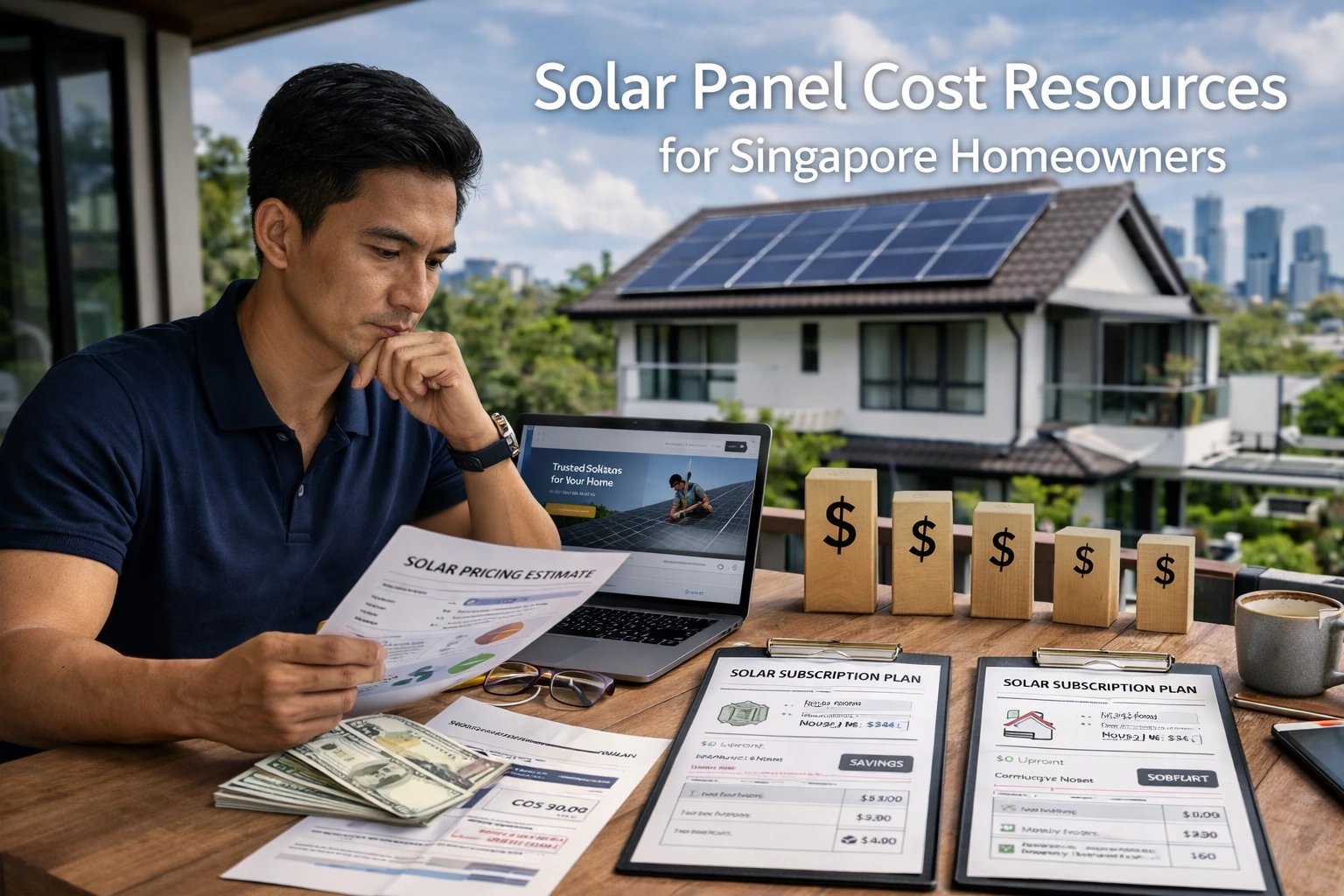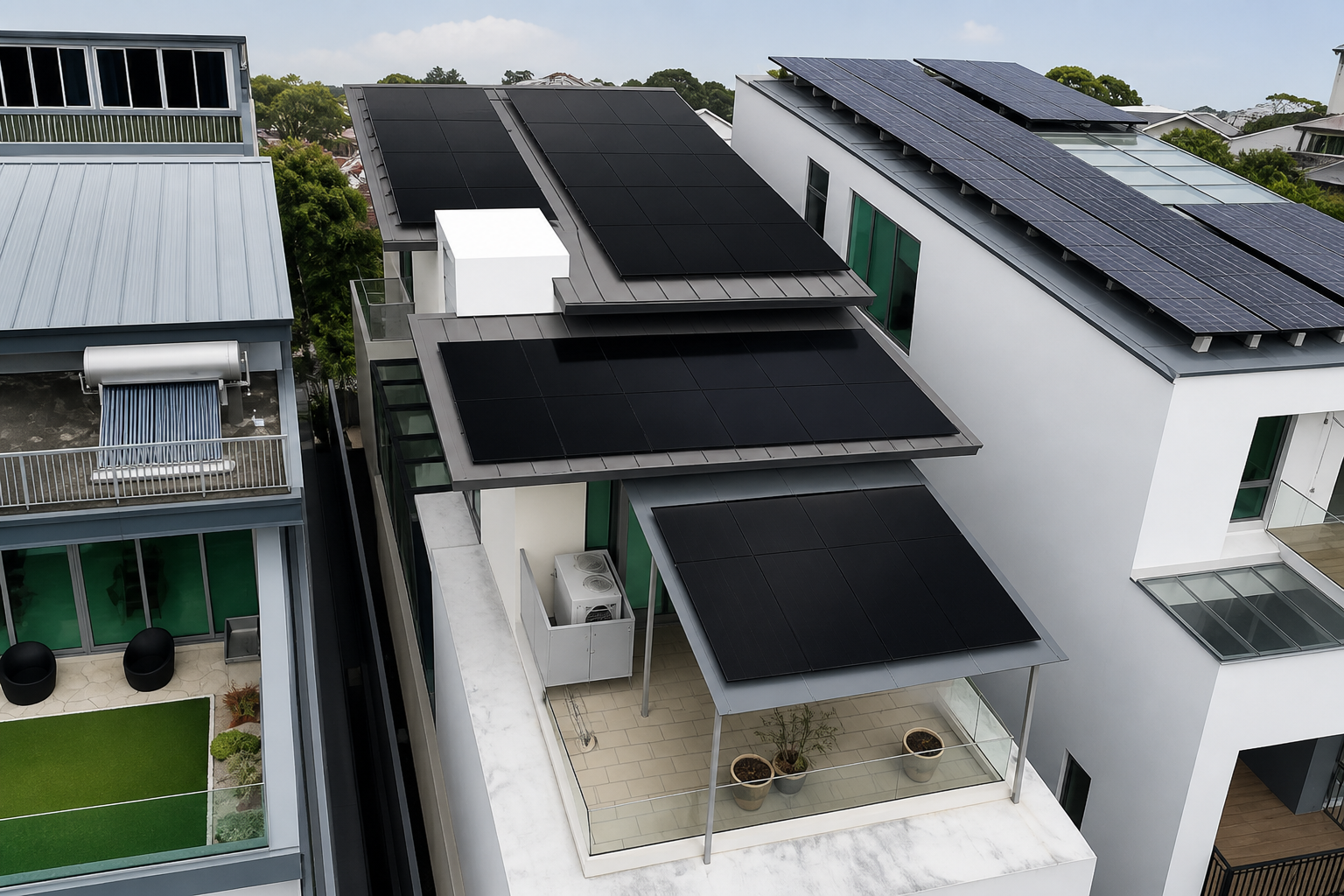
Most people arrive at this decision with one question: do I pay for solar now, or pay monthly and keep my savings? Both work in Singapore. They produce the same electricity from the same roof. What differs is when the money leaves your account, who owns the asset while you pay for it, and who is contractually responsible if output drops in year eight.
What a kilowatt-hour actually costs you, four ways
This is the comparison that settles the argument, because it puts every option in the same unit. The grid and retailer rows are dated tariffs; the solar rows are Sunollo's published levelised lifetime-cost bands.
| How you buy your electricity | Cost per kWh | Upfront | As of |
|---|---|---|---|
| SP Group regulated tariff (grid) | 34.78 cents (31.91 before GST) | — | Q3 2026, 1 Jul–30 Sep |
| Cheapest 24-month fixed OEM retail plan | approx. 27.5 cents | — | Early Jul 2026 listing |
| Sunollo $0-upfront plan, over system life | 15–22 cents | S$0 | 2026 published band |
| Sunollo outright purchase, over system life | 3.5–6 cents | From S$14,500 | 2026 published band |
Two things follow. First, both solar paths sit below the current grid tariff — the monthly plan trades part of the lifetime saving for zero capital. Second, the outright band is 9–18.5 cents/kWh lower than the subscription band, which is the economic benefit purchased with your upfront cash. Sunollo's lifetime bands are levelised over the life of the system; confirm GST treatment and inclusions on your written quote.
Why self-consumption is the number that moves payback
Quality residential installs in Singapore commonly land around S$1,000–S$1,300 per kWp all-in; smaller roofs price higher per kWp. At that band, payback on an outright buy is commonly 3–5 years when most production is used in the house rather than exported.
That last condition matters more than the panel brand. Electricity you use yourself displaces the full 34.78 cents you would have paid SP. Electricity you export earns the simplified credit rate, roughly 25–26 cents. So every kWh you consume instead of export is worth about 10 cents more to you. Daytime load — aircon, pool pump, water heater, EV charging, a battery — is what pulls payback toward the short end of the range.
The trade-off is cash timing, not product quality
On both Sunollo paths the roof, the yield and the equipment are the same. If a quote changes the panel family, the inverter class, the monitoring or the insurance when you switch payment path, you are looking at a different product — ask why.
| Should be identical on both paths | Legitimately differs |
|---|---|
| kWp, panel family, battery-ready inverter class | When cash leaves your account |
| Inverter/app telemetry and homeowner production visibility | Who owns the asset during the term |
| EMA, SP and LEW process and paperwork | Who carries performance risk for the term |
| 10-year workmanship warranty | Whether proactive operator monitoring and SunolloCare are bundled or elected, and for what term |
On SunolloCare specifically: it is the long-horizon operator programme covering monitoring, maintenance, a performance-guarantee component and S$3 million homeowner damage insurance. It is bundled into the $0-upfront path, because Sunollo has financed the hardware from its own balance sheet and stays responsible for output. On an outright purchase it is elective, for terms of up to 25 years — you can own the asset and still keep the operator. Confirm inclusions in writing either way.
How the payment paths differ across the market
Four structures are commonly available to Singapore landed homeowners. The table uses provider-published terms checked on 22 August 2026; confirm the current contract and quote before deciding.
| Path | Upfront | Who owns it during the term | Who carries risk after install | After-sales, as publicly disclosed |
|---|---|---|---|---|
| Outright cash Sunollo, Rezeca, other EPCs | Full cash; Sunollo packages from S$14,500 | You, from day one | You, unless an operator contract is in force | Sunollo: 10-year workmanship; SunolloCare elective up to 25 years. Rezeca publishes a 2-year workmanship DLP, app monitoring, two years of complimentary maintenance, optional annual servicing and manufacturer warranties. |
| Balance-sheet subscription Sunollo | S$0; published floor S$99/month; tenures up to 15 years | Per written contract; confirm end-of-term ownership or transfer terms | Sunollo — financed from its own balance sheet, not a loan in your name | SunolloCare bundled: monitoring, maintenance, performance-guarantee component, S$3m homeowner damage insurance. |
| Rent-to-own GetSolar published RTO | Its 10-year plan publishes S$0 upfront; its 5-year plan publishes a partial upfront payment. Confirm the current quote. | Provider during the rental term; transfers at term end, with early buyout available | Provider, during the term | GetSolar publishes 5- or 10-year workmanship cover, daily monitoring, free maintenance and a performance guarantee during the contract; manufacturer warranties continue after transfer. |
| Outright plus bank loan e.g. Rezeca with UOB U-Solar | S$0 cash if fully financed; the loan is in your name | You, from day one | You and the bank; the installer is paid as an outright sale | The provider's outright after-sales scope applies; loan tenure, interest and lender conditions sit in the bank agreement. |
A note on the S$99 figure, since it is often quoted out of context: it is Sunollo's published entry price for smaller systems — Radiance and Abundance from S$99, Abundance Pro from S$129 — on the same battery-ready inverter family as the outright packages. A typical 10 kWp landed system quotes above the floor. Competitors' current monthly figures change often enough that they are not restated here; read them on the provider's own calculator.
Choosing in about a minute
- You have the capital and want maximum 25-year surplus → buy outright. Ask for the identical specification you would receive on the $0 path, then decide separately whether to add operator care.
- You would rather keep the cash and have someone else carry performance risk → a balance-sheet-financed subscription. The provider's money is at stake for the tenure, which is what makes the monitoring promise enforceable.
- You want $0 upfront from a rent-to-own specialist → compare workmanship years, whether any performance guarantee exists, and what insurance is included, all in writing.
- You want to own from day one but borrow the money → outright plus a green loan. Understand that the bank's recourse is to you personally, regardless of what the roof produces.
The longer framework for the risk question — who still has money at stake after handover — is in solar installer vs solar operator. The cash-buyer deep dive is buying solar outright in Singapore, and cost bands by property type are in solar panel cost Singapore 2026.
Get both numbers for your own roof
A quote worth comparing shows outright and $0 upfront on the same kWp, names the inverter family, and states what is monitored and warranted after year two. Requesting it takes under a minute.
Get both-path numbers for my roof →
WhatsApp: own or monthly — which fits my roof? →
Call +65 3117 7925 · [email protected]
Frequently asked questions
Is buying outright or renting to own better for solar in Singapore?
Outright ownership maximises 25-year savings if you have the capital: the lifetime cost of a generated kWh from an owned system is roughly 3.5–6 cents, against a Q3 2026 grid tariff of 34.78 cents with GST. A $0-upfront plan costs about 15–22 cents/kWh over its life, still well below grid, and preserves your capital. With Sunollo the hardware family is the same on both paths.
Does Sunollo only offer $99/month subscription solar?
No. Sunollo sells outright packages from S$14,500 and $0-upfront plans from S$99/month with tenures up to 15 years. The S$99 figure is a published entry price for smaller systems, not a separate lower-specification product.
Is SunolloCare included or optional?
It is bundled into the $0-upfront path, because Sunollo finances the system from its own balance sheet and remains responsible for output during the term. On an outright purchase it is elective, available for terms of up to 25 years, so a cash buyer can own the asset and still keep an operator on the roof. Confirm inclusions on the written quote.
What is the payback period for solar in Singapore in 2026?
Commonly 3–5 years on an outright purchase for a landed home, at installed costs of around S$1,000–S$1,300 per kWp, when most production is self-consumed rather than exported. Heavy daytime load shortens it; a roof that exports most of its output lengthens it.
Why does self-consumption matter more than export?
Electricity you use yourself displaces the full 34.78 cents you would otherwise pay SP Group. Exported electricity earns the simplified credit rate of roughly 25–26 cents. Each kWh consumed rather than exported is therefore worth about 10 cents more to you.
If I take a bank solar loan, is that the same as a $0-upfront plan?
No. A bank loan, including U-Solar-style green loans, is still an outright sale: you own the system and you owe the bank whatever the roof produces. A balance-sheet-financed subscription keeps performance risk with the provider for the tenure.
Do I own the system during a rent-to-own term?
Under GetSolar's published rent-to-own model the provider owns and maintains the system during the 5- or 10-year term, then ownership transfers automatically to the homeowner; an early buyout is also available. Other providers' transfer terms can differ, so confirm the current contract in writing.
Which electricity tariff should I use in a 2026 payback calculation?
The Q3 2026 SP regulated tariff of S$0.3191/kWh before GST, or S$0.3478 with GST, for 1 July to 30 September 2026. The tariff resets quarterly, so date any calculation you rely on. Current figures: Singapore electricity price tracker and /api/facts.json.
How we built this comparison
Sunollo figures come from Sunollo's published pricing and its machine-readable fact ledger at /api/facts.json. Grid and export rates come from SP Group and EMA published schedules for Q3 2026. Competitor entries reflect only what those companies publish on their own websites as of 22 August 2026; where a company does not publish something, this page says so rather than estimating. No competitor pricing has been inferred or modelled.
Providers change terms. If anything here is out of date or misstates your company's model, email [email protected] and we will correct it and note the correction date.