The bottom line: Two years ago the just-right panel for a Singapore premium roof was 540W. Cell technology has moved on. AIKO’s Stellar 3N+72 now delivers 665W of All-Back-Contact (ABC) output at 24.6% efficiency while keeping the same 1,134 mm residential width — so it produces more energy per square metre than anything else you can put on a home, in a format still built for homes. That is why Sunollo’s 3rd-generation Eclipse panel — Eclipse Plus — is 665W. Not 500W. Not 770W. Just right, again.
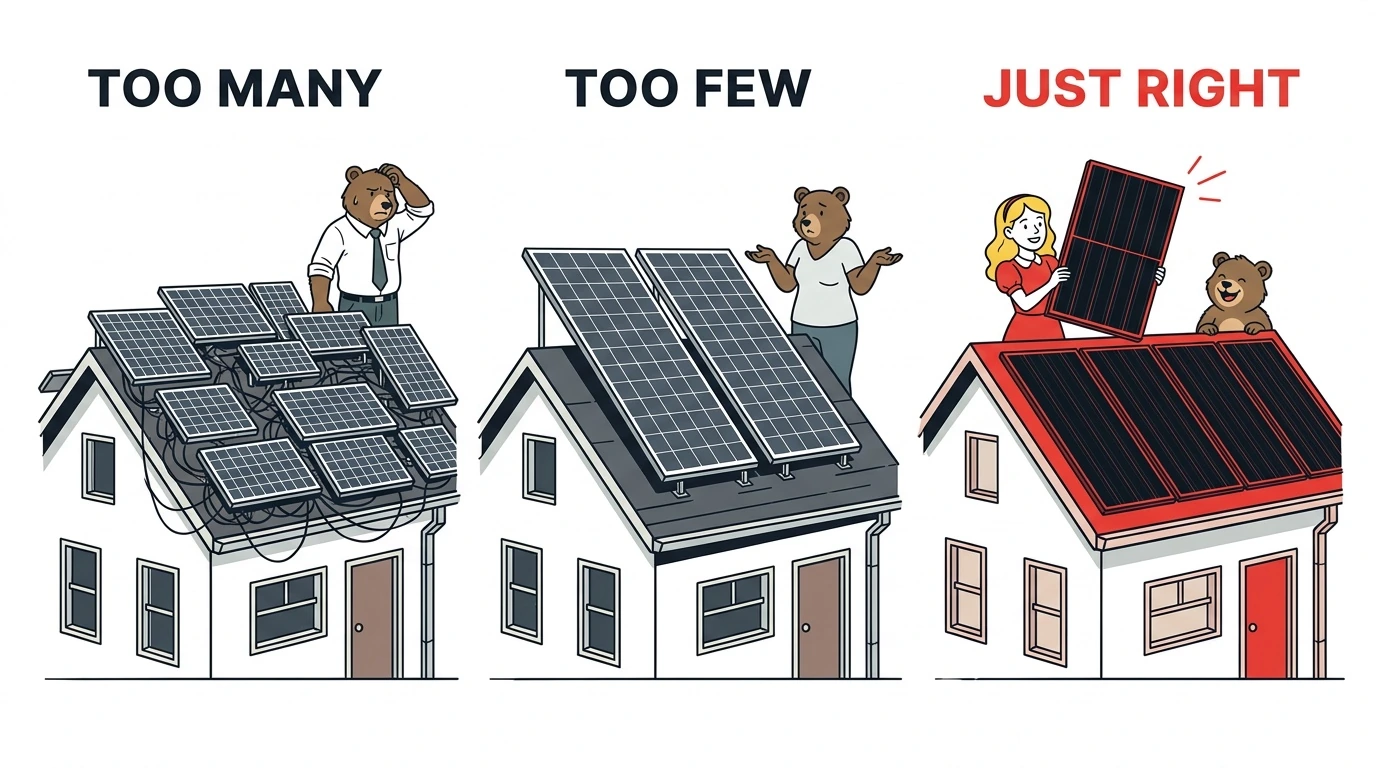
The Goldilocks Panel, Grown Up
A few years ago we wrote that the “just right” solar panel for a Singapore premium home was 540W. We meant it. At the time, going bigger meant going to a commercial-format module that was too wide, too heavy, and too industrial for a beautiful landed roof.
That was true. It just stopped being true.
Goldilocks did not change her mind about wanting things just right. The porridge changed. AIKO’s cell technology took a genuine step forward, and the question every premium-solar company has to answer — what is the single best panel to standardise on? — now has a different answer than it did in 2024.
The new answer is 665W: the AIKO Stellar 3N+72, an N-Type ABC module that Sunollo installs as Eclipse Plus, the 3rd generation of our Eclipse line. This article explains, honestly and in detail, why it is the new Goldilocks — why it beats both the smaller 500W class and the larger 770W commercial class — and why the deciding factor is not the number printed on the front of the panel.
Executive Summary
If you want the thesis before the detail: on a residential roof you are area-constrained, not panel-count-constrained. The only thing that scales your annual energy is watts per square metre — efficiency. The 770W commercial panel has a bigger number, but it is bigger because the panel is physically bigger, not because the technology is better; the best 770W modules top out around 22–23% and are ~1,303 mm wide and ~40 kg. The 500W class is excellent but small — more panels for the same system. The AIKO 665W ABC sits in between by design: it keeps the 1,134 mm residential width, extends only in length, and delivers 24.6% efficiency — the highest in mass production. More energy per square metre than the big panel, fewer panels than the small one. 500W is too small. 770W is too big. 665W is the platform.
Section 1 — It’s Width, Not Watts
When people argue about big panels, they argue about wattage. That is the wrong axis. The number that actually decides whether a panel belongs on a home is its width.
Here is the lineage of AIKO’s residential modules, and the one dimension that never changed:
- 500W class (Neostar, earlier Eclipse): 1,762 × 1,134 × 30 mm
- 540W class (Eclipse SunMax, 2nd gen): 1,954 × 1,134 × 30 mm
- 665W — Eclipse Plus, 3rd gen (Stellar 3N+72): 2,382 × 1,134 × 30 mm
- 770W+ commercial class (utility-scale G12): ~2,384 × ~1,303 × ~35 mm
Look down the width column. Every residential AIKO panel — 500W, 540W, 665W — is 1,134 mm wide. They grow only in length. That constant width is not an accident; it is what lets panels tile cleanly across the narrow facets of a terrace, semi-detached, or bungalow roof without wasting edge space.
The 770W commercial panel breaks the rule. To reach 770W it widens to roughly 1,303 mm — about 15% wider. That extra width is exactly why 700W+ modules feel wrong on a house: they leave dead strips along the edges of residential facets, they are heavier and more structurally demanding, and they visually overwhelm a domestic roofline. They were designed for the open, repeating rows of a solar farm, where width is free.
So the real story of the 665W panel is this: AIKO found a way to deliver 665W without leaving the 1,134 mm residential format. It got there by extending length and by raising cell efficiency — not by going wide. That is the whole trick, and it is why 665W is the first “big” panel that still belongs on a home.
Section 2 — The Metric That Actually Matters: Energy per Square Metre
A solar farm can always add another row of panels. Your roof cannot. On a home, the usable area is fixed the day the architect drew it. That changes the entire optimisation.
When area is fixed, the only lever that increases your annual energy is how many watts you fit into each square metre — module efficiency. Everything else is secondary.
This is where the 770W panel’s big number quietly falls apart:
| Panel class | Dimensions (mm) | Width | Module efficiency | Energy per m² |
|---|---|---|---|---|
| 500W class | 1,762 × 1,134 | 1,134 mm | ~22–24% | Good |
| 665W — AIKO Eclipse Plus | 2,382 × 1,134 | 1,134 mm | 24.6% | Highest |
| 770W commercial class | ~2,384 × ~1,303 | ~1,303 mm | ~22–23% | Lower than 665W |
The 770W module is not more powerful per square metre. It is more powerful per panel — because it is a physically larger panel. Spread that 770W over its ~3.1 m² body and you are looking at roughly 22–23% efficiency, because it uses larger-format cells rather than ABC. The AIKO 665W spreads 665W over 2.70 m² at 24.6%.
On a roof where the square metres are the constraint — which is every residential roof — the 665W ABC panel therefore harvests more annual energy per square metre than the 770W panel. The bigger number loses to the better technology exactly where it counts.
Section 3 — A Worked Example on a Real Roof
Theory is cheap. Let us put the three panels on the same semi-detached facet: a clean main plane 5.8 m wide × 9.5 m deep (~55 m² usable), the most common premium-roof archetype in Sunollo’s portfolio.
Portrait packing, N = floor(W ÷ panel width) × floor(D ÷ panel length):
| Panel | Columns × rows | Panels | System size | Roof used well? |
|---|---|---|---|---|
| 500W (1.762 m) | 5 × 5 | 25 | 12.5 kWp | Yes, but 25 panels |
| 665W (2.382 m) | 5 × 3 | 15 | 9.98 kWp | Clean, full rows |
| 770W (1.303 m wide) | 4 × 3 | 12 | 9.24 kWp | Wasted side strip |
Two things jump out. First, the 770W panel loses a whole column: at 1,303 mm wide, only 4 fit across the 5.8 m facet (4 × 1.303 = 5.21 m, leaving a ~0.59 m dead strip), versus 5 columns for the 1,134 mm panels. Its size advantage per panel is erased by losing a column and stranding roof area. Second, the 500W reaches a slightly higher raw kWp here — but only by using 25 panels instead of 15. That is 10 extra modules, 10 extra sets of clamps and connectors, more rooftop hours, and a busier roofline, to gain capacity worth a handful of kWh a year.
The 665W result — 15 panels, full clean rows, no stranded area, highest energy per square metre — is the Goldilocks outcome. Not the most panels. Not the biggest panels. The right ones.
Transparency note: this is a first-order packing model (it ignores rail overhangs, inter-row gaps and edge clearances) on a representative facet, used to illustrate the geometry. Sunollo models your actual roof before quoting. See the appendix for assumptions.

Section 4 — Why It Looks the Way It Does: ABC and the Beautiful Black Front
Pick up almost any solar panel and you will see thin silver lines running across each cell — the busbars and fingers that collect current from the front surface. They work, but they do two unwanted things: they cast tiny shadows that cost you efficiency, and they break up the panel’s appearance with a grey grid.
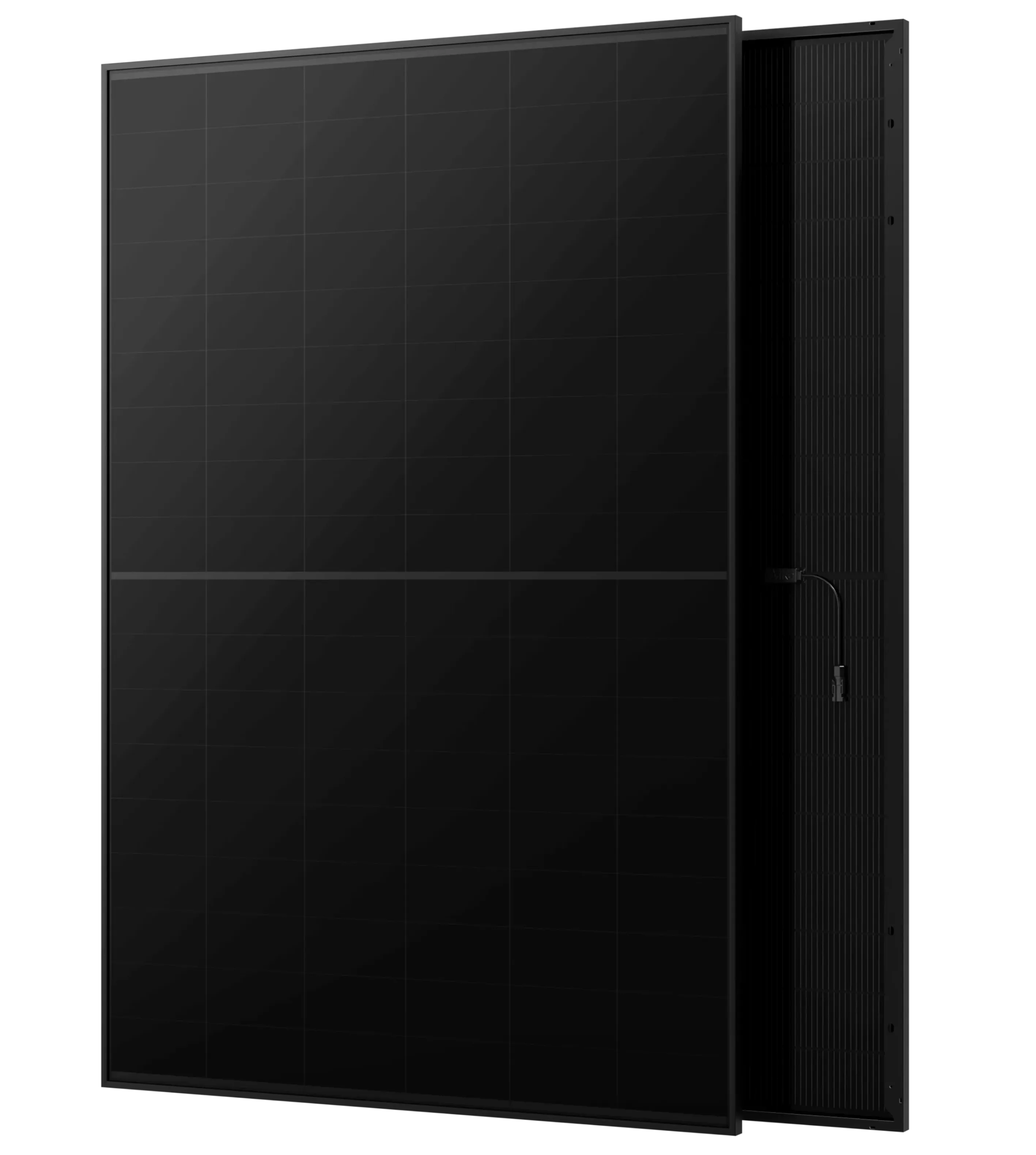
AIKO’s ABC — All Back Contact — technology moves every electrical contact to the back of the cell. The front is left as a clean, uninterrupted, deep-black surface, broken only by the subtle seams between cells — the “black stripes” that give the panel its signature look. Nothing on the front is wasted on wiring.
That single design choice delivers two things at once:
- The highest efficiency in mass production. With no front-side gridlines shading the cell, more of every photon reaches active silicon. That is how AIKO reaches 24.6% at 665W (up to 25.4% across the Stellar range) — numbers other commercial panels simply do not match.
- The most elegant roof in the neighbourhood. A uniform matte-black field with no silver grid is, quite simply, the most beautiful way solar has ever looked on a premium home. For the kind of roofs Sunollo serves — where the home is an architectural statement — this is not a detail. It is the point.
We go deeper into the cell physics in our guide to AIKO ABC N-Type technology. The short version: technically superior and better looking, from the same design decision.
Section 5 — Eclipse Plus: More Power, Even From the Back
Sunollo brands the panels we install as the Eclipse line. The 665W AIKO Stellar 3N+72 is our 3rd generation, and we call it Eclipse Plus — because it generates more, in more ways, than any Eclipse before it.
Bifacial: it harvests light from the rear
Eclipse Plus is a dual-glass bifacial module — 2.0 mm of coated tempered glass front and back, instead of a plastic backsheet. The rear face is photovoltaically active, so light reflected off the roof surface (the albedo) is captured and converted too. On a bright tile or membrane roof in Singapore’s high diffuse irradiance, that rear harvest adds a real, free increment of energy on top of the front-side rating — the panel quite literally generates from its backside.
Dual-glass means it lasts longer, too
The glass-glass sandwich is not just about bifaciality. It seals the cells between two rigid, UV-stable, moisture-proof panes, which is why this module carries a 30-year linear performance warranty (and a 15-year product warranty), with degradation of ≤1% in year one and just ≤0.35% per year thereafter. After three decades it is still guaranteed to produce around 88–90% of its original output. Glass-glass also resists the micro-cracks and potential-induced degradation that age cheaper backsheet panels.
Class A fire rating — the highest there is
Eclipse Plus carries an IEC Class A fire rating, the top classification for spread-of-flame and burning-brand resistance. On Singapore’s dense landed streets, where roofs sit close together, putting the highest fire class on your home is not a box-ticking exercise — it is the responsible default.
Built for the tropics
Heat is the enemy of solar output, and Singapore is relentlessly hot. Eclipse Plus has a temperature coefficient of just −0.26%/°C on peak power — meaning it loses less output as the roof bakes than conventional panels do. Combined with ABC’s strong partial-shading behaviour and a −40°C to +85°C operating range, it is engineered for exactly the conditions it will live in.
.png)
Section 6 — The AIKO Partnership: Why Sunollo Builds on ABC
Sunollo does not make solar panels. We choose them — and then we stand behind that choice for the 25-to-30-year life of your system. So the question of whose technology to build the Eclipse line on is one of the most important decisions we make.
We build it on AIKO, and we do so deliberately. AIKO is the company that took All-Back-Contact technology out of the laboratory and into volume manufacturing. They hold multiple independently certified world records for cell and module efficiency, and they have committed their entire production roadmap to ABC — not as a side project, but as the core of the business. That focus is why AIKO ABC modules consistently sit at the top of mass-production efficiency tables.
For Sunollo, partnering with AIKO means our flagship panel is made by a manufacturer whose mission is aligned with ours: deliver the highest real-world energy yield, the longest life, and the most refined product onto a premium home. When AIKO advances the technology — as they did from the 500W and 540W formats to the 665W Stellar 3N+72 — our Eclipse line advances with it. Eclipse Plus is the current expression of that partnership. It will not be the last.
If you want to see how AIKO stacks up against the field, we lay it out in our Singapore solar panel brand comparison.
Section 7 — Where a Smaller Panel Still Makes Sense
Sunollo is not dogmatic, and honesty matters more than a tidy story. There are roofs where the 665W is not the right call, and we will say so before you ask:
- Short, broken, or heavily obstructed facets. A 2,382 mm panel needs a continuous run of roof to lie down on. On a facet chopped up by dormers, valleys, skylights or plant, a shorter 500W-class module can sometimes tuck into spaces the longer panel cannot reach — recovering capacity that would otherwise be lost.
- Very tight access. At 2.38 m and ~32 kg, Eclipse Plus is a confident two-person carry. On the rare home where the only path to the roof is a narrow internal staircase with sharp turns, panel length becomes a genuine logistics constraint, and a shorter format wins.
In both cases we model the geometry and the access first, and we recommend the panel the roof calls for. But those are the exceptions. For the clean, contiguous facets of Singapore’s premium landed homes — the homes Sunollo is built to serve — the 665W Eclipse Plus is the platform.
Conclusion: Just Right, Again

The 500W panel is too small — excellent technology in too small a unit, so it asks your roof for more panels than it should.
The 770W panel is too big — a bigger number bought with a wider, heavier body that belongs in a solar field, and lower efficiency per square metre where your roof actually meters it out.
The 665W AIKO Stellar 3N+72 — Sunollo Eclipse Plus — is just right. It keeps the residential 1,134 mm width, extends only in length, and carries the highest-efficiency cells in mass production: 24.6% ABC, busbar-free black front, bifacial dual-glass that harvests from the rear, Class A fire rating, and a 30-year warranty. More energy per square metre than anything else you can put on a home, in a panel still designed for a home.
Goldilocks did not lower her standards. The technology rose to meet them.
If you want to know what Eclipse Plus would do on your roof, start with a Sunollo design consultation. We will model your actual facets, run the layout, and show you the exact system — panel by panel.
Appendix: Specifications, Assumptions & Sources
AIKO Stellar 3N+72 / Eclipse Plus 665W — key specifications
- Model: AIKO-A665-MDE72Dw (Stellar 3N+72 series, 655–685W)
- Cell type: N-Type ABC (All Back Contact), 144 cells
- Module efficiency: 24.6% at 665W (up to 25.4% across the range)
- Dimensions: 2,382 × 1,134 × 30 mm; weight 32.4 kg
- Glass: dual-glass bifacial, 2.0 + 2.0 mm coated semi-tempered
- Temperature coefficient (Pmax): −0.26%/°C; operating range −40°C to +85°C
- Fire rating: IEC Class A; max static load front 5,400 Pa / back 2,400 Pa; hail 25 mm at 23 m/s
- Warranty: 30-year linear performance (≤1% year-one, ≤0.35%/yr thereafter) + 15-year product
- Source: AIKO Stellar 3N+72 datasheet V3.1, 2025-09
Comparison classes — representative figures
- 500W class: ~1,762 × 1,134 mm, residential 1,134 mm width. Used here to represent AIKO’s smaller ABC format / earlier Eclipse generations.
- 770W commercial class: ~2,384 × ~1,303 mm, ~35–40 kg, ~22–23% efficiency, larger-format (non-ABC) cells. Representative of utility-scale G12 modules; specific competitor specs vary.
Packing model — illustrative
Panel counts use the first-order portrait model N = floor(W / panel width) × floor(D / panel length). Real installations account for rail overhangs, inter-row gaps, edge clearances and obstructions. The worked example uses a representative 5.8 × 9.5 m semi-detached facet and is illustrative, not a surveyed dataset.
Energy-per-square-metre claim
The statement that the 665W ABC module harvests more energy per square metre than a 770W commercial panel follows directly from module efficiency: 24.6% (AIKO 665W, datasheet) vs ~22–23% (typical highest-efficiency 770W class). Annual yield in absolute terms still varies with orientation, tilt, shading, soiling and inverter efficiency.