As solar technology evolves beyond traditional rooftop panels, one of the most exciting developments is BIPV — Building-Integrated Photovoltaics. But how does BIPV compare to conventional solar panels? When does architectural integration make more sense than standard rooftop installation? This guide provides a clear-eyed comparison for Singapore building owners and architects.
What Are Traditional Solar Panels?
Traditional (or rack-mounted) solar panels are standalone modules installed on top of an existing roof structure. They are the most common form of solar in Singapore, mounted on aluminium rails a few centimetres above the roof surface. The roof is the structural support; the panels are a bolt-on addition.
Key characteristics:
- Efficiency: 20–24% (monocrystalline TOPCon/HJT)
- Cost: SGD 1.20–1.80 per Wp installed
- Lifespan: 25–30 years
- Aesthetics: Visible on roof, uniform black or blue appearance
- Installation: Mounted on rails above existing roof material
For a complete guide to choosing conventional panels, see our best solar panels 2026 guide.
What Is BIPV?
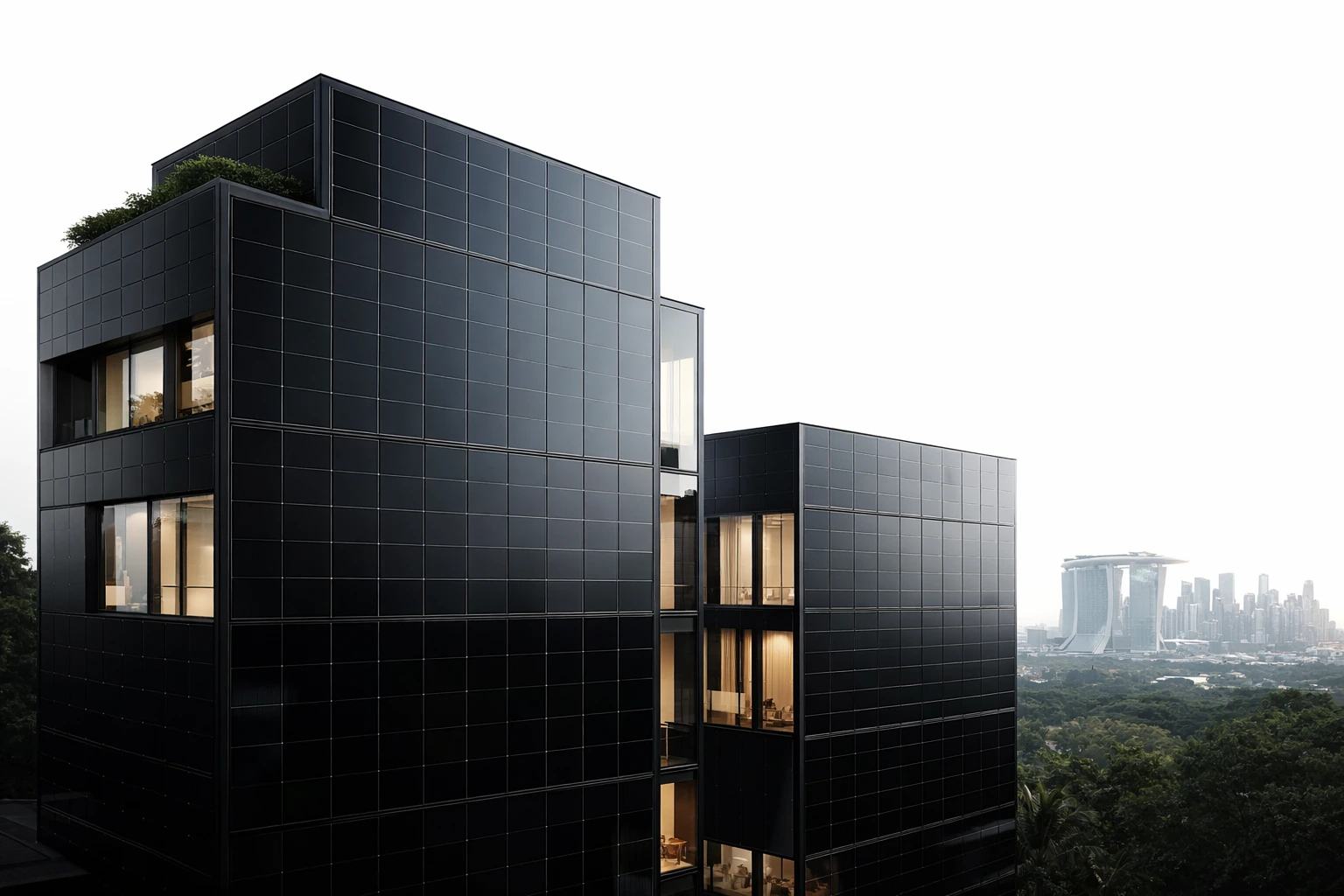
BIPV replaces conventional building materials with photovoltaic elements. Instead of mounting panels on a roof, the roof (or facade, window, or louvre) itself generates electricity. The solar cells are embedded within the building material, serving a dual purpose: weather protection/structural function AND energy generation.
BIPV forms available from Sunollo Pro:
- Cloud Cover: Translucent BIPV roof panels that allow filtered natural light while generating power
- Sunshine Tiles: Solar roof tiles that replace conventional tiles entirely
- PV Glass: Transparent photovoltaic glass for facades and windows
- Stellar Louver: Solar-generating louvres for sun shading that produces electricity
Head-to-Head Comparison
Efficiency
Traditional panels win. Standard monocrystalline panels achieve 20–24% efficiency. BIPV products range from 8–18% depending on form factor. PV glass (which must maintain transparency) has lower efficiency than opaque BIPV roof tiles.
However, BIPV can deploy solar on surfaces where traditional panels cannot — facades, windows, shading elements. The lower per-square-metre efficiency is offset by vastly larger deployable area.
Cost per Watt
Traditional panels win. At SGD 1.20–1.80/Wp, conventional panels are significantly cheaper than BIPV products (SGD 3–6/Wp). However, this comparison is misleading: BIPV replaces a building material you would need to buy anyway. When you subtract the cost of the conventional material BIPV replaces (roof tiles, facade cladding, window glass), the premium drops to 30–60%.
Aesthetics
BIPV wins decisively. For architecturally sensitive projects, heritage buildings, or homeowners who want seamless integration, BIPV is unmatched. Solar disappears into the building design rather than sitting conspicuously on top of it. Read about how BIPV transforms roofs into art.
Deployable Area
BIPV wins. Traditional panels are limited to suitable roof surfaces (south-facing, unshaded, structurally adequate). BIPV can be applied to north, east, and west facades, windows, canopies, carports, and architectural features — potentially tripling the available solar area on a building.
Durability and Warranty
Comparable. Both technologies offer 25+ year lifespans with proper installation. BIPV products are tested to the same IEC standards as conventional panels, with additional building material certifications (fire resistance, water tightness, structural loading).
When to Choose Traditional Panels
- Maximum energy generation per dollar is the priority
- Ample unshaded roof space available
- Retrofitting an existing building with no planned renovation
- Budget is the primary constraint
When to Choose BIPV
- New construction or major renovation (BIPV replaces conventional materials)
- Architectural aesthetics are important
- Roof space is limited but facade area is available
- Building regulations restrict conventional panel mounting
- Green building certification (BCA Green Mark) is a goal
- Commercial or institutional buildings seeking design distinction
The Hybrid Approach
The most powerful strategy combines both: conventional panels on the roof for maximum generation, BIPV on facades and features for additional capacity and aesthetics. This hybrid approach can increase total building solar capacity by 40–70% compared to roof-only installations.
Sunollo offers both through our residential solar packages (conventional panels) and Sunollo Pro (BIPV), allowing a unified design that maximises both generation and architectural beauty.
BIPV and Singapore’s Future
As Singapore pushes toward 2 GWp of solar by 2030, BIPV will play an increasingly critical role. The island’s limited land area means rooftops alone cannot meet the target — facades, windows, and other building surfaces must contribute. BIPV turns every building into a power plant, not just its roof.
This aligns with Sunollo’s vision: solar for every surface, energy from every angle, a nation that powers itself from every building it constructs.
Explore BIPV options with Sunollo Pro or compare with our conventional panel packages.
Continue reading: Solar Glass Windows | Green Building Certification | Best Solar Panels 2026