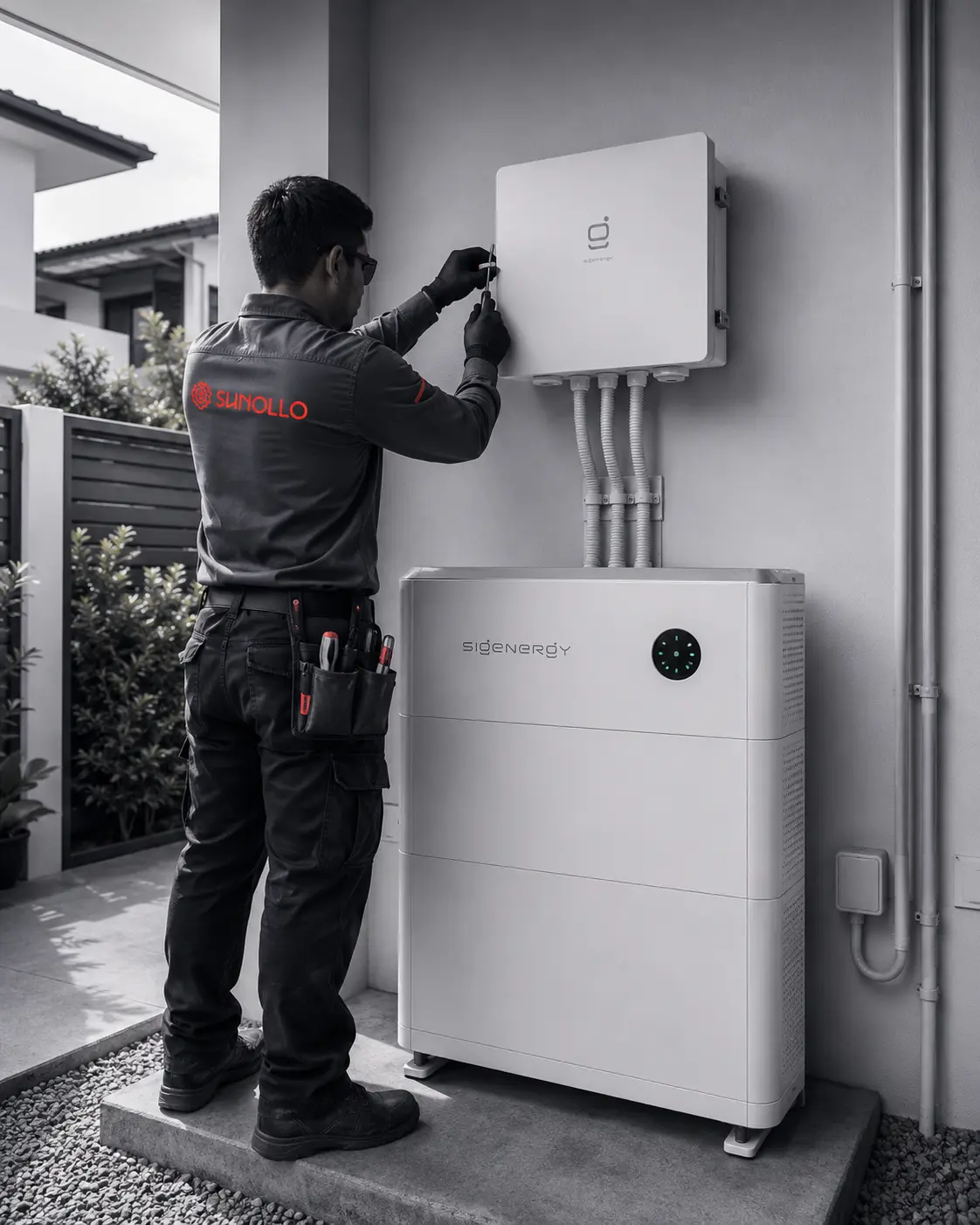
Quick answer: Why is residential solar fundamentally different from utility-scale and C&I solar?
Residential solar is not a solar business. It is a consumer business that happens to install solar — closer operationally to Uber, Amazon, Grab, and Apple than to Vestas, Schneider, or a utility-scale developer. Utility-scale solar is project finance with one sophisticated buyer per project, a 24-month deal cycle, and contracted IRRs. C&I solar is B2B procurement with professional buyers, 3-12 month deal cycles, and 15-25% retail discount PPAs. Residential solar is 1,000+ individual homeowners per year, each making a S$12,000-18,000 emotional decision in 3-6 weeks based on a 25-year warranty promise. Density compounds: clustering 10 installations in one neighbourhood drops cost-per-install by 20-30%. The metrics that matter are not LCOE — they are CAC, conversion rate, install velocity, NPS, referral rate, and 5-year retention. The companies that win residential solar in Singapore over the next decade will look more like Sunrun (US$9 billion market cap, built as a consumer finance company that does solar) than like any traditional solar EPC. Singapore's opportunity: ~70,000 viable landed home rooftops, <10% penetrated, ~5,000 installs/year potential at peak, S$1 billion+ cumulative residential market by 2035 — plus a much larger expansion into battery, EV charging, and Virtual Power Plant services on top.
Most people who try to scale residential solar fail for the same reason: they think they are in the solar business. They are not. They are in the consumer business. And the operating system of a consumer business at scale has almost nothing in common with the operating system of a utility-scale solar project.
This is the single most consequential idea in residential energy that almost nobody in the industry talks about openly. It is the unstated reason why Sunrun is worth US$9 billion in market cap and the average Singapore solar EPC firm is worth almost nothing. It is the reason the founders who scale residential solar tend to come from Uber, Amazon, McKinsey, private equity, and consumer finance — and rarely from utility engineering. It is the reason Singapore's S$1 billion+ residential rooftop opportunity will not be won by whoever has the cheapest panel or the most efficient inverter.
It will be won by whoever builds the best consumer operating system for a 25-year asset, sold one home at a time, across hundreds of square kilometres of dense urban geography, to homeowners who decide in 3-6 weeks but live with the consequences for the next quarter-century.
This piece is a deep map of why that is true, what it actually takes operationally, who the right reference companies are, and what winning looks like. It is in the same series as our earlier piece on the five games of Singapore energy — but where that piece was a value chain map at the sector level, this one is the operating map of Game 5 (Distributed Energy) at the residential layer specifically.
Part I — The Three Solar Businesses Are Not the Same Business
1. The Misclassification That Costs Companies Hundreds of Millions
Walk into almost any Singapore solar conference and you will hear "the solar industry" discussed as a single thing. It is not. It is at least three different industries that happen to share a common technology — and the operating systems required to win each are so different that companies which try to compete in all three usually end up mediocre in all three.
The three businesses, with their core characteristics:
| Dimension | Utility-scale | C&I (Commercial & Industrial) | Residential |
|---|---|---|---|
| Project size | 10–200 MWp | 200 kWp – 10 MWp | 3–15 kWp |
| Decision-maker | Utility procurement / IPP sponsor / hyperscaler | Corporate facilities / sustainability buyer | Individual homeowner / family |
| Deal cycle | 18–36 months | 3–12 months | 3–6 weeks |
| Counterparty sophistication | Highly professional | Professional | Lay consumer |
| Cap-ex source | Project finance / sponsor equity | Owner cash or PPA debt | Owner cash, loan, or lease |
| Margin structure | Contracted PPA / merchant exposure | 15–25% discount to retail tariff | Install margin + 25-yr recurring |
| Volume per year | 1–5 projects | 10–100 projects | 1,000–5,000+ installations |
| Number of stakeholders per deal | 30–80 (lenders, EPC, off-taker, regulator) | 5–15 (CFO, facilities, ESG, finance) | 1–4 (homeowner, spouse, sometimes parents) |
| Trust required | Institutional credit rating | Corporate counterparty review | 25-year personal warranty trust |
| Customer touchpoints over asset life | Quarterly reports to sponsor | Annual review | Daily monitoring + 25-yr service |
Read that table closely. Notice that utility-scale and residential are not "the same business at different sizes." They are opposite businesses on almost every dimension that determines how a company is operationally structured: the cadence of decisions, the number of customers, the sophistication of the buyer, the source of capital, the time horizon of the relationship, the volume of throughput, and the nature of the trust being purchased.
A company optimised for utility-scale (think the EPC firms that build 50 MWp solar farms in Indonesia or Vietnam) is built around project execution: large teams of engineers, deep procurement and supply chain capability, sharp pencils on contracted IRR, structured finance literacy, regulator and lender management. The customer count is small. The deal cycle is long. The operations are bursty (a few large projects per year).
A company optimised for residential is built around customer throughput at scale: lead generation engines, sales consultation processes, design throughput systems, installation crew dispatch logistics, after-sales call centre operations, software for monitoring and customer self-service, brand and trust marketing, density-driven cluster economics. The customer count is large. The deal cycle is short. The operations are continuous (hundreds of small projects in pipeline simultaneously, daily).
These are two different companies. The market keeps assuming they are one company.
2. The First 2×2: Volume × Decision-maker Sophistication
The cleanest way to see the difference is to map each segment on volume of customers per year versus sophistication of the decision-maker.
| Low volume of customers / year | High volume of customers / year | |
|---|---|---|
| Sophisticated buyer | Utility-scale solar (1–5 deals/year, professional procurement). Closest analogue: M&A advisory. | C&I solar (10–100 deals/year, professional procurement at smaller scale). Closest analogue: SaaS enterprise sales. |
| Lay consumer buyer | (rare; small fragmented contractors) | Residential solar (1,000–5,000+ installs/year, emotional purchase). Closest analogue: Uber / Grab / Amazon / Apple. |
The lower-right cell — high volume of lay consumer customers — is where every consumer technology company you have heard of operates. It is also where residential solar lives. The companies that succeed in this cell are operating consumer companies, not technology companies. Their primary competitive moat is the operational ability to deliver consistent customer experience at scale, not the technology embedded in the product.
Apple does not win on chip design alone; it wins on the integrated retail-product-service experience across hundreds of millions of customers. Uber did not win on routing algorithms; it won on the network density across thousands of cities. Amazon did not win on warehouse efficiency alone; it won on the integration of supply chain, customer experience, and reverse logistics across hundreds of millions of customers.
Residential solar is in the same cell, with the same operating principles, and almost nobody in the energy industry has internalised that fact.
Part II — The Twelve Questions This Piece Answers
Before going further, here is the explicit list of questions this piece works through:
Part III — Why Residential Solar Is Actually Closer To...
3. The Uber Comparison: Two-Sided Network + Density
Uber's strategic insight was that the marketplace business is not won by being everywhere — it is won by being dense in the places you choose to compete. The early Uber playbook (and the Grab playbook in Southeast Asia after) was to launch a single city, achieve high driver density and passenger density in a few neighbourhoods, get the pickup time under 5 minutes, generate organic word-of-mouth, then expand.
Residential solar at scale runs on identical mechanics. The "drivers" are the installation crews; the "passengers" are the homeowners. The unit economics are dominated by the same variable: how dense is your local network?
This is exactly the playbook that Uber, Grab, and DoorDash used to scale. It is also why most attempts at "national" residential solar before achieving regional density fail — the unit economics simply do not work at low density. Sunrun's early growth was concentrated in California, Massachusetts, and a handful of high-incentive states before national expansion. Tesla's solar business follows the same pattern, focused on specific regions before broader rollout.
For Singapore specifically, density is an even more potent advantage than in the US. The country is 728 square kilometres. Landed home estates cluster geographically. A solar company that builds dense market share in 5-10 landed-home districts (Bukit Timah, Holland, Serangoon Gardens, East Coast, Sembawang, Sentosa Cove, etc.) reaches density economics that no national broadcaster can match.
4. The Amazon Comparison: Customer Experience + Reverse Logistics + Day 1
Amazon's institutional obsession with customer experience is the most studied management principle in modern business. Jeff Bezos's "Day 1" mentality, the requirement that every operational decision starts from the customer working backward, the policy that warranty returns and reverse logistics are treated as core operational excellence rather than overhead — all of this maps directly onto residential solar.
Three Amazon principles apply almost without modification:
(a) Customer experience is the moat, not the technology. The most painful operational areas in residential solar are the ones customers actually remember: the messy installation that left grease marks on the driveway, the inverter that failed in year three and took six weeks to replace, the unanswered phone call when the monitoring app stopped working. These are not "operational details" — they are the entire product. The company that delivers consistent, on-time, polite, communicative service across 1,000+ installations per year wins the market. The company that delivers cheapest panels and shrugs at after-sales does not. This is the same insight Amazon institutionalised through the customer-obsession leadership principle two decades ago.
(b) Reverse logistics is core, not overhead. Solar panel warranty claims happen across a 25-year period. Inverter failures cluster around year 8-12. Workmanship claims (water ingress, mounting failure) appear in years 1-3. A residential solar company at scale must be able to dispatch a service crew to a customer's roof within 48-72 hours, diagnose, source replacement parts, and resolve — all while maintaining customer confidence. The companies that build this operation deliberately, as a primary system rather than an afterthought, retain customers, generate referrals, and capture the upsell pathway to battery, EV charger, and VPP enrolment. The companies that under-invest in reverse logistics lose customers and erode the entire 25-year LTV.
(c) Day 1 thinking applied to a 25-year asset. Bezos famously said that Amazon, even after decades of operation, would behave like a "Day 1" company. The institutional risk for a residential solar company is that, once installation is complete and the customer is generating savings, the company drifts into Day 2 thinking — treating the customer relationship as concluded. The companies that remain in Day 1 mode — proactively reaching out at year 2 for system performance check, at year 5 for panel washing, at year 10 for inverter replacement consultation, at year 15 for battery addition — generate 2-3x lifetime customer value compared to companies that treat the install as the transaction.
5. The Grab Comparison: Local Density + Multi-Product Platform + Operations Excellence
If Uber teaches density, Grab teaches density-plus-platform. Grab started in 2012 as a taxi-hailing app in Malaysia. Within a decade, it had expanded into ride-hailing, food delivery, payments, financial services, business loans, GrabExpress logistics, GrabRewards, and insurance — all sharing a common customer base and operational backbone in Southeast Asia.
The strategic insight: once you have built deep customer relationships and operational infrastructure in a region, the marginal cost of layering additional products onto the same customer base is dramatically lower than the cost of acquiring a new customer for each product. Singapore residential solar follows the same logic.
The natural product stack expansion path:
None of these are profitable to acquire customers for individually. All of them are highly profitable when sold to existing solar customers because the customer acquisition cost is essentially zero — it has already been paid in the original sale. The platform economics emerge from the customer relationship, not from the panel.
This is the Grab playbook, applied to residential energy in Singapore. The companies that get this right become category leaders. The companies that try to compete on panel sales alone become commodity contractors competing on price.
6. The Apple Comparison: Integrated Product + Retail Experience + Premium Pricing Power
Apple's strategic playbook is the most ambitious model that residential solar should learn from — the one that produces the highest unit economics if executed well, and the most embarrassing failure if executed poorly. Apple's core insight is that consumer products with deep integration of hardware, software, retail experience, and service produce premium pricing power that pure-play competitors cannot match — and that this premium accumulates into a customer relationship moat across products.
The relevant Apple elements for residential solar:
(a) Integrated product: Apple does not sell a CPU, an operating system, and a customer service contract as three separate products. It sells "iPhone" as a single integrated experience. Residential solar at the highest tier should not sell panels, inverters, mounting, installation, monitoring, and after-sales as six separate line items. It should sell "your home's energy system" as a single, integrated, branded experience. Sunrun does this with "BrightBox" and the Sunrun home subscription. Tesla does this with the Solar Roof + Powerwall + Tesla app ecosystem.
(b) Retail experience as positioning: Apple's retail stores are unprofitable on a per-store revenue basis but enormously profitable on customer trust and brand pricing power. A premium residential solar brand in Singapore could operate a showroom — physical or digital — that demonstrates installed systems, monitoring, battery integration, and the customer service tier in ways no website can. This is the equivalent of the Apple Store's Genius Bar for solar.
(c) AppleCare as a profit centre and trust signal: AppleCare+ is a multi-billion-dollar revenue stream for Apple, but its more important strategic function is to signal to customers that Apple stands behind the product across a multi-year relationship. SunolloCare, or any equivalent maintenance and monitoring subscription, plays exactly the same role: it is both a profit centre and a trust signal that the installer will be present across the 25-year asset life.
(d) Ecosystem expansion: iPhone → iPad → Watch → AirPods → Services. Each product strengthens the lock-in of every other product because they share the same operating system, account, and customer relationship. The residential solar equivalent — solar → battery → EV charger → VPP enrolment → maintenance subscription — produces the same ecosystem effect.
(e) Premium pricing power: Apple commands 25-40% price premiums over functionally equivalent products from competitors. This is not because Apple has better silicon (it often does not, on raw specs). It is because the integrated experience, retail trust, and ecosystem create a willingness-to-pay that pure-play competitors cannot replicate. In residential solar, the same dynamic exists. Sunrun systems are not the cheapest installation in any given US zip code, but Sunrun captures the highest market share because the integrated finance + install + service product is worth more to customers than the lowest-cost alternative.
The trap: trying to execute the Apple model with inconsistent operational quality. Apple's pricing power depends on every customer interaction reinforcing the premium. If a Sunollo customer's installation is messy, or after-sales is slow, or monitoring breaks, the premium evaporates and the company is left charging Apple prices for non-Apple service. The Apple model only works if the operating system is genuinely Apple-grade.
7. The Sunrun Lesson: Consumer Finance, Not Technology
The single most important strategic lesson in residential solar history is what Sunrun figured out in 2007. Lynn Jurich and Edward Fenster started Sunrun with backgrounds in private equity and consulting — not in solar engineering. Their core insight was that the bottleneck in residential solar adoption was not technology. It was upfront capital.
A homeowner facing a US$25,000-40,000 installation bill (US market sizes, larger than Singapore) was making a decision they could not easily finance, did not know how to underwrite, and could not easily compare across vendors. Sunrun's innovation: own the panels themselves, install on the customer's roof, and charge the customer a monthly subscription that was below their previous electricity bill. Solar-as-a-service.
Three downstream consequences of this innovation:
(a) Removed the upfront capital barrier. The homeowner's first-year cash outlay went from US$30,000 to roughly US$0 — and their monthly bill went down. This dramatically expanded the addressable market beyond the homeowners who could write large cheques.
(b) Created a securitisable asset class. Aggregated monthly subscription payments from 100,000+ homeowners across 20-25 year contracts is a long-dated, diversified, real-asset-backed cashflow stream. Wall Street understands how to underwrite this. Sunrun could raise billions of dollars in asset-backed debt at infrastructure-grade rates, fund the upfront installation costs, and grow the customer base much faster than a cash-purchase model would allow.
(c) Transformed the customer relationship into a subscription. Once the customer relationship is a 20-25 year subscription rather than a one-time transaction, the entire operating model changes. Customer retention matters. NPS matters. Upsell to battery, EV charger, and home energy management matters. The financing model is the product.
Singapore is roughly 10 years behind the US in this evolution. As of 2026, residential solar in Singapore is dominated by cash purchases (with some green loan financing via DBS, OCBC, UOB). No company has yet introduced a Sunrun-style solar-as-a-service subscription at scale. The market structure to enable it — standardised contracts, AMI-enabled performance monitoring, MAS taxonomy alignment, an asset-backed debt issuer comfortable with the credit risk — is being assembled piece by piece, as we discussed in the previous piece on the five games.
The first company that introduces a credible residential solar subscription in Singapore captures a category-defining position. It will likely not be a traditional solar EPC. It is more likely to be a consumer-tech operator (or a solar installer that has been hiring consumer-tech operators) who recognises that the financing model is the product.
Part IV — The Value Chain, Decomposed
Let's now walk through every step of what running a residential solar company at scale actually involves — the full value chain, not the marketing-deck version.
8. Step 1: Lead Generation
The pipeline begins with leads — homeowners who have expressed some level of interest in solar. The major channels:
The strategic question is the channel mix. A company over-reliant on paid digital has a CAC that scales linearly with growth (no efficiency gains, often worsens). A company that builds organic and referral channels has a CAC that improves as the customer base grows (compounding efficiency). The right benchmark: blended CAC under 10% of average installed price (around S$1,200-1,800 in Singapore for a S$15,000 install).
9. Step 2: Sales and Consultative Selling
A solar lead is not a sale. It is a 3-6 week consultative process during which the homeowner is making a S$12,000-18,000 emotional decision based on incomplete information, family input, and a 25-year warranty promise. The role of the solar sales advisor is closer to a wealth manager or a healthcare consultant than a retail salesperson.
The typical sales process:
The conversion rate at each step is the key operating metric. A typical residential solar funnel in Singapore: 100 leads → 50 site visits → 35 quotes → 18 contracts → 18 installs. That is an 18% lead-to-install conversion rate, which is roughly in line with industry benchmarks. The top operators reach 30-40% on warm-channel leads (referrals, content-marketing-sourced).
The advisors who do this well share certain traits: high emotional intelligence, ability to translate engineering language into homeowner language, patience with multi-week decision cycles, comfort with absent-decision-maker spouses, comfort with explaining the same warranty terms ten different ways. They are closer to consultative wealth advisors than to solar engineers.
10. Step 3: Design and Engineering
Once a customer commits to a quote, the design engineer produces a detailed system design: panel layout on the roof, electrical single-line diagram, structural anchoring scheme, cable routing, inverter sizing, monitoring system configuration, expected annual yield, and compliance documentation for the regulator and SP Group.
Design throughput is one of the operational bottlenecks. A single design engineer at a mature operation can produce 20-30 design packages per month. Software tooling (HelioScope, Aurora Solar, pvDesign, internal CAD systems) raises this throughput. Singapore-specific complexities include shading from neighbouring HDB blocks, structural considerations on older landed properties, and SP Group interconnection requirements.
11. Step 4: Permits and Regulatory
Singapore residential solar requires multiple regulatory approvals. The major touch points:
A specialised permitting and regulatory team is needed to manage these in parallel across 100+ active customer projects at any time. The timeline from contract signature to installation start is typically 4-8 weeks, of which permits are often the bottleneck. Operators that compress this to 3-4 weeks gain a meaningful competitive advantage in customer experience.
12. Step 5: Procurement and Supply Chain
A 9 kWp residential system contains roughly 20 solar panels, one inverter, mounting rails and brackets, DC cabling, AC cabling, isolators, junction boxes, monitoring equipment, and balance-of-system components. At 1,000 installations per year that is 20,000 panels, 1,000 inverters, and substantial volumes of every other component — all requiring supplier management, quality control, just-in-time delivery, and inventory management.
The strategic supply chain decisions:
The standardisation question is structural. A company that standardises around 2-3 panel models, 2 inverter models, and 1-2 mounting systems achieves dramatically better installation crew efficiency, design throughput, training simplicity, and after-sales serviceability than a company that custom-quotes every project. The Apple-equivalent approach: a small number of beautifully integrated configurations, not unlimited customisation.
13. Step 6: Installation and Operations
The installation crew is the operational heart of the company. A typical residential install requires:
At 1,000 installations per year, a company needs roughly 15-25 active installation crews — about 60-100 installers and helpers. This is a significant blue-collar workforce that needs to be recruited, trained, certified, retained, and continuously improved.
Crew dispatch and routing is a Uber-style optimisation problem. The dispatcher must consider: which crew is qualified for which type of installation, which crew has capacity in which week, which projects are permit-cleared and ready to install, which materials are in stock, which crew is geographically closest to which projects, and what the safety and weather constraints are. Software for crew dispatch is one of the highest-leverage internal tools a residential solar company can build.
The two-pizza team principle (Bezos's rule that no team should be larger than what two pizzas can feed) applies directly: 4-person crews are autonomous operational units that can be staffed, dispatched, and evaluated independently. They are the equivalent of a delivery driver pair at Amazon, a Grab driver, or a Uber driver — the front-line operational atom.
14. Step 7: Commissioning and Handover
Once the panels are installed and electrically connected, the system must be commissioned: electrical testing, performance verification, monitoring system configuration, customer onboarding to the monitoring app, walkthrough of system controls and isolation procedures, hand-off of warranty documentation, and final customer signature on completion.
The commissioning step is where the customer's emotional experience of the project peaks. A clean, professional, communicative handover sets the foundation for a 25-year relationship. A rushed, paperwork-heavy, indifferent handover undoes weeks of trust-building. The companies that treat commissioning as a Genius Bar-level experience moment generate dramatically higher NPS and referral rates than companies that treat it as administrative cleanup.
15. Step 8: Monitoring and Software
Every installed system in 2026 includes monitoring — inverter-level data on production, panel-level data on string performance, customer-facing apps showing daily and monthly generation. The software stack includes:
The strategic decision: build internally vs licence vendor solutions. The companies that build proprietary customer-facing software create a stronger brand experience and capture more data on their customer fleet — at the cost of significant engineering investment. The companies that rely entirely on inverter-vendor monitoring deliver an inconsistent customer experience and lose the data layer.
16. Step 9: After-Sales and Warranty
Warranty claim management is, as discussed earlier, a primary operational capability — not an afterthought. A company at 1,000+ installations cumulative will see warranty claims at a steady rate: workmanship issues year 1-3 (water ingress, mounting issues, electrical), panel defects year 5-15, inverter failures year 8-12, system-level issues across the 25-year window.
The required infrastructure:
The economic stakes: a customer whose warranty claim is handled quickly and professionally becomes a referral source generating multiple new customers. A customer whose warranty claim is mishandled becomes a public negative review on Google and a social warning across their entire network.
17. Step 10: Recurring Service and Subscription Layer
Beyond warranty, the recurring revenue layer: maintenance subscriptions, panel washing, system upgrades, battery additions, EV charger installations, VPP enrolment management, and home energy management services.
The most strategically important step in the entire value chain — because it is where 25-year LTV is captured — is often the most undermanaged. Companies that systematically reach out to customers at year 2, year 5, year 10, year 15, and year 20 with proactive service offerings capture 2-3x more lifetime revenue than companies that wait for inbound requests. This is the Apple, Amazon, and Sunrun lesson made operational.
Part V — The Operational Loops
18. Daily Loop: Crew Dispatch and Throughput
A residential solar company running 1,000+ installs/year operates daily on:
Daily KPIs to monitor: number of installs in progress, number of installs completed today, number of site visits conducted, number of leads received, number of quotes sent, number of contracts signed, number of after-sales tickets open vs resolved, crew utilisation rate.
19. Weekly Loop: Pipeline and Forecasting
Weekly cadence:
20. Monthly Loop: Cohort Analysis and Strategic Review
21. Quarterly Loop: Strategy and Hiring
22. Annual Loop: Customer Lifecycle Touch Points
23. Multi-Year Arc: The 25-Year Relationship
Each touchpoint is a revenue opportunity. Each interaction is a trust event. The companies that institutionalise this lifecycle as a primary operating system, with named lifecycle managers and CRM systems that drive the contact cadence, capture the full LTV. The companies that fire-and-forget after installation forfeit 60-70% of the available 25-year customer value.
Part VI — The People
24. Not the People You Think
The most common staffing failure in residential solar is to over-weight engineers and under-weight operators. The engineer mindset (precise specifications, technical optimisation, careful project execution) is essential — but it cannot be the dominant culture. The dominant culture must be consumer operations.
The five archetypal leaders a residential solar company at scale needs:
(1) Operations and supply chain leader: thinks in throughput, density, routing, inventory turns. Background: Uber, Grab, Amazon last-mile, foodpanda, logistics. Sees each install as a delivery problem at scale. Optimises for crew utilisation and customer experience velocity, not just cost.
(2) Customer success and after-sales leader: thinks in cohorts, lifetime value, NPS, retention curves. Background: One Medical, AppleCare, consumer subscriptions, healthcare service. Treats every customer interaction across 25 years as a primary asset.
(3) Design and engineering leader: owns product quality and technical excellence. Background: solar engineering, electrical engineering, but with consumer-product literacy. Standardises configurations rather than custom-engineering every project.
(4) Sales and consultative advisor leader: thinks in funnels, conversion, emotional intelligence at scale. Background: consultative selling (wealth management, healthcare, large-ticket consumer durables — kitchens, cars, real estate). Builds advisor training, scripts, qualification frameworks, and family-decision navigation playbooks.
(5) Software and data leader: builds the tooling that lets the other four scale. Background: consumer tech, B2B SaaS, or internal-tools engineering. Builds CRM, monitoring app, crew dispatch tool, financial reporting, customer self-service.
The single biggest hiring trap: bringing in too many people from utility-scale or oil-and-gas backgrounds. The institutional habits of those industries — large project teams, long deal cycles, sophisticated counterparties, low customer count per year — are exactly wrong for residential. The strongest residential solar companies in the world (Sunrun, Sunnova, Tesla Energy) staff predominantly from consumer technology, consumer finance, and consumer services — not from the energy industry.
25. The Founder Background Pattern
The successful residential solar founders all share a pattern: their primary professional formation was in consumer-facing or services businesses, not in solar engineering.
This is not an accident. The skills that scale a residential solar company — consumer operations, marketing and brand, financing innovation, organisational design for throughput, software product literacy, family-decision empathy — are the same skills that scale Uber, Grab, Amazon, Apple, and Stripe. They are largely independent of solar physics.
Part VII — Scaling the Operation
26. The Unit Economics of an Installation
A typical 9 kWp residential install in Singapore in 2026, broken down (illustrative, indicative of category structure):
| Line item | % of installed price | Approx S$ on a S$15,000 install |
|---|---|---|
| Solar panels | 25–30% | S$3,750–4,500 |
| Inverter | 10–15% | S$1,500–2,250 |
| Mounting, cabling, BoS | 10–12% | S$1,500–1,800 |
| Installation labour and crew | 12–18% | S$1,800–2,700 |
| Permits and regulatory | 3–5% | S$450–750 |
| Customer acquisition (marketing + sales) | 8–15% | S$1,200–2,250 |
| Design, software, after-sales reserve | 8–12% | S$1,200–1,800 |
| Gross margin to operator | 10–15% | S$1,500–2,250 |
Three structural observations.
First, CAC is variable. The 8-15% range on customer acquisition spans a 2x difference in cost — entirely driven by channel mix and brand strength. A company with weak brand and reliant on paid digital is in the upper end of that range. A company with strong organic and referral channels is at the lower end. Over time, the difference compounds — a 5-point CAC efficiency advantage flows directly to gross margin or to price competitiveness.
Second, panel cost is decreasing globally. Solar panel cell prices have fallen ~60% over two years to US$0.10-0.12 per watt-peak. As panel cost as a share of installed price drops, the share of the value chain captured by installation, software, customer experience, and brand grows. The companies that build moats in these higher-margin areas position for the steady-state economics.
Third, the install-only margin of 10-15% is not where the long-term economics live. The long-term economics are in the recurring layer — maintenance subscriptions, battery additions, EV chargers, VPP enrolment, and system upgrades over 25 years. A well-managed installer captures 1.5-2x the install margin in recurring revenue over the 25-year customer lifecycle. Companies that treat the install as the transaction forfeit this.
27. The Second 2×2: Density × Per-Install Margin
| Low geographic density | High geographic density | |
|---|---|---|
| Low gross margin (5–10%) | Race-to-the-bottom contractor. Sub-scale, financially fragile. Common in early markets. | Volume play. Lower price, higher install count, marginal profitability. Acceptable as a customer acquisition strategy. |
| High gross margin (15–20%+) | Premium custom installer. Sustainable for boutique brands. Difficult to scale. | Category leader. The strategically optimal cell. High density + premium margin = compounding economics + recurring revenue platform. |
The upper-right cell — high density combined with premium margin — is the strategic objective. The companies that occupy this cell build defensible competitive moats: brand pricing power, dense referral networks, operationally efficient crews, integrated product expansion, and recurring revenue at scale. Sunrun occupies this cell in the US for residential. Apple occupies it in consumer electronics globally.
28. The Third 2×2: Customer Acquisition Cost × Customer Lifetime Value
| Low CAC | High CAC | |
|---|---|---|
| Low LTV (install only) | Marginally profitable contractor. Survivable but capped. | Unprofitable. Common failure mode for over-marketed solar startups. |
| High LTV (install + battery + EV + service + VPP) | Category leader. Compounding unit economics. | Profitable but capital-intensive. Sustainable but slower scaling. |
The objective: low CAC combined with high LTV. Low CAC comes from brand, referral, content, and operational density. High LTV comes from product expansion, service subscription, and 25-year relationship management. The companies that build both win. The companies that build neither do not survive a single bad year.
29. The Software Multiplier
Software is not a feature in residential solar at scale. It is the multiplier that determines how large a company can grow per unit of fixed cost.
Three categories of internal software matter most:
(a) CRM and pipeline tooling: tracks every lead from inquiry to install to lifetime customer events. Integrates marketing source data, sales activity, design output, permit status, install scheduling, commissioning, and after-sales tickets in one place. Salesforce, HubSpot, and increasingly internal-built solutions for solar-specific workflows.
(b) Operations and dispatch: schedules crew assignments, optimises routing, tracks installation progress in real time, captures photos and QA checks, handles materials logistics. Internal tools usually outperform off-the-shelf for this category.
(c) Customer-facing app: shows production data, savings versus grid, monitoring health, service ticket creation, billing if subscription model, future product opportunities (battery, EV, VPP). The mobile-first customer-facing app is increasingly table stakes — Tesla, Sunrun, and Enphase have all set the bar high. A company without one looks generationally outdated to consumer-tech-literate Singapore homeowners.
The strategic choice: build vs buy. Building internal customer-facing software is expensive (S$500K-2M of engineering investment) but creates differentiation, captures the data layer, and enables product expansion. Relying entirely on inverter-vendor monitoring (which is often poorly designed and lacks brand cohesion) caps the customer experience and gives up the data. Mature operators eventually build their own.
Part VIII — What Winning Looks Like
30. The KPIs That Actually Matter
Not LCOE. Not kWp per square metre. Not even panel efficiency. The seven KPIs that determine winners in residential solar at scale:
The companies that report and optimise these weekly outperform companies that primarily track installed kWp and revenue. This is not coincidence — these metrics are causally upstream of the financial outcomes that matter.
31. The Singapore Residential Opportunity, Sized
Singapore has approximately 70,000+ landed homes (detached, semi-detached, and terrace) with viable rooftop solar potential. As of end 2025, fewer than 10% are installed — about 6,912 residential installations per EMA data, of which the majority are HDB (5,061) with the remainder split across landed and condo.
The forward trajectory, under the base case of continued tariff escalation and battery cost decline:
That implies annual installation volume in the landed segment alone climbing to 2,500-5,000 per year at peak. At an average installed value of S$15,000-20,000 per system, that is a S$300-600 million per year market in landed alone — plus parallel markets in HDB rooftop (SolarNova primarily), private condos with management approval, and small commercial.
Layered on top: home batteries (S$5,000-22,000 per system, attach rates trending up from current ~10% to plausible 40-60% by 2032), EV charger integration (smaller value but high attach rates), maintenance subscriptions (S$200-600/year per customer), and Virtual Power Plant service revenue as that market matures.
Cumulative residential solar + battery + EV + services market in Singapore by 2035: comfortably exceeds S$1 billion, with most of the recurring revenue layer accruing to the operators that have built the customer relationships in the prior decade.
32. What "Winning" Means Operationally
The company that wins residential solar in Singapore over the next decade looks like this:
This is a meaningfully different operational profile from a traditional solar EPC firm scaled down to residential. It is the profile of a consumer business that happens to install solar.
Part IX — Closing
33. The Thesis Restated
Residential solar is not a solar business. It is a consumer business that installs solar — closer operationally to Uber, Amazon, Grab, and Apple than to any traditional energy company. The companies that win the next decade of Singapore's S$1 billion+ residential rooftop market will not be the ones with the cheapest panels or the most efficient inverters. They will be the ones with the best consumer operating system: lead generation that compounds through brand and referral, sales advisory that handles the emotional layer of a 25-year purchase decision, design and supply chain standardised for throughput, installation crews dispatched with Uber-grade density logic, after-sales handled with Amazon-grade reverse logistics, software that multiplies productivity, and a 25-year customer relationship treated as the primary asset rather than the install.
The strategic implication for Singapore: the existing solar landscape — heavy on engineering, light on consumer operations — is structurally underequipped for what the next decade requires. The opportunity for a category leader to emerge is genuine. The window is now: the macro forces (tariff escalation, battery cost decline, VPP infrastructure assembly, hyperscaler PPA demand spillover into adjacent markets) all point toward residential adoption acceleration. The institutional, operational, and capital structures that support this — internal software, dense crew operations, residential financing innovation, recurring service platforms — are the parts that need building.
34. What This Means For The Reader
If you are a homeowner: the questions you should ask when evaluating a solar installer are not just about panel efficiency or price. They are about operational depth — how many installs has the company done in your neighbourhood, what is their NPS, what does their after-sales process actually look like, what is their software experience, and what is their commitment to be present across 25 years of warranty and service. The cheapest panel installed by a company that disappears is the most expensive solar you can buy.
If you are an operator or founder in residential solar: the mental model shift is the entire game. Hire consumer operators, not just solar engineers. Build software internally. Cluster geographically before national scaling. Treat after-sales as a primary capability. Design for the 25-year relationship, not the install transaction.
If you are an investor: the relevant comparables for valuing a residential solar operator are not utility-scale developers. They are consumer subscription businesses with strong recurring revenue, high NPS, and operational density advantages. The right valuation multiples are closer to consumer services or SaaS than to energy infrastructure — provided the company has actually built the operating system to justify them.
If you are a regulator or policymaker: the residential segment of Game 5 in the five-game framework is where the largest aggregate citizen-level participation in Singapore's energy transition will be earned or lost. The institutional decisions that determine whether VPP scales beyond sandbox, whether AMI smart meters reach majority of residential premises, whether residential financing structures become bankable, and whether installer credentialing keeps pace with demand will determine how much of the available consumer-led decarbonisation actually arrives.
35. Where Sunollo Sits
This is the company we are building. The thesis is exactly what is described in this piece: residential solar in Singapore is a consumer business, not a solar business, and the operational rhythm of running thousands of homes a year is closer to Uber, Amazon, Grab, and Apple than to any utility-scale energy company. We are building toward the category-leader position in the upper-right cell of every 2×2 in this analysis — dense, premium, software-multiplied, customer-relationship-led, 25-year-relationship-thinking. The Singapore Solar Data Hub exists because data transparency is part of the trust foundation a 25-year relationship requires. The content series — including the energy sovereignty piece and the five games piece — exists because positioning a residential solar company as a consumer brand requires the kind of analytical depth that earns trust over time.
If you are a Singapore homeowner thinking about solar, our offer is straightforward: an honest assessment of your specific roof, consumption pattern, and economic case. Not the cheapest install. The right install. Talk to us.
For the homeowner-facing version of this argument — why a cash buyer should still keep a funded operator on the roof for 25 years — see Buying Solar Outright in Singapore: The 25-Year Question.