


The bottom line: The Goldilocks roof for Singapore solar is 30–60 m² with minimal shading and south or flat orientation — large enough for a meaningful 8–12 kWp system but small enough to need premium AIKO 540W panels for maximum power per square metre. This profile fits most Singapore landed homes and delivers 10,000–15,000 kWh annually with optimal cost-per-watt economics.
The Goldilocks Roof: Why Sunollo Chooses AIKO 540W for Singapore’s Premium Homes
A solar panel is a rectangle. A roof is a set of rectangles pretending not to be.
That single tension — between the clean geometry of a panel and the messy reality of a roof — explains every important decision in residential solar design. It explains why choosing the right panel is not just about wattage per square metre. It explains why bigger is not always better. And it explains why Sunollo made a deliberate, considered choice to standardise on the AIKO 540W module for Singapore’s premium landed homes.
This is not a straightforward comparison article. It is an honest one. The AIKO 490W module is an excellent panel. On certain roofs, in certain depth bands, it can genuinely pack in more capacity than a 540W panel — because its shorter length sometimes lets it squeeze in one extra row. That is real, and we will show you the exact maths.
But that is not the whole story. And the rest of the story is where Sunollo’s conviction lives.
Executive Summary
If you want the core thesis before the detail: The AIKO 490W module has a shorter panel length (1,762 mm vs 1,954 mm for the 540W family) that lets it unlock one extra row on certain roof depths — but only in specific, narrow threshold windows, not continuously or universally. When you optimise for the full project — total installed capacity, fewer panels, simpler wiring, cleaner aesthetics, and lower balance-of-system cost — the AIKO 540W wins across the more valuable middle of Singapore’s premium residential roof distribution. 490W is a special case usage. 540W is the platform.
Section 1 — A Roof Is Not a Datasheet
When homeowners compare solar panels, the conversation usually starts with the datasheet. Peak power in watts. Efficiency percentage. Temperature coefficient. Degradation curve. Warranty length.
These numbers matter. We discuss many of them in our deep dive on AIKO ABC technology. But they do not answer the question that actually determines how much energy your system produces: how many of these panels fit on your specific roof?
The question is not which panel looks best on a datasheet. The question is which one survives contact with the roof.
Consider two homeowners on the same street. One has a terrace house with a usable roof facet 4.2 metres wide and 7.4 metres deep. The other has a semi-detached home with a clean 5.8-metre-wide, 9.2-metre-deep main facet. The “best” panel for each of them is not the same panel — and neither can be determined from a wattage spec alone.
This is why panel selection at Sunollo begins not with the datasheet, but with the roof geometry. We model every installation before we quote it. And over hundreds of landed homes across Singapore, we have learned exactly where different panel formats win — and why the answer for premium residential solar almost always points to the 540W family.
Section 2 — The Geometry That Creates the Debate
The entire 490W vs 540W debate comes down to one number: 192 millimetres. That is the length difference between the two panel families. It is less than the width of a sheet of A4 paper. And it is the source of every advantage and every trade-off we will discuss.
The Exact Dimensions
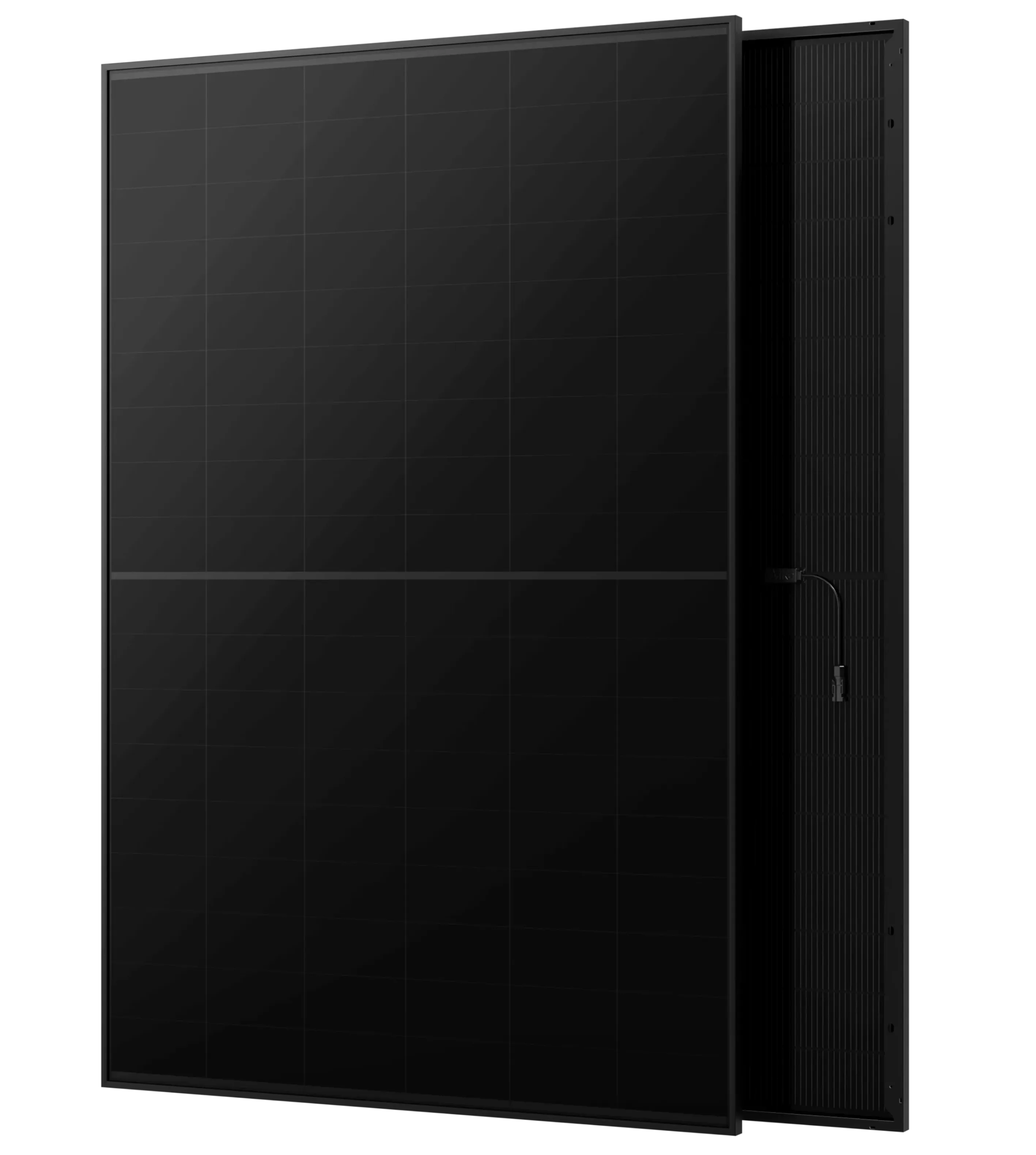
- AIKO 490W family (Neostar 3P54 / 3S54): 1,762 mm × 1,134 mm × 30 mm
- AIKO 540W family (515–540W large-format): 1,954 mm × 1,134 mm × 30 mm
- Length delta: ΔL = 192 mm — the source of the entire debate
The Basic Packing Model
For a roof facet with usable width W and usable slope-depth D, the number of panels that fit in portrait orientation is:
N = floor(W ÷ 1.134) × floor(D ÷ L)
Where L is 1.762 m for the 490W panel or 1.954 m for the 540W panel.
The Threshold Windows: When 490W Unlocks One Extra Row
The 490W module’s shorter length only creates a packing advantage when D sits in a specific band: deep enough for 490W to fit an extra row, but not deep enough for 540W to fit the same number. The formula: k × 1.762 m ≤ D < k × 1.954 m
- 3 rows vs 2 rows: depth 5.29 m to 5.86 m (window width: 0.58 m)
- 4 rows vs 3 rows: depth 7.05 m to 7.82 m (window width: 0.77 m)
- 5 rows vs 4 rows: depth 8.81 m to 9.77 m (window width: 0.96 m)
490W is not continuously better. It is better in windows. Outside these narrow bands, both panels fit equal rows and 540W wins on per-panel power. The window must be hit precisely to deliver the 490W advantage.
Section 3 — Singapore Roofs Are a Distribution, Not a Single Number
Singapore’s Landed Housing Archetypes
- Terrace I (Intermediate): min. plot 150 m², min. width 6 m. Typical usable facet depth: 5–7 m. Most likely to sit inside a 490W threshold window.
- Corner Terrace / Semi-Detached: min. plot 200 m², min. width 8 m. Typical depth: 7–10 m. The dominant class in Sunollo’s portfolio.
- Detached Bungalow: 400 m²+ plot, 10 m+ frontage. Depth often 9–14+ m. Near-exclusively a 540W market.
- Good Class Bungalow (GCB): 1,400 m²+ plot. Large facets with generous depth. Overwhelmingly 540W.
Singapore’s EMA confirms average annual irradiance of 1,580 kWh/m²/year. The EMA also notes that overly complex or fragmented roofs are less suitable for solar PV — pointing exactly towards the clean, contiguous facets where 540W excels.
The Distribution Insight
- Roof depth 6.0 m: outside any threshold window. Both fit 3 rows. 540W wins on per-panel power.
- Roof depth 7.5 m: inside the 7.05–7.82 m window. 490W fits 4 rows, 540W fits 3. 490W wins on raw capacity.
- Roof depth 8.0 m: outside any window. Both fit 4 rows. 540W wins on per-panel power.
- Roof depth 9.0 m: inside the 8.81–9.77 m window. 490W fits 5 rows, 540W fits 4. 490W wins on raw capacity.
- Roof depth 10.0 m: outside any window. Both fit 5 rows. 540W wins on per-panel power.
- Roof depth 11.0 m: inside the 10.57–11.72 m window. 490W fits 6 rows, 540W fits 5. 490W wins on raw capacity.
- Roof depth 12.0 m: outside any window. Both fit 6 rows. 540W wins on per-panel power.
Transparency note: The distribution analysis is a strategic model based on URA planning controls and Sunollo’s installation portfolio. It is illustrative, not a nationally surveyed dataset.
The 20-Scenario Distribution: Where Each Panel Wins
Running the packing model across 20 representative Singapore landed roof geometries shows the full picture. When both panels fit equal rows, 540W always delivers 10.2% more power from the same panel count. When 490W gets one extra row, its advantage shrinks as the roof deepens: 36% on a shallow 2-row terrace facet, 21% at 3 rows, 13% at 4 rows, and just 9% at 5 rows.
The Total Value Winner column accounts for raw DC output plus panel count, BOS complexity, and aesthetic finish. A 9–13% raw DC advantage does not outweigh 6–8 extra panels, extra connectors, and a busier roofline on a premium installation.
#Property TypeFacet (W × D)490W — Panels / kWp540W — Panels / kWpRaw DC GapTotal Value Winner1Terrace-I5.0 × 5.5 m12 / 5.88 kWp8 / 4.32 kWp490W +36%490W ✓2Terrace-I5.0 × 6.0 m12 / 5.88 kWp12 / 6.48 kWp540W +10%540W ✓3Terrace-I5.0 × 7.5 m16 / 7.84 kWp12 / 6.48 kWp490W +21%490W ✓4Terrace-I6.0 × 8.0 m20 / 9.80 kWp20 / 10.80 kWp540W +10%540W ✓5Corner Terrace6.0 × 7.5 m20 / 9.80 kWp15 / 8.10 kWp490W +21%490W ✓6Corner Terrace6.0 × 8.5 m20 / 9.80 kWp20 / 10.80 kWp540W +10%540W ✓7Semi-Detached7.0 × 8.0 m24 / 11.76 kWp24 / 12.96 kWp540W +10%540W ✓8Semi-Detached7.0 × 9.0 m30 / 14.70 kWp24 / 12.96 kWp490W +13%540W ✓9Semi-Detached7.0 × 10.0 m30 / 14.70 kWp30 / 16.20 kWp540W +10%540W ✓10Semi-Detached8.0 × 9.0 m35 / 17.15 kWp28 / 15.12 kWp490W +13%540W ✓11Semi-Detached8.0 × 10.0 m35 / 17.15 kWp35 / 18.90 kWp540W +10%540W ✓12Semi-Detached8.0 × 12.0 m42 / 20.58 kWp42 / 22.68 kWp540W +10%540W ✓13Bungalow9.0 × 10.0 m35 / 17.15 kWp35 / 18.90 kWp540W +10%540W ✓14Bungalow9.0 × 11.0 m42 / 20.58 kWp35 / 18.90 kWp490W +9%540W ✓15Bungalow10.0 × 12.0 m48 / 23.52 kWp48 / 25.92 kWp540W +10%540W ✓16Bungalow10.0 × 11.0 m48 / 23.52 kWp40 / 21.60 kWp490W +9%540W ✓17Bungalow10.0 × 14.0 m56 / 27.44 kWp56 / 30.24 kWp540W +10%540W ✓18Bungalow11.0 × 12.0 m54 / 26.46 kWp54 / 29.16 kWp540W +10%540W ✓19GCB14.0 × 14.0 m84 / 41.16 kWp84 / 45.36 kWp540W +10%540W ✓20GCB16.0 × 14.0 m98 / 48.02 kWp98 / 52.92 kWp540W +10%540W ✓
540W wins on total project value in 17 of 20 scenarios — 85% of the distribution. The three genuine 490W wins (scenarios 1, 3, 5) are all tight intermediate terrace houses sitting precisely inside the threshold windows. Every semi-D, bungalow, and GCB in the table goes to 540W. Notice the diminishing-returns pattern too: as roofs get deeper, 490W’s extra-row advantage shrinks from 36% down to just 9%, while 540W’s per-panel advantage compounds quietly across the full installation.
Section 4 — Where 490W BEARly Wins
Credit where it is due. The AIKO 490W module earns its advantages on specific roof geometries.
Scenario A: Tight Intermediate Terrace (~5.3–5.9 m usable depth)
A 6-metre plot with a usable facet of 5.5 m. At this depth:
- 490W: floor(5.5 ÷ 1.762) = 3 rows → 5 wide × 3 rows = 15 panels × 490W = 7.35 kWp
- 540W: floor(5.5 ÷ 1.954) = 2 rows → 5 wide × 2 rows = 10 panels × 540W = 5.40 kWp
490W delivers 36% more DC capacity on this roof. That is a genuine, significant advantage.
Scenario B: Mid-Range Depth Window (~7.1–7.8 m)
At 7.5 m usable depth, 490W fits 4 rows while 540W fits only 3. A real but smaller advantage — 21% more capacity on narrow facets.
Scenario C: The 8.8–9.8 m Band
At 9.0 m depth, 490W fits 5 rows vs 540W’s 4 rows. For an 8-metre-wide bungalow facet: 490W delivers 17.15 kWp vs 540W’s 15.12 kWp — a 13% advantage that is real, but marginal once panel count and BOS complexity are included.
The Honest Summary
The 490W module wins when usable depth lands precisely inside a threshold window. On those roofs, the argument is real and we respect it. Sunollo is not dogmatic — we will install 490W when the geometry genuinely justifies it. But as the 20-scenario analysis above shows, those windows account for a minority of the premium residential roof distribution.
Section 5 — Why Raw Geometry Is Not the Right Objective Function
Even on roofs where 490W wins on raw DC, that is the wrong objective function for a premium residential solar project.
The correct objective is not Maximise installed module power density (W/m²). The correct objective is Maximise total project value over the system lifetime.
The Full Project Score
- + Installed DC capacity (kWp)
- + Annual energy yield (kWh)
- − Module count — fewer panels = fewer rails, connectors, failure points, labour hours
- − Balance-of-system complexity — more panels means more string decisions, more fusing, more combiner complexity
- − Roof fragmentation penalty — forcing an extra row creates awkward partial rows or orphan panels
- − Aesthetic clutter — more panels creates visual density that detracts from a premium installation
- − Installation complexity — every additional panel is more rooftop time, another connector pair, another attachment point
490W can win on the first bullet. 540W wins on the whole equation.

Module Count Advantage in Practice
- 10 kWp target: 21 × 490W = 10.29 kWp vs 19 × 540W = 10.26 kWp — 2 fewer panels
- 15 kWp target: 31 × 490W = 15.19 kWp vs 28 × 540W = 15.12 kWp — 3 fewer panels
- 20 kWp target: 41 × 490W = 20.09 kWp vs 37 × 540W = 19.98 kWp — 4 fewer panels
At a rough installed cost of $300–500 per panel including hardware and labour, 4 fewer panels on a 20 kWp system represents $1,200–$2,000 in direct savings. The annual energy difference between equivalent-size systems is under 45 kWh per year — worth less than $10 at Singapore electricity rates.
Section 6 — The Goldilocks Case for 540W
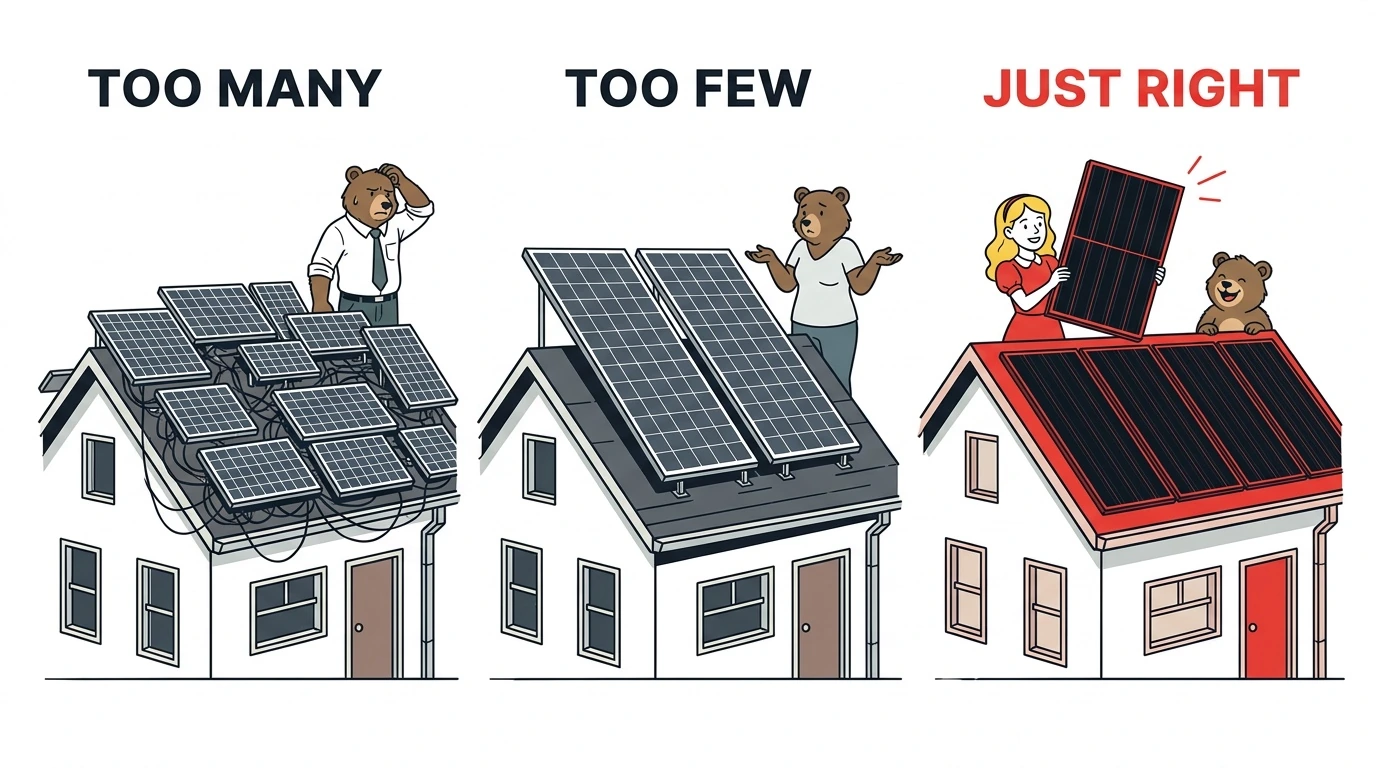
There is a panel size that is just right for a given market. Not the smallest available. Not a warehouse-scale module. The AIKO 540W is Sunollo’s Goldilocks panel.
Not Too Small
On the roof types Sunollo serves — semi-Ds, bungalows, GCBs with 8–14 m usable facet depths — the extra 192 mm length of the 540W format is not a liability. Those roofs have more than enough depth for full 540W rows. Using 490W on these roofs simply means more panels for the same capacity, with no geometric benefit.
Not Too Large
Commercial 600W–700W modules are physically unwieldy on residential rooftops: heavier, harder to manoeuvre through tight access paths, more structurally demanding, and visually overwhelming on a domestic pitch. They are not designed for a 200 m² semi-D plot.
Just Right
- 540W per panel of AIKO ABC N-type output in a single elegant module
- Roof compatibility: fits cleanly across Sunollo’s full target market range
- Minimum panel count for any target system size
- Visual quality: fewer panels, cleaner rows, more negative space on the roof
- BOS efficiency: fewer connectors, simpler strings, lower complexity
- 30-year performance: same AIKO ABC N-type cell technology, ultra-low degradation
.png)
Section 7 — Why Sunollo Chooses 540W
Sunollo is not optimising for the most awkward roof in Singapore. We are optimising for the roofs worth serving beautifully.
Our Market: Premium Residential Singapore
- The owner cares about aesthetics as much as economics. A cluttered roofline is not acceptable.
- The roof is a visible architectural feature. The solar installation is part of the home’s presentation.
- The homeowner will see the installation every day for 25–30 years. The finished quality matters.
- The expectation is a premium, engineered solution — not a maximum-panel-count approach.
The 490W Cases We Still Serve
There are roofs where 490W is the right answer. A tight intermediate terrace with a 5.5 m usable facet and no viable secondary roof planes is a legitimate 490W candidate. We model the geometry first. We will install 490W when the threshold-window maths genuinely justifies it for a specific client and roof. But those cases are the exception, not the definition of our strategy.
Not Universal. Intentional.
The AIKO 540W as Sunollo’s platform panel is not a claim that it wins on every roof in Singapore. It is a claim that it wins on the roofs Sunollo is designed to serve: premium, clean, contiguous residential facets where total system elegance and finished quality matter alongside pure kilowatt-hours.
Conclusion: The Best Panel Is Not the One That Wins the Awkward Roof

The best panel is the one that wins the roofs worth serving.
AIKO 490W is the specialist. It wins on narrow threshold bands. It earns its extra rows on tight geometry.
AIKO 540W is the platform. It wins 85% of the distribution. It delivers more power per panel, fewer panels per system, simpler balance-of-system design, cleaner aesthetics, and better total project value on the premium residential canvas Sunollo operates on.
Not too small. Not too large. Just right.
If you want to understand what the Goldilocks panel can do for your specific roof, start with a Sunollo design consultation. We will model your actual roof geometry, run the threshold analysis on your facets, and show you the exact layout.
Appendix: Math, Assumptions, and Source Transparency
Panel Dimensions — Measured from Published Datasheets
- AIKO 490W family: 1,762 × 1,134 × 30 mm — AIKO published datasheets
- AIKO 540W family: 1,954 × 1,134 × 30 mm — AIKO published datasheets
- Length delta: 0.192 m (192 mm)
Singapore Solar Irradiance — Measured from Source
- ~1,580 kWh/m²/year — Energy Market Authority (EMA) Singapore
URA Housing Geometry Anchors — Measured from Source
- Terrace I: min. plot 150 m², min. width 6 m — URA Residential Handbook
- Semi-Detached: min. plot 200 m², min. width 8 m — URA Residential Handbook
- Detached Bungalow: ~400 m² plot, ~10 m width — URA Bungalow Guide
20-Scenario Analysis — Illustrative Model
All scenario calculations use the first-order packing model N = floor(W/1.134) × floor(D/L). Real installations account for rail overhangs, inter-row gaps, edge clearances, and obstructions. The “Total Value Winner” assessment treats a raw DC advantage of less than ~18% as insufficient to override the BOS and aesthetic benefits of fewer panels for a premium installation. This threshold is a strategic judgement, not a universal engineering constant.
Threshold Window Formulas — Derived from Published Dimensions
490W gains a row advantage when: k × 1.762 m ≤ D < k × 1.954 m for integer k ≥ 2
Energy Yield Modelling — Illustrative
Annual yield estimates: irradiance × DC capacity × performance ratio (0.80). Real yields vary by orientation, tilt, shading, and inverter efficiency.


