Turn the warranty into a live test: use the 60-second inverter, app, SP-meter and accountability check at handover and once a quarter.
Why Your Solar Contract Matters More Than the Price Tag
Most Singapore homeowners spend weeks comparing solar panel brands, system sizes, and prices. They spend minutes reading their contract. This is a costly mistake.
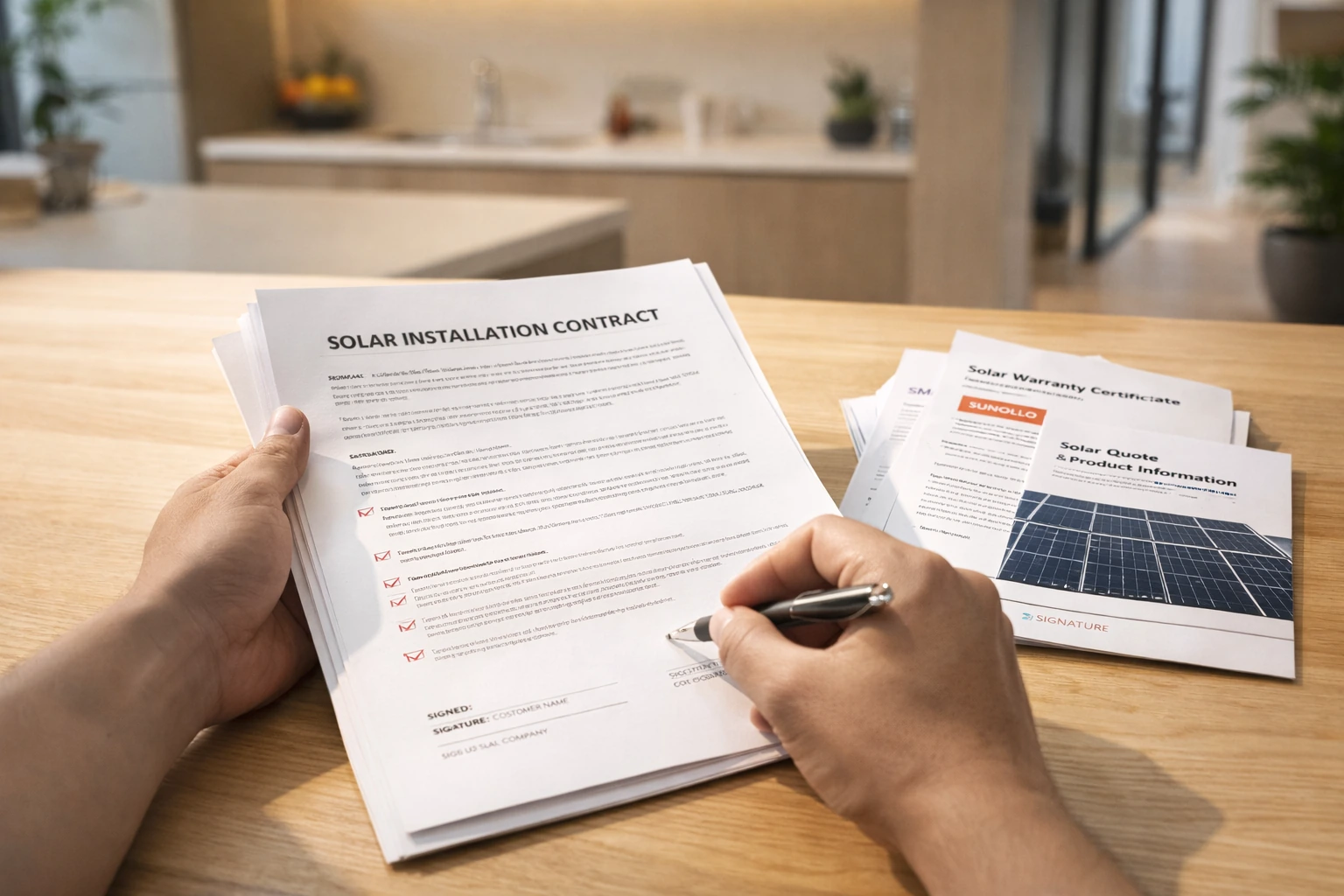
Your solar installation contract governs everything that happens after the sale — who fixes what, for how long, under what conditions, and what happens if things go wrong. A S$20,000 system with a weak contract can cost you far more than a S$25,000 system with strong protections.
This guide walks you through every critical element of a solar contract in Singapore: the Defects Liability Period, the layered warranty system, payment structures, and the exact clauses you must read before signing. Whether this is your first solar purchase or you are comparing your third proposal, this is the contract literacy guide that protects your investment.
The Defects Liability Period (DLP): What It Really Means
Definition and Duration
The Defects Liability Period is a contractual mechanism borrowed from the construction industry. In solar EPCC (Engineering, Procurement, Construction and Commissioning) contracts, the DLP creates a fixed window — typically 12 to 24 months from the date of practical completion or system commissioning — during which the installer is obligated to rectify defects in workmanship or materials at their own cost.
The DLP starts when your system is commissioned and handed over. This is not the date you signed the contract, and not the date the panels were physically placed on your roof. It is the date the system was tested, connected to the grid via SP Group, and formally accepted by you as the homeowner. Make sure this date is clearly documented.
What the DLP Covers
The DLP specifically covers:
- Workmanship defects: Improperly sealed roof penetrations, loose wiring connections, incorrect panel mounting angles, or cable management issues that emerged after installation.
- Material defects attributable to installation: Damaged panels or components resulting from the installation process itself (not pre-existing manufacturing defects).
- Non-conformance with specifications: If the installed system does not match what was specified in the contract — wrong panel model, incorrect inverter capacity, or missing components.
What the DLP Does NOT Cover
This is where most homeowners are caught off guard:
- Equipment manufacturer defects: A panel with a manufacturing flaw (hot spot, micro-crack from factory) is a manufacturer warranty issue, not a DLP issue. The installer may assist, but the obligation sits with the manufacturer.
- Performance decline: If your system gradually produces less energy over time, the DLP does not require the installer to investigate or remedy this unless it was caused by a specific workmanship defect.
- Weather or external damage: Storm damage, lightning strikes, falling debris, or pest damage are not DLP issues.
- Anything after the DLP expires: Once the 12 or 24-month window closes, the contractor has no further DLP obligation. An inverter failure in month 25 is your problem to resolve through manufacturer warranty channels.
DLP vs. Warranty: The Critical Distinction
| Feature | Defects Liability Period | Manufacturer Warranty |
|---|---|---|
| Issued by | Your installer (contractor) | Equipment manufacturer |
| Typical duration | 12–24 months | 10–30 years |
| Covers | Workmanship and installation defects | Product and performance defects |
| Claim process | Contact your installer directly | Contact manufacturer or authorised rep |
| If company closes | DLP becomes unenforceable | Warranty may still be claimable |
The Solar Warranty Stack: Understanding All Four Layers
A solar system does not have one warranty. It has at least four separate warranties from different parties, each with different durations, terms, and claim processes. Understanding this stack is essential.
Layer 1: Panel Product Warranty (12–15 Years)
This warranty covers manufacturing defects in the solar panels themselves — cracked cells, delamination of the protective layers, junction box failures, frame defects, and electrical faults originating from the factory.
Key terms to check:
- Duration (12 years is standard; premium brands offer 15 years)
- Whether it covers labour costs for panel replacement or only the panel itself
- Whether shipping costs for replacement panels are covered
- The claims process — do you contact the manufacturer directly, or does the installer handle it?
- Whether the warranty is transferable to a new owner if you sell your home
Layer 2: Panel Performance Warranty (25–30 Years)
This warranty guarantees that the panels will maintain a minimum power output over time. A typical performance warranty might guarantee 97% output at year 1, declining linearly to 84–87% at year 25 or 30.
The hidden challenge: Proving a performance warranty claim requires independent testing by a certified laboratory. You need to demonstrate that a panel is producing below its warranted output level, accounting for temperature, irradiance, and other variables. This testing can cost S$500–S$2,000 per panel. For a single underperforming panel, the cost of proving the claim may exceed the value of the replacement.
Key terms to check:
- The guaranteed output percentages at years 1, 10, 15, 25, and 30
- Whether the warranty uses a linear or step degradation model
- Who bears the cost of independent performance testing
- Whether the manufacturer has a regional service centre in Southeast Asia
Layer 3: Inverter Warranty (5–12 Years Standard)
The inverter is the component most likely to fail during your system's lifetime. It converts the DC electricity from your panels into AC electricity for your home, and it operates continuously under heat and electrical stress.
Why this warranty gap matters most: A standard inverter warranty of 5 years on a 25-year system leaves you unprotected for 20 years on the most failure-prone component. Inverter replacement costs range from S$1,500 for a basic string inverter to S$5,000 or more for a premium hybrid inverter with battery capability.
Extended warranty options: Most major inverter manufacturers (Sungrow, SMA, Fronius, Enphase, Huawei) offer paid warranty extensions to 15 or 20 years. These typically cost S$300–S$800 at the time of purchase — a fraction of the replacement cost. This is one of the highest-value add-ons you can purchase.
Key terms to check:
- Standard warranty duration (5, 10, or 12 years)
- Availability and cost of extended warranty to 15 or 20 years
- Whether the warranty covers labour for replacement or only the unit itself
- Turnaround time for warranty replacements (how long will your system be down?)
Layer 4: Installer Workmanship Warranty (1–10 Years)
This is the most variable and often the most important warranty layer. It covers the installer's own work: wiring, mounting, roof penetrations, system configuration, and overall build quality.
The gap most homeowners miss: Many installers offer no explicit workmanship warranty beyond the DLP. When asked about warranty, they point to the panel and inverter manufacturer warranties — which cover equipment, not installation quality. A roof leak caused by improperly sealed mounting brackets at year 3 is an installation defect, not a panel defect. If the installer's workmanship warranty has expired, the repair cost is yours.
What good looks like: Premium installers offer 5–10 year workmanship warranties with clear scope definitions. Some, like Sunollo, go further with performance-based guarantees that align the installer's interests with your long-term system performance through our Savings Guarantee.
Key terms to check:
- Exact duration (distinct from DLP)
- Scope — does it cover all installation work or only specific components?
- Exclusions — what is not covered?
- Response time commitments for warranty claims
- Whether the warranty transfers if you sell your home
Payment Structure: Protecting Your Cash Flow
How and when you pay matters. A well-structured payment schedule protects you by linking payments to verifiable milestones.
Recommended Payment Milestone Structure
| Milestone | Typical % | What to verify |
|---|---|---|
| Contract signing | 10–20% | All specifications confirmed in writing |
| Equipment delivery | 30–40% | Correct equipment delivered and inspected |
| Installation complete | 20–30% | Physical installation finished and inspected |
| Commissioning and grid connection | 10–20% | SP Group approval, system generating power |
Red flags in payment terms:
- Requesting more than 50% upfront before any work begins
- No milestone-based structure — full payment required before installation
- Final payment due before SP Group grid connection is confirmed
- No retention amount held until after the system has been verified as operational
10 Contract Clauses You Must Read Before Signing
Beyond DLP and warranties, these clauses directly affect your rights and protections:
- System specifications: Exact panel model, quantity, inverter model, and total system capacity (kWp). Any deviation from these specifications without your written consent should be a breach of contract.
- Performance guarantee: Does the contract include any production guarantee? If so, what metric is used (kWh per year, specific yield), and what remedy is offered if the system underperforms?
- Timeline and delays: Expected installation start date, completion date, and what happens if the installer misses these deadlines. Are there penalties for delays?
- Permit and approval responsibility: Who is responsible for obtaining BCA structural approval, SP Group grid connection approval, and any other regulatory permits? This should always be the installer.
- Roof warranty protection: A clause confirming that the installation will not void your existing roof warranty, and that the installer assumes responsibility for any roof damage caused by their work.
- Monitoring and maintenance: What monitoring system is included? Is there an ongoing maintenance agreement? What does it cover and for how long?
- Termination and cancellation: Under what conditions can either party terminate the contract? What are the financial consequences? Is there a cooling-off period?
- Dispute resolution: How are disputes handled — mediation, arbitration, or court proceedings? Which jurisdiction applies?
- Assignment and transfer: Can the installer subcontract the work? Can you transfer the contract to a new homeowner?
- Insurance during installation: Does the installer carry professional indemnity insurance and workmen's compensation insurance? Request copies of their policies.
What Happens If Your Installer Goes Out of Business?
This is the scenario nobody wants to think about, but it happens. Singapore's solar industry has seen companies enter and exit the market. If your installer closes:
- DLP and workmanship warranty: Effectively void. There is no entity to claim against.
- Panel manufacturer warranty: Still valid, but you will need to contact the manufacturer or their regional distributor directly. Having your original purchase documentation, serial numbers, and warranty certificates is essential.
- Inverter manufacturer warranty: Same as above — contact the manufacturer directly with your documentation.
- Ongoing monitoring: If the installer ran your monitoring platform, you may lose access. Ensure you have independent access to your inverter's own monitoring portal.
How to protect yourself:
- Choose an installer with a proven track record (5+ years in business) and financial stability
- Keep all documentation independently — do not rely on the installer's records alone
- Record all panel and inverter serial numbers
- Register your equipment warranties directly with the manufacturers
- Consider an installer that offers subscription or ongoing service models, as these create stronger long-term incentives for the company to remain operational
Your Contract Review Checklist
Before you sign any solar installation contract in Singapore, verify every item on this list:
- DLP duration is clearly stated (minimum 12 months; 24 months preferred)
- Workmanship warranty duration is stated separately from the DLP
- Panel product warranty duration and warranting party are specified
- Panel performance warranty terms and degradation schedule are included
- Inverter warranty duration is stated, with extended warranty option noted
- Payment is milestone-based with no more than 20% due at signing
- System specifications (panel model, quantity, inverter model, kWp) are exact
- Installation timeline with start and completion dates is included
- Permit responsibility (BCA, SP Group) is assigned to the installer
- Monitoring system and any ongoing maintenance terms are defined
- Dispute resolution mechanism is specified
- Installer's insurance documentation is provided or available on request
A contract that covers all these points protects both parties and sets the foundation for a successful long-term solar investment. For more on evaluating your full solar purchase, read our pillar guide on 15 Solar Panel Myths in Singapore Exposed or explore our guide to choosing the best solar company.