Estimated reading time: 18 minutes
Your electricity bill shouldn't feel like a second mortgage.
Yet for thousands of Singapore homeowners, that's exactly what it's become. SP Group tariffs hovering above 30 cents per kilowatt-hour. Quarterly shocks when the air-conditioning runs a little harder than expected. A creeping sense that no matter what you switch off, the number on the bill barely moves.
Here's the truth most electricity retailers won't tell you: the biggest savings don't come from switching plans. They come from changing the source.
This guide walks you through every lever available to a Singapore household in 2026 — from small habit changes worth S$20–$50 a month, to the one move that can erase 60–80% of your bill permanently. We'll cover quick wins you can do today, the real maths behind solar, how to earn money from your roof through the Net Energy Rebate, smart home strategies, and a real before-and-after case study from a landed property right here in Singapore.
No fluff. Just numbers, strategy, and action.
The State of Electricity in Singapore, 2026
Before we talk about saving, let's understand what we're up against.
Singapore's electricity is generated almost entirely from imported natural gas — a fossil fuel whose price is tied to volatile global markets. When gas prices spiked in 2022–2023, electricity tariffs followed. While prices have moderated slightly, the structural reality remains: we are a price-taker in a global energy market we don't control.
| Period | SP Regulated Tariff (cents/kWh) | Typical Monthly Bill (landed home) |
|---|---|---|
| 2020 | 22.0 | S$250–S$400 |
| 2022 | 27.5 | S$320–S$500 |
| 2024 | 32.6 | S$380–S$600 |
| 2026 (current) | 30.1–32.0 | S$350–S$650 |
For a typical landed home consuming 1,200–2,000 kWh per month, that's S$4,200–S$7,800 per year on electricity alone. Over a decade, you're looking at S$50,000–S$80,000 — enough for a new car, your child's university fund, or a significant renovation.
The question isn't whether to save. It's how much and how fast.
Part 1: Quick Wins — Save S$30–S$150/Month Without Spending a Dollar on Equipment
These are the low-hanging fruit. None of them require installation, contractors, or capital. They're behavioural and maintenance changes that add up surprisingly fast.
❄️ Air-Conditioning: The 40–60% Monster
Air-conditioning is the single largest electricity consumer in almost every Singapore home. It typically accounts for 40–60% of your total bill.
What to do:
- Set to 25°C, not 22°C. Every degree lower adds roughly 3–5% to your AC energy use. Going from 22°C to 25°C can save 10–15% on your cooling cost.
- Use fan mode + AC together. A ceiling fan lets you raise the thermostat by 2°C while feeling equally cool. Fans use 1/30th the energy of an air-conditioner.
- Clean your filters monthly. A clogged filter forces the compressor to work harder. A 15-minute clean can save 5–7% on cooling energy.
- Use the timer. Set the AC to switch off 1–2 hours before you wake up. Your room stays cool enough while eliminating the most expensive hours of overnight running.
- Service annually. A well-maintained system with proper refrigerant levels runs 10–20% more efficiently than a neglected one.
Quick maths: If your AC costs S$200/month and you implement all of the above, expect savings of S$40–S$70/month. That's S$500–S$840/year from air-conditioning alone.
💡 Lighting: Small Watts, Big Waste
- Switch all bulbs to LED. LEDs use 75% less energy than incandescent and 30% less than CFLs. A single bulb swap saves S$8–S$15/year. Across 30+ bulbs in a landed home, that's S$250–S$450/year.
- Use motion sensors in low-use areas (storerooms, bathrooms, car porch). Lights that are on only when needed cost almost nothing to run.
- Maximise natural light. Open blinds and curtains during the day. If your home design allows, consider light shelves or reflective surfaces to push daylight deeper into rooms.
🌀 Appliances: The Silent Drains
- Choose NEA 5-tick appliances. A 5-tick fridge uses up to 40% less energy than a 1-tick model. Since fridges run 24/7, this is one of the highest-impact swaps you can make.
- Wash clothes in cold water. Heating water accounts for ~90% of a washing machine's energy use. Cold wash with modern detergent cleans just as effectively.
- Don't run half loads. Wait until your dishwasher and washing machine are full. Two half loads use more energy than one full load.
- Switch off standby. Devices on standby (TV, game consoles, chargers, microwave clocks) consume 5–10% of total home energy. Use power strips with switches for easy one-flick shutoffs.
🏠 Your Home Envelope: Keep Cool Air In
- Seal gaps around windows and doors. Cool air escaping means your AC works overtime. Weather strips cost under S$20 and take minutes to install.
- Use window film or tinted glass. Solar heat gain through windows is a major cooling load in tropical homes. UV-blocking film can reduce heat gain by 30–50%, directly lowering AC demand.
- Install curtains or blinds on west-facing windows. The afternoon sun is brutal. Blocking it at the glass saves more than trying to cool it after it enters.
| Quick Win | Estimated Monthly Savings | Effort |
|---|---|---|
| AC set to 25°C + fan | S$40–S$70 | Zero cost |
| LED bulbs throughout | S$20–S$40 | S$50–S$100 one-time |
| 5-tick appliance upgrades | S$15–S$30 | At next replacement |
| Standby power elimination | S$10–S$20 | Power strips ~S$30 |
| Window film + sealing | S$15–S$25 | S$100–S$300 one-time |
| Total Quick Wins | S$100–S$185 | |
These are meaningful savings. But if you want to move from "reducing" your bill to practically eliminating it, there's one lever that outperforms everything else combined.
Part 2: Solar — The Move That Changes Everything
Why Solar Is the Ultimate Energy-Saving Strategy
Every tip above saves you a percentage of your bill. Solar replaces the bill itself.
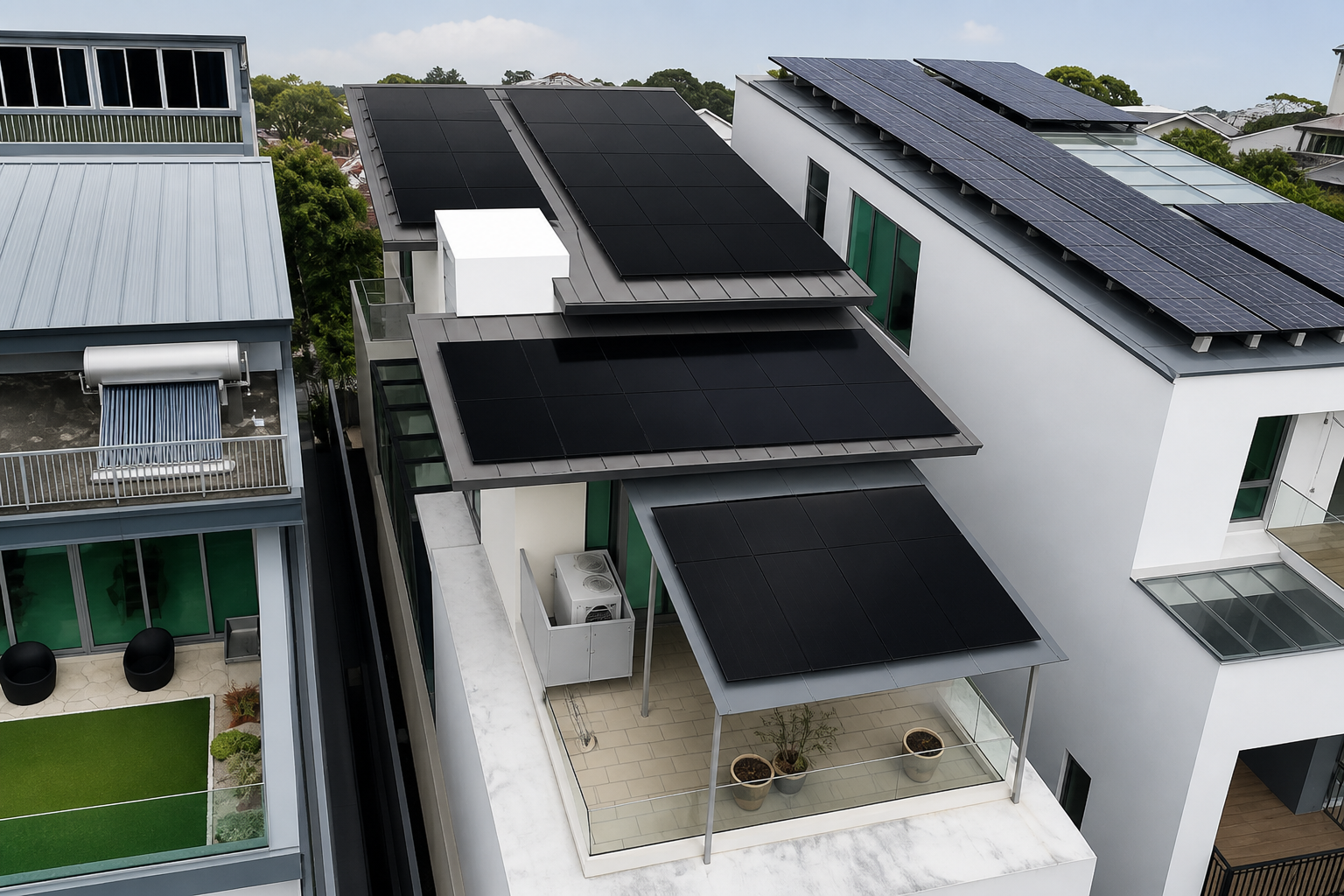
When you install solar panels on your roof, you're generating your own electricity from sunlight — free, clean, and abundant in Singapore's tropical climate. Instead of buying every kilowatt-hour from SP or a retailer at 30+ cents, you produce it on your own roof at an effective cost of 8–12 cents/kWh, locked in for 25 years.
That's not a discount. That's a structural transformation of your energy economics.
The Real Numbers
| | Before Solar | After Solar | You Save |
|---|---|---|---|
| Terrace house | S$350/month | S$80/month | S$270/month |
| Semi-detached | S$550/month | S$100/month | S$450/month |
| Bungalow | S$900/month | S$150/month | S$750/month |
These aren't projections from a sales brochure. They're based on real 2026 tariff rates, actual solar irradiance data for Singapore (1,200–1,400 kWh/kWp annually), and typical household consumption patterns.
Put it this way: A semi-detached homeowner installing a 14 kWp system saves roughly S$5,400/year. Over the system's 25-year life, that's S$135,000 in total savings — from a system that costs S$20,000–S$25,000 installed. The payback? 4–6 years. After that, your electricity is essentially free.
But What About Rainy Days?
Singapore gets rain. A lot of it. But here's what people get wrong: solar works on light, not heat. Even under overcast skies, modern panels produce 10–25% of their rated capacity. And because Singapore has no winter, there's no seasonal production collapse. Your annual output is remarkably consistent year to year.
Over a full year, a well-designed solar system in Singapore reliably produces 1,200–1,400 kWh per kWp installed. The rainy days are already baked into that number.
You Don't Need S$20K Upfront
This is the other misconception that holds people back. In 2026, you have multiple paths to solar:
- Cash purchase: Best total ROI. Payback in 5–7 years, then 18–20 years of free electricity.
- Green loan: S$0 upfront. Monthly repayment is typically less than your electricity savings, so you're cash-positive from month one.
- Subscribe / Rent-to-own: Fixed monthly fee, own the system at the end of the term. Sunollo's Guaranteed Savings model means if your savings don't exceed your payment, Sunollo covers the difference.
The bottom line: there is no financial barrier to going solar in Singapore in 2026. Only an information barrier — which this article is here to remove.
Part 3: The Net Energy Rebate — How Your Roof Earns You Money
This is the part most people don't know about, and it changes the calculus entirely.
What Is NER?
The Net Energy Rebate (NER) is Singapore's mechanism for compensating homeowners who export surplus solar electricity to the national grid. Under the NER framework:
- Any electricity your solar system produces that you don't use flows back to the grid.
- SP automatically credits you at the prevailing wholesale electricity price (the Weighted Average Wholesale Electricity Price, or WAWEP).
- The credit appears as an offset on your next SP bill. No separate invoicing, no retail licence, no paperwork on your part.
How Much Can You Earn?
The wholesale price fluctuates quarterly, but in 2025–2026 it has ranged from roughly 15–25 cents/kWh.
| System Size | Typical Monthly Export | Estimated Monthly NER Credit |
|---|---|---|
| 8 kWp (terrace) | 300–500 kWh | S$45–S$100 |
| 14 kWp (semi-D) | 500–800 kWh | S$75–S$160 |
| 23 kWp (bungalow) | 800–1,200 kWh | S$120–S$240 |
Think of it this way: Your roof becomes a miniature power plant. You use what you need during the day, and sell the rest to the grid. Between self-consumption savings and NER export credits, solar doesn't just reduce your bill — it can flip it into a net income.
Maximising Your NER Credits
- Shift heavy loads to daytime — run your dishwasher, washing machine, and pool pump between 10 am and 3 pm when solar output peaks. This maximises self-consumption at 30+ cents/kWh instead of exporting at 15–25 cents/kWh.
- Right-size your system — a system that's too small leaves money on the table; too large and your export credits don't keep up with the capital cost. A good installer designs for the sweet spot.
- Add a battery (when it makes sense) — a battery lets you store surplus for evening use instead of exporting at wholesale and buying back at retail. The spread is your profit.
Part 4: Smart Home Strategies — Let Technology Do the Saving
The combination of solar and smart home technology is where modern energy saving gets genuinely exciting.
📱 Smart Energy Monitoring
Systems like SolarEdge (which Sunollo installs as standard) provide real-time, per-panel monitoring through a smartphone app. You can see exactly how much energy each panel produces, how much your home consumes, and how much flows to the grid — down to the minute.
This isn't a gimmick. Monitoring transforms behaviour. Homeowners who actively monitor their energy use typically reduce consumption by an additional 5–15% simply by understanding their patterns.
⏰ Smart Scheduling
- Smart plugs + timers: Schedule high-draw appliances (water heater, dryer, EV charger) to run during peak solar hours.
- Smart AC: Use Wi-Fi-enabled air conditioners or smart IR controllers (like Sensibo, Ambi Climate, or Cielo) to optimise cooling schedules, geo-fence your AC (it turns off when you leave, pre-cools before you arrive), and hold tighter temperature setpoints without manual intervention.
- Smart lighting: Automated schedules, motion detection, and daylight sensors ensure lights are on only when needed.
⚡ EV Charging: The Next Frontier
If you own or plan to own an electric vehicle, solar + smart EV charging is a game-changer. Instead of charging from the grid at 30+ cents/kWh (or paying S$0.50–S$0.60/kWh at public chargers), you charge from your own roof at the effective solar cost of 8–12 cents/kWh.
With a smart EV charger, you can set it to draw power only when solar production exceeds household consumption. Your car charges on pure sunshine. The annual fuel cost for a typical EV driven 15,000 km drops from ~S$1,200 (grid charging) to ~S$350 (solar charging).
Solar + EV is the most powerful one-two punch in household energy economics. You eliminate your electricity bill and your petrol bill in one move.
Part 5: Electricity Retailer Plans — What Still Makes Sense with Solar
Even with solar, you'll still draw grid electricity at night and during heavy-consumption periods. Choosing the right retailer plan optimises that remaining cost.
What to Look For in 2026
- No minimum consumption clauses. Some plans penalise you for using less than a certain amount. With solar slashing your grid draw, you need a plan that doesn't punish low consumption.
- Fixed-rate plans offer predictability but may not be the cheapest if wholesale prices drop. Discount-off-regulated-tariff (DORT) plans give you a percentage off SP's rate and follow market movements — useful if you believe tariffs will soften.
- Time-of-use (TOU) plans, if available, let you pay less during off-peak hours (typically 11 pm–7 am). Combined with a battery that stores solar for peak hours, TOU plans can yield exceptional savings.
| Plan Type | Best For | Watch Out |
|---|---|---|
| Fixed rate | Predictable budgeting | May lock in a high rate |
| DORT (discount off SP) | Riding falling tariffs | No protection if tariffs spike |
| Time-of-use | Solar + battery owners | Limited availability in 2026 |
| Wholesale indexed | Risk-tolerant, low-usage homes | Volatile monthly bills |
Pro tip: With solar handling 60–80% of your consumption, the retailer plan matters less than it did before. The biggest savings have already been captured at the source. But optimising the remaining 20–40% can save an additional S$20–S$50/month.
Part 6: Real Case Study — A Singapore Semi-Detached Home, Before and After
Let's make all of this concrete with a real scenario.
The Home
- Property: Semi-detached house, Bukit Timah area
- Occupants: Family of 5
- Monthly electricity consumption: ~1,600 kWh
- Monthly bill (before): S$520
- Air-conditioning: 5 units, running 6–8 hours/day
- Pool pump: Yes, running 6 hours/day
What They Did
| Action | Monthly Impact |
|---|---|
| AC set to 25°C + ceiling fans in all bedrooms | – S$45 |
| All lights switched to LED | – S$25 |
| Standby power strips installed | – S$15 |
| Pool pump timer set to 10 am–4 pm (solar hours) | – S$10 |
| 12 kWp Sunollo solar system installed | – S$340 |
| NER export credits | – S$55 |
The Result
| | Before | After |
|---|---|---|
| Monthly electricity bill | S$520 | S$30 |
| Annual electricity cost | S$6,240 | S$360 |
| Annual savings | — | S$5,880 |
| System cost (12 kWp, cash) | — | S$19,500 |
| Payback period | — | 3.3 years |
| 25-year total savings | — | S$127,500 |
From S$520/month to S$30/month. From spending S$6,240/year to saving S$5,880/year. The solar system paid for itself in under 3.5 years, and will generate free electricity for another 21+ years.
This isn't an exceptional case. It's a typical one. The maths works for virtually every landed home in Singapore.
Part 7: The Complete Energy-Saving Stack — Ranked by Impact
Here's how every strategy in this guide stacks up, ranked from highest to lowest monthly savings:
| Rank | Strategy | Monthly Savings | Upfront Cost |
|---|---|---|---|
| 1 | Rooftop solar panels | S$250–S$750 | S$0–S$50K (financing available) |
| 2 | NER export credits | S$45–S$240 | Included with solar |
| 3 | AC optimisation | S$40–S$70 | S$0 |
| 4 | LED lighting throughout | S$20–S$40 | S$50–S$100 |
| 5 | Smart home automation | S$15–S$40 | S$100–S$500 |
| 6 | Appliance upgrades (5-tick) | S$15–S$30 | At replacement |
| 7 | Standby power elimination | S$10–S$20 | S$30 |
| 8 | Window film + sealing | S$15–S$25 | S$100–S$300 |
| 9 | Retailer plan optimisation | S$20–S$50 | S$0 |
| 10 | Solar EV charging | S$70–S$100 | S$1,500–S$3,000 (charger) |
Implementing the full stack — quick wins + solar + NER + smart home — can take a landed home from S$500–S$900/month to under S$50/month.
Frequently Asked Questions
Q: What uses the most electricity in a Singapore home?
A: Air-conditioning, by a wide margin. It typically accounts for 40–60% of a household's electricity bill. Water heating, refrigeration, and lighting are the next largest consumers.
Q: How much can solar realistically save per month?
A: For a typical landed home, solar saves S$250–S$750 per month depending on system size and consumption. Most homeowners see a 60–80% reduction in their electricity bill.
Q: Is it worth switching electricity retailers in 2026?
A: It can save S$20–S$50/month, but the impact is modest compared to solar. If you already have solar, focus on a plan with no minimum consumption clauses and consider a DORT or TOU plan for the remaining grid usage.
Q: Do energy-saving tips really make a meaningful difference?
A: Yes, but they have limits. Behavioural changes and appliance upgrades can save S$100–S$185/month. Solar is the step that saves S$250–S$750/month. The combination is what gets you to near-zero bills.
Q: What is the best temperature for AC in Singapore to save electricity?
A: 25°C is the sweet spot — comfortable for most people and significantly more efficient than 22–23°C. Pair with a ceiling fan for optimal comfort at lower cost.
Q: Can I save electricity without installing solar?
A: Absolutely. The quick wins in Part 1 of this guide can save S$100–S$185/month. But solar is the only strategy that can reduce your bill by 60–80%.
Q: How does the Net Energy Rebate (NER) work?
A: Surplus solar electricity you export to the grid is credited at the wholesale price (15–25 cents/kWh in 2026). SP automatically offsets this against your bill. No paperwork needed.
Q: Is a battery worth it for energy saving?
A: Batteries make sense if you have high night-time consumption (especially EV charging). They store surplus solar for evening use, capturing the spread between retail and wholesale electricity prices. Payback is 8–12 years in current conditions.
Q: What's the single biggest thing I can do to cut my electricity bill?
A: Install solar panels. Nothing else comes close. It's the difference between saving 10–20% (tips and habits) and saving 60–80% (solar).
Q: Are there government subsidies for solar in Singapore?
A: Singapore doesn't offer direct subsidies for residential solar. However, the NER effectively provides ongoing compensation for exported electricity, and the streamlined EMA/SP approval process keeps installation costs low. The economics are strong without subsidies.
Your Next Step
You've read the strategies. You've seen the numbers. You know the quick wins, and you know the one move that changes everything.
The only question left is: when do you start?
Not sure where your home sits in these numbers? Use our solar savings calculator to see what your specific property could save based on your consumption and roof size.
Sunollo offers a free, no-obligation energy assessment for every landed homeowner in Singapore. Our consultants will analyse your consumption, design a system for your roof, and show you exactly what you'll save — with real numbers, not projections.
Get Your Free Energy Assessment →
Related Articles
The Complete Solar Guide for Singapore 2026
Solar Panel Cost Calculator Singapore
Net Energy Rebate: Complete Guide