The bottom line: Solar in Singapore delivers 15–25% IRR with 3–5 year payback — outperforming most financial instruments. A typical 10 kWp system on a landed home costs S$10,000–S$15,000 (or S$0 upfront from S$99/month), generates S$3,500–S$5,000 per year in savings, and produces S$80,000–S$120,000 in lifetime value over 25 years. The longer you wait, the more you forgo.
Introduction: Why Solar ROI in Singapore Is Exceptional in 2026
Return on investment (ROI) is the ultimate measure of any financial decision, and solar energy in Singapore delivers returns that rival — and often exceed — traditional investments. With system costs at historic lows and electricity tariffs consistently above S$0.30/kWh, solar installations in 2026 are achieving payback periods of just 3–4 years and 25-year ROI of 580–660%.
But not all solar installations deliver the same returns. The difference between a mediocre installation and an excellent one can mean S$30,000–S$50,000 in additional lifetime value. This guide breaks down exactly how to maximise your solar ROI — from choosing the right installer and equipment, to understanding how optimisers, batteries, and ongoing maintenance affect your long-term returns.
Whether you're evaluating your first solar quote or comparing proposals from multiple installers, this guide gives you the financial framework to make the best decision. For full pricing details, see our Solar Panel Cost Singapore 2026 pricing guide.
Understanding Solar ROI: The Basic Calculation
Solar ROI is straightforward in principle: compare your total investment against your total savings over the system's lifespan.
The ROI Formula
ROI = (Total Savings Over Lifespan – Total Investment) ÷ Total Investment × 100%
For a Sunollo system:
- Total Investment: S$1,000–S$1,200 per kWp, fully installed (including panel-level optimisers and SunolloCare)
- Annual Energy Production: Approximately 1,350 kWh per kWp in Singapore
- Electricity Tariff (Q1 2026): S$0.3148/kWh
- Annual Tariff Increase (projected): 3%
- Annual Panel Degradation: 0.4% (with quality panels and optimisers)
Example: 10 kWp System ROI Calculation
Let's walk through a concrete example using Sunollo's pricing:
- System cost: 10 kWp × S$1,100/kWp = S$11,000
- Year 1 production: 10 × 1,350 = 13,500 kWh
- Year 1 savings: 13,500 × S$0.3148 = S$4,250
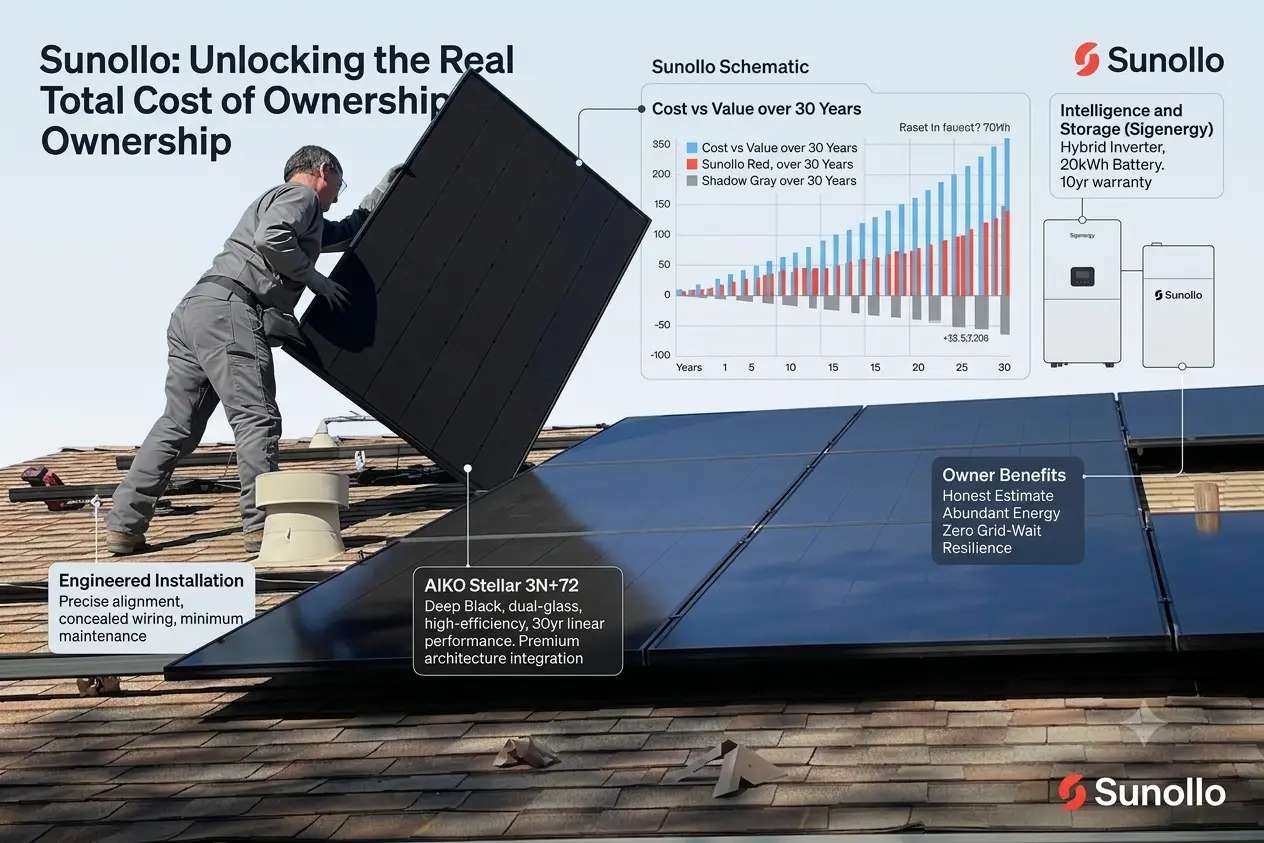
- 25-year cumulative savings: ~S$146,300 (accounting for tariff increases and degradation)
- 25-year ROI: (S$146,300 – S$11,000) ÷ S$11,000 × 100% = ~1,230% gross ROI
- Annualised ROI: ~49% per year
Even using the more conservative net ROI metric (which accounts for the opportunity cost of capital), solar delivers returns that significantly outperform property, equities, and fixed deposits.
ROI Comparison: Sunollo vs Typical Installer vs Budget Installer
Not all solar installations are created equal. The upfront price is only part of the equation — energy yield, equipment quality, warranty coverage, and ongoing maintenance have a massive impact on lifetime returns.
| Factor | Sunollo | Typical Installer | Budget Installer |
|---|---|---|---|
| Price per kWp | S$1,000–1,200 | S$900–1,100 | S$700–900 |
| 10 kWp System Cost | S$10,000–12,000 | S$9,000–11,000 | S$7,000–9,000 |
| Optimisers Included | Yes (standard) | Optional add-on (+S$1,500–2,500) | No |
| Inverter Type | Optimiser-based (SolarEdge) | String inverter (Huawei/Sungrow) | Budget string inverter |
| Yield Advantage | +5–25% vs string | Baseline (string) or +5–25% (if optimiser added) | -5–10% vs tier-1 string |
| Year 1 Production (10 kWp) | 13,500–14,200 kWh | 12,500–13,500 kWh | 11,500–12,500 kWh |
| Year 1 Savings | S$4,250–4,472 | S$3,935–4,250 | S$3,620–3,935 |
| 25-Year Savings | S$139,000–155,000 | S$120,000–139,000 | S$100,000–120,000 |
| Aftercare Programme | SunolloCare (25-year monitoring, maintenance, insurance, performance guarantee) | 1–2 year workmanship warranty only | Minimal or none |
| 25-Year ROI | 580–660% | 450–550% | 350–450% |
| Payback Period | 3–4 years | 3.5–4.5 years | 3–4 years (but lower total returns) |
Key Insight: Cheapest Upfront ≠ Best ROI
The budget installer may have a slightly lower upfront cost, but the lower energy yield, faster degradation, lack of monitoring, and absence of aftercare mean you lose S$20,000–S$55,000 in lifetime savings. Sunollo's systems cost marginally more upfront but deliver S$19,000–S$35,000 more in 25-year savings compared to budget installations, thanks to optimisers, premium components, and comprehensive aftercare.
Payback Period by System Size
Your payback period depends on system size, consumption patterns, and shading. Here's a detailed breakdown for different system sizes using Sunollo pricing:
| System Size | System Cost (Sunollo) | Year 1 Production | Year 1 Savings | Payback Period | 25-Year Net Savings | 25-Year ROI |
|---|---|---|---|---|---|---|
| 5 kWp | S$5,000–6,000 | 6,750 kWh | S$2,125 | 2.8–3.4 years | S$67,000–72,000 | 580–660% |
| 10 kWp | S$10,000–12,000 | 13,500 kWh | S$4,250 | 2.8–3.4 years | S$134,000–143,000 | 580–660% |
| 15 kWp | S$15,000–18,000 | 20,250 kWh | S$6,375 | 2.8–3.4 years | S$201,000–215,000 | 580–660% |
| 20 kWp | S$20,000–24,000 | 27,000 kWh | S$8,500 | 2.8–3.4 years | S$268,000–287,000 | 580–660% |
Note: Payback periods assume Q1 2026 tariff of S$0.3148/kWh and high self-consumption ratio. Actual payback may vary based on consumption patterns and export credit rates. Net savings are after deducting the initial system cost.
How to Shorten Your Payback Period
- Maximise self-consumption: Run energy-intensive appliances during 10 AM – 3 PM to consume solar energy directly rather than exporting it
- Right-size your system: Match your system size to your actual consumption for the optimal balance of self-consumption and export
- Use optimisers: Panel-level optimisers (included standard with Sunollo) can boost yield by 5–25%, directly accelerating payback
- Leverage incentives: Check our incentives and green financing guide for available grants and financing options that reduce your upfront cost
Impact of Optimisers on ROI
Panel-level optimisers are one of the most impactful yet underappreciated factors in solar ROI. Here's why they matter so much for your returns:
The Yield Advantage
Optimisers allow each panel to operate at its individual maximum power point, independent of other panels in the string. In real-world conditions (partial shading, panel mismatch, varying orientations, soiling), this translates to 5–25% more energy production compared to a standard string inverter setup.
The ROI Impact
Let's quantify the impact for a 10 kWp system over 25 years:
| Scenario | Additional Yield | Additional Year 1 Savings | Additional 25-Year Savings | ROI Impact |
|---|---|---|---|---|
| No shading (ideal conditions) | +5% | +S$213 | +S$7,300 | +30–40% ROI |
| Light shading (nearby buildings/trees) | +10–15% | +S$425–638 | +S$14,600–21,900 | +60–100% ROI |
| Moderate shading (partial shade on some panels) | +15–20% | +S$638–850 | +S$21,900–29,200 | +100–140% ROI |
| Significant shading (complex roof) | +20–25% | +S$850–1,063 | +S$29,200–36,500 | +140–180% ROI |
Even in the best-case scenario with zero shading, optimisers still deliver a 5% yield improvement due to panel mismatch mitigation. In typical Singapore residential installations where some shading is present, the yield improvement is commonly 10–20%, translating to S$14,600–S$29,200 in additional lifetime savings.
Sunollo includes panel-level optimisers as standard in every installation. Most other installers either don't offer them or charge S$1,500–S$2,500 extra. When you account for the additional energy production over 25 years, the optimisers pay for themselves within 1–2 years and then deliver pure additional value for the remaining 23+ years.
Battery ROI Analysis: When Batteries Improve vs Reduce Overall ROI
Battery storage adds resilience and self-consumption, but its impact on pure financial ROI requires careful analysis.
When Batteries Improve ROI
- High evening consumption: If your household uses significantly more electricity in the evening than during the day, a battery captures excess daytime solar production that would otherwise be exported at lower wholesale rates. The self-consumption premium (the difference between retail tariff and export credit rate) drives battery ROI.
- Time-of-use tariffs: If your electricity provider offers peak/off-peak pricing, batteries can charge during cheap solar hours and discharge during expensive peak hours.
- Rising electricity costs: As tariffs increase, the value of each stored kWh increases, improving battery ROI over time.
- Future net metering changes: If Singapore reduces net metering credits (as some countries have done), batteries become essential for capturing solar value.
When Batteries May Reduce Overall ROI
- Strong net metering credits: If export credits are close to retail tariff value, the financial incentive to self-consume via battery is smaller.
- Low evening consumption: If your household uses most of its electricity during daytime solar hours, there's less excess energy to store.
- Limited budget: If you have to choose between more panels or a battery, more panels typically deliver better pure financial ROI.
Battery ROI by Configuration
| Configuration | Additional Cost | Additional Annual Savings | Battery Payback | Overall System ROI Impact |
|---|---|---|---|---|
| Solar only (10 kWp) | Baseline | Baseline | — | 580–660% |
| Solar + 5 kWh battery | +S$5,000–7,000 | +S$300–500 | 10–15 years | 480–560% |
| Solar + 10 kWh battery | +S$7,000–10,000 | +S$500–800 | 9–14 years | 450–530% |
| Solar + 13.5 kWh battery | +S$10,000–12,000 | +S$600–1,000 | 10–15 years | 420–510% |
The Verdict on Batteries
Batteries currently reduce pure financial ROI slightly compared to solar-only installations, but they add significant non-financial value: backup power, energy independence, and future-proofing. For homeowners who prioritise these benefits alongside financial returns, batteries priced at S$5,000–S$12,000 represent a reasonable addition. As battery prices continue to fall and electricity tariffs continue to rise, battery ROI will improve steadily.
Property Value Impact of Solar in Singapore
Beyond electricity savings, solar installations can increase your property's market value — an often-overlooked component of solar ROI.
How Solar Affects Property Value
While Singapore-specific studies are limited, international research consistently shows that homes with solar installations sell for a premium:
- US studies (Lawrence Berkeley National Laboratory) found that homes with solar sold for approximately US$4 per watt of installed capacity — a 10 kW system added ~US$40,000 to home value.
- Australian research found a 3–6% increase in property value for solar-equipped homes.
- Singapore market: As sustainability becomes increasingly important to buyers (especially younger demographics and expatriates), solar-equipped homes with transferable aftercare programmes like SunolloCare are becoming more attractive.
Factors That Maximise Property Value Impact
- Transferable warranty and aftercare: Sunollo's SunolloCare programme transfers to new owners, making the solar system a clear asset rather than a liability. Buyers know they're getting a monitored, maintained, insured system.
- System age and condition: A well-maintained system with documented performance history commands a higher premium than a neglected one.
- Quality of equipment: Premium brands and optimiser-based systems signal quality to potential buyers.
- Remaining lifespan: A system with 20 years of remaining life and transferable SunolloCare is significantly more valuable than one with 5 years left.
While it's difficult to assign a precise dollar value to the property premium in Singapore, the trend is clear: solar installations are becoming a desirable feature that enhances both a property's sustainability credentials and its market appeal.
25-Year Cash Flow Projection with Rising Electricity Costs
This detailed cash flow projection shows exactly how your solar investment performs over 25 years, assuming a 10 kWp Sunollo system with 3% annual electricity tariff increases:
| Year | Tariff (S$/kWh) | Production (kWh) | Annual Savings | Cumulative Savings | Net Position (After System Cost) |
|---|---|---|---|---|---|
| 0 | — | — | — | — | -S$11,000 |
| 1 | S$0.3148 | 13,500 | S$4,250 | S$4,250 | -S$6,750 |
| 2 | S$0.3242 | 13,446 | S$4,359 | S$8,609 | -S$2,391 |
| 3 | S$0.3340 | 13,392 | S$4,473 | S$13,082 | +S$2,082 |
| 4 | S$0.3440 | 13,339 | S$4,589 | S$17,671 | +S$6,671 |
| 5 | S$0.3543 | 13,285 | S$4,707 | S$22,378 | +S$11,378 |
| 7 | S$0.3759 | 13,179 | S$4,953 | S$32,137 | +S$21,137 |
| 10 | S$0.4108 | 13,021 | S$5,349 | S$47,534 | +S$36,534 |
| 15 | S$0.4764 | 12,764 | S$6,078 | S$76,215 | +S$65,215 |
| 20 | S$0.5523 | 12,511 | S$6,909 | S$109,080 | +S$98,080 |
| 25 | S$0.6403 | 12,263 | S$7,852 | S$146,300 | +S$135,300 |
Key observations:
- The system reaches payback in year 3, turning cash-flow positive
- By year 10, you've saved S$47,534 — more than 4x your initial investment
- By year 25, your net position is +S$135,300 from a S$11,000 investment
- Annual savings grow each year as tariffs increase, from S$4,250 in year 1 to S$7,852 in year 25
- The compounding effect of rising tariffs means that the second half of the system's life generates more savings than the first half
To explore financing options that can reduce your upfront cost even further, see our solar financing guide.
SunolloCare's Role in Maintaining ROI
The biggest threat to solar ROI isn't equipment failure — it's gradual, undetected underperformance. A dirty panel here, a faulty connection there, and your system could be producing 10–20% less energy than it should — costing you hundreds or thousands of dollars per year in lost savings.
How SunolloCare Protects Your Investment
- Panel-level monitoring: Because every Sunollo system includes panel-level optimisers, we monitor each panel individually. If one panel drops even 10% below expected output, an alert is triggered automatically.
- Scheduled maintenance: Regular cleaning and inspection visits prevent the gradual buildup of soiling that can reduce output by 5–15%.
- Performance guarantee: Sunollo guarantees your system will meet its production targets.
- Full system insurance: Equipment failure, storm damage, or other unforeseen events are covered.
- Inverter replacement planning: Inverters typically need replacement after 12–15 years. SunolloCare includes planning and management for this inevitability.
The ROI Impact of Aftercare
Systems without monitoring and maintenance typically experience 1–3% annual performance loss beyond normal degradation. Over 25 years, this compounds into a significant gap:
| Scenario | Additional Annual Loss | 25-Year Production Loss | 25-Year Savings Loss |
|---|---|---|---|
| Well-maintained (SunolloCare) | 0% | Baseline | Baseline |
| Minimal maintenance | 1–2% | 12–24% | S$15,000–30,000 |
| No maintenance | 2–3% | 24–36% | S$30,000–45,000 |
Ready to explore solar for your home? Visit our Solar for Homes page to get started, or check our incentives and financing guide to minimise your upfront cost.
Frequently Asked Questions
1. What is the ROI of solar panels in Singapore in 2026?
With Sunollo systems priced at S$1,000–S$1,200/kWp fully installed (including optimisers and SunolloCare), the 25-year ROI is 580–660%. A 10 kWp system costing ~S$11,000 generates approximately S$146,300 in savings over 25 years — a net gain of S$135,300.
2. How long is the payback period for solar panels?
The typical payback period for Sunollo systems is 3–4 years, which is among the fastest globally.
3. Do panel-level optimisers improve ROI?
Yes, significantly. Optimisers boost energy yield by 5–25% depending on shading conditions, translating to S$7,300–S$36,500 in additional 25-year savings.
4. Is a cheaper solar installer a better deal?
Not necessarily. Budget installers may save S$2,000–3,000 upfront, but typically deliver S$20,000–S$55,000 less in 25-year savings due to lower yield, faster degradation, and lack of aftercare.
5. Do batteries improve solar ROI?
Batteries currently reduce pure financial ROI slightly (from 580–660% to 420–560%) but add substantial non-financial value including backup power and energy independence.
6. Does solar increase property value in Singapore?
International studies consistently show solar installations increase property values by 3–6%. In Singapore, solar-equipped homes with transferable aftercare programmes are becoming increasingly attractive to buyers.
7. How do rising electricity prices affect solar ROI?
Rising electricity prices significantly enhance solar ROI because your panels produce roughly the same energy each year, but the value of that energy increases with tariffs.
8. How does SunolloCare protect my solar ROI?
SunolloCare prevents the S$15,000–S$45,000 in lost savings that unmaintained systems typically experience over 25 years through panel-level monitoring, scheduled maintenance, performance guarantee, and full system insurance.
Ready to run the numbers on your own home? Calculate your solar ROI with our free tool — built for Singapore landed homes with real payback and savings projections.
To understand how different system configurations and contract options affect your payback timeline, you can explore pricing options.